
One frame of drift is enough for a global streaming giant to reject your master delivery, immediately stalling your distribution timeline and blowing your budget. Mastering audio conforming for international film release is the only way to protect your cinematic integrity when moving between 23.976, 24, and 25 fps territories. It’s a technical minefield where “near enough” simply isn’t good enough for the high stakes of global cinema.
We understand the frustration of facing QC rejections because of pitch issues or sync drift that only appears after a standards conversion. You’ve worked too hard on your film to let a technical error at the finish line compromise your reach. This article provides a clear roadmap to navigate the technical localisation workflow, ensuring your audio remains locked across every international version. We’ll examine the 2026 global distribution requirements, from ITU-R BS.1770-5 loudness compliance to the specific dialogue-gated standards used by major platforms, so you can deliver with absolute confidence.
Key Takeaways
- Understand that localisation is a technical synchronisation process, not just a translation task, essential for meeting international legal and cultural requirements.
- Master the precise mechanics of audio conforming for international film release to ensure foreign language assets remain perfectly aligned with modified video edits.
- Eliminate the “Mickey Mouse” effect in PAL territories by using professional pitch correction algorithms to maintain sonic integrity during frame rate conversions.
- Organise master assets to support 20+ languages and spatial audio formats like Dolby Atmos for efficient multi-territory delivery.
- Avoid expensive QC rejections and distribution delays by adhering to strict EBU and SMPTE specifications through professional mastering and standards conversion.
Understanding Film Content Localisation for Global Markets
Localisation is frequently misunderstood as a simple translation task. In practice, it is a rigorous technical synchronisation process. It requires the total re-engineering of master assets to fit the technical and cultural framework of a specific market. Effective audio conforming for international film release involves the surgical alignment of sound to a picture that may have been edited for local censorship, timing, or commercial breaks. Precision is mandatory. One frame of drift ruins the illusion for the viewer.
Every territory has unique requirements. A master destined for France is technically distinct from one headed to Japan. These differences are driven by legal mandates, cultural sensitivities, and rigid broadcast specifications. When localisation is handled poorly, the audience experience suffers. Dialogue feels detached from the performance. The director’s vision is diluted. Beyond the art, your brand’s reputation is at stake. Distributors cannot afford the stigma of “low-quality” technical delivery in a competitive global market.
The Scope of Modern Content Localisation
Modern localisation is a multi-layered operation. It involves integrating Dubbing tracks, forced narratives, and complex subtitle files into a cohesive package. Graphic localisation is equally critical. On-screen text, titles, and credits must be replaced or overlayed without breaking the visual flow of the film. Finally, every asset must comply with territory-specific broadcast standards. Whether it is EBU R 128 in Europe or ATSC A/85 in North America, technical compliance is the only way to ensure your content actually makes it to air.
The Commercial Reality of Global Distribution
Technical errors are expensive. A single frame rate mismatch or a loudness violation results in immediate QC rejection from platforms like Netflix or Disney+. These delays cost money. They can cause you to miss critical marketing windows or festival deadlines. Implementing a robust technical localisation workflow for film distributors is the only way to mitigate these risks. It protects your investment by catching errors before they reach the platform.
Future-proofing is essential. As we head into late 2026, delivery standards are becoming increasingly strict. You need assets that are compatible with high-bitrate streaming and physical 4K UHD media simultaneously. Professional audio conforming for international film release ensures your content is ready for every screen, everywhere, without the need for costly last-minute fixes.
The Technical Mechanics of Audio Conforming for International Film Release
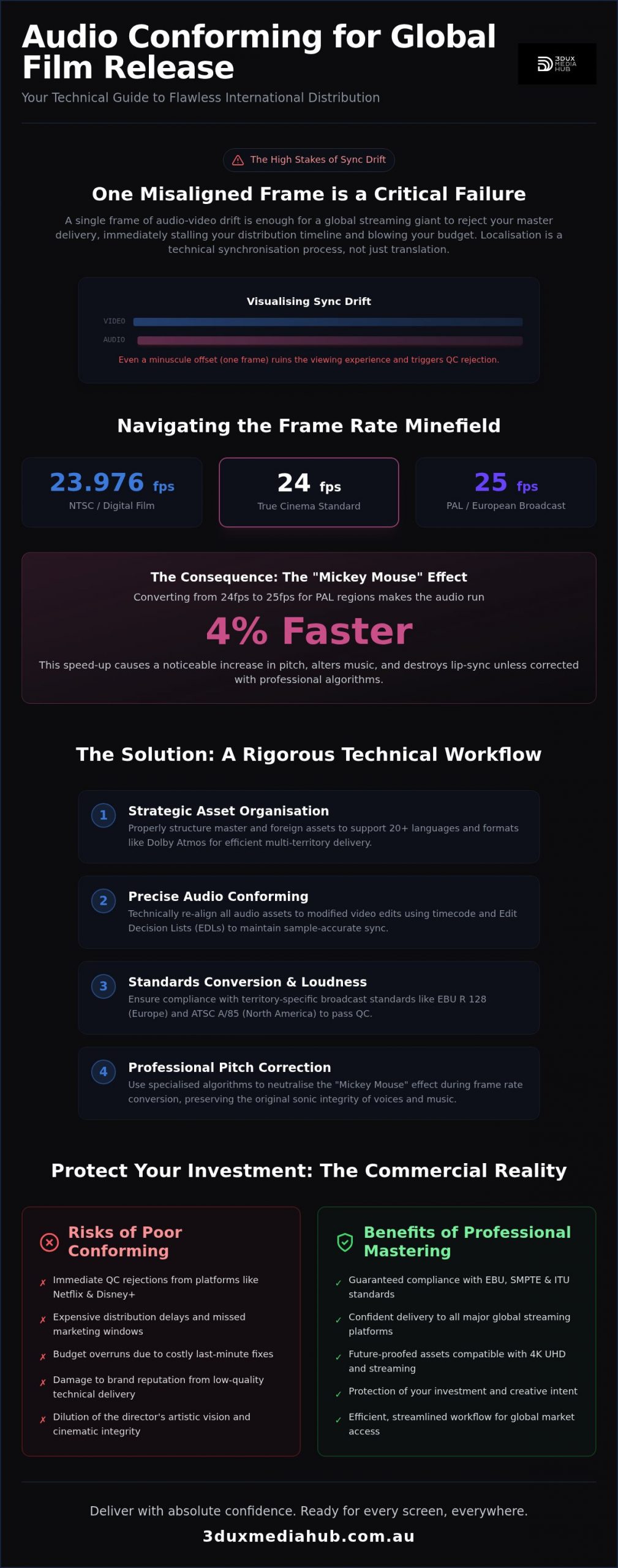
Audio conforming is the technical process of re-aligning audio assets to a modified video edit. It is the bridge between the original mix and a localised version. In the distribution chain, we distinguish between “Master” assets, the primary mix and picture, and “Foreign” assets, which include dubbed dialogue and territory-specific edits. When a film moves into a new market, the video master often changes. It might be shortened for broadcast or altered for local credits. Without precise audio conforming for international film release, the sound will inevitably drift from the picture.
Maintaining sample-accurate sync across a 90-minute feature is a high-stakes task. It requires a deep understanding of timecode and edit decision lists (EDLs). If the conforming process is flawed, the resulting “sync drift” will trigger an immediate rejection during quality control. We ensure every transient remains locked to the visual cue, protecting the integrity of the performance and the director’s original intent.
Frame Rate Discrepancies and Their Impact
Global release involves navigating the 24fps, 23.976fps, and 25fps split. These slight timing shifts are catastrophic over long durations. A film converted from 24fps to 25fps for PAL regions runs 4% faster. This destroys lip-sync and alters the pitch of the music and voices. Re-timing audio without degrading quality requires specialised algorithms. It isn’t just about speed; it’s about preserving the original sonic character while fitting the new frame rate. Professional standards conversion is the only way to manage these shifts without compromising the audio quality.
Channel Mapping and Audio Deliverables
Distributors must provide organised 5.1 and 7.1 surround stems for international dubbing. The M&E (Music and Effects) track is the most critical deliverable in the audio conforming for international film release workflow. It must be “clean”, meaning it’s free of any original dialogue, to allow for seamless localisation. Metadata consistency is another non-negotiable requirement. Proper metadata ensures your files meet global accessibility standards for synchronized media. We specialise in high-efficiency encoding to ensure every deliverable is compliant and ready for the global stage.
Overcoming the Complexity of Standards Conversion and Pitch Correction
Converting a cinematic master for international broadcast is more than a speed adjustment. When a 24fps film is accelerated to 25fps for PAL regions, the resulting 4% speed increase creates the notorious “Mickey Mouse” effect. Actors sound unnaturally sharp. Musical scores lose their intended key. This shift is unacceptable for premium releases. Effective audio conforming for international film release requires sophisticated pitch correction that decouples timing from frequency. It ensures the performance sounds exactly as the director intended, regardless of the playback speed.
Standard time-stretching tools found in basic editing suites often fail under the pressure of a feature-length project. They introduce audible artefacts, such as “warbling” or metallic textures, especially in sustained musical notes or deep vocal performances. We utilise advanced phase-locked algorithms to preserve the original sonic signature. This ensures the theatrical feel remains intact, even when the programme duration has technically shortened. A simple standards conversion is never enough for high-value assets. It requires a surgical approach to maintain fidelity across the entire frequency spectrum.
Advanced Standards Conversion Techniques
High-end distribution requires motion-compensated frame rate conversion to ensure visual fluidity. Audio must track these changes with absolute precision. Protecting audio fidelity during aggressive time compression or expansion is a cornerstone of our workflow. For producers seeking video localisation services Australia, the goal is a master that meets the technical audio requirements of the most demanding global platforms. Understanding the full scope of regional technical requirements is equally critical; our comprehensive broadcast standards conversion services guide for 2026 outlines the specific requirements for every major global region to ensure your assets pass every rigorous QC check. We handle the heavy lifting of standards conversion so your content remains compliant across all territories without sonic degradation.
The QC Checklist for Conformed Audio
Quality control is the final barrier against rejection. Every conformed track must undergo a rigorous technical audit to ensure it meets international delivery standards. Our process includes several non-negotiable checks:
- Digital Artefacts: We scan for clicks, pops, or “zipper noise” introduced during re-sampling or pitch processing.
- Phase Coherence: Folded-down stereo tracks are tested to ensure no phase cancellation occurs. This prevents the sound from becoming “hollow” or losing dialogue clarity on domestic systems.
- Sync Verification: We check sync at the head, middle, and tail of the programme. Drift is often cumulative. It might look correct in the first ten minutes but fall out of sync by the final act.
This methodical approach ensures that your audio conforming for international film release is bulletproof. We eliminate the technical hitches that lead to expensive re-deliveries and missed deadlines.
Strategic Asset Preparation for Multi-Language Delivery
Managing 20 plus languages is a logistical mountain. You aren’t just swapping a dialogue track. Every dubbed version requires a dedicated set of conformed assets to maintain parity with the master. Precision audio conforming for international film release ensures that when a viewer switches from English to French or Japanese, the sync remains absolute. This is particularly critical for object-based audio like Dolby Atmos. Localising spatial audio involves re-rendering objects within a 3D soundstage. You must ensure localised dialogue objects match the exact spatial coordinates of the original performance to preserve the immersive experience.
Subtitle integration demands frame-accurate timing. A delay of even two frames renders text unreadable or distractingly out of sync with the visual cues. Forced narratives require even more technical care. These are the subtitles that appear when characters speak a third language or when on-screen text needs translation. They must be either “burned-in” to the video or precisely timed via metadata to ensure the audience never loses the plot. Engaging professional subtitle integration services ensures these assets are handled with the frame-accurate precision required to meet 2026 global delivery standards. We manage these assets with surgical precision to ensure your film meets 2026 global delivery standards.
Managing Dubbing and Subtitling Assets
Technical specifications for dubbing studios are rigid. You must provide the correct sync pops and cues to ensure the foreign language performance can be conformed back to the master. Subtitle files, whether in SRT, STL, or VTT formats, must be conformed to the final edit after any standards conversion. Consulting with leading content localisation firms early in production allows you to build a technical pipeline that supports these requirements from day one. This proactive approach eliminates the need for expensive “fix-it” sessions late in the distribution cycle.
Encoding for Global Platforms
Encoding for global platforms involves meeting specific, non-negotiable requirements. Streaming giants like Netflix currently demand 48kHz, 24-bit linear PCM audio with an average loudness of -27 LKFS, measured using the dialogue-gated method defined in ITU-R BS.1770-1. We manage these complexities through high-efficiency HEVC and AVC encoding. Whether you are targeting UHD Blu-ray, DVD, or global streaming, bitrate management is the key. You must balance high-fidelity audio across dozens of tracks without exceeding the total bandwidth of the delivery format. Our expertise in audio conforming for international film release ensures your master is optimised for every platform.
If you are ready to prepare your film for a global audience, contact 3DUX for professional audio encoding and localisation services that guarantee technical compliance.
Why Professional Mastering is Non-Negotiable for Global Distribution
Attempting a “DIY” approach to localisation is a high-stakes gamble that rarely pays off. While automated tools and basic plugins have improved, they lack the technical nuance required to pass a rigorous Tier-1 broadcaster or streaming platform QC. These platforms don’t just look for sync; they scan for metadata consistency, phase integrity, and strict adherence to loudness gating. As previously discussed, cumulative sync drift can be subtle. It often remains undetected on a standard timeline but triggers an immediate rejection when processed through a global delivery hub. This results in expensive re-deliveries and potential missed release windows.
Professional mastering ensures your assets meet exact EBU and SMPTE specifications from the outset. We understand the precise differences between the EBU R 128 target of -23 LUFS and the Netflix requirement of -27 LKFS. Navigating these technical variances requires more than just a software preset. It requires a deep understanding of the audio conforming for international film release workflow to ensure that every localised track, from the M&E to the final dubbed mix, maintains its theatrical impact while remaining compliant. Technical integrity is the foundation of global distribution success. For physical media releases, pairing this expertise with rigorous Blu-ray quality control services is essential to prevent costly recalls and replication errors across international territories.
The 3DUX Media Hub Advantage
3DUX Media Hub provides a “safe pair of hands” for high-value cinematic assets. With over 20 years of industry experience, we offer authoritative technical knowledge across 4K UHD authoring, Blu-ray, and complex digital delivery. Our approach is grounded in reliability and precision. We operate as a no-nonsense technical partner, handling everything from HEVC encoding to Dolby Atmos localisation. We provide national service with a global understanding of distribution markets, ensuring your content is ready for any territory. We specialise in high-efficiency encoding and fast turnaround times without compromising the technical standards your project deserves.
Next Steps for Your International Release
Preparing for a global launch requires a proactive strategy. Waiting until the final delivery phase to address audio conforming for international film release is a recipe for technical hitches. We recommend a comprehensive audit of your current assets to determine localisation readiness before you lock your master. A technical consultation early in the post-production chain can save thousands in late-stage fixes. We can help you organise your stems, verify your frame rates, and ensure your M&E tracks are truly “clean” for international dubbing. Contact 3DUX today to develop a bespoke localisation and conforming strategy that protects your film’s integrity on the world stage.
Ready Your Master for the Global Stage
Precision is the baseline for global distribution. We’ve explored how managing frame rate drift and pitch correction protects your film’s sonic integrity. Success in 2026 requires more than just a translated script; it demands surgical audio conforming for international film release to meet platform-specific standards. Whether it’s Netflix’s dialogue-gated loudness or complex Dolby Atmos spatial coordinates, technical compliance is non-negotiable.
With over 20 years of technical post-production experience, 3DUX Media Hub acts as a safe pair of hands for your high-value assets. We specialise in 4K UHD, Blu-ray, and DVD authoring, backed by comprehensive broadcast quality QC and standards conversion. Don’t risk a late-stage rejection when expert help is available to secure your delivery.
Ensure your film is global-ready with 3DUX Media Hub’s professional localisation services.
Frequently Asked Questions
What is the difference between audio conforming and simple syncing?
Audio conforming is a surgically precise re-alignment of sound to a new video master, whereas simple syncing usually refers to aligning audio to a single, static picture. Conforming specifically accounts for frame rate changes and edit differences across various international territories. It ensures that audio conforming for international film release remains sample-accurate even after the video timeline has been altered for local broadcast requirements or censorship.
Why does my film’s audio sound higher in pitch after international conversion?
The higher pitch is a direct result of the 4% speed increase when converting 24fps cinematic masters to 25fps PAL broadcast standards. Without professional pitch correction, every sound is shifted up by approximately a semi-tone, creating the notorious “Mickey Mouse” effect. We use advanced, phase-locked algorithms to maintain the original key and vocal character while matching the faster frame rate required for certain global markets.
Do I need a separate master for every country my film is released in?
You don’t always need a unique master for every single country, but you do need one for every technical standard and language variant. For example, a single PAL master might serve multiple European countries, provided the audio tracks and subtitles are correctly organised within the file structure. We help you consolidate these requirements to minimise costs while ensuring total compliance with territory-specific regulations.
Can I conform audio myself using standard editing software?
Most standard editing software lacks the specialised phase-locked algorithms required for high-end pitch correction and standards conversion. While you can technically move clips on a timeline, you risk digital artefacts and cumulative sync drift that will fail professional QC. Achieving audio conforming for international film release requires dedicated tools that preserve audio fidelity and phase coherence during aggressive time-compression or expansion.
What are M&E tracks and why are they vital for localisation?
M&E tracks are “Music and Effects” stems that contain every sound except the original dialogue. They are the foundation of localisation. Without a clean M&E track, it’s impossible to add foreign language dubbing without losing the background atmosphere, foley, and score. These tracks must be meticulously checked for “dialogue bleed” or remaining original language before the localisation process can begin to ensure a professional result.
How long does the audio conforming process typically take for a feature film?
A standard feature film typically requires three to five business days for the full conforming and QC cycle. This timeline accounts for the initial alignment, pitch correction, and a comprehensive technical audit of all stems. Complex projects involving multiple language versions or Dolby Atmos requirements may require additional time to ensure every deliverable meets the target specifications without compromise or technical hitches.
What happens if my conformed audio fails a broadcast QC test?
A QC failure results in an immediate rejection and a request for re-delivery, which can cause you to miss critical broadcast or festival deadlines. You’ll often be charged additional testing fees by the platform or distributor. We prevent this by performing an internal, broadcast-grade QC before any master leaves our facility. This catches potential errors, such as loudness violations or sync drift, before they reach the distributor.
Does 3DUX Media Hub handle localisation for independent films as well as major studio releases?
Yes, 3DUX Media Hub provides the same level of technical expertise to independent filmmakers as we do for major studio releases. We understand that independent projects often have high stakes and tight budgets. Our no-nonsense approach ensures your film meets international delivery standards regardless of the production scale. We provide a safe pair of hands for every asset, ensuring your project is ready for global distribution.