A single frame rate error can cost your production its entire international distribution window. You’ve likely spent months perfecting the colour grade and sound mix, only to have a global broadcaster reject the master because of minor judder or ghosting. Relying on professional broadcast standards conversion services is the only way to ensure your high-value assets meet the rigid technical requirements of the 2026 media market.
We understand the high stakes. This guide provides the technical roadmap to master these complexities and pass every rigorous QC check on the first attempt. You’ll learn how to maintain high-fidelity visual and audio quality while navigating the shift toward IP-based delivery and hybrid distribution models.
We’ll break down the latest 2026 requirements for ATSC 3.0 and DVB-I. We’ll explain how to avoid the pitfalls of low-quality conversions. Most importantly, we’ll outline the specific technical requirements for every major global region to ensure your content is ready for the world stage.
Key Takeaways
- Understand the critical differences between regional delivery specifications to avoid costly rejections from broadcasters in the UK, USA, and Australia.
- Master the transition between Rec.709 and Rec.2020 colour spaces to maintain visual fidelity across 4K UHD and standard HD formats.
- Learn why motion-compensated broadcast standards conversion services are essential for eliminating artifacts like judder and ghosting in high-motion content.
- Optimise your delivery workflow by consolidating high-bitrate master files, such as ProRes 4444 or DNxHR, before starting the conversion process.
- Ensure your media passes every broadcast Quality Control (QC) check first time by integrating professional conversion with rigorous technical standards.
What are Broadcast Standards Conversion Services?
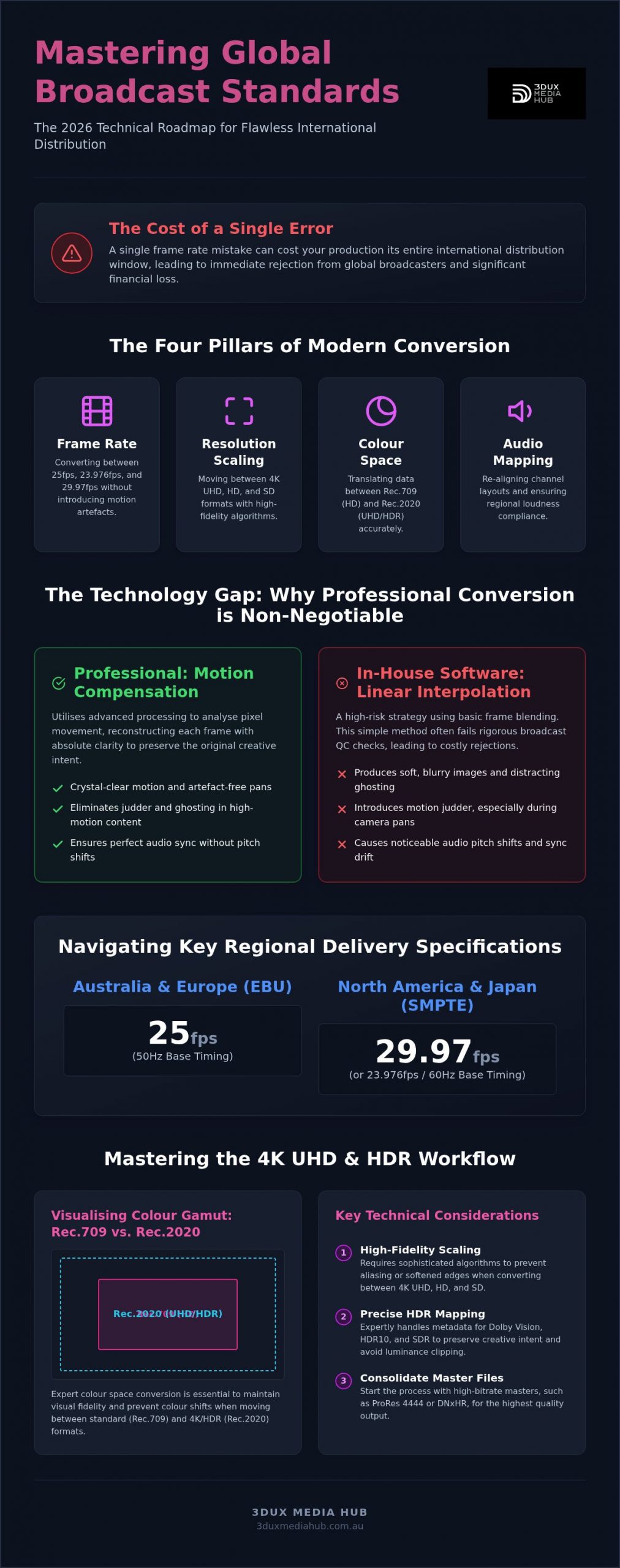
Broadcast standards conversion is the precise technical process of re-engineering media assets to meet the specific delivery requirements of a target international market. It isn’t a simple case of changing a file extension or hitting “export” in a standard editing suite. This process involves the sophisticated manipulation of video and audio data to ensure compatibility across different regional systems. High-end broadcast standards conversion services manage the complex translation of frame rates, spatial resolutions, and colour spaces while maintaining the creative integrity of the original content.
Precision is mandatory. Broadcasters in the UK, USA, and Australia operate under vastly different technical delivery specifications. A master file that passes Quality Control (QC) in Sydney will likely face immediate rejection in New York if the frame rate and scanning format don’t align with local requirements. The foundational principles of Television standards conversion have evolved from analogue signal processing into a deep digital science involving four key components:
- Frame Rate: Converting between 25fps, 23.976fps, and 29.97fps without introducing motion artifacts.
- Resolution Scaling: Moving between 4K UHD, HD, and legacy SD formats using high-fidelity algorithms.
- Colour Space: Translating luminance and chrominance data between Rec.709 (HD) and Rec.2020 (UHD/HDR).
- Audio Mapping: Re-aligning channel layouts and ensuring loudness compliance for specific regional mandates.
In 2026, the landscape is more demanding than ever. We’ve moved beyond basic resolution swaps into complex 4K HDR and High Frame Rate (HFR) workflows. Managing High Dynamic Range metadata during a conversion requires an expert hand to prevent luminance clipping or colour shifts that can ruin a high-value production.
The Evolution of Regional Standards
Why “In-House” Software Conversions Often Fail
Relying on basic editing software for standards conversion is a high-risk strategy. Most desktop applications use linear interpolation, which simply blends adjacent frames to fill gaps. This results in soft images, distracting ghosting, and “judder” during camera pans. Audio is also a major failure point. Improper speed changes often lead to noticeable pitch shifts or sync drift over long durations. Professional broadcast standards conversion services utilise motion-compensated processing to analyse pixel movement, ensuring every frame is reconstructed with absolute clarity. Professional conversion is the critical safeguard that ensures your programme survives the rigours of broadcast-grade QC without compromising visual or auditory fidelity.
The Technical Pillars of Modern Conversion: 4K, HDR, and Beyond
Modern distribution pipelines demand more than simple frame rate adjustments. High-fidelity broadcast standards conversion services must now account for extreme data density and complex metadata. The transition to 4K UHD and High Dynamic Range (HDR) has introduced technical variables that can easily break a delivery chain if handled incorrectly. Precision is the only way to avoid costly rejections during the final QC phase.
Resolution scaling requires sophisticated algorithms to prevent aliasing or softened edges. Whether performing a high-quality up-conversion for a 4K master or a down-conversion for legacy HD broadcast, the goal is pixel-perfect clarity. This is inextricably linked to colour space conversion. Moving between the narrow Rec.709 gamut and the expansive Rec.2020 requires precise LUT application and gamut mapping. This ensures colours remain accurate across different display technologies without clipping or shifting.
HDR mapping is perhaps the most sensitive pillar of the 2026 workflow. Converting between Dolby Vision, HDR10, and Standard Dynamic Range (SDR) involves more than just luminance capping. It requires preserving the cinematographer’s creative intent. Audio conforming is equally vital. International dubs often require sample rate adjustments and complex channel re-mapping to suit specific regional hardware configurations. Every element must be aligned to the target market’s specific technical mandate.
Mastering 4K UHD for International Release
Global distribution platforms have strict bitrate requirements for 4K content. Maintaining consistency across these platforms is essential for a seamless viewer experience. High-efficiency video coding (HEVC) is the standard for 2026, providing the necessary compression without sacrificing image quality. Professional 4K UHD authoring services ensure your master files are optimised for these specific regional pipelines, preventing bandwidth issues during transmission.
HDR to SDR Down-Conversion
A common pitfall in modern mastering is the “one-click” HDR to SDR conversion. This automated approach often results in flat, washed-out images that lose all shadow detail and highlight nuance. Preserving the cinematic look for legacy broadcast requires manual tone mapping and careful luminance management. By using professional grade tools, we ensure the high-impact visuals of your HDR master are translated effectively for SDR audiences. If you need to prepare your assets for global markets, our team can optimise your media workflow to meet any delivery specification with total precision.
Motion Compensation vs. Linear Interpolation
The technical gap between basic file transcoding and professional broadcast standards conversion services is most evident in how motion is handled. Choosing the wrong processing method doesn’t just result in a “soft” image. It creates catastrophic temporal errors that lead to immediate QC failure. For 2026 delivery, understanding the distinction between linear interpolation and motion compensation is vital for any distributor. Precision is the only way to protect your assets.
Linear interpolation is the budget approach often found in standard editing software. It works by blending adjacent frames to create a “middle” frame. This results in ghosting, where a moving object appears in two places at once, and a significant loss of temporal resolution. These artifacts are a red flag for automated QC systems. Tools like Interra Baton or Telestream Vidchecker are programmed to detect the “smearing” associated with linear interpolation. If your file shows evidence of frame blending, it will be flagged as a critical failure, necessitating a costly re-delivery.
Professional motion compensation takes a radically different approach. Rather than blending frames, it uses sophisticated algorithms to track individual pixels across time. By calculating motion vectors, the system reconstructs new frames that accurately represent where objects should be at that exact millisecond. This level of precision is non-negotiable for high-action content like sports or fast-paced drama. A blurring ball or stuttering actor is unacceptable for premium broadcast. High-fidelity conversion ensures that motion remains fluid and sharp, regardless of the destination frame rate.
The “Judder” Problem in Frame Rate Conversion
Converting 24fps film to 29.97fps for the North American market is a notorious technical challenge. Historically, this relied on a 3:2 pulldown process, which often introduced a “jumpy” cadence known as telecine judder. While digital systems have replaced tape, the underlying timing mismatch remains a threat to visual quality. Motion-compensated conversion eliminates telecine judder by calculating the exact position of moving objects within the new frame structure. This creates a seamless transition that maintains the original timing of the production.
Preserving the “Film Look” During Conversion
A common fear for filmmakers is the “soap opera effect”. This occurs when conversion makes a cinematic 24p feature look like high-frame-rate video. Maintaining the film look requires a delicate balance of frame rate adjustment and shutter angle simulation. It ensures the motion blur remains natural rather than clinical. For a deeper look at these regional nuances, see our technical guide on PAL to NTSC conversion quality. This rigour ensures your content feels like cinema, regardless of where in the world it’s being watched.
Preparing Your Assets for Global Delivery: A Technical Checklist
Success in international distribution depends entirely on the integrity of your source materials. Professional broadcast standards conversion services require robust, high-bitrate masters to produce a flawless result that survives the rigours of transmission. Preparing your assets correctly before handover prevents delays and ensures your content remains compliant with global mandates. Follow this five-step technical checklist to streamline your delivery workflow.
- Step 1: Identify target specifications. Every broadcaster has a unique “spec sheet”. The requirements for the BBC in the UK differ significantly from Netflix or regional Australian networks. Pinpoint these before starting.
- Step 2: Consolidate master files. Always provide the highest quality source available. ProRes 4444 or DNxHR are the preferred industry standards. Avoid using highly compressed H.264 or H.265 files as a starting point for conversion.
- Step 3: Organise audio stems. Supply separate stems for Music, Effects, and Dialogue. This is critical for localisation and ensures audio channel mapping remains accurate across different regional configurations.
- Step 4: Perform an in-house review. Check your master for obvious visual glitches, dead pixels, or illegal audio peaks. Catching these early saves time during the final professional QC phase.
- Step 5: Hand over to a professional hub. Transfer your assets to a specialist facility for final conversion, encoding, and technical QC.
If you need to ensure your media meets these exacting standards, you can book a technical assessment with our mastering team today.
Broadcast Delivery Specifications and QC
Technical rejections are often caused by easily avoidable errors. Gamut violations, luma overshoots, and audio sync drift are the most common culprits. Many modern broadcasters now require specific delivery wrappers, such as the AS-11 standard for UK programmes. Professional QC acts as your final safety net. It identifies these minute technical breaches before they reach the broadcaster’s ingest system, protecting your distribution deal and your reputation.
Dealing with Subtitles and Localisation
Frame rate conversion can wreak havoc on subtitle timing. If a film is converted from 24fps to 25fps without adjusting the timecode of the subtitle file, the text will gradually drift out of sync with the dialogue. You must decide between burnt-in (forced) subtitles for specific scenes or soft-code assets for multi-language support. Managing these variables is a core part of audio conforming for international film release. This ensures your localised assets remain perfectly aligned with the converted video master, regardless of the target region’s frame rate.
Why 3DUX Media Hub is Australia’s Choice for Standards Conversion
Navigating the final stages of global distribution requires more than just technical software. It demands a partner who understands the high stakes of international delivery. 3DUX Media Hub brings over 20 years of technical expertise to every project, providing a definitive bridge between post-production and the global broadcast market. Our broadcast standards conversion services are designed for speed, precision, and absolute compliance. We don’t just process files; we ensure your assets are ready for the world stage.
Efficiency is central to our operation. We recognise that distribution windows are often tight and delivery deadlines are non-negotiable. Our team specialises in fast turnaround times without compromising the rigorous technical standards that broadcasters demand. We provide a comprehensive suite of mastering services tailored for the 2026 media landscape:
- High-Fidelity Standards Conversion: Motion-compensated processing for all global frame rates.
- 4K UHD and HDR Mastering: Expert management of Rec.2020 colour spaces and HDR metadata.
- Advanced Video and Audio Encoding: Optimised bitrates for HEVC, ProRes, and broadcast wrappers.
- Broadcast Quality QC: Multi-point inspections to prevent technical rejections.
- Content Localisation: Precise alignment of audio stems and subtitle assets.
From Conversion to Authoring: A Complete Workflow
One of the most significant advantages of partnering with us is our integrated workflow. We don’t treat standards conversion as an isolated task. Instead, we integrate it directly into our Blu-ray and DVD authoring processes. This ensures that your physical media masters are fully compliant with global players and regional hardware from the outset. Whether you’re preparing a limited theatrical run or a wide physical release, our end-to-end approach eliminates the compatibility issues that often plague multi-vendor pipelines. For many distributors, the decision comes down to in-house vs outsourced media mastering, and our hub provides the professional infrastructure to handle high-volume assets with ease.
A Safe Pair of Hands for Your Content
Our commitment to broadcast-grade quality is absolute. We provide a “no-nonsense” approach to technical compliance, acting as a safe pair of hands for high-value media assets. From independent creators to major nationwide broadcasters, our clients rely on our meticulous attention to detail to protect their distribution deals. We understand the nuances of every major global spec, ensuring your content passes QC first time, every time. Ready to take your content global? Contact 3DUX Media Hub today to discuss your 2026 distribution requirements.
Master Your Global Media Delivery
The 2026 media landscape leaves no room for technical error. As global delivery shifts toward IP-based models and complex 4K HDR workflows, the quality of your master file remains your most valuable asset. Passing every broadcast QC check on the first attempt requires more than just luck; it demands a deep understanding of regional frame rates and the precision of motion-compensated broadcast standards conversion services. Relying on basic software for high-stakes projects is a risk that often results in costly rejections and missed distribution windows.
With over 20 years of industry experience, 3DUX Media Hub acts as a definitive partner for film distributors and broadcasters alike. We specialise in high-efficiency 4K UHD encoding and global delivery, ensuring your content maintains its creative integrity across every border. Our team is focused on fast turnaround times, helping you meet demanding schedules without sacrificing technical excellence. Whether you’re navigating new DVB-I standards or preparing a feature for the North American market, we provide the authoritative expertise needed for a successful release.
Ready to ensure your assets are compliant and ready for air? Get a technical consultation for your global distribution project at 3DUX Media Hub. We look forward to helping you connect with audiences worldwide.
Frequently Asked Questions
What is the difference between PAL and NTSC in 2026?
In 2026, PAL and NTSC refer primarily to regional frame rate and timing standards rather than analogue signals. Australia and the UK remain 25fps (50Hz) territories, while North America and Japan adhere to 23.976fps or 29.97fps (60Hz) timing. Modern broadcast standards conversion services ensure your digital assets bridge this timing gap without introducing motion artifacts or sync errors.
How long does a professional broadcast standards conversion take?
Turnaround times vary based on the project’s complexity and duration. A standard feature-length master typically requires 24 to 48 hours for conversion and technical QC. We prioritise efficiency to meet tight global distribution windows without compromising on precision or reliability.
Will converting my film from 24fps to 25fps affect the audio pitch?
Converting from 24fps to 25fps results in a 4% speed increase. Without professional intervention, this causes a noticeable pitch shift in the audio. Our process includes sophisticated pitch correction to ensure the dialogue and music remain in their original key while matching the new frame rate perfectly.
Can you convert SDR content to HDR for 4K UHD release?
You can convert SDR content to HDR using inverse tone mapping, but the results depend on the quality of the source master. While it won’t replicate the full dynamic range of a native HDR grade, it allows legacy content to be prepared for 4K UHD release. This requires careful luminance management to avoid a forced or artificial appearance.
What are the most common reasons for a broadcast QC rejection?
Technical rejections are usually triggered by gamut violations, luma overshoots, or frame rate judder. Incorrect audio channel mapping and metadata errors are also frequent culprits. Professional QC identifies these breaches before they reach the broadcaster’s ingest system, saving you from costly delays.
Do I need different conversions for streaming vs. Blu-ray distribution?
Streaming and Blu-ray often require different technical masters. Streaming platforms typically demand high-bitrate mezzanine files with specific metadata for HDR10 or Dolby Vision. Blu-ray distribution requires authoring-compliant streams that meet strict physical media hardware specifications and buffer requirements.
What file formats are best for standards conversion?
High-bitrate mezzanine formats like ProRes 4444 or DNxHR are the gold standard for conversion. These formats preserve the maximum amount of image data and colour information. Avoid using highly compressed H.264 or H.265 files as a source, as they lack the bit-depth required for professional-grade processing.
Is motion-compensated conversion really worth the extra cost?
Motion-compensated conversion is essential for high-value assets. Unlike cheaper linear interpolation, it reconstructs frames by tracking pixel movement. This eliminates the ghosting and blurring that lead to immediate QC failure. For sports, action, or premium drama, the investment is mandatory to ensure a broadcast-grade result that passes first time.