
Localisation is often mistaken for a simple translation task, but for global delivery, it’s actually a rigorous technical mastering process. If you’re looking for professional video localisation services Australia provides, you already know that the stakes are incredibly high. Managing dozens of language tracks while ensuring audio remains perfectly conformed across varying frame rates is a massive undertaking. One small oversight in your subtitle safe-zone specs can lead to a costly, immediate rejection from international broadcasters or streaming platforms.
It’s a common frustration to see a project stalled by technicalities just as it’s ready for the world stage. We’ll show you how to master the technical workflow of video localisation to ensure your content meets strict international broadcast and physical media standards every time. This guide provides a clear technical roadmap for asset preparation, helping your content pass international quality control on the first attempt. You’ll learn how to streamline your delivery across digital and physical platforms with precision, ensuring your media is ready for any market.
Key Takeaways
- Distinguish technical localisation from simple translation to ensure assets are fully conformed for global delivery.
- Master audio conforming techniques to manage frame rate shifts from 24fps to 25fps without compromising pitch.
- Optimise asset preparation by using textless ‘virgin’ video tracks and structured DME audio stems.
- Evaluate the technical impact of dubbing versus subtitling on bitrate and file size for 4K UHD and Blu-ray authoring.
- Leverage professional video localisation services Australia relies on to pass international broadcast QC first time.
What is Technical Video Localisation for Global Markets?
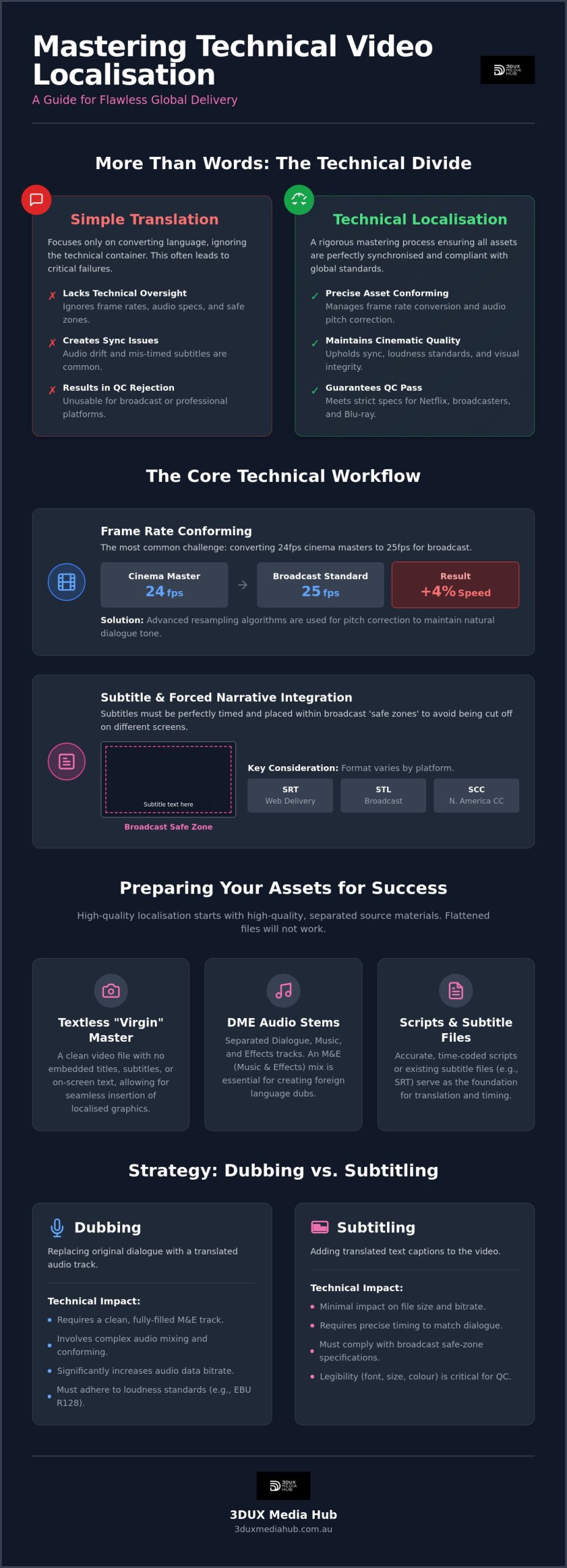
Technical video localisation is the precise synchronisation of translated assets with primary master video files. It’s the engine room of global delivery. While many mistake this for a simple linguistic task, it’s actually a rigorous mastering process. When sourcing video localisation services Australia offers, you need a partner who treats this as a technical exercise. It involves the alignment of localised audio, subtitles, and forced narratives with a high-resolution master track. Without this technical layer, your content won’t just feel “off”; it’ll fail the strict quality control (QC) requirements of international broadcasters.
Simple translation often fails because it lacks technical oversight. If your subtitle file isn’t timed to the correct frame rate, or your audio tracks aren’t conformed to the master video’s sample rate, the output is unusable. What is Technical Video Localisation beyond the words? It’s the management of frame rate drift, audio pitch correction, and ensuring subtitles sit within broadcast safe-zones. Maintaining cinematic quality across different regional standards is non-negotiable for high-value assets.
The Difference Between Translation and Localisation
Translation covers the linguistic conversion, but localisation addresses the technical and cultural context. For Australian distributors, this means more than just swapping English for Spanish. It involves adapting content for specific regional dialects and meeting technical delivery specs for platforms like Netflix or local broadcasters. Precision in localisation directly impacts global revenue for independent film and TV. It ensures the story resonates emotionally while the file itself functions perfectly on any playback device, from a smartphone to a 4K UHD home cinema system.
Key Technical Assets in the Localisation Chain
Success depends on the quality of your source materials. You can’t achieve professional results with flattened files. The localisation chain requires specific components:
- Master Video: This should be a clean, textless primary asset, often called a “virgin” track. It allows for the seamless insertion of localised titles and forced narratives.
- M&E Tracks: Music and Effects tracks are essential for dubbing. They must be fully filled, meaning every sound except the dialogue is present and balanced.
- Subtitle Containers: Different platforms require different formats. SRT is the standard for web delivery, while STL is preferred for broadcast. SCC files are critical for North American closed captioning standards.
Managing these assets requires a “safe pair of hands” to ensure that the final delivery meets the high-stakes demands of the entertainment industry.
The Technical Process: Audio Conforming and Subtitle Integration
The technical delivery of multi-language content is defined by precision in audio conforming. It’s where many projects stall. When you engage video localisation services Australia experts, the focus shifts from linguistics to signal processing. The most common challenge is managing frame rate discrepancies. Converting a 24fps cinema master to a 25fps broadcast standard results in a 4% speed increase. Without expert pitch correction, dialogue sounds unnaturally high. We utilise advanced resampling algorithms to maintain tonal integrity while ensuring frame-accurate sync across every language track.
Following best practices for video localization requires a rigorous approach to asset preparation. It’s not enough to just “slide” audio tracks. Every millisecond counts. This is especially true for physical media standards where bitrates are fixed and timing errors are magnified. Quality Control (QC) is the final gatekeeper. We perform a full linear pass on every localised asset to verify sync, legibility, and technical compliance. It’s the only way to guarantee your content passes international QC the first time, saving you from expensive re-deliveries.
Audio Conforming for Multi-channel Sound
Managing 5.1 and 7.1 surround sound localisation adds layers of complexity. Each dialogue track must be conformed to the original Music and Effects (M&E) mix without bleeding into the environmental soundstage. We ensure all conformed tracks comply with international loudness standards like EBU R128. This prevents jarring volume shifts when switching between language streams on a Blu-ray or digital platform. For complex projects, our broadcast quality QC verifies that every channel maintains phase alignment and dynamic range across all regional versions.
Professional Subtitle and Captioning Integration
Subtitles are more than just text on screen. They are technical overlays that must respect “broadcast safe” zones. If text sits too low, it’s cut off by older displays or obscured by platform UI elements.
- Open vs Closed: Open captions are burned into the video; closed captions exist as separate data streams like SCC or STL.
- Graphic Clashing: Timing must be adjusted to avoid overlapping with original on-screen titles or lower-thirds.
- Script Support: Non-Latin scripts like Japanese or Arabic require specific font rendering and UTF-8 encoding to prevent “tofu” characters.
The role of QC extends to legibility. We check font weight, contrast, and reading speed to ensure the viewer experience remains consistent regardless of the language. This meticulous approach is what separates a generic translation from a professional localisation master ready for global delivery.
Choosing Your Strategy: Dubbing vs Subtitling for Australian Distributors
Selecting between dubbing and subtitling is a strategic decision that fundamentally dictates your technical overhead. For Australian distributors, this choice often rests on the target market’s cultural expectations and the delivery platform’s technical constraints. When engaging video localisation services Australia experts, you must consider how each method impacts your bitrate budget. Dubbing requires additional high-fidelity audio streams, which can consume significant space on a 4K UHD or Blu-ray master. Subtitling, by contrast, is a data-light solution that preserves the original performance while allowing for rapid global deployment.
Analysing dubbing vs subtitling strategies reveals that while European markets often demand full dubbing for narrative features, Asian and Nordic markets frequently prefer subtitling. A hybrid strategy is often the most effective for complex global releases, where high-priority markets receive a full dub and secondary markets are serviced with professional subtitles. This modular approach ensures you maximise reach without overextending your post-production budget or compromising the technical integrity of the master file. For a deeper look at how to structure this process end-to-end, the localisation workflow for film distributors outlines how to build a robust pipeline that meets the latest DCI specifications while maintaining broadcast-grade quality control.
Dubbing and Voiceover Technical Requirements
Successful dubbing relies entirely on the quality of your Music and Effects (M&E) tracks. If the M&E is “unfilled” (missing critical foley or background ambience), the localised dialogue will feel detached from the scene. Technical precision is required for lip-syncing, where translated scripts must be adapted to match the mouth movements of the original actors. For documentaries or industrial content, a “UN-style” voiceover is often preferred, where the original dialogue remains audible at a lower level beneath the localised track. This is technically simpler but still requires precise audio ducking and levels management to meet broadcast standards.
Subtitling: The Efficient Path to Global Markets
Subtitling offers the fastest turnaround and lowest technical barrier to entry. However, it requires meticulous management of “forced narratives.” These are the subtitles that only appear to translate on-screen text, such as street signs, letters, or location markers, even when the viewer has the main subtitles turned off. On a physical disc master, such as a Blu-ray, you can include dozens of subtitle tracks without impacting the video bitrate. This makes it an ideal solution for multi-region releases where a single SKU must serve multiple territories. Our video localisation services Australia workflow ensures these tracks are correctly flagged in the disc’s navigation logic for seamless user selection.
How to Prepare Your Assets for Multi-language Localisation
Efficiency in global delivery starts in the edit suite. If your files aren’t prepped for multi-language tracks, your project will hit a wall at the mastering stage. High-quality video localisation services Australia providers require a specific set of master assets to ensure a clean finish. This isn’t just about sending a high-res file. It’s about providing a modular project that can be reconstructed for any regional market without technical artifacts. Prepping correctly saves weeks of revisions and thousands in additional post-production costs.
The Importance of Textless Masters
A clean, textless master, often called a “virgin” video track, is non-negotiable. This asset contains all the visual information but lacks burnt-in English titles, lower-thirds, or credits. If titles are baked into the video, translators can’t overlay localised text without creating messy masks or jarring “jump” cuts. For physical media releases, we use technical workflows like “seamless branching” on Blu-ray. This allows the player to switch between different localised video segments, such as opening titles or location markers, based on the user’s language setting. It’s a sophisticated way to provide a fully localised experience without duplicating the entire feature length of the video.
Preparing Audio Stems for International Mixes
You must separate your audio into distinct stems: Dialogue, Music, and Effects (DME). A “full mix” is useless for dubbing because you can’t remove the original English dialogue without destroying the background ambience. Professional localisation requires your M&E tracks to be truly “clean” of any stray dialogue or vocal remnants. Music and Effects tracks serve as the technical backbone of the dubbing process, allowing new dialogue to be mixed into a pristine soundscape.
Beyond the media files, you should provide a comprehensive “as-broadcast” script. This document must include frame-accurate time-coded dialogue and descriptions of all on-screen text. It serves as the single source of truth for translators and subtitle editors. Finally, select your delivery formats early. Digital platforms often require Interoperable Master Format (IMF) packages, while physical media needs specific encoding for 4K UHD or Blu-ray. Before final mastering, perform a technical QC on every localised asset to verify sync and compliance. For a “safe pair of hands” to manage this complex technical workflow, explore our content localisation services.
Why 3DUX Media Hub is the Choice for Technical Localisation in Australia
Global distribution leaves no room for technical error. When your assets are destined for international markets, you need more than a translation house. You require a technical partner with the hardware and expertise to handle complex mastering requirements. 3DUX Media Hub brings over 20 years of technical expertise in video post-production and mastering to every project. We act as a “safe pair of hands” for your high-value assets. Our team understands the high stakes of the entertainment industry, ensuring your media meets the most rigorous international standards for broadcast and physical media.
Choosing video localisation services Australia providers often comes down to technical capability. We specialise in 4K UHD, Blu-ray, and DVD authoring for global markets, providing a level of precision that generic agencies cannot match. Our workflow is designed for speed and reliability. We understand that distribution deadlines are often high-pressure. Our facility is equipped to handle fast turnarounds without compromising on quality. Every asset undergoes comprehensive broadcast-quality QC to ensure your content passes international delivery requirements the first time.
End-to-End Localisation and Asset Preparation
Our services cover the entire localisation chain. We manage everything from initial standards conversion to final authoring and encoding. We utilise high-efficiency HEVC encoding to deliver superior visual quality, even at the demanding bitrates required for 4K UHD delivery.
- Standards Conversion: Professional handling of frame rate shifts and resolution scaling across PAL and NTSC regions.
- Advanced Encoding: Multi-pass HEVC and AVC encoding for digital platforms and physical media.
- Technical Mastering: Precise integration of multi-language audio stems and complex subtitle streams.
3DUX handles the technical heavy lifting. This allows your team to focus on the core business of distribution and marketing while we ensure the files are technically perfect and compliant with regional delivery specifications.
Get Started with Your Global Release
Every international delivery has unique requirements. We don’t believe in one-size-fits-all workflows. We provide customised localisation solutions tailored specifically to your project’s scope and target territories. Whether you are prepping a single independent feature or a multi-season series for a global streaming platform, our technical team is ready to consult on your requirements. We ensure your assets are organised, conformed, and ready for any market on the planet. Contact our technical team today to discuss your next international delivery and experience the precision of professional video localisation services Australia.
Secure your global delivery with 3DUX Media Hub’s localisation services
Master Your International Distribution Workflow
Success in global markets depends on technical precision. Localisation is a rigorous mastering exercise where frame rates, audio sync, and subtitle safe-zones must align perfectly. By preparing textless masters and clean DME stems early, you ensure your content meets international standards without the risk of costly re-renders or immediate QC rejections.
When you partner with 3DUX for video localisation services Australia, you gain a proactive partner focused on your end goal. We bring 20+ years of technical mastering experience and specialist knowledge in 4K UHD and HEVC encoding to every project. Our broadcast-grade QC for all international deliveries ensures your assets are ready for global delivery across all digital and physical platforms.
Your story deserves a global audience. We’re here to ensure it arrives in perfect condition.
Frequently Asked Questions
What is the difference between subtitling and closed captioning for video localisation?
Subtitles translate spoken dialogue for viewers who don’t understand the original language. Closed captions go further by including non-speech information like sound effects and speaker identification to assist the d/Deaf and hard of hearing. While subtitles are primarily a linguistic tool, closed captions are a critical accessibility requirement for broadcast compliance in most international territories.
Do I need an M&E track for every language I localise into?
You only need one master Music and Effects (M&E) track to localise into any number of languages. This clean track contains all sound elements except for the dialogue, allowing us to layer new localised voiceovers or dubs over the original soundscape. It is the technical foundation that ensures consistent audio quality across every regional version of your project.
How much time does the technical localisation process typically take?
A standard feature film usually takes 10 to 15 business days for full technical conforming and quality control. This timeline depends on the number of languages and the complexity of the assets provided. Specialist facilities can often expedite this for high-pressure distribution deadlines, using efficient encoding and mastering workflows to ensure your content is ready for global delivery without delay.
What are ‘forced narratives’ and why are they important for global delivery?
Forced narratives are subtitles that translate essential on-screen information like street signs, letters, or location markers. They are called ‘forced’ because they must appear even when the viewer has regular subtitles turned off. These tracks are vital for global delivery to ensure the audience doesn’t miss critical plot points or context that is only conveyed through visual text.
Can 3DUX Media Hub handle standards conversion for US and European markets?
We provide expert standards conversion to ensure your content meets the specific technical requirements of US and European markets. This includes managing frame rate shifts between 23.976fps and 25fps without causing audio pitch issues or sync drift. Our facility handles the conversion of high-resolution masters to ensure they pass the strict QC standards of international broadcasters and streaming platforms.
What file formats do I need to provide for professional subtitle integration?
Professional integration typically requires STL for broadcast or SRT for digital platforms, while SCC files are essential for North American standards. Providing these formats alongside a time-coded script ensures your video localisation services Australia workflow remains frame-accurate. We use these files to map text directly to the master video, ensuring broadcast-safe positioning and perfect timing for every language track.
Is it better to localise for 4K UHD or stick to standard HD for international sales?
Localising for 4K UHD is the standard for high-value international sales. While HD is still accepted, 4K masters using HEVC encoding provide the technical quality required by major global streaming services. Investing in high-resolution video localisation services Australia ensures your content is future-proofed and ready for premium physical media delivery, such as 4K UHD Blu-ray authoring.
How does audio conforming affect the final sync of my localised film?
Audio conforming ensures that your sound tracks stay in perfect sync when the video frame rate is changed for different regional standards. Converting a 24fps master to 25fps for Australian or European broadcast requires precise resampling to prevent the audio from drifting. Proper conforming also includes pitch correction, ensuring the voices don’t sound unnaturally high after the speed adjustment.