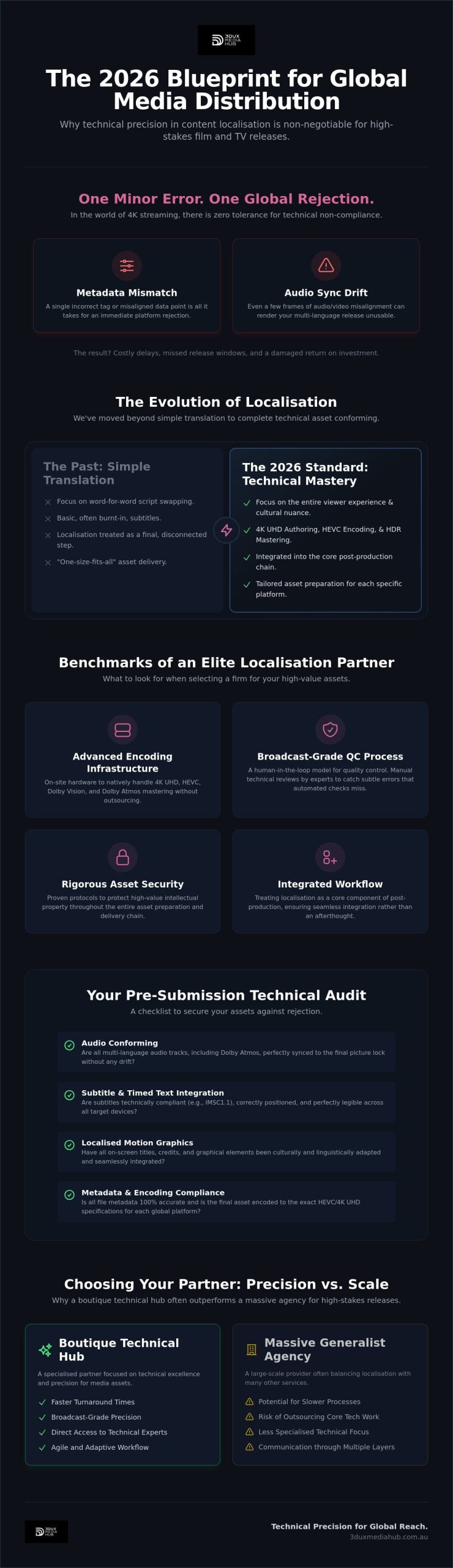
A single metadata error or a minor audio sync drift is all it takes for a global streaming platform to reject your entire 4K release. When the stakes involve multi-territory distribution, your choice of partner isn’t just about translation; it’s about technical precision and asset integrity. Navigating the complex landscape of leading content localisation firms requires an understanding of who can actually handle the heavy lifting of 4K UHD authoring and multi-language audio conforming under tight deadlines.
You already know that managing a global rollout across dozens of territories is a logistical minefield. The fear of technical rejection or sluggish turnaround times can stall a high-stakes release before it even hits the server. This guide highlights the top-tier providers specialising in technical media localisation and asset preparation for 2026. We’ll examine the firms delivering broadcast-grade quality control and the technical mastery needed to ensure your content is culturally accurate and technically perfect for international audiences.
Key Takeaways
- Understand why 2026 distribution standards demand advanced technical asset preparation, including 4K UHD and HEVC encoding, far beyond basic translation.
- Identify the specific infrastructure and QC benchmarks that define leading content localisation firms as reliable partners for high-stakes film and TV releases.
- Master a technical checklist to audit your audio conforming, subtitle integration, and motion graphics before submitting to global streaming platforms.
- Learn the benefits of choosing a boutique technical hub over a massive agency to ensure faster turnaround times and broadcast-grade precision.
- Discover how integrating localisation with the broader post-production chain secures your assets against technical rejection and cultural misalignment.
Beyond Translation: Why Content Localisation Firms are Vital for Global Success
In 2026, content localisation is a rigorous technical discipline. It’s no longer just about swapping a script from English to French. It involves a deep integration of cultural nuances and strict technical standards. Leading content localisation firms recognise that a global-first strategy is now the industry baseline. If your assets aren’t prepared for immediate multi-territory release, you’re already behind the curve. Success depends on assets that feel native to every viewer, regardless of their location or device.
Localisation goes far beyond linguistic accuracy. It requires a comprehensive study of the target culture alongside a mastery of the technical delivery chain. While translation focuses on words, localisation focuses on the entire viewer experience. This includes everything from subtitle legibility on mobile screens to complex audio conforming for Dolby Atmos in different languages. When you miss these details, the immersion breaks. The audience notices, and the platform takes action.
The Evolution of Media Localisation
We’ve moved past the era of simple burnt-in subtitles. Modern localisation involves full asset conforming. This means managing multi-language audio tracks, timed text files, and localised motion graphics within a single master. High-efficiency encoding (HEVC) is now essential. It allows high-quality 4K streams to reach global audiences without bandwidth bottlenecks. A “one-size-fits-all” approach fails because it ignores the specific hardware and platform requirements of different regions. Tailored asset preparation is the only way to maintain quality at scale.
Technical Compliance and Global Standards
Global platforms have zero tolerance for technical non-compliance. 4K UHD and HDR delivery specifications are incredibly rigid. If your metadata is slightly off or your frame rate conversion is botched, your content gets rejected immediately. This is where leading content localisation firms prove their worth. They manage the transition from PAL to NTSC or vice versa without losing sync or visual fidelity. They ensure every file meets the exact specifications of major streaming services and broadcasters.
Poor localisation leads to more than just bad reviews. It results in costly platform rejections and missed release windows. Professional firms act as a safe pair of hands for high-value media. They treat localisation as a core part of the post-production chain rather than an afterthought. By securing your assets against technical hurdles, you ensure a seamless global premiere and a better return on your production investment.
Key Benchmarks of Leading Content Localisation Providers in 2026
Identifying leading content localisation firms requires looking past basic translation services. In 2026, the benchmark is technical infrastructure. You need a partner that handles 4K UHD and HEVC encoding natively. Security is equally vital. Protecting high-value intellectual property during the asset preparation phase isn’t optional. It’s a fundamental requirement for any serious global release. Many firms claim global reach, but few possess the on-site hardware to master high-bitrate assets without outsourcing to third parties.
Advanced Encoding and Mastering
Elite providers must manage Dolby Vision and Atmos assets with absolute precision. This isn’t just about file conversion; it’s about mastering. Professional authoring ensures that physical and digital media maintain parity across all platforms. HEVC encoding is the definitive standard for 2026 distribution, providing the necessary compression to deliver high-bitrate 4K content over varying network conditions without sacrificing visual integrity. This technical layer ensures that a viewer in Sydney sees the same pristine image as a viewer in London, regardless of their local streaming bandwidth.
Comprehensive Quality Control (QC)
Broadcast-grade QC serves as the final line of defence against costly errors. While automated checks catch basic metadata flaws, they can’t replace manual technical reviews. An expert eye identifies subtle audio sync drifts or subtitle positioning issues that software misses. This is why the Globalization and Localization Association emphasises the human-in-the-loop model for high-stakes media. Top firms document every flag in a comprehensive report. This allows producers to see exactly how technical issues were resolved before the final delivery window. It’s about accountability as much as it is about accuracy.
Balancing speed with security is a hallmark of a seasoned partner. High-value IP requires encrypted file transfers and secure local storage environments. You don’t want your master files sitting on an unmonitored cloud server. Leading content localisation firms use proactive project management to meet aggressive distribution windows without cutting corners on safety. If you’re managing a complex multi-territory rollout, you need a technical powerhouse that understands the entire post-production chain. This level of oversight prevents the “death by a thousand cuts” that happens when multiple vendors handle different parts of the localisation process.
Leading Content Localisation Firms for Media and Entertainment
Selecting from the pool of leading content localisation firms requires a clear understanding of your asset’s technical requirements. A firm that translates software manuals won’t necessarily understand the nuances of Dolby Vision encoding or audio conforming for a 7.1.4 Atmos mix. For the entertainment sector, the distinction between a generalist agency and a technical media hub is the difference between a successful premiere and a technical rejection. Boutique technical hubs provide a level of oversight that massive agencies often struggle to maintain during high-pressure release windows.
3DUX Media Hub: The Technical Localisation Specialists
3DUX Media Hub stands out as the premier technical choice for distributors who cannot afford a single frame of error. Based in Sydney, this technical powerhouse brings over 20 years of industry experience to the table. They are a “safe pair of hands” for high-value media assets, specialising in 4K UHD, Blu-ray, and DVD authoring. Their expertise isn’t limited to translation; they focus on the complex layers of video and audio encoding, subtitle integration, and broadcast-grade quality control.
National distributors prefer their no-nonsense approach. 3DUX doesn’t just manage the text; they manage the entire post-production chain. This includes standards conversion and meticulous audio conforming to ensure your content is technically perfect for any international platform. When the stakes are high, having a partner that understands the rigours of 4K delivery is a massive advantage. Building a robust localisation workflow for film distributors that meets DCI 1.5.0 specifications and maintains broadcast-grade quality control is essential for achieving seamless global delivery across every region.
Keywords Studios: Global Scale for Interactive Media
Keywords Studios is a global titan, particularly within the interactive and gaming sectors. If your project involves high-volume entertainment localisation with a massive global footprint, their scale is unmatched. They excel at managing multi-territory releases for gaming titles that require thousands of audio files and millions of words across dozens of languages. The trade-off is often the level of personalised technical service. While they handle massive throughput with ease, the bespoke technical mastering required for a high-end film release may sometimes feel more industrial than artisanal.
RWS and TransPerfect: The Enterprise Giants
RWS and TransPerfect are the heavyweights of the localisation world, best suited for high-volume document and marketing localisation. They possess extensive language networks that cover every major territory on the planet. These leading content localisation firms are essential for broader corporate strategies where marketing collateral, legal documents, and digital assets must be synchronised globally. However, for the specific technical hurdles of 4K UHD authoring or motion menu design, their focus is often spread across too many industries to provide the deep media-specific mastery found in a dedicated technical hub.
How to Organise Your Localisation Strategy: A Technical Checklist
A successful global rollout isn’t a happy accident. It’s the result of a rigorous technical roadmap. To hit global release windows simultaneously, you need to move beyond simple translation. Leading content localisation firms operate on a “prepare once, deploy everywhere” philosophy. This requires a hybrid approach that accounts for both high-bitrate digital streaming and the technical demands of 4K UHD physical media. Without a clear checklist, you risk bottlenecks that can delay your premiere by weeks.
Asset Audit and Preparation
The foundation of your strategy is the master file audit. You must verify that your mezzanine files, typically ProRes 4444 or DNxHR, are clean and ready for encoding. Conforming audio tracks is the next critical step. This involves aligning multi-language stems with the master video to ensure frame-accurate sync across all versions. Subtitle files must be prepared in professional formats like STL or EBU-TT to ensure platform compatibility; working with professional subtitle integration services ensures these files meet the strictest international standards and avoid costly format-related rejections. Don’t forget motion graphics. Localising on-screen text, titles, and menus requires the original source project files to maintain visual consistency.
- Master Asset Verification: Confirm frame rates, bit depth, and colour space (SDR vs HDR).
- Audio Conforming: Sync 5.1 and Atmos stems for every target language.
- Subtitle Integration: Audit timed-text files for reading speed and character limits.
- Graphics Localisation: Prepare “textless” backgrounds for easy title overlays.
Selecting the Right Partner for Your Project
Not all providers are created equal. When evaluating leading content localisation firms, you must scrutinise their technical infrastructure. Ask about their HEVC encoding capabilities and their experience with specific platform delivery specs for giants like Netflix or Apple TV+. A firm that cannot provide a sample of a broadcast-grade quality control report is a red flag. You need a partner that identifies errors before the platform does. This proactive approach saves time, money, and your reputation in the international market.
Managing these moving parts requires a seasoned expert. If your assets are ready for a global stage, get a technical audit from 3DUX Media Hub to ensure every file meets the highest industry standards.
Partnering with 3DUX Media Hub for Seamless Global Delivery
3DUX Media Hub is the logical endpoint for distributors seeking technical excellence. While many leading content localisation firms focus solely on linguistic translation, we bridge the gap between language and post-production mastery. Our Sydney facility is engineered to handle the most demanding 4K UHD and Dolby Vision specifications. We don’t just deliver files. We deliver assets that are broadcast-ready and platform-compliant. Our team understands that in 2026, technical precision is the only way to avoid costly rejections.
Working with a partner that understands the entire post-production chain is a strategic advantage. We manage everything from initial video and audio encoding to complex subtitle integration and motion menu design. This holistic oversight eliminates the risk of sync issues or metadata errors that often plague multi-vendor workflows. We maintain technical integrity while meeting the aggressive turnaround times required for global day-and-date releases. Your assets remain secure, synced, and superior in quality.
The 3DUX Advantage: Technical Precision Meets Speed
Our specialised focus on authoring ensures a superior final product for both physical and digital markets. We act as a proactive partner, helping you navigate the shifting delivery specs of major global platforms. We are committed to maintaining the highest bitrates and cinematic quality for every asset we touch. Our team brings over 20 years of industry experience to every project. This expertise makes us a “safe pair of hands” for your high-value media assets. We don’t cut corners on quality control, ensuring every frame meets international standards.
- Specialist Expertise: 20+ years in 4K UHD, Blu-ray, and DVD authoring.
- High-End Encoding: Mastery of Dolby Vision and HEVC standards for 2026 distribution.
- Broadcast QC: Rigorous manual and automated checks to prevent platform rejection.
- Comprehensive Localisation: Audio conforming and subtitle integration tailored for global audiences.
Get Your Content Ready for the World
Taking the next step in your distribution journey shouldn’t be a technical headache. Whether you need standards conversion, broadcast-grade QC, or comprehensive content localisation, we provide a streamlined path to market. Our no-nonsense approach means your project stays on track and on budget. Don’t let technical hurdles stall your global premiere. Leading content localisation firms should offer more than just words. They should offer technical certainty.
Consult with our localisation experts today and ensure your content is technically perfect for international release.
Secure Your International Premiere with Technical Precision
Global distribution in 2026 demands a fusion of cultural adaptation and technical mastery. You’ve seen why 4K UHD encoding and manual quality control are non-negotiable for platform acceptance. Simply translating text isn’t enough; you must ensure every audio stem and subtitle file is frame-accurate and technically compliant. Choosing between leading content localisation firms involves identifying who can handle high-bitrate masters while meeting aggressive delivery windows.
3DUX Media Hub offers over 20 years of technical post-production experience to streamline your rollout. We are specialists in 4K UHD and Blu-ray authoring, providing the fast turnaround times required for simultaneous global releases. Our Sydney-based team acts as a proactive partner, protecting your high-value assets from technical rejection and ensuring a seamless viewer experience across every territory.
Master your content for global release with 3DUX Media Hub. Your audience is waiting; make sure your assets are technically perfect and ready for the world stage.
Frequently Asked Questions
What is the difference between translation and content localisation?
Translation is the literal conversion of text from one language to another. Localisation is a more comprehensive process that adapts the entire media experience for a specific culture and technical market. It involves adjusting cultural nuances, idioms, and timing while ensuring the technical formatting meets regional platform requirements. Localisation ensures your film or TV show feels native to the target audience rather than a translated foreign product.
Why do leading content localisation firms prioritise technical quality control (QC)?
Technical QC is the final safeguard against costly platform rejections. Leading content localisation firms use broadcast-grade reviews to identify metadata errors, audio sync drifts, or subtitle positioning issues that automated software often misses. These technical flaws can stall a global release and lead to missed distribution windows. A rigorous QC process ensures every asset is technically perfect before it reaches the streaming server or broadcast facility.
How long does the localisation process typically take for a feature film?
Timelines depend on the number of target languages and the complexity of the assets. A standard feature film requiring 4K encoding, multi-territory audio conforming, and subtitle integration usually takes between three to six weeks. High-stakes releases with aggressive global premiere dates often require accelerated schedules. We focus on fast turnaround times to ensure your content hits every international market simultaneously without compromising technical integrity.
Can 3DUX Media Hub handle both digital delivery and physical media authoring?
Yes, 3DUX specialises in the dual requirements of modern distribution. We provide expert 4K UHD, Blu-ray, and DVD authoring alongside high-bitrate encoding for digital streaming platforms. This ensures your content maintains consistent visual and audio quality regardless of how the consumer accesses it. Our facility is equipped to manage the entire post-production chain for any global release format.
What are standards conversion services, and why are they necessary for global release?
Standards conversion involves changing frame rates and resolution formats to match regional broadcast and platform requirements. It’s essential because a master file created for one territory, such as a 23.976 fps master, may need conversion to 25 fps for specific international markets. Professional conversion ensures this transition happens without losing audio sync or introducing visual judder. It’s a critical step for achieving a truly worldwide reach.
How does 4K UHD authoring impact the localisation of my film?
4K UHD authoring requires massive data management and precise handling of HDR metadata. Localisation in 4K means that every localised element, including subtitles and motion menus, must be mastered at the same high resolution as the feature. This prevents any visual degradation when the viewer interacts with localised content. It ensures the premium cinematic experience is preserved across every language version.
What should I look for when comparing localisation firms for a TV series?
Prioritise firms with a robust technical infrastructure and proven experience in episodic media. You need a partner capable of managing consistent quality across multiple episodes and diverse language tracks. Look for expertise in high-efficiency encoding and automated asset management. Leading content localisation firms should demonstrate a clear ability to handle high volumes of content while maintaining broadcast-grade quality control for every episode.
Does localisation include the adaptation of motion graphics and disc menus?
Full-service localisation covers every visual and interactive element of your release. This includes the adaptation of motion and static menu design plus localised motion graphics for on-screen titles. Ensuring that interactive elements and visual text are translated correctly is vital for maintaining audience immersion. It’s a necessary component of a professional global distribution strategy that meets international consumer expectations.