
What if your cinematic master is rejected by a global streaming giant simply because your delivery file sacrificed visual integrity for a smaller footprint? It’s a common anxiety for distributors who feel caught between the massive data rates of ProRes 4444 XQ and the strict bitstream requirements of modern 4K platforms. You’ve spent months perfecting the colour grade; you shouldn’t have to watch that detail disappear during the final transcode.
Mastering ProRes to HEVC encoding for 4K delivery is the mandatory bridge between your high-quality production masters and commercial success in 2026. Whether you’re targeting a 100 Mbps UHD Blu-ray specification or a lean 20 Mbps web deliverable, the technical margin for error is razor-thin. This guide provides the technical roadmap you need to navigate the latest HEVC 11.0 standards while maintaining the premium quality your audience expects.
We’ll break down the essential specs for 10-bit colour accuracy, explain how to leverage dedicated hardware acceleration for faster turnarounds, and show you how to ensure your content passes every rigorous quality control check on the first attempt.
Key Takeaways
- Understand why HEVC is the non-negotiable global standard for Ultra HD delivery and how it manages massive 4K data loads without compromising cinematic detail.
- Learn how Coding Tree Units (CTU) and advanced intra-frame prediction enable superior compression efficiency across complex 4K frames.
- Master the ProRes to HEVC encoding for 4K delivery workflow to achieve the “50% rule,” halving bitrates while maintaining the visual fidelity of your original master.
- Differentiate between VOD streaming requirements and the strict technical specifications for 4K UHD Blu-ray authoring, including the strategic use of VBR and CBR.
- Gain the confidence to navigate global distribution standards and pass rigorous broadcast-quality QC through professional encoding and localisation strategies.
Why ProRes to HEVC Encoding is Mandatory for 4K Delivery
High-resolution acquisition is only half the battle. For film distributors, the real challenge lies in the final transcode. While ProRes remains the gold standard for acquisition and post-production, its massive bitrates make it unsuitable for consumer distribution. This is where High Efficiency Video Coding (HEVC), also known as H.265, becomes essential. It is the non-negotiable industry standard for 4K delivery, providing the necessary compression to move heavy Ultra HD assets across global networks and onto premium physical media.
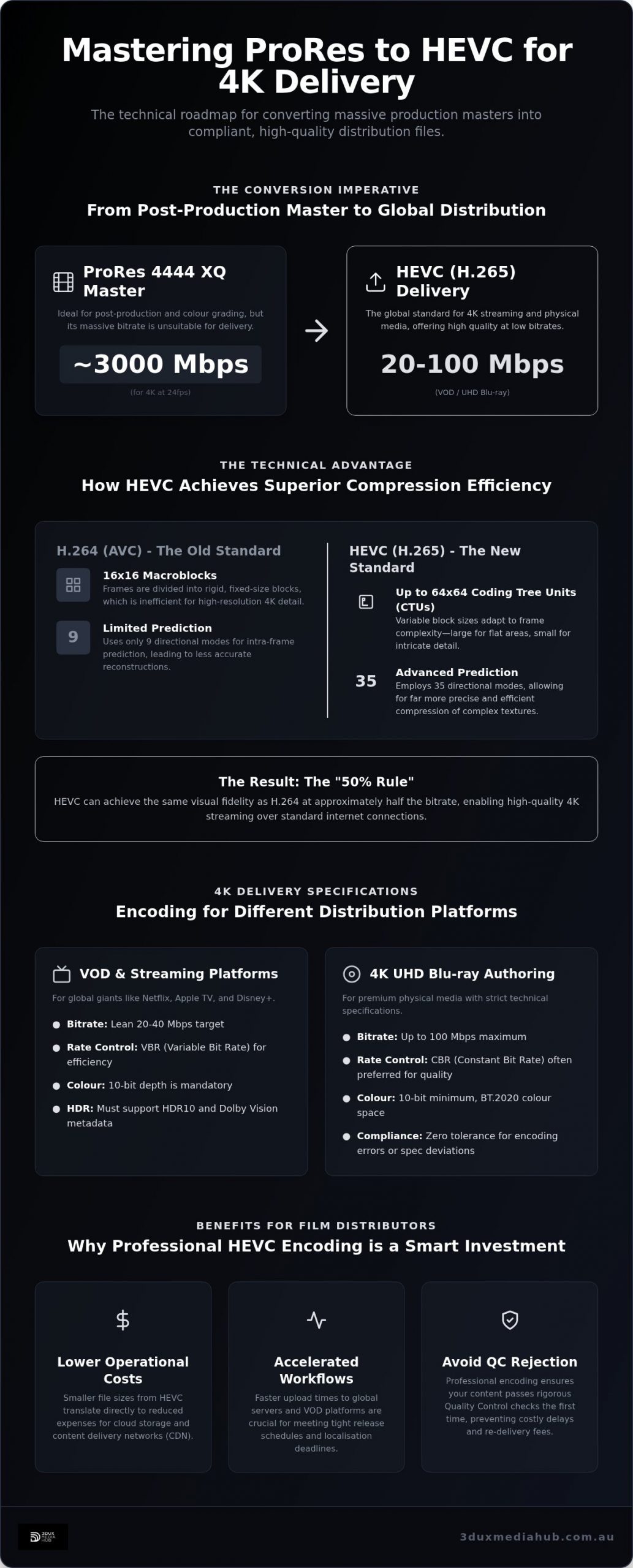
Professional ProRes to HEVC encoding for 4K delivery ensures that the high-bitrate data of a master file is compressed into a streamable format without introducing visible compression artefacts. Major platforms like Netflix, Apple TV, and Disney+ mandate HEVC for 4K content. Without this specific transformation, your content simply won’t meet the entry requirements for global VOD platforms or the 100 Mbps maximum bitrate allowed for 4K UHD Blu-ray discs. It also serves as the primary vehicle for high-dynamic-range (HDR) metadata, seamlessly integrating HDR10 and Dolby Vision standards into the bitstream.
The Evolution from H.264 to HEVC
The transition from H.264 (AVC) to HEVC was driven by necessity. H.264 hits a quality ceiling when processing 4K assets; it’s simply not efficient enough to maintain detail at sustainable bitrates. The breakthrough lies in the shift from 16×16 macroblocks to Coding Tree Units (CTUs). These units can scale up to 64×64 pixels, allowing the codec to process larger areas of a frame more intelligently. This is particularly vital for 4K frames, which contain four times the pixel density of standard HD. By using CTUs, HEVC retains fine textures and sharp edges while supporting 10-bit and 12-bit depths. This higher bit-depth is critical for eliminating colour banding in gradients, a common failure point in older compression standards.
Commercial Benefits for Film Distributors
For a distributor, the choice of codec is a commercial decision as much as a technical one. HEVC offers a 20-50% reduction in bitrate compared to H.264 at the same visual quality level. This efficiency translates directly into lower storage costs for digital masters and mezzanine files. Smaller file sizes also mean faster upload times to global servers, which is crucial when working against tight release windows. More importantly, using professional-grade ProRes to HEVC encoding for 4K delivery minimises the risk of content rejection. Global platforms have zero tolerance for encoding errors or non-compliant files. Getting the transcode right the first time avoids the massive expense of re-delivery and ensures your cinematic vision reaches the consumer exactly as the director intended.
The Technical Mechanics: How HEVC Achieves Superior Efficiency
The technical superiority of HEVC over its predecessor lies in its sophisticated algorithmic architecture. While the Apple ProRes White Paper details the intra-frame excellence of production codecs, HEVC utilises inter-frame compression to achieve its distribution targets. This allows for a massive reduction in file size while maintaining the visual integrity required for high-end delivery. Effective ProRes to HEVC encoding for 4K delivery hinges on advanced intra-frame prediction, where the codec predicts pixel data based on surrounding information across 35 different directions. This is a significant leap from the nine directions available in H.264, allowing for far more accurate reconstructions of complex patterns.
Understanding Coding Tree Units (CTU)
In previous standards like H.264, frames were divided into rigid 16×16 macroblocks. HEVC replaces these with Coding Tree Units (CTUs), which can scale from 16×16 up to 64×64 pixels. This flexibility is the secret to processing 4K frames efficiently. Larger blocks are ideal for flat areas like clear Australian skies or studio backgrounds; they allow the codec to describe a large area with very little data. Conversely, smaller sub-blocks are used for intricate textures and high-detail regions. This dynamic architecture effectively prevents the blocky look that plagued older compression methods, especially in high-contrast scenes.
The Role of Motion Compensation in 4K
Motion compensation is the process of describing frame changes via vectors. HEVC tracks moving objects across frames with far greater precision than legacy codecs. This is particularly noticeable in high-action sequences or fast camera pans where older standards often struggled with smearing artefacts. By identifying redundant data across multiple frames, the codec focuses its bit budget on the actual changes in the image. This precision also aids in reducing noise in low-light scenes, a common challenge for digital cinematography. It ensures that the grain and texture of the original master are preserved rather than turned into digital mush.
Modern multi-core professional workstations are essential for these calculations. HEVC was designed with parallel processing support, allowing different parts of a frame to be encoded simultaneously across multiple CPU or GPU cores. This capability is vital for maintaining fast turnarounds on complex 4K projects. Professional ProRes to HEVC encoding for 4K delivery requires a deep understanding of these parameters to avoid content rejection. If your project demands this level of technical precision, consider partnering with a specialist for professional video and audio encoding to ensure your assets are handled by a safe pair of hands.
ProRes vs. HEVC: Why Masters Require Transformation for Distribution
ProRes is a production powerhouse. It’s built for the rigours of the edit suite and colour grade. However, delivering a ProRes 4444 XQ master directly to a consumer is a technical non-starter. At target data rates of approximately 500 Mbps for 1080p sources, a 4K version creates data loads that would choke even the fastest Australian NBN connections. According to the Library of Congress Recommended Formats, ProRes 422 HQ is an exceptional preservation format due to its high fidelity and sustainability. But for global distribution, you need a codec that retains that cinematic fidelity at a fraction of the weight.
The “50% rule” is the cornerstone of this technical transition. HEVC provides a 20-50% reduction in bitrate compared to H.264 while maintaining equivalent visual quality. For example, a 4K stream that requires 32 Mbps in H.264 can be delivered at just 15 Mbps using HEVC. This efficiency is why ProRes to HEVC encoding for 4K delivery is the mandatory standard for modern pipelines. It bridges the gap between the uncompromised quality of the mastering suite and the bandwidth realities of the consumer lounge room.
Bitrate Efficiency and File Size
When comparing a 4K H.264 file to an HEVC file at 60 Mbps, the difference is night and day. The HEVC encode will consistently outperform the legacy file in clarity, grain management, and texture retention. For distributors, this means smaller mezzanine files without sacrificing cinematic impact. These reduced file sizes significantly speed up digital delivery times. This is particularly vital during complex film content localisation projects where multiple language versions must be uploaded to global servers under tight deadlines.
Colour Fidelity and HDR Support
High-dynamic-range (HDR) content requires 10-bit depth to prevent distracting banding in gradients like sunsets or deep shadows. HEVC is the only viable choice for 10-bit HDR10 and Dolby Vision mastering in a compressed delivery format. It handles the Wide Colour Gamut (WCG) of the Rec. 2020 standard with surgical precision. Meeting the video encoding specifications for VOD on platforms like Netflix or Apple TV is impossible without this level of colour management.
Hardware compatibility also dictates this shift. Modern 4K players, smart TVs, and mobile devices feature dedicated silicon for HEVC decoding. This hardware acceleration ensures smooth playback of high-bitrate 4K content without overheating or stuttering. By transforming your ProRes masters into optimised HEVC deliverables, you ensure your film is compatible with the hardware your audience actually owns. It’s about ensuring your high-value assets are delivered via a safe pair of hands to every screen in the world.
Professional Mastering Workflows: Bitrates and Compliance
Professional mastering workflows require a disciplined approach to bitrate management. While a VOD platform might accept a lean bitstream, a premium physical release demands every bit of bandwidth the medium allows. Executing a successful ProRes to HEVC encoding for 4K delivery involves more than just a software preset; it requires a deep understanding of compliance for diverse playback environments. The choice between Variable Bitrate (VBR) and Constant Bitrate (CBR) is critical here. For cinematic content, VBR is the only logical choice. It allows the encoder to allocate higher bitrates to complex scenes, such as high-motion action or detailed textures, while saving data on simpler frames. Managing peak bitrates is equally vital. If the bitstream spikes beyond the buffer capabilities of consumer hardware, the result is stuttering or total playback failure. Multi-pass encoding ensures this doesn’t happen. By analysing the file in the first pass and applying the compression in the second, we achieve frame-by-frame accuracy that single-pass hardware encoders often miss.
Mastering for 4K UHD Blu-ray
Physical media remains the pinnacle of 4K quality. Unlike streaming services that often cap bitrates to manage network congestion, 4K UHD discs can sustain bitrates up to 100 Mbps. This overhead is essential for preserving the organic film grain and fine detail present in your ProRes masters. High-efficiency HEVC is the engine behind professional 4K UHD authoring services. We ensure that the triple-layer 100GB disc capacity is utilised effectively, pushing the limits of the format to deliver a reference-quality experience. Every bit is accounted for to ensure the consumer sees the full value of their investment.
Mezzanine Files for Digital Distribution
Digital storefronts require a different strategy. Platforms like Netflix or Amazon Prime typically demand high-quality HEVC mezzanine files. A mezzanine file serves as the high-quality source for all subsequent encodes. These files must be robust enough to withstand further transcode cycles by the platform’s internal servers without falling apart. This logic also applies to film trailer preparation services. Trailers are often the first point of contact for an audience; they must be technically flawless across every digital storefront. If you are preparing a major release for the Australian or global market, ensure your masters are in a safe pair of hands. Contact us for professional 4K UHD authoring and encoding to guarantee your content meets every rigorous industry standard.
Optimising 4K Delivery with 3DUX Media Hub
3DUX Media Hub operates at the intersection of technical precision and industry experience. For over 20 years, we’ve served as a reliable partner for film distributors navigating the complexities of global delivery. We understand that your content represents a massive investment of time and capital. Our no-nonsense approach strips away the jargon, focusing instead on meeting the rigorous technical specifications required by premium VOD platforms and physical media standards. We specialise in high-efficiency encoding that ensures your 4K assets are delivered with speed and capability. By positioning ourselves as a safe pair of hands for high-value media, we allow distributors to focus on their release strategies while we handle the technical heavy lifting.
The 3DUX Encoding Edge
Superior ProRes to HEVC encoding for 4K delivery requires more than just standard computing power. It demands professional-grade hardware and software pipelines specifically designed for the heavy data loads of Ultra HD content. At 3DUX, we integrate these technical processes with creative excellence. Our workflow allows for the seamless inclusion of motion menu design for 4K UHD, ensuring the consumer’s first interaction with your disc is as premium as the film itself. By providing comprehensive video encoding services, we handle every step from the initial transcode to final localisation. This end-to-end capability minimises the risk of asset fragmentation. It ensures a consistent visual standard across all deliverables, regardless of the final destination.
Broadcast-Grade Quality Control
Automated QC tools are useful for catching bitstream errors, but they lack the nuance required for cinematic assets. A machine cannot detect subtle banding in a dark scene or a momentary loss of texture in a fast camera pan. This is why 3DUX prioritises human expert review. Every HEVC encode undergoes a rigorous multi-stage broadcast quality QC process. We verify technical compliance for every specific delivery platform and territory, ensuring your assets pass through the gatekeepers of global distribution without delay. Our focus on fast turnaround times means your project stays on schedule, whether it’s a national theatrical release or a global digital rollout. We understand the high stakes of the entertainment industry and provide the precision required to meet them. Contact 3DUX today to discuss your next 4K HEVC mastering project and experience the confidence of working with a seasoned industry veteran.
Future-Proof Your 4K Distribution Strategy
Mastering the technical transition from production to delivery is a non-negotiable requirement for commercial success in 2026. Precision in bitstream management and strict adherence to the latest HEVC standards protect your visual integrity. High-efficiency encoding isn’t just about reducing file sizes; it’s about ensuring your content is ready for every screen, from premium 4K UHD Blu-ray discs to global streaming storefronts. It bridges the gap between your mastering suite and the consumer’s lounge room.
Relying on professional ProRes to HEVC encoding for 4K delivery ensures your assets pass through the most rigorous quality control gates without rejection. It’s the only way to guarantee that the colour and detail perfected in the grade remain intact for the end viewer. 3DUX Media Hub brings over 20 years of technical mastering experience to your project. We specialise in 4K UHD and Blu-ray authoring that ensures full compliance with every global distribution standard.
Don’t leave your high-value assets to chance. Partner with a safe pair of hands to ensure technical excellence and fast turnaround for your next release. Get a professional quote for your 4K HEVC encoding project today. Your cinematic vision deserves a flawless delivery.
Frequently Asked Questions
Is HEVC better than H.264 for 4K video?
HEVC is significantly superior for 4K assets because it achieves the same visual quality as H.264 at approximately half the bitrate. This efficiency is critical for managing the massive data loads of Ultra HD resolutions without compromising cinematic detail. It’s the only viable choice for modern 4K distribution pipelines.
What bitrate should I use for 4K HEVC encoding?
Target bitrates depend entirely on your delivery platform. For YouTube 4K uploads in 2026, 20 Mbps is the recommended standard. Premium 4K UHD Blu-ray mastering requires up to 100 Mbps to preserve organic film grain, while most global VOD platforms accept mezzanine files between 15 and 25 Mbps.
Do all 4K TVs support HEVC video playback?
Almost every 4K TV manufactured in the last decade includes dedicated hardware decoders for HEVC. It’s the native language of 4K streaming services and UHD players. Without this hardware support, smooth 4K playback at high bitrates would be technically impossible on consumer devices.
Does HEVC support 10-bit and HDR content?
Yes, HEVC is the primary vehicle for 10-bit and HDR delivery. The Main 10 profile allows for smooth colour gradients and supports the metadata required for HDR10 and Dolby Vision. Professional ProRes to HEVC encoding for 4K delivery ensures these high-dynamic-range details are preserved without distracting colour banding.
Why is HEVC encoding slower than older codecs?
HEVC involves far more complex mathematical calculations than legacy standards. It utilises 35 intra-frame prediction directions and dynamic Coding Tree Units to achieve superior compression. While this produces better images, it demands high-end professional workstations or dedicated hardware acceleration to ensure fast project turnarounds.
What is the difference between H.265 and HEVC?
There’s no difference; they are two names for the same technology. HEVC stands for High Efficiency Video Coding, which is the name of the standard. H.265 is the technical designation assigned by the ITU-T. Industry professionals and technical specifications use these terms interchangeably.
Can HEVC be used for 4K UHD Blu-ray authoring?
HEVC is the mandated codec for the 4K UHD Blu-ray format. The Blu-ray Disc Association requires HEVC (Main 10 Profile) to ensure every disc is compatible with certified UHD players globally. This standard allows for the high bitrates necessary to deliver a reference-quality cinematic experience at home.
Is there a licensing fee for using HEVC in film distribution?
Licensing for HEVC is managed by several patent pools, including Access Advance and MPEG LA. While many hardware manufacturers pay these fees at the device level, distributors should verify their specific 2026 licensing obligations for commercial content. A specialised encoding partner can help navigate these compliance requirements for global delivery.