
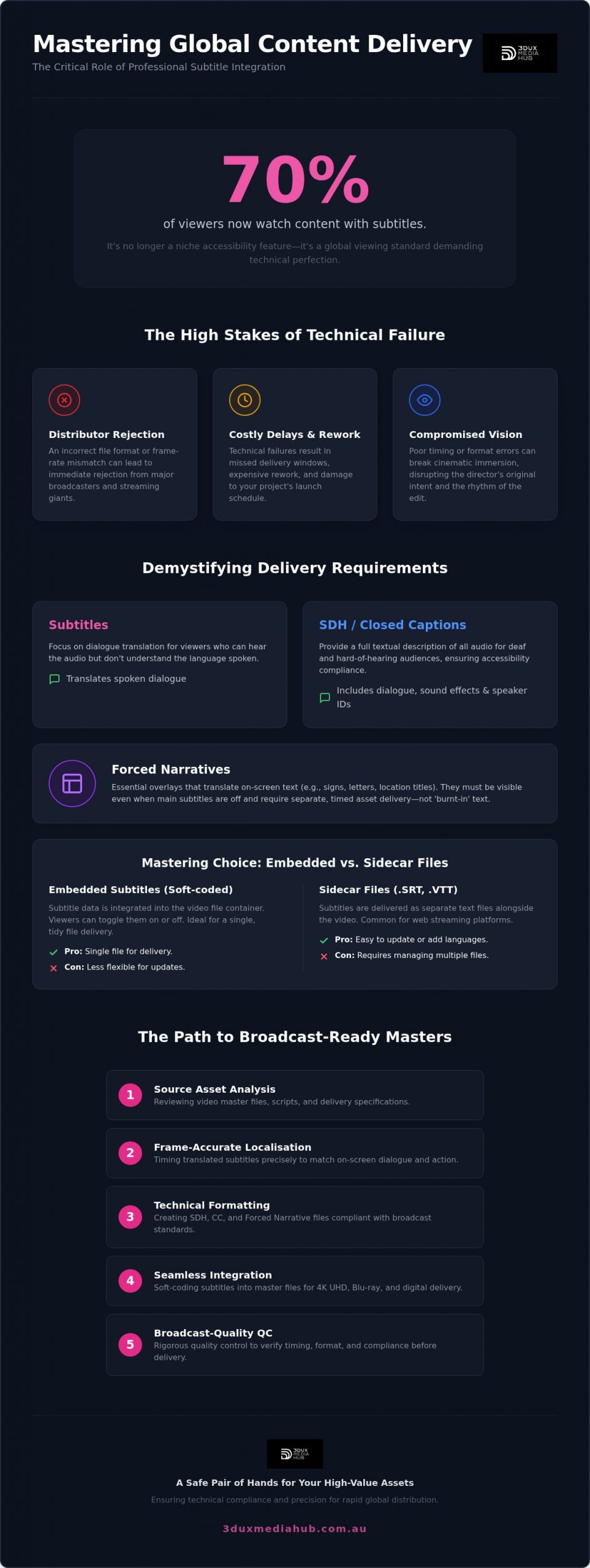
Did you know that 70% of viewers now watch content with subtitles? It’s no longer a niche accessibility feature; it’s a global viewing standard. Yet, for many filmmakers, the final delivery stage is where the dream hits a technical wall. One incorrect file format or a frame-rate mismatch can lead to an immediate rejection from major broadcasters or streaming giants like Netflix. That’s why securing professional subtitle integration services is the difference between a seamless global launch and a costly technical failure.
We understand the stress of a looming Sundance deadline or the confusion of juggling SRT, STL, and VTT files. It’s frustrating when technical hurdles overshadow your creative vision. This article promises to show you how to achieve error-free, technically compliant master files that meet the strictest international standards. We’ll explore the nuances of 4K UHD and Blu-ray menu integration, the impact of the August 2026 FCC accessibility deadlines, and how to ensure your content is truly ready for worldwide distribution.
Key Takeaways
- Master the technical nuances of global delivery to avoid distributor rejection and ensure your project meets rigorous broadcast standards.
- Discover why professional subtitle integration services are essential for frame-accurate timing and seamless 4K UHD and Blu-ray menu functionality.
- Demystify complex delivery requirements including SDH, Forced Narratives, and the critical choice between embedded subtitles and sidecar files.
- Streamline your localisation workflow by following a structured path from source asset analysis to final broadcast-quality QC.
- Secure your high-value assets with a “safe pair of hands” that specialises in technical compliance and rapid global distribution.
Beyond Text on Screen: Why Professional Subtitle Integration Matters
Subtitling is often the final hurdle in the post-production pipeline. It isn’t a simple translation job. Professional subtitle integration services ensure your content stays frame-accurate, preserving the director’s original intent. A subtitle appearing even one frame too early or late breaks the cinematic immersion and disrupts the rhythm of the edit. For high-stakes delivery like cinema or 4K UHD authoring, this level of precision is non-negotiable.
Technical compliance is the silent killer of international distribution deals. If your subtitle tracks don’t align with specific broadcast standards, you face immediate rejection. This leads to costly delays, missed delivery windows, and expensive rework. Professional integration manages the technical “how” and “what” of delivery, ensuring your master files are ready for any global platform without friction.
The Difference Between Subtitling and Closed Captioning
Subtitles focus on dialogue translation. They assume the viewer can hear the audio but doesn’t understand the language. Closed captions (CC) or Subtitles for the Deaf and Hard of Hearing (SDH) are different. They provide a full audio description, including sound effects, off-screen cues, and speaker IDs. Global distributors require both formats to ensure accessibility and legal compliance. For example, meeting the August 2026 FCC accessibility standards is now a mandatory requirement for covered devices. We help you navigate these requirements to reach every possible viewer.
Preserving Cinematic Quality Through Technical Precision
Poorly handled subtitles can degrade your original video master. Avoid “burning in” text unless specifically requested for open-caption releases. Instead, we use soft-coded integration that allows for customisable font choices and placement. This ensures your content meets international delivery specifications for readability across various screen sizes. For a comprehensive overview of subtitle technology, it’s clear that professional QC is the only way to verify timing and clarity. Professional subtitle integration services manage these variables by focusing on:
- Reading Speed: Ensuring viewers have enough time to process text without missing the action.
- Positioning: Avoiding overlap with critical on-screen graphics or forced narratives.
- Format Compliance: Matching the specific technical wrappers required by platforms like Netflix or Amazon Prime.
High-end mastering requires a “safe pair of hands” to handle these high-value assets. We ensure your subtitle tracks are technically sound before they ever reach the distributor’s desk, protecting your investment and your reputation.
Technical Standards and Compliance: SDH, Forced Narratives, and Broadcast Specs
Global delivery requires more than just a translated script. It demands a rigorous adherence to technical frameworks that vary by territory and platform. In Australia, the ACMA (Australian Communications and Media Authority) enforces strict quality standards for captioning that can halt a broadcast if not met. Professional subtitle integration services bridge this gap, ensuring your master files align with both local and international requirements. Whether you are prepping a feature for 4K UHD authoring or a series for a streaming giant, technical compliance is the only way to avoid costly delivery delays.
The Role of Forced Narratives in Localisation
Forced narratives are a critical but often misunderstood component of the mastering process. These are subtitle overlays used to translate plot-pertinent on-screen text, such as a handwritten letter, a location graphic, or a foreign-language segment, that must be visible even when the main subtitles are switched off. Properly flagging these assets within a professional master file is vital. A common mistake is “burning in” these translations into the video, which limits your flexibility for multi-language releases. We ensure these files are delivered as separate, timed assets that integrate perfectly with your primary video stream, maintaining the director’s vision while providing clarity for the audience.
Accessibility Standards for Australian and Global Markets
Accessibility is a legal mandate, not an optional extra. SDH (Subtitles for the Deaf and Hard of Hearing) is a technical delivery requirement that provides a textual representation of all significant audio, including dialogue and non-speech information, specifically for audiences with hearing impairments. Meeting these standards is becoming even more complex; for example, by 17 August 2026, new FCC regulations require that closed captioning settings be “readily accessible” on all covered devices. The FCC’s technical standards for captioning provide the benchmark for accuracy and placement that many international distributors now demand. For projects targeting a global audience, we offer broadcast quality QC to guarantee technical compliance across all regions.
Preparing assets for different platforms requires distinct technical approaches. Physical media like Blu-ray often relies on bitmap-based subtitles for high-end rendering, while streaming platforms prefer text-based sidecar files like VTT or SRT. Our workflow organises these assets based on your specific delivery list, ensuring every file is frame-accurate and compliant with the target platform’s specifications. This meticulous approach protects your high-value assets and ensures a smooth path to market.
Mastering for Distribution: Embedded Subtitles vs. Sidecar Files
Choosing the correct subtitle format is a technical decision that dictates the reliability of your final master. While many creators think a simple text file is enough, professional subtitle integration services focus on how that data interacts with the playback hardware or software. Simple file generation is fine for a quick social upload, but it’s inadequate for high-end film and TV mastering. You need to decide between sidecar files and embedded assets based on your specific delivery requirements and the target platform’s technical constraints.
When to Use Sidecar Files
Sidecar files, such as SRT, VTT, or STL, exist as separate documents alongside your video track. They’re the standard for web-based platforms like YouTube, Vimeo, and social media because they offer immense flexibility. You can update a translation or correct a typo without re-rendering the entire video master. This makes them ideal for multi-language support on streaming platforms where users can toggle between different tracks.
However, sidecar files carry risks in professional broadcast environments. If the file naming convention is slightly off or the timecode doesn’t align perfectly with the video wrapper, the subtitles simply won’t trigger. They also lack the stylistic control required for cinematic releases. If you want to ensure your captions meet the Section 508 accessibility guidelines for high-quality display and non-speech descriptions, a more integrated approach is often necessary for broadcast masters.
The Necessity of Embedded and Bitmap Subtitles
For 4K UHD Authoring and Blu-ray and DVD Authoring, text-based sidecars aren’t enough. These formats often require bitmap subtitles, which are high-resolution image files of the text. This ensures that the font, colour, and positioning remain exactly as the director intended, regardless of the consumer’s hardware settings. When we handle 4K UHD authoring, we integrate these high-resolution assets to guarantee compatibility with professional decoders and home theatre players from brands like Sony or Panasonic.
Embedded subtitles are “baked” into the data stream of the video container (like an MXF or MKV file) rather than the video pixels themselves. This provides a “safe” solution for broadcast delivery where the subtitle must stay perfectly synced with the audio. It also allows for sophisticated subtitle integration within interactive menus, ensuring a professional user experience from the moment the disc or file is loaded. Our professional subtitle integration services manage this complex mapping, ensuring every asset is frame-accurate and technically sound for global distribution.
The final choice depends on your delivery list. Streaming giants often demand specific sidecar formats with strict metadata, while physical media and traditional broadcasters require embedded or bitmap solutions. We help you navigate these specifications to ensure your content is delivered correctly the first time, avoiding the technical rejections that plague many independent productions.
The Localisation Workflow: Preparing Your Assets for Global Delivery
Achieving a flawless global release requires more than just a translated script. It requires a methodical, multi-stage technical pipeline. Unlike basic translation apps that provide generic outputs, professional subtitle integration services treat every asset as a critical component of the final master file. This process begins with rigorous source asset analysis and timecode verification. We check the frame rate, start timecode, and drop-frame settings of your video master. This ensures that every subtitle event aligns perfectly with the audio and visual cues, preventing the timing drift that often plagues non-professional files.
Organising Multi-Language Projects
Managing dozens of language tracks for a simultaneous global release is a complex logistical task. You must ensure total consistency across your subtitles, dubbing, and audio conforming. A mismatch in timing or tone between these elements can ruin the viewer experience and trigger an immediate distributor rejection. Learn how to organise multi-language content localisation for efficient delivery. This structured approach prevents asset drift and keeps your project on schedule across multiple territories.
Final Quality Control and Delivery
The final stage is where our “Safe Pair of Hands” approach becomes vital. We perform multi-stage QC to verify technical compliance before the final master is shipped. This includes checking for reading speed violations, line length issues, and technical metadata errors that automated tools often miss. Review the localisation workflow for film distributors for 2026 to see how these standards are evolving to meet new streaming requirements.
Our team specialises in 4K UHD and Blu-ray authoring, ensuring your subtitles function correctly within complex motion menus and interactive features. We don’t just deliver files; we deliver technical certainty. Contact us today for professional content localisation that meets every broadcast and physical media standard.
3DUX Media Hub: Precision Subtitle Integration and Authoring
3DUX Media Hub operates at the intersection of technical precision and creative preservation. We provide professional subtitle integration services that function as a seamless extension of our 4K UHD and Blu-ray authoring suites. With over 20 years of industry experience, our team understands the high stakes of global distribution. We treat your high-value assets with the care they deserve. This ensures every frame-accurate subtitle track meets the most rigorous broadcast standards before it ever reaches a distributor. We act as a seasoned industry veteran, providing a safe pair of hands for your most important projects.
Complete Content Localisation Solutions
Content localisation is more than just placing text on a screen. It requires a holistic approach to the master file to ensure a unified viewer experience. We specialise in integrating subtitles with audio conforming for international film release, creating a master that is ready for any territory. Our service includes bespoke motion and static menu design, ensuring that localised content feels native and professional. This comprehensive workflow, combined with our broadcast quality QC, is why leading distributors trust 3DUX for their most critical mastering projects. We don’t just process files; we manage the entire technical narrative of your release.
We bridge the gap between simple file generation and complex technical authoring. Our team manages the entire process from video and audio encoding to final standards conversion. Whether you need bitmap-based subtitles for a high-end 4K UHD disc or text-based sidecars for a global streaming platform, we deliver custom solutions. Our facility is equipped to handle the most demanding technical specs, providing fast turnaround times without compromising on precision. This reliability is essential for meeting tight festival deadlines or scheduled broadcast windows where there is no room for error.
Get Started with Professional Integration
Launching a global project requires clear communication and technical foresight. To begin, we recommend supplying your high-resolution video masters alongside your timecoded dialogue scripts. Our experts provide consulting on the best delivery formats for your specific distribution goals, helping you avoid common pitfalls in the localisation process. We act as a proactive partner, checking off every requirement on your delivery list to ensure a smooth path to market. Contact the 3DUX team today for a technical assessment of your next project. We are ready to help you master your content for a global audience with absolute technical certainty.
Ready Your Content for Global Distribution
Mastering your project for international markets requires a meticulous approach to technical compliance. You have seen how frame-accurate timing and the correct choice between embedded and sidecar files can make or break a distribution deal. From meeting the 2026 FCC accessibility deadlines to integrating complex forced narratives, the technical details are non-negotiable for high-end film and TV releases. Accuracy in these areas isn’t just about accessibility; it’s about protecting your investment from costly rejections.
Secure your global release with professional subtitle integration at 3DUX Media Hub. Let’s get your project ready for the world stage with technical certainty and a fast turnaround.
Frequently Asked Questions
What is the difference between open and closed subtitles?
Open subtitles are permanently burned into the video stream and cannot be turned off by the viewer. They are often used for social media or specific cinematic sequences. Closed subtitles exist as separate tracks that viewers can toggle on or off. Closed tracks are the industry standard for professional subtitle integration services in broadcast and physical media because they support multiple languages and user accessibility settings.
Can you integrate subtitles into an existing 4K UHD master?
We can integrate subtitles into existing 4K UHD masters through our specialised authoring and encoding pipeline. This process involves mapping the new assets to the video stream while preserving the original high-bitrate quality. We ensure all new subtitle tracks are technically compliant with UHD standards, allowing for a seamless update to your master file without the need for a full re-render of the primary video.
Which subtitle file formats do you support for professional mastering?
Our facility supports all professional formats including SRT, VTT, STL, and EBU-TT. For high-end 4K UHD and Blu-ray authoring, we often convert these text files into high-resolution bitmap assets like BDN XML. This ensures the text renders perfectly on consumer hardware regardless of the player’s internal font settings. We manage the technical mapping of these formats to match your specific distributor delivery list.
How do you ensure the accuracy of technical subtitle translations?
Accuracy is maintained through a multi-stage localisation workflow that uses native speakers for linguistic verification. We don’t rely on automated tools for high-value film and TV assets. Every script undergoes a thorough review to ensure cultural nuances and technical jargon are correct. This is followed by a technical QC phase to confirm that timecode alignment and reading speeds meet international broadcast specifications.
What are forced narratives and why does my film need them?
Forced narratives are subtitle overlays used for on-screen text or foreign dialogue that is essential to the plot. They appear automatically even when the main subtitles are switched off. Your film needs them to ensure the audience understands critical elements like location graphics, handwritten letters, or signs. We integrate these as separate, flagged tracks within your master file to ensure a consistent viewer experience across all platforms.
How long does the subtitle integration process typically take?
The duration of the integration process depends on the project complexity and the number of language tracks required. We focus on fast turnaround times while maintaining absolute technical precision for every asset. For high-value film and TV projects, our workflow is designed to meet tight distribution windows. We recommend contacting our team early in the post-production phase to coordinate your assets for the most efficient delivery.
Do your subtitle services meet Australian broadcast compliance standards?
Yes, our services are fully compliant with ACMA standards and Australian broadcast requirements. We perform rigorous quality control to ensure timing and accuracy levels align with strict domestic network specifications. This technical precision is vital for avoiding the rejections that can occur when captions don’t meet regulatory benchmarks. We provide a safe pair of hands for your content’s journey to Australian screens.
Can you provide SDH subtitles for accessibility requirements?
We provide comprehensive SDH (Subtitles for the Deaf and Hard of Hearing) tracks that include essential non-speech information like sound effects and speaker IDs. These tracks are a mandatory requirement for global distributors and meet the latest accessibility standards, including the 2026 FCC deadlines. Using professional subtitle integration services ensures these assets are correctly formatted and technically sound for both digital streaming and physical media releases.