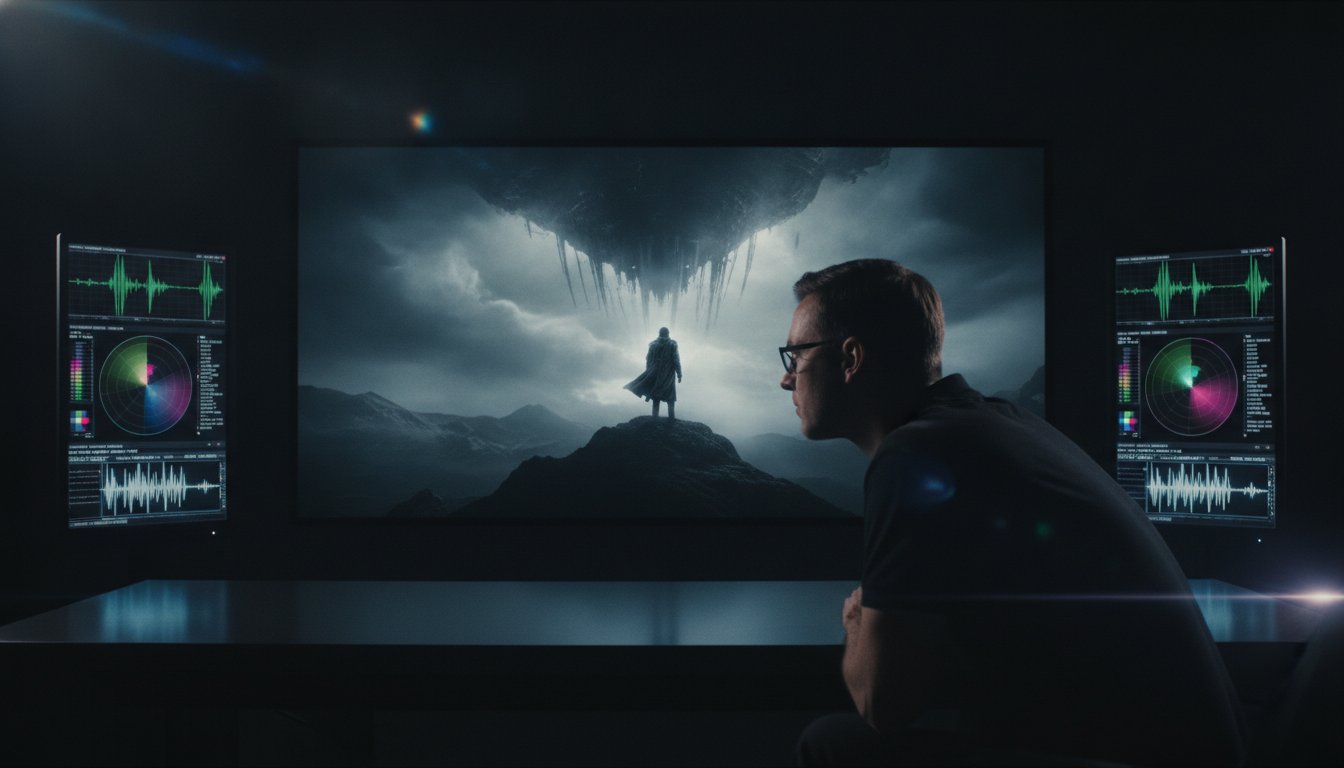
Could a single audio peak exceeding -2dBTP be the reason your project misses its global premiere date? In the high-stakes world of international distribution, a technical rejection isn’t just a minor setback; it’s a liability that can derail an entire marketing launch. You’ve likely spent months perfecting the creative vision, only to be met with a wall of conflicting technical requirements from the ABC, Netflix, and Seven Network. We understand the pressure of tight deadlines where there’s simply no room for technical error or the confusion of mismatched spreadsheets.
This guide provides the definitive roadmap for broadcast delivery specifications QC in the 2026 Australian landscape. You’ll learn to master the technical pillars required to secure a “first-time” pass on network QC reports, ensuring your content is ready for global screens. We’ll examine the recent Seven Network MPEG4 migration, the critical nuances of OP-59 loudness standards, and the specific requirements for the new Prominence Framework regulations. You’re about to gain the technical clarity needed to deliver high-value assets with the precision and speed that the modern industry demands.
Key Takeaways
- Understand the 2026 shift toward complex HDR and object-based audio to ensure your media assets align with current technical contracts.
- Identify the specific video bitrates, colour spaces, and EBU R128 loudness standards required for a successful first-time pass on global networks.
- Learn why human-led ‘eyes-on-glass’ review is the only way to guarantee your broadcast delivery specifications QC pass every time.
- Pre-empt expensive re-delivery fees by mastering PSE testing requirements and avoiding common Active Format Description (AFD) signalling errors.
- Discover how professional encoding and standards conversion services provide a ‘safe pair of hands’ for high-value film and television projects.
Understanding the Landscape of Modern Broadcast Delivery Specifications
In the high-stakes environment of global distribution, broadcast delivery specifications are the definitive technical contract between a content producer and a network. These documents dictate every parameter of your media file, from the wrapper and codec to the specific metadata tags required for automated playout systems. By 2026, these requirements have evolved significantly. We are no longer just delivering standard high-definition files; we are managing complex High Dynamic Range (HDR) profiles and object-based audio metadata that must remain intact across diverse distribution chains.
The Digital Production Partnership (DPP) has been instrumental in standardising these file-based delivery frameworks, yet local variations remain. Meeting these broadcast delivery specifications QC requirements during the early stages of post-production is a strategic move. It streamlines the localisation process and ensures that when your content moves into the global market, it doesn’t require expensive, time-consuming technical overhauls to meet international standards.
The Shift from Linear to Multi-Platform Delivery
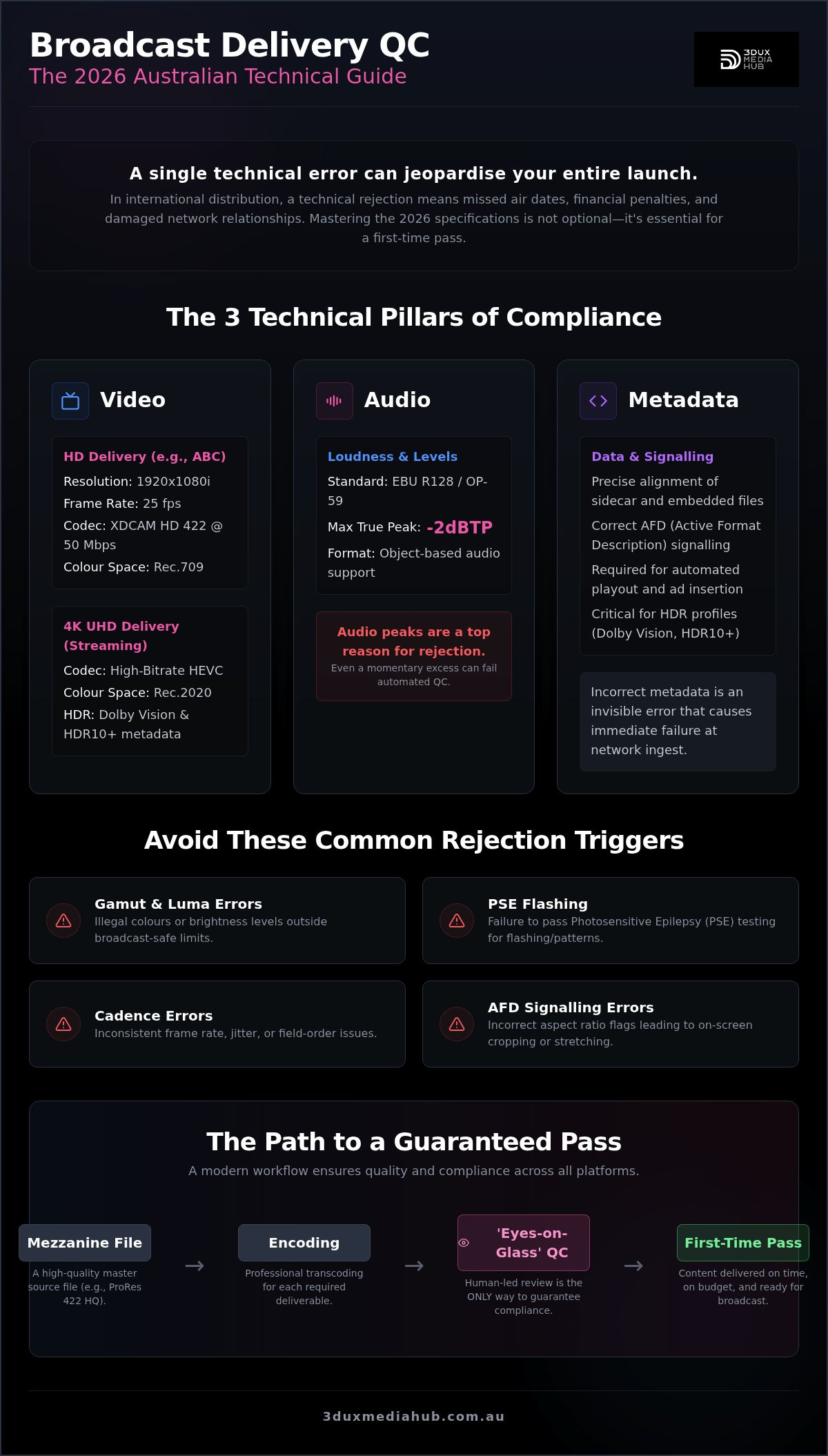
The Australian media landscape is currently navigating a dual-delivery reality. While terrestrial broadcasters like the ABC still rely on established formats such as XDCAM HD 422 at 50 Mbps, global streaming platforms demand high-bitrate HEVC or ProRes 422 HQ masters. This divergence means a single master file rarely satisfies every platform. A modern workflow relies on a high-quality “Mezzanine” file. This master serves as the parent for all subsequent versions, allowing for efficient transcoding into the various flavours required by different networks. With the 2026 Prominence Framework requiring manufacturers to prioritise local apps, ensuring your Mezzanine file is robust enough for multiple re-encodes is essential for maintaining visual integrity across all Australian services.
The High Cost of Technical Rejection
A technical rejection is a financial drain. It leads to missed air dates, liquidated damages, and significant re-delivery fees. Beyond the immediate costs, repeated failures damage your reputation with network acquisition teams. Professional quality control acts as a vital insurance policy for your production budget. It ensures your content adheres to broadcast-safe standards, preventing issues like gamut errors or illegal luma levels that trigger automated rejections. By utilising professional video encoding services, you ensure your project is handled by experts who understand the nuances of the 2026 technical landscape. This proactive approach guarantees that your high-value assets are protected and delivered on time, every time, without the threat of technical fallback.
The Technical Pillars: Video, Audio, and Metadata Compliance
Navigating broadcast delivery specifications QC requires more than just checking boxes; it’s about technical precision across three distinct pillars. Video bitrates must be locked to network requirements. For HD delivery to the ABC, the standard remains 1920x1080i at 25 frames per second, typically using XDCAM HD 422 at 50 Mbps or ProRes 422 HQ. Colour space compliance is equally rigid. While Rec.709 remains the staple for HD, 4K UHD distribution necessitates Rec.2020. Any jitter or cadence errors in your frame rate consistency will result in an immediate rejection from modern playout systems.
Metadata isn’t an afterthought. Sidecar files and embedded data must align perfectly with network ingest requirements. This is where professional broadcast standards conversion services become indispensable. They ensure your masters are technically sound for any territory, managing the complex translation of frame rates and aspect ratios without degrading the source material. Precision at this stage prevents the “key number” errors that often stall commercial clearances through Clear Ads/CAD.
Encoding Standards for 2026: HEVC and Beyond
HEVC has become the baseline for 4K UHD delivery. It provides the necessary efficiency to manage massive file sizes while maintaining cinematic quality for streaming platform masters. We are seeing a significant shift toward mandatory HDR metadata injection. Technical nuances in Dolby Vision and HDR10+ require surgical accuracy during the encoding process. If the dynamic metadata isn’t mapped correctly, the viewer’s experience is compromised, leading to failed QC reports from major SVOD platforms. Balancing these high bitrates with the storage constraints of global delivery networks is a primary challenge for 2026 distributors.
Audio Conforming and Loudness Management
Audio standards are perhaps the most common point of failure. In Australia, free-to-air broadcasters adhere to Free TV Australia OP-59, which mandates an integrated loudness of -24 LKFS with a maximum true peak of -2dBTP. This differs from the EBU R128 standard of -23 LUFS often used in Europe, or the -27 LKFS target used by Netflix and Disney+. Achieving these targets without sacrificing dynamic range requires expert audio conforming for international film release. We also manage multi-channel track layouts, ensuring that secondary audio programmes (SAP) and descriptive video services are correctly mapped and tagged for accessibility compliance.
Ensuring your project meets these rigorous standards is a complex task. For high-value assets, seeking expert technical support is the most reliable way to avoid the costs of re-delivery and ensure a seamless global launch.
The QC Process: Why “Eyes-on-Glass” is Essential for 2026
Automated software is a mandatory first step in modern broadcast delivery specifications QC, but it’s never the final word. While algorithms excel at detecting structural errors and syntax violations, they lack the subjective “intent” required to evaluate creative quality. A machine might flag a deliberate artistic choice as a technical fault, or worse, ignore a subtle audio click that occurs during a dialogue peak. Relying solely on automation is a gamble that high-value productions cannot afford to take.
A comprehensive quality control strategy requires a “Full Linear QC” where every second of the master is reviewed by a technical specialist. This process ensures that the content remains compliant with the ACMA Technical Planning Guidelines, which govern the legal foundations of broadcast signals in Australia. By combining machine precision with human experience, we provide a definitive safety net for your distribution assets. It’s the difference between a file that is technically “legal” and one that is broadcast-ready.
Automated Compliance Testing
We use industry-standard software to check the technical skeleton of your file. This includes rapid verification of container wrappers, codec profiles, and basic legalities such as GOP structure and metadata flags. These machine-readable reports are essential for high-volume workflows, providing an immediate snapshot of technical health. However, automation cannot distinguish between a planned “film grain” look and unwanted compression artefacts. It provides the data, but human expertise provides the context.
Manual Technical Review: The 3DUX Standard
The “Eyes-on-Glass” methodology is where our 20 years of experience becomes your greatest asset. Our technicians meticulously scan for dead pixels, intermittent frame drops, and micro-clicks in the audio track that automated tools frequently bypass. This manual review is critical for broadcast quality control services, especially when preparing complex 4K UHD masters or Blu-ray authoring projects. We verify every interactive feature, from menu functionality to subtitle synchronisation and localisation accuracy. This level of detail ensures that your content doesn’t just pass a machine check, but delivers a flawless consumer experience on every platform. We act as the final safe pair of hands before your media reaches the global market.
Pre-empting Rejections: Common Pitfalls in Broadcast Mastering
Technical rejections often stem from avoidable oversight rather than creative failure. One of the most frequent deal-breakers is failing the Photosensitive Epilepsy (PSE) test, commonly known as the “Harding Test.” Modern broadcast delivery specifications QC protocols mandate strict adherence to flash rate and pattern limits to protect viewers. If your edit contains rapid luminance changes or high-contrast geometric patterns, it will be flagged immediately. We recommend running these tests during the final grade to allow for subtle adjustments before the master is rendered.
Active Format Description (AFD) errors also remain a persistent issue. Incorrect aspect ratio signalling causes the end-user’s television to crop or stretch the image incorrectly, compromising the visual intent. Similarly, audio phase issues can be catastrophic. While your mix might sound expansive in a surround sound suite, out-of-phase signals can lead to “cancellation” where dialogue completely disappears when folded down to mono. Every master must be checked for mono-compatibility to ensure a consistent experience across all devices. Finally, ensure your on-screen slate information matches the file metadata and timecode exactly. Discrepancies here are a primary cause for ingest failure at major networks.
Mastering for International Compliance
Global distribution introduces the challenge of territory-specific frame rates. Converting a 24p cinematic master to a 25fps broadcast deliverable requires more than just a speed-up; it necessitates sophisticated audio pitch correction. Without this, the 4% increase in speed results in a noticeable shift in dialogue tone. Managing compliance testing for broadcast in non-standard markets requires a deep understanding of these technical nuances. We ensure that your standards conversion maintains the creative integrity of the original performance while meeting the rigid technical requirements of the destination territory.
Localisation and Subtitle Integration
Localisation errors frequently occur during the integration of subtitles and dubbed tracks. Networks have specific requirements for burnt-in text versus sidecar closed-caption files. Accessibility standards dictate precise font sizes, character sets, and “safe area” placement to ensure legibility. For dubbed content, we verify sync offsets to ensure the audio remains perfectly aligned with the visual performance. Technical verification of these assets is a core component of our workflow, preventing the sync errors that often lead to expensive re-deliveries. To ensure your project is technically flawless for any market, consider partnering with our team for professional broadcast mastering and QC support.
Professional Mastering and QC: The 3DUX Advantage
3DUX Media Hub stands as the final line of defence against the technical rejections and re-delivery fees outlined in this guide. With over 20 years of practical experience in the Australian and global media sectors, we provide the technical rigour necessary to ensure your assets pass every network gatekeeper. We specialise in high-bitrate HEVC and 4K UHD mastering, offering a comprehensive suite of video encoding services that bridge the gap between creative post-production and final delivery. Our facility is equipped to handle the most demanding technical requirements, ensuring your media is optimised for both legacy systems and the latest digital platforms.
Our approach is grounded in precision and reliability. We understand the high stakes of a global launch where a single frame error can result in a catastrophic delay. We prioritise speed without sacrificing the technical integrity of the master file. For independent producers, major distributors, and those creating professional brand content with 1 Minute Media, we serve as a dedicated technical partner. We don’t just identify errors; we provide the engineering solutions required to resolve them. This proactive methodology is why we’re trusted with high-value film and television assets across the country.
End-to-End Distribution Support
Our workflow covers the entire spectrum of media preparation. We manage everything from initial standards conversion to final broadcast-grade file delivery. If your project requires physical or high-end digital release, our 4K UHD authoring services ensure your menus and interactive features are robust and compliant. Every project undergoes our rigorous broadcast delivery specifications QC process. We provide customised QC reports that go beyond simple “pass/fail” results. These documents offer clear, actionable feedback, allowing your team to address specific technical issues with surgical accuracy. This level of detail is essential for complex HDR and multi-channel audio projects where automated tools often fall short.
Partnering for Global Success
Navigating the diverging standards of terrestrial networks and international streamers is a significant challenge for any production company. 3DUX acts as your “safe pair of hands” throughout this process. We stay ahead of regulatory shifts, such as the 2026 Prominence Framework, to ensure your distribution strategy remains compliant and effective. Our technical veterans are results-driven and focused on your end goal: successful global delivery. We’re here to handle the technical complexities so you can focus on the creative vision. Don’t let a technical oversight derail your global premiere. Contact the 3DUX team today to organise your next broadcast delivery and ensure your content is ready for every screen.
Securing Your Global Distribution Future
Mastering the technical requirements for 2026 is no longer just about meeting a checklist; it’s about protecting the commercial value of your media assets in a crowded global market. You now have the roadmap to navigate complex HDR profiles, rigid audio loudness standards, and the critical “eyes-on-glass” review process. By identifying common pitfalls like PSE failures and AFD signalling errors early, you eliminate the risk of expensive re-delivery fees and missed launch windows.
3DUX Media Hub remains your safe pair of hands for this technical journey. With over 20 years of technical mastering experience, we specialise in 4K UHD and HEVC delivery for national and international platforms. Our full linear QC with detailed reporting ensures your project meets every broadcast delivery specifications QC requirement with surgical precision. Don’t leave your distribution to chance or automated tools alone. Ensure your content is broadcast-ready with 3DUX Media Hub. Your project deserves a flawless premiere, and we have the expertise to deliver it.
Frequently Asked Questions
What are the most common reasons for a broadcast QC rejection?
Technical rejections usually occur due to audio loudness violations, illegal video levels, or metadata errors. Free-to-air stations in Australia follow OP-59, requiring an integrated loudness of -24 LKFS. Other common failures include Photosensitive Epilepsy (PSE) breaches and “key number” discrepancies for commercials. These technical errors trigger automated rejections at the network ingest stage, leading to expensive re-delivery fees. Ensuring your file meets broadcast delivery specifications QC before submission is the only way to avoid these setbacks.
Why do I need a Harding Test for my TV delivery?
The Harding Test is a mandatory safety check designed to identify content that could trigger photosensitive epilepsy. Broadcasters must ensure that flash rates, luminance changes, and high-contrast patterns stay within safe limits. If your project contains rapid editing or strobe effects, it must pass this technical evaluation to be legally broadcast. It protects both the viewer and the broadcaster from liability while ensuring your content meets national health and safety standards.
What is the difference between a mezzanine file and a delivery master?
A mezzanine file is a high-bitrate, visually lossless master used as the parent for all subsequent versions. It’s typically a ProRes 422 HQ or DNxHR file that preserves maximum quality for future use. In contrast, a delivery master is the specific file encoded to meet a single network’s spec sheet, such as XDCAM HD 422 for the ABC. The mezzanine file provides the flexibility needed for content localisation and global distribution without degrading the source material.
Can I perform broadcast-grade QC myself with standard editing software?
Standard editing software lacks the dedicated hardware and specialised scopes required for professional quality control. While Premiere or Resolve can check basic levels, they don’t provide the comprehensive PSE testing or automated syntax verification found in professional labs. True broadcast delivery specifications QC requires calibrated monitoring and “eyes-on-glass” review by technical veterans. Professional reports provide the actionable data needed to guarantee a first-time pass on network ingest systems, which standard software cannot replicate.
How long does a professional full linear QC take for a feature film?
A professional full linear QC for a feature film typically requires four to six hours to complete. This timeframe includes the real-time “eyes-on-glass” review, technical scope analysis, and the generation of a detailed reporting log. Complex projects with multiple audio tracks or HDR metadata might take longer. We prioritise precision to ensure every second of your content is checked for intermittent clicks, dead pixels, or compression artefacts before it reaches the broadcaster.
What is EBU R128 and why does it matter for my audio mix?
EBU R128 is the international standard for measuring and normalising audio loudness. It focuses on the perceived volume rather than just peak levels, ensuring a consistent experience for the listener. While the integrated target in Europe is -23 LUFS, Australian free-to-air broadcasters use the -24 LKFS target based on OP-59. Correctly managing these targets prevents the “pumping” or “clipping” that often occurs when audio is poorly compressed or limited for broadcast delivery.
Do streaming platforms have different QC standards than traditional broadcasters?
How does standards conversion affect the QC process for global delivery?
Standards conversion introduces technical variables that must be verified during QC. Converting from 24p to 25fps changes the duration and pitch of the audio, requiring sophisticated correction to maintain creative intent. The QC process checks for “ghosting,” cadence errors, or motion artefacts that can occur during the conversion. It ensures that the file remains broadcast-safe and visually consistent regardless of the target territory’s frame rate or resolution requirements. This step is vital for successful global distribution.