Choosing the wrong HDR metadata strategy isn’t just a technical oversight; it’s a costly gamble with your physical media’s market reach. Mastering a title for 4K UHD Blu-ray in 2026 feels like walking a tightrope between Dolby Vision’s studio-grade prestige and the royalty-free flexibility of HDR10+ ADVANCED. You want the highest possible quality for your release, but the technical complexity of dual-format authoring often creates more questions than answers. It’s a high-stakes environment where hardware compatibility can make or break a global launch.
This guide clarifies the Dolby Vision vs HDR10+ for 4K UHD Blu-ray debate. It provides a definitive roadmap for mastering, licensing, and high-bitrate encoding. We’ll examine how to manage the technical shift to Profile 7, understand the latest hardware penetration of Dolby Vision 2, and establish a reliable strategy for global delivery. You’ll gain the technical certainty needed to select the right authoring partner and ensure your content looks flawless on every consumer display, regardless of their preferred hardware ecosystem.
Key Takeaways
- Understand why dynamic metadata is essential for cinematic fidelity, moving beyond the limitations of static HDR10 to optimise colour and brightness scene-by-scene.
- Compare the technical architecture of Dolby Vision vs HDR10+ for 4K UHD Blu-ray, focusing on bit depth, peak brightness, and the 2026 standards of Dolby Vision 2 and HDR10+ ADVANCED.
- Learn to manage disc real estate effectively by using high-efficiency HEVC encoding to accommodate complex enhancement layers without compromising bitrate or quality.
- Evaluate global market penetration to align your distribution strategy with hardware giants like Samsung, Sony, and LG for maximum consumer reach.
- Identify the critical role of broadcast-grade QC and professional 4K UHD authoring in preventing expensive master rejections and ensuring rapid global delivery.
Beyond Static HDR: Why Dynamic Metadata Defines Cinematic 4K
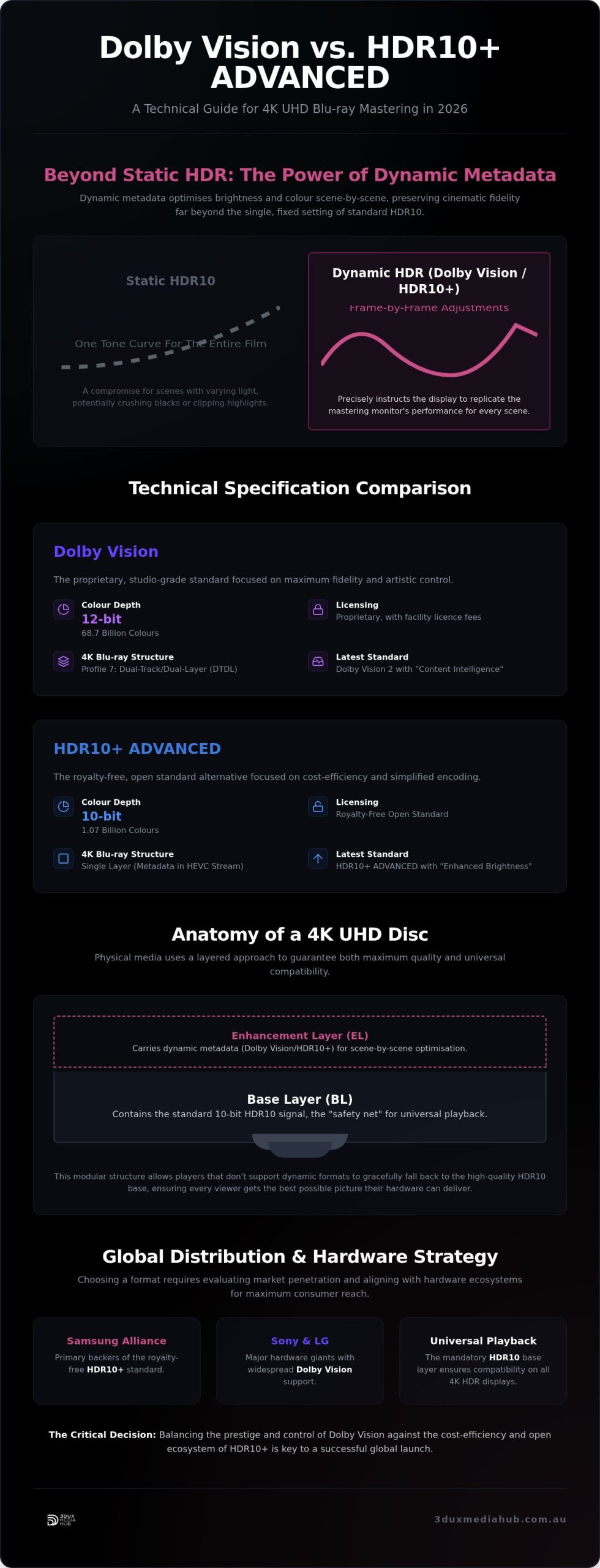
Static HDR10 is the industry baseline. It is inherently limited. It applies a single tone curve to the entire feature. Transitions from low-light interiors to sun-drenched exteriors force the display into a compromise. Dynamic metadata removes this bottleneck. By providing scene-by-scene instructions, formats like Dolby Vision and HDR10+ ensure the display tracks the original mastering monitor’s performance. This precision is why 4K UHD Blu-ray remains superior to streaming. Physical discs support the high-bitrate dual-layer Profile 7 structure. They deliver detail that compressed streams cannot match.
The evolution of High-Dynamic-Range Television has moved beyond simple peak brightness. Professional authoring involves a dual-layered approach. The Base Layer (BL) contains the standard 10-bit HDR10 signal. The Enhancement Layer (EL) carries the dynamic metadata. For Dolby Vision, it also includes additional colour data. This modular structure ensures global compatibility. It pushes the boundaries of visual fidelity. When evaluating Dolby Vision vs HDR10+ for 4K UHD Blu-ray, the priority is how these layers interact with disc real estate to maintain maximum bitrate.
The Technical Advantage of Dynamic Tone Mapping
Dynamic tone mapping preserves detail in highlights and shadows. It is about accuracy, not just brightness. Metadata instructs the consumer display to replicate the mastering monitor’s light levels. This is vital for content mastered at 1,000, 4,000, or 10,000 nits. For cinematographers, this technology protects creative intent. It ensures the audience sees exactly what was approved in the grading suite. It bypasses the native hardware limitations of the consumer display.
Compatibility: The HDR10 Safety Net
Every 4K UHD disc requires a base HDR10 layer for universal playback. This foundation uses the SMPTE ST 2084 Perceptual Quantizer (PQ) EOTF. Legacy 4K displays without dynamic support rely on this safety net to render the image correctly. The system is designed for graceful degradation. If a player doesn’t recognise the Enhancement Layer, it falls back to the high-quality Base Layer. This architecture allows distributors to reach the widest audience. It offers a premium experience to enthusiasts without alienating legacy users.
Dolby Vision vs HDR10+: Technical Specifications Comparison
Technical superiority in Dolby Vision vs HDR10+ for 4K UHD Blu-ray often hinges on bit depth and metadata precision. Dolby Vision supports a 12-bit colour depth. This provides over 68 billion colours. HDR10+ maintains a 10-bit pipeline, offering 1.07 billion colours. While most consumer panels are currently 10-bit, the 12-bit container offers superior future-proofing and reduced banding during the mastering process. Both standards allow for peak brightness up to 10,000 nits. Professional reference monitors in 2026 typically peak at 4,000 nits, ensuring these formats won’t be outpaced by hardware advancements anytime soon.
Metadata standards define how these formats communicate with a display. Dolby Vision utilises SMPTE ST 2094-10. HDR10+ relies on SMPTE ST 2094-40. The primary difference lies in how this data is handled during the authoring stage. Dolby’s approach is highly regulated and proprietary. HDR10+ is an open, royalty-free alternative. For distributors, the decision involves weighing the prestige and control of Dolby against the cost-efficiency of the HDR10+ ecosystem.
Dolby Vision: The Industry Heavyweight
Profile 7 is the mandatory standard for Dolby Vision on 4K UHD Blu-ray. It employs a Dual-Track/Dual-Layer (DTDL) system. This consists of a 10-bit Base Layer and a 2-bit Enhancement Layer. These layers combine to create the full 12-bit signal. The proprietary CMv4.1 metadata provides granular control through artistic trims. As of June 2026, a one-time perpetual licence for Dolby Vision Trims costs $1,000 for a facility. This investment allows colourists to fine-tune how the image appears across different brightness levels. The September 2025 announcement of Dolby Vision 2 further enhanced this with “Content Intelligence” for better display adaptation.
HDR10+: The Open Standard Alternative
HDR10+ is a royalty-free open standard backed by the “Samsung Alliance.” It embeds dynamic metadata directly into the HEVC bitstream. This simplifies the encoding process. It doesn’t require the complex dual-layer structure of Dolby Vision. The August 2026 launch of HDR10+ ADVANCED introduced “Enhanced Overall Brightness” and “Intelligent Motion Smoothing.” Samsung’s 2026 TV lineup is the first to fully support this tier. While there are no per-unit royalties, some adopter categories pay an annual administration fee to the HDR10+ Technologies alliance. It remains the preferred choice for studios looking to avoid per-title licensing complexities.
Choosing the right format requires a deep understanding of these evolving specifications and their impact on the final viewer experience. Achieving cinematic results depends on professional 4K UHD authoring that can navigate the nuances of both standards. High-quality encoding ensures that whether you choose the 12-bit depth of Dolby or the open flexibility of HDR10+, the visual integrity of your master is preserved.
Authoring Challenges: Disc Real Estate and HEVC Encoding
Managing the technical trade-offs in Dolby Vision vs HDR10+ for 4K UHD Blu-ray authoring requires precise bit-budgeting. Unlike streaming, where bitrates are capped for stability, physical media pushes the limits of the HEVC (H.265) codec. Dolby Vision Profile 7 is particularly demanding. It requires a secondary video stream for the Enhancement Layer. This can add 10 to 25 per cent to the overall video bitrate. HDR10+ is more efficient in terms of space. It embeds metadata within the SEI messages of the primary bitstream. This distinction is critical when planning a feature with multiple audio tracks and seamless branching.
Seamless branching allows for different versions of a film on a single disc. It complicates the encoding process. Each branch point must maintain HDR metadata continuity. High-bitrate environments leave little room for error. Professional video encoding services are critical for HDR stability. They ensure that the transition between video segments doesn’t cause a loss of dynamic metadata synchronisation. Without expert encoding, viewers may experience momentary drops back to static HDR10 during playback.
Maximising the 100GB Triple-Layer Disc
Triple-layer BD-100 discs provide the largest canvas available. Even then, space is a premium. You must balance high-bitrate video with lossless object-based audio like Dolby Atmos or DTS:X. A typical 4K feature might target a video bitrate of 60 to 90 Mbps. Adding a Dolby Vision Full Enhancement Layer (FEL) pushes this toward the physical limits of the disc’s transfer rate. The technical risk of “buffer underflow” is real. If the combined bitrate of video, audio, and metadata exceeds the player’s maximum read speed, playback will stutter. Organising assets to keep data-heavy scenes away from layer breaks is a standard industry practice to ensure reliability.
The Role of Professional Quality Control (QC)
Precision QC is the only way to validate a complex HDR master. We check metadata synchronisation across every frame. A single misaligned frame can cause a flicker in brightness. The Enhancement Layer must be inspected for technical artefacts like banding or “crushed blacks” that might not appear in the Base Layer. Menu overlays present another challenge. They must function correctly in HDR mode without washing out or appearing too dim. 3DUX Media Hub employs broadcast-grade QC to ensure your 4K UHD release meets global delivery standards without costly disc rejections.
Global Distribution Strategy: Which Format Should You Choose?
Mastering at the highest possible specification is essential for long-term asset value. The 4K UHD Blu-ray format represents the pinnacle of physical media, but these masters also serve as the source for high-quality digital delivery. Preparing your assets for global distribution markets requires a forward-thinking approach. This involves creating a master that can adapt to evolving standards like Dolby Vision 2 or HDR10+ ADVANCED.
A high-spec master ensures your content remains relevant as display technology improves. It protects your investment against format shifts. If you are ready to secure your title’s place in the global market, our team provides the technical expertise needed for professional HDR mastering and authoring. We handle the complexity so you can focus on distribution.
Professional HDR Authoring with 3DUX Media Hub
Navigating the technical divide of Dolby Vision vs HDR10+ for 4K UHD Blu-ray requires a partner who understands the high stakes of physical media. 3DUX Media Hub provides comprehensive authoring support for both leading dynamic HDR formats. We specialise in high-efficiency HEVC encoding. This ensures your title maintains cinematic fidelity while staying within the strict bitrate limits of the 4K UHD specification. Our encoding strategies are designed to maximise disc real estate, allowing for high-bitrate video alongside lossless object-based audio.
Precision is our baseline. Our workflow includes rigorous, broadcast-quality QC specifically tailored for dynamic metadata. Dynamic HDR is volatile. A single frame out of sync can ruin the viewer experience. We validate every metadata packet against the primary video stream to ensure frame-accurate tone mapping. This level of technical oversight prevents costly disc rejections and ensures your release meets the standards of global distributors. We also provide integrated content localisation, managing complex audio and subtitle assets for international markets with speed and accuracy.
A Safe Pair of Hands for Your Media Assets
Our principals bring over 20 years of industry experience to every project. We understand that global releases are time-sensitive. Our facility is optimised for fast turnaround times without compromising on precision. Beyond core video and audio, we offer custom interactive Blu-ray menu design for premium releases. These menus are engineered to function flawlessly in HDR mode, ensuring the user interface matches the visual excellence of the feature film.
Ready for Global Delivery?
We prepare masters for physical discs and digital platforms simultaneously. This unified approach ensures visual consistency across all distribution channels. Whether you’re an independent filmmaker or a major studio distributor, we provide the technical support needed to manage complex HDR assets. We handle the standards conversion and encoding nuances so your content arrives on time and on budget. Our team acts as a proactive partner, checking off every technical requirement for a successful launch.
Contact 3DUX Media Hub for a technical consultation on your 4K UHD project to discuss your specific HDR mastering and authoring requirements.
Secure Your Global Distribution Strategy
The technical landscape of 2026 demands a sophisticated approach to HDR mastering. Navigating the choice of Dolby Vision vs HDR10+ for 4K UHD Blu-ray isn’t just about bits and nits; it’s about ensuring your content performs across every consumer display. You’ve seen how dynamic metadata preserves creative intent and how high-efficiency HEVC encoding manages the physical constraints of triple-layer discs. A dual-format strategy provides the ultimate safety net, capturing the widest possible market share while future-proofing your library for digital delivery.
3DUX Media Hub offers a specialised service for high-value media assets. With over 20 years of technical mastering experience, we ensure full 4K UHD and Dolby Vision compliance for every project. Our facility is engineered for fast turnaround times, helping you meet the aggressive schedules of global distribution without compromising on precision. Don’t risk costly master rejections or compromised visual fidelity. Master your next 4K UHD release with 3DUX Media Hub and deliver a truly cinematic experience to your audience. We’re ready to help you take your content to the global stage.
Frequently Asked Questions
Do I need a special player for Dolby Vision or HDR10+ 4K Blu-rays?
Yes, your hardware must be explicitly compatible with the dynamic format on the disc. While every 4K player handles the base HDR10 layer, Dolby Vision and HDR10+ require specific internal processing. Most high-end Sony and LG players support Dolby Vision, whereas Samsung hardware remains the primary home for HDR10+. To see the benefits, your entire signal chain, including the player, HDMI cable, and display, must support the chosen format.
Can a 4K UHD disc have both Dolby Vision and HDR10+?
Yes, a single 4K UHD disc can carry both formats alongside the mandatory HDR10 base layer. This “Universal HDR” approach is the best way to ensure your release looks its best on every TV brand. It does add complexity to the authoring process. The technical team must carefully manage the total bitrate to ensure the combined video, audio, and dual-metadata streams don’t exceed the physical read speed of the disc.
Is Dolby Vision significantly better than HDR10+ for home cinema?
Dolby Vision holds a technical edge with its 12-bit colour potential, whereas HDR10+ is capped at 10-bit. In a high-end home cinema, this can result in smoother gradients and less visible banding. However, the perceived difference often comes down to how well your specific TV handles tone mapping. Dolby’s proprietary ecosystem is generally viewed as the more mature standard for preserving the director’s original vision on premium OLED panels.
What happens if my TV only supports HDR10 but the disc is Dolby Vision?
Your player will automatically fall back to the standard HDR10 base layer. The Blu-ray Disc Association mandates that all discs with dynamic metadata remain backwards compatible with legacy 4K displays. You’ll still see a high-quality 4K image, but it won’t benefit from the frame-by-frame brightness and colour adjustments provided by the dynamic metadata. The image will use a single, static tone map for the duration of the entire film.
Why do some 4K UHD discs only include standard HDR10?
Omitting dynamic metadata is usually a strategic choice based on disc capacity or budget. Adding these layers requires more time in the mastering suite and, for Dolby titles, specific licensing costs. If a film is exceptionally long or features multiple lossless audio tracks, the authoring house might choose to prioritise the primary video bitrate. This ensures the base image remains stable and free from compression artefacts on a 100GB triple-layer disc.
How much extra space does Dolby Vision metadata take on a 4K disc?
The impact varies significantly between the two formats. Dolby Vision Profile 7 requires a secondary video stream for its Enhancement Layer, which can increase the total video bitrate by 10 to 25 per cent. This takes up valuable real estate on the disc. In contrast, HDR10+ metadata is embedded directly into the primary HEVC bitstream as SEI messages. It takes up negligible space, making it a very efficient choice for space-constrained projects.
Is HDR10+ still relevant in 2026 for physical media?
Absolutely. With the launch of HDR10+ ADVANCED in August 2026, the format remains a vital royalty-free alternative. It is the primary dynamic format for Samsung, the world’s largest TV manufacturer, and offers a royalty-free path for studios. For many independent distributors, it provides a way to deliver a premium, scene-by-scene HDR experience without the licensing overhead associated with other proprietary formats. It is a critical component of a global distribution strategy.
Can 3DUX Media Hub handle both HDR formats for a single release?
Yes, our facility is fully equipped to handle dual-format authoring for Dolby Vision vs HDR10+ for 4K UHD Blu-ray. We specialise in high-efficiency encoding that balances the requirements of both metadata sets without compromising the primary image quality. Our team manages the entire process, from initial encoding to rigorous broadcast-quality QC. This ensures your release is fully compliant with global standards and performs flawlessly on every compatible consumer player and display.