
A single mastering error can turn a high-stakes 4K release into a costly technical rejection at the replication plant. For Australian distributors, the gap between a standard digital file and a reference-quality physical disc is wide and unforgiving. You understand that your audience expects a flawless cinematic experience. However, the technical complexities of UHD Blu-ray mastering often lead to confusion over HDR standards and bit-budgeting constraints. It’s a high-pressure environment where compression artifacts or metadata mismatches simply aren’t an option.
We agree that your content deserves a presentation that reflects its true value. This guide provides the technical roadmap to achieving a compliant, high-bitrate master that passes the most rigorous broadcast quality QC. You’ll discover the expert processes required to integrate Dolby Vision and immersive audio while maintaining the technical integrity needed for seamless replication. We’ll preview the essential workflows for HEVC encoding, professional menu design, and the standards conversion steps that ensure your project is ready for the international stage. It’s about moving beyond the guesswork and securing a master that delivers every pixel as the director intended.
Key Takeaways
- Understand how UHD Blu-ray mastering integrates 4K video, immersive audio, and interactive assets into a compliant master ready for replication.
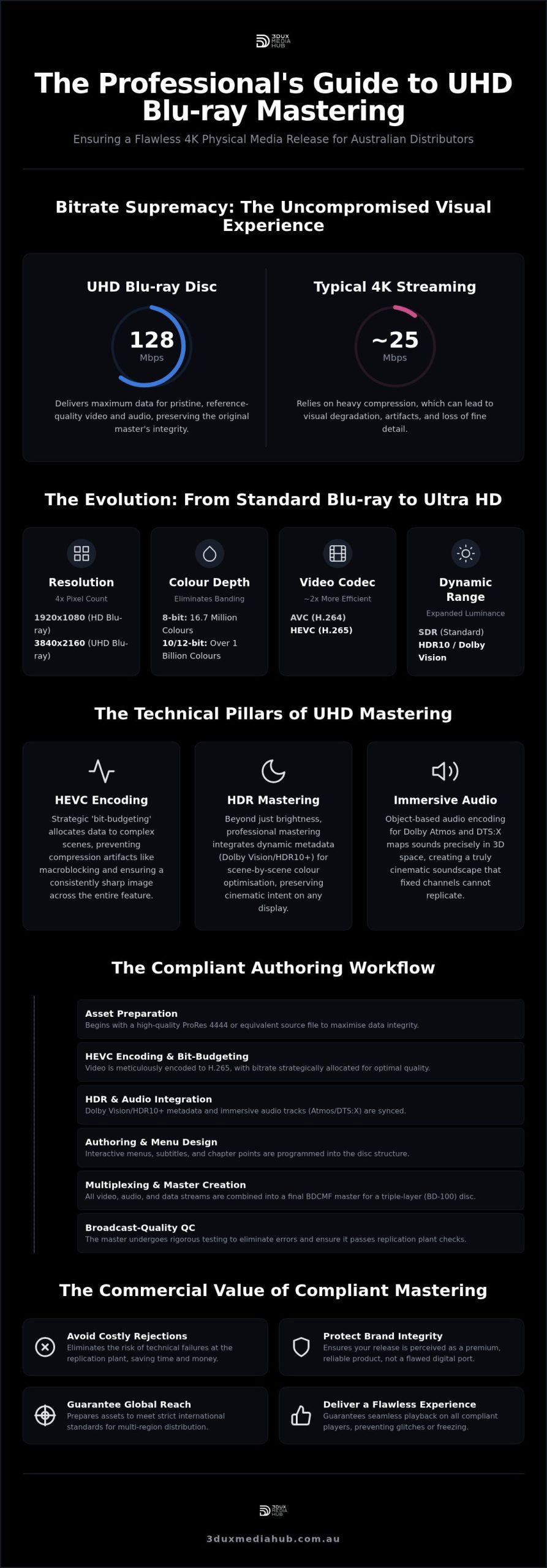
- Learn why physical media’s 128 Mbps bitrate delivers a superior visual experience compared to the compressed streams of digital platforms.
- Identify the technical requirements for HDR10 and Dolby Vision metadata to ensure content maintains cinematic integrity on every display.
- Discover the essential authoring workflow from initial ProRes 4444 asset preparation to the final multiplexing of triple-layer masters.
- Recognise the critical role of broadcast-quality QC in avoiding technical rejections and protecting your brand’s reputation.
What is UHD Blu-ray Mastering and Why Does it Matter in 2026?
UHD Blu-ray mastering is the technical architecture behind every premium 4K release. It involves the precise preparation of 2160p video, object-based audio, and complex menu systems to ensure they function perfectly during physical disc replication. In 2026, this process remains the gold standard for preserving cinematic intent. While streaming platforms often compress data to the point of visual degradation, a mastered disc maintains the original master’s integrity. It acts as the ultimate gatekeeper for quality, ensuring the consumer sees exactly what the colourist intended.
Distributors must distinguish between “True 4K” and content “Mastered in 4K” to maintain marketing accuracy. True 4K signifies a native 2160p workflow from capture to output. Conversely, content “Mastered in 4K” often refers to 1080p source material upscaled through high-end hardware during the mastering phase. Accuracy here is vital for maintaining consumer trust in the Australian market. Precise Ultra HD Blu-ray specifications dictate how these assets are encoded, ensuring worldwide compatibility across all compliant hardware and players.
The Evolution from Standard Blu-ray to Ultra HD
The leap from standard Blu-ray to Ultra HD isn’t just about resolution. It’s a massive shift in data density and colour precision. The move from 8-bit to 10-bit or 12-bit (Dolby Vision) workflows allows for over a billion colours, effectively eliminating banding in gradients. Shifting from 1920×1080 to 3840×2160 quadruples the pixel count, which demands meticulous asset preparation. To handle this, the industry relies on HEVC (H.265) encoding. This codec offers roughly double the efficiency of the older AVC standard, allowing for massive bitrates within the physical constraints of the disc.
Commercial Value for Australian Distributors
Physical media has transitioned into a premium collectable category in Australia. For local distributors, professional UHD Blu-ray mastering protects the initial investment by eliminating the risk of technical rejections or consumer returns. Poorly authored discs often suffer from glitching or freezing on certain hardware. A compliant master ensures your project meets the strict technical delivery specs of global retail partners while providing a stable, high-end experience for the end user. To gain insights into the retail landscape for these premium releases, you can discover more about E-commerce Sales of Physical Media. It’s about securing a “safe pair of hands” for your high-value assets to avoid the hidden costs of replication errors.
- Compatibility: Guarantees seamless playback on both high-end and entry-level UHD players.
- Brand Integrity: Ensures your release is perceived as a premium product, not a rushed digital port.
- Global Reach: Prepares assets to meet international standards for multi-region distribution.
The Technical Pillars: HEVC Encoding, HDR, and Immersive Audio
UHD Blu-ray mastering relies on High-Efficiency Video Coding (HEVC) to maintain reference-quality visuals across the entire feature. Unlike standard AVC used for legacy formats, HEVC handles the massive data requirements of 2160p with superior efficiency. This makes “bit-budgeting” a critical phase of the authoring process. We strategically allocate data to ensure that complex scenes with high motion or fine textures receive the necessary bandwidth. This prevents macroblocking or soft images during playback. Every megabit counts when you are aiming for a consistent, high-bitrate experience on a BD-100 disc.
Mastering for High Dynamic Range (HDR)
HDR is more than just peak brightness. It is about expanded colour volume and shadow detail. HDR10 provides static metadata, which sets a single luminance range for the entire film. However, professional mastering suites often utilise dynamic metadata via Dolby Vision or HDR10+. This allows for scene-by-scene adjustments that preserve the director’s vision on a wider range of displays. This guide to Ultra HD Blu-ray highlights how these standards interact with consumer hardware. Our process ensures that content falls back gracefully to a high-quality SDR signal for non-HDR displays. We use calibrated grading monitors to verify that every colour is accurate and that the metadata is perfectly aligned with the video stream.
Object-Based Audio Encoding
Immersive audio completes the 4K experience. Authoring for Dolby Atmos or DTS:X requires mapping audio objects rather than relying on fixed channels. This creates a three-dimensional soundstage that adapts to the user’s home theatre setup. We manage multiple high-resolution audio streams simultaneously. This includes director commentaries, secondary languages, and descriptive audio tracks for accessibility. Frame-accurate audio conforming is essential to avoid sync issues that can lead to technical rejections. For distributors looking to secure their assets, choosing a partner with expert video and audio encoding capabilities is a vital step. It ensures every track is perfectly synchronised and compliant with global standards before the master is sent for replication.
Bitrate Supremacy: Why Physical Mastering Outperforms 4K Streaming
VBR vs CBR: Optimising the Data Stream
Variable Bitrate (VBR) is the industry standard for high-fidelity physical media encoding. Unlike Constant Bitrate (CBR), which applies a uniform data rate regardless of scene complexity, VBR is an intelligent allocation system. It directs more data to high-motion sequences while scaling back during static shots. This technical precision is vital when mastering 100GB (BD-100) discs. It allows for maximum visual impact without exceeding the physical read-speed limits of the hardware. Understanding the UHD Blu-ray mastering process is essential for distributors who want to push these boundaries without risking playback errors or “freezing” on consumer players.
Preserving the Film Grain
Film grain is often the first casualty of heavy compression. Low-bitrate encoders frequently mistake grain for digital noise and attempt to smooth it out. This results in “waxy” skin tones and a loss of fine detail, often referred to as Digital Noise Reduction (DNR) artifacts. High-bitrate mastering respects the cinematic look of 35mm film transfers. It ensures the master reflects the DP’s original vision without digital interference. Dark scenes are particularly vulnerable to banding in low-bitrate environments. A professional master provides the bit-depth and precision needed to keep shadows clean and gradients smooth. It keeps the image looking like film, not a digital approximation.
- No Macroblocking: Eliminates the blocky artifacts seen in streaming during dark or fast-moving scenes.
- Colour Precision: Maintains the integrity of 10-bit and 12-bit colour spaces without dithering issues.
- Reliability: Provides a consistent, high-end experience regardless of the user’s network stability.
The Authoring Workflow: From Source Assets to Triple-Layer Masters
Professional UHD Blu-ray mastering begins with high-fidelity mezzanine files. We typically require ProRes 4444 or DNxHR source assets alongside uncompressed audio tracks. This ensures the encoding process starts with the highest possible visual and sonic data. Once assets are verified, we move into the multiplexing phase. This involves combining video, audio, and subtitle streams into a compliant m2ts structure. It is a meticulous assembly where timing and metadata must be frame-accurate to ensure global hardware compatibility.
Interactive layers add the final polish. We develop 4K-native menus and Java-based (BD-J) interactivity to provide a seamless user interface. Every element must be optimised for 2160p displays to avoid the soft, upscaled look of legacy menu designs. Before any master is finalised, it undergoes rigorous compliance testing. We use industry-standard verification tools to check for buffer underflows and disc structure errors. This proactive approach acts as a “safe pair of hands” for your content, ensuring the master is ready for error-free replication.
Disc Capacity and Layering Strategies
Choosing between BD-66 (dual layer) and BD-100 (triple layer) depends on programme length and target bitrate. For feature films with extensive special features, the 100GB capacity of a BD-100 is often essential. Managing the “layer break” is a critical technical challenge. Our authoring team carefully positions these transitions during quiet scenes or scene changes. This prevents the momentary playback pauses that can frustrate viewers on certain players. We maximise every gigabyte of disc real estate, ensuring supplemental content doesn’t compromise the main feature’s bitrate.
Localisation and Asset Integration
Global releases require complex localisation strategies. We offer professional subtitle integration services that cater to multi-language requirements. This process involves conforming localised audio and text assets to the primary 4K master. We also manage region coding and parental control settings within the disc architecture. Every asset must be perfectly integrated to maintain compliance across different territories. For distributors targeting international markets, our comprehensive authoring and localisation services ensure your project is technically sound for any region.
- Asset Conforming: Ensuring frame-accurate sync between localised audio and 4K video.
- BD-J Interactivity: Custom Java programming for advanced menu features and bonus content.
- Compliance Verification: Rigorous QC to prevent technical rejections at replication plants.
Partnering with 3DUX Media Hub for Compliant UHD Release
3DUX Media Hub brings over 20 years of technical expertise to the Australian media landscape. We operate as a proactive partner for distributors who require a “safe pair of hands” for their high-value assets. Our state-of-the-art authoring suites are purpose-built for 4K UHD, Blu-ray, and DVD projects. We understand the high stakes of the entertainment industry. A single technical error can delay a national launch or cause a costly product recall. This is why we prioritise a “First Time Right” approach for every project we handle. We deliver fast turnaround times to meet tight distribution windows and strict retail deadlines. Our team ensures that your UHD Blu-ray mastering requirements are met with precision and speed.
Our commitment to excellence extends across the entire production pipeline. We don’t just act as a vendor; we function as a technical extension of your team. This means we anticipate potential issues before they reach the replication stage. We manage the complexities of HEVC encoding and HDR metadata integration so you can focus on your core business. Our reputation is built on reliability and a deep understanding of global delivery standards. We provide a seamless path from your source files to a compliant, world-class master.
Broadcast-Grade Quality Control (QC)
Our Blu-ray quality control services go beyond basic automated checks. We employ a rigorous human-in-the-loop verification process to identify technical glitches that software might overlook. This includes checking for momentary compression artifacts, audio sync drifts, and metadata mismatches. We ensure your 4K release meets the highest standards of the Australian film industry. This meticulous QC phase acts as the final barrier against replication errors. It protects your brand’s reputation with collectors who expect a flawless cinematic experience. We provide detailed QC reports to give you complete confidence in the final master.
End-to-End Distribution Support
We provide comprehensive support from initial standards conversion to the final delivery of the replication master. Our team handles complex motion and static menu design to enhance the consumer’s interactive experience. We ensure that every button, transition, and special feature functions perfectly on all compliant hardware. We manage the entire technical pipeline to ensure your project is ready for global distribution. Whether you are preparing a boutique triple-layer release or a high-volume retail title, we guarantee technical compliance. Ready to master your next 4K release? Contact 3DUX Media Hub today to discuss your project requirements and secure your distribution window.
- Expertise: Decades of experience in the Australian media sector.
- Precision: Broadcast-grade QC to prevent technical rejections.
- Efficiency: Fast turnaround times to meet retail deadlines.
- Versatility: Support for 4K UHD, Blu-ray, and DVD formats.
Secure Your Reference-Quality 4K Release
Professional UHD Blu-ray mastering remains the only way to deliver an uncompromised cinematic experience. We’ve explored how high-bitrate HEVC encoding and dynamic HDR metadata create a visual standard that streaming platforms simply can’t match. Success in the Australian market requires technical precision and strict adherence to global compliance standards. From managing triple-layer BD-100 structures to ensuring flawless Dolby Vision integration, every technical detail matters. Don’t risk your project’s reputation on a master that hasn’t been rigorously verified by experts.
3DUX Media Hub offers over 20 years of industry experience to protect your high-value media assets. We provide global distribution support and fast turnaround times without ever sacrificing quality or accuracy. Our broadcast-grade QC ensures your master is compliant and ready for replication on day one. We’re here to help you navigate the complexities of modern physical media with total confidence. Enquire about our 4K UHD Authoring and Mastering Services today to secure your next distribution deadline. It’s time to give your audience the flawless 4K presentation they expect.
Frequently Asked Questions
What is the difference between 4K UHD mastering and standard Blu-ray authoring?
UHD Blu-ray mastering differs from standard Blu-ray authoring primarily through the use of the HEVC (H.265) codec and support for High Dynamic Range (HDR). While standard Blu-ray is capped at 1080p with 8-bit colour, UHD mastering supports native 2160p resolution and 10-bit or 12-bit colour depth. This allows for over a billion colours and significantly higher bitrates. It also facilitates object-based audio formats like Dolby Atmos, which aren’t standard on legacy Blu-ray profiles.
Does my film need to be shot in 4K to be mastered for UHD Blu-ray?
Your project doesn’t strictly need to be shot in native 4K to benefit from this format. Many distributors release “Mastered in 4K” titles that use high-quality upscaling from 2K or 1080p sources. The primary advantages of the format, such as High Dynamic Range and the wider Rec.2020 colour gamut, can still be applied to upscaled content. However, native 4K capture provides the highest level of fine detail and texture for a true reference-quality release.
What video formats do I need to provide for 4K UHD mastering?
We require high-quality mezzanine files to begin the UHD Blu-ray mastering process. Ideally, you should provide Apple ProRes 4444 or Avid DNxHR files to ensure maximum visual fidelity. Audio should be supplied as uncompressed 24-bit WAV files, either as interleaved multi-channel tracks or discrete mono stems. If your project includes Dolby Vision, you must also provide the corresponding metadata XML files. Providing clean, high-bandwidth assets prevents the introduction of encoding artifacts.
How long does the UHD Blu-ray mastering process take?
The timeline for mastering depends on the complexity of your project and the volume of supplemental features. A standard feature-length project typically takes several weeks to move from asset delivery to a finalised master. This window includes HEVC encoding, menu design, multiplexing, and multiple rounds of broadcast-quality QC. We prioritise a fast turnaround to meet tight retail deadlines, but we never bypass the essential verification steps required for a compliant UHD Blu-ray mastering workflow.
Can you integrate Dolby Atmos and Dolby Vision into the 4K master?
Yes, we specialise in integrating Dolby Atmos and Dolby Vision into professional 4K masters. These technologies are the dual pillars of the Ultra HD experience. We map object-based audio to ensure it functions perfectly in home theatre environments. Simultaneously, we integrate dynamic metadata to allow for scene-by-scene luminance adjustments. This ensures your content looks and sounds exactly as the creative team intended, regardless of the consumer’s specific hardware setup.
What is a BD-100 disc and when should a distributor use it?
A BD-100 is a triple-layer disc providing 100GB of storage capacity. Distributors should choose this format for long-form features or titles that require exceptionally high bitrates to preserve complex visual textures. It’s also the preferred choice when including extensive 4K special features alongside the main film. Using a BD-100 helps avoid the heavy compression required for smaller BD-66 discs, ensuring your release maintains its status as a premium, collector-grade product.
Is professional QC included in the mastering service?
Professional QC is a fundamental part of our mastering workflow. We employ a human-in-the-loop verification process alongside automated compliance checking to identify technical glitches before replication. This includes checking for buffer underflows, metadata mismatches, and audio sync drifts. Our goal is to ensure your master is “First Time Right,” protecting you from the massive costs and reputational damage associated with technical rejections at the replication plant or costly consumer returns.
Can 3DUX Media Hub handle localisation for international 4K releases?
We provide comprehensive localisation services for distributors targeting global markets. This includes professional subtitle integration and audio conforming for multiple languages. We ensure that every localised asset is perfectly synchronised with the primary 4K master. Our team also manages region coding and parental control settings to meet the specific legal and technical requirements of different territories. We act as a single point of contact for your entire international distribution strategy.