A single technical rejection from a global streaming platform can derail an entire distribution window and cost your production thousands in lost revenue. In a market where standards like VVC (H.266) and AV1 are rapidly shifting the goalposts, technical precision isn’t optional. You’ve likely spent hours worrying about bitrate drift or whether your HDR metadata will trigger a fail during a broadcast QC. Accessing expert video encoding services Sydney is about more than just file conversion; it’s about securing your asset’s integrity for the world stage.
We understand the pressure of meeting 10-bit colour and P3-D65 mastering requirements while keeping file sizes manageable. This article breaks down how professional encoding ensures your content meets rigorous international standards for seamless delivery. You’ll discover the exact technical workflows needed to produce perfect masters that preserve visual fidelity and guarantee compliance across every major global platform in 2026.
Key Takeaways
- Understand the critical distinction between basic transcoding and mastering-grade encoding to eliminate the risk of technical rejection from global platforms.
- Leverage professional video encoding services Sydney to navigate the technical complexities of HEVC, AVC, and evolving HDR standards for 2026.
- Optimise your assets for every distribution path by mastering the specific bitrate and codec requirements for VOD, broadcast, and 4K UHD media.
- Ensure visual integrity through a combination of automated checks and human-eye Quality Control to eliminate artefacts like banding and mosquito noise.
- Achieve seamless global delivery by aligning your technical specifications with rigorous international broadcast and streaming compliance mandates.
What Are Professional Video Encoding Services?
Video encoding is the final technical bridge between a creative master and the viewer’s screen. It is the process of compressing and converting raw video data into a specific video coding format designed for efficient distribution. This stage is the most critical gatekeeper in the production pipeline. While directors and editors focus on creative intent, a professional encoder focuses on technical compliance and asset preservation. Without high-end video encoding services Sydney, even the most visually stunning content risks technical failure at the point of delivery.
The Difference Between Transcoding and Encoding
The industry often uses the terms transcoding and encoding interchangeably, but they represent different levels of technical rigour. Transcoding is typically a file-to-file conversion, often involving a compressed source. This process frequently leads to generational quality loss and “baked-in” errors. Mastering-grade encoding starts from a high-bitrate mezzanine master or an uncompressed source. This allows for precise control over colour space mapping, frame rate conversions, and HDR signalling. Professional tools handle these conversions with mathematical accuracy, ensuring that metadata remains intact and that the final file is a technically perfect representation of the original grade.
Why ‘DIY’ Exports Often Fail Delivery Specs
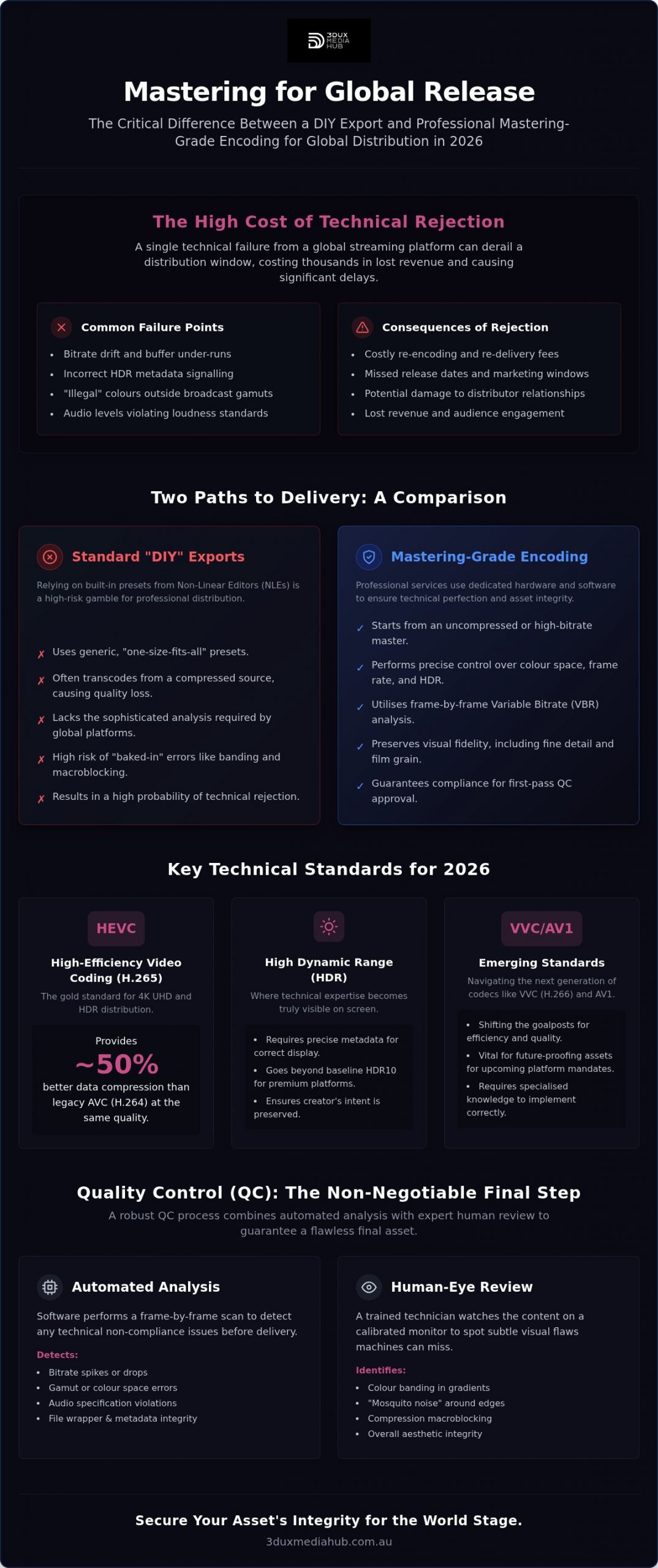
Standard Non-Linear Editors (NLEs) are designed for creative assembly, not deep-level technical mastering. Their built-in h.264 and h.265 presets lack the sophisticated buffer analysis required by global distributors. Amateur exports frequently trigger rejections due to “illegal colours” that exceed broadcast gamuts or audio levels that violate strict loudness standards. Professional video encoding services Sydney use dedicated hardware and software to perform frame-by-frame analysis. This identifies artefacts like banding or macroblocking before they reach the distributor. Relying on a standard software export is a gamble that often results in costly delays. Professional encoding provides a “safe pair of hands” for high-value assets, ensuring they pass through the most rigorous Quality Control (QC) gates on the first attempt.
Technical Mechanics: Codecs, Bitrates, and HDR Standards
Mastering for global distribution requires a deep understanding of the mathematical trade-offs between compression and fidelity. In 2026, the industry has largely transitioned away from legacy AVC (H.264) for high-resolution assets. While AVC remains the fallback for legacy compatibility, it lacks the efficiency required for modern 4K UHD workflows. High-end video encoding services Sydney now prioritise HEVC (H.265) and emerging VVC (H.266) standards to ensure content meets the stringent bandwidth requirements of streaming giants and broadcast networks alike.
Visual fidelity is often sacrificed in consumer-grade exports because standard software treats every frame with a “one size fits all” approach. Professional encoding uses sophisticated Variable Bitrate (VBR) passes to allocate data where it’s needed most. High-motion sequences or complex textures like water and smoke receive higher bitrates, while static shots are compressed more efficiently. This precision preserves the delicate film grain and fine detail that define high-value productions, preventing the “plastic” look often associated with aggressive compression.
High-Efficiency Video Coding (HEVC) for 4K
HEVC is the foundational video compression standard that provides approximately 50% better data compression than AVC at the same level of video quality, making it the primary choice for 4K and HDR distribution in 2026. This efficiency is why HEVC has become the gold standard for 4K UHD authoring services. By reducing the bitrate required for a 4K stream, distributors can reach wider audiences without compromising the viewer experience. Our technicians ensure these files are perfectly structured to avoid buffer under-runs during playback. For a detailed technical breakdown of the conversion process, our guide on ProRes to HEVC encoding for 4K delivery covers the essential specs and bitstream requirements for 2026 distribution.
Mastering for High Dynamic Range (HDR)
HDR mastering is where technical expertise becomes truly visible. While HDR10 provides a baseline for high contrast, premium distribution often demands the dynamic metadata found in Dolby Vision or HDR10+ Advanced. These formats require precise encoding to ensure that the creative intent of the colourist translates accurately to every consumer display, from OLED TVs to mobile devices. Standards conversion is a critical part of this process; moving between HDR and SDR requires more than just a LUT. It demands a frame-by-frame analysis to ensure luminance levels remain within “legal” bounds. If you need to secure your project’s technical integrity, it’s best to consult with a specialist encoding partner early in the post-production phase.
Colour depth is the final piece of the puzzle. We utilise 10-bit and 12-bit encoding paths to eliminate banding in gradients, particularly in sky shots or dark, moody scenes. This high-bit depth is a non-negotiable requirement for platforms like Netflix, which now mandate P3-D65 mastering for all HDR content. By leveraging professional video encoding services Sydney, you ensure your masters aren’t just compliant, but future-proofed for the next generation of display technology.
Digital vs. Physical: Encoding for Different Distribution Paths
Distribution is no longer a “one size fits all” process. In 2026, content must be optimised for vastly different delivery environments, ranging from high-bandwidth home theatres to mobile devices on 5G networks. Professional video encoding services Sydney bridge this gap by creating specific masters tailored to each platform’s unique technical constraints. A file destined for a global streaming service requires a different approach to compression and metadata than one destined for a 4K UHD Blu-ray disc.
Encoding for Streaming and VOD Platforms
Streaming giants like Netflix, iTunes, and Amazon Prime have rigid delivery specifications that demand absolute compliance. These platforms typically require high-quality mezzanine files, such as ProRes 4444 or DNxHR, as the starting point for their internal encoding ladders. A critical component of this workflow is Adaptive Bitrate Streaming (ABR). We encode multiple versions of your content at various resolutions and bitrates, allowing the platform’s player to switch seamlessly based on the viewer’s internet speed. Adhering to video encoding specifications for VOD ensures your content doesn’t just look good, but actually plays without buffering or technical glitches across every device. In 2026, this often involves VVC (H.266) streams targeting 12-16 Mbps for 4K, providing a significant efficiency gain over legacy standards.
Mastering for Physical Media (4K UHD & Blu-ray)
While streaming offers convenience, physical media remains the gold standard for cinematic quality. A 4K UHD disc allows for bitrates significantly higher than any streaming service, often peaking at 100 Mbps or more. This extra headroom is essential for preserving the complex grain structures and wide colour gamuts discussed in earlier sections. Mastering for disc also involves complex navigation and motion menu design for 4K UHD, which must be encoded to match the primary feature’s quality. We carefully manage buffer levels and disc layer-breaks to ensure that playback remains seamless, even on high-end enthusiast players. Protecting your physical release from costly technical rejections requires the same rigour as any digital delivery, which is why our Blu-ray quality control services form an integral part of every disc mastering workflow.
Audio encoding is the final pillar of a premium release. We provide expert mastering for immersive formats like Dolby Atmos and DTS:X, ensuring the soundstage is as expansive as the visuals. Whether you’re delivering a digital-only release or a high-end collector’s disc, our video encoding services Sydney provide the technical rigour needed to pass every QC check. By managing the specific demands of each distribution path, we protect your creative vision from the point of master export to the final consumer experience.
Why Quality Control (QC) is Non-Negotiable
Technical rejection is the single most expensive mistake in the distribution chain. A single frame with a digital hit or a minor audio sync drift can trigger an automatic fail from a global platform, leading to missed release windows and significant re-delivery fees. In a landscape where speed is often prioritised, professional video encoding services Sydney act as the final line of defence. Quality Control is not merely a “final look” but a rigorous, multi-layered audit of every technical parameter within your asset.
Encoding artefacts are the primary enemy of premium content. Even with the advanced codecs discussed earlier, aggressive compression can introduce visual failures that a standard software export will ignore. We look for specific issues that undermine the viewer experience:
- Banding: Visible steps in colour gradients, most common in sky shots or dark, atmospheric scenes.
- Macroblocking: Square clusters of pixels that appear during high-motion sequences when the bitrate is insufficient.
- Mosquito Noise: Shimmering distortion around sharp edges or text, often caused by poor high-frequency management.
Automated vs. Manual Quality Control
Modern QC requires a hybrid approach. Automated software is highly effective at scanning for objective technical failures such as dropouts, flash-frames, and illegal luminance levels. These tools provide a mathematical certainty that the file meets the “letter of the law” for delivery. However, software cannot judge creative intent. A professional “eyes-on” pass by an experienced technician is essential to ensure that the aesthetic of the film remains intact. This is particularly vital for film trailer preparation services, where every second must be technically perfect to capture audience attention. We verify that the high-impact visuals of a trailer haven’t been compromised by the encoding process.
Technical Compliance for International Markets
Global distribution demands adherence to regional technical standards that go beyond simple video specs. Audio compliance is a frequent point of failure. We ensure all masters meet EBU R128 (for Europe and Australia) or ATSC A/85 (for the US) loudness standards to prevent jarring volume shifts. Subtitle and closed caption synchronisation is also audited to ensure positioning is correct and text remains legible against varying backgrounds. Managing frame rate conversions is another critical hurdle. Converting a 23.976fps cinema master to a 25fps broadcast master requires precise pitch correction to ensure the audio remains natural — a process that demands the same rigour as audio conforming for international film release to prevent sync drift from stalling your distribution timeline. By trusting your project to video encoding services Sydney with deep technical expertise, you eliminate the guesswork. To secure your delivery window, book a comprehensive broadcast-grade QC audit for your next release.
The 3DUX Approach: Mastering-Grade Encoding for Global Release
3DUX Media Hub isn’t just a technical vendor; we’re a proactive partner in your distribution strategy. With over 20 years of technical industry experience, we understand the high stakes of the entertainment industry. We’ve built our reputation as a “safe pair of hands” for high-value media assets by delivering technically perfect masters under tight deadlines. Our facility provides comprehensive video encoding services Sydney that bridge the gap between creative completion and global consumer connection. Precision and reliability are the foundations of every file we generate.
We handle the entire technical pipeline from your mezzanine master to final delivery assets. This end-to-end support eliminates the fragmented workflows that often lead to technical errors or metadata mismatches. Our team projects an image of efficiency and capability, ensuring that every asset meets the rigorous standards discussed throughout this guide. We don’t just process files; we protect your creative vision through a methodical, no-nonsense approach to mastering.
Specialised 4K and HDR Mastering
Our expertise is deeply rooted in the most demanding technical standards of 2026. We specialise in HEVC and HDR encoding, providing tailored solutions for both independent filmmakers and major global distributors. We understand that every project has unique requirements. Whether you’re a boutique producer or a major studio, our workflow integrates content localisation and asset preparation seamlessly. By managing bitrates and HDR metadata with surgical precision, we preserve the fine detail of your production while meeting the strict constraints of modern streaming and broadcast platforms. Our commitment to technical integrity ensures that your 4K UHD project stands out for all the right reasons.
Your Partner for Global Distribution
Managing complex delivery schedules for international markets requires a methodical and thorough approach. 3DUX organises these requirements under one roof, providing access to professional QC and broadcast standards conversion without the need for multiple vendors. We understand the “fast turnaround” nature of the industry and have optimised our facility to meet aggressive distribution windows. Our technicians move you rapidly from one service offering to the next without unnecessary filler, mirroring the efficiency of the encoding processes we manage. We provide the technical certainty you need to hit your release dates with confidence.
Don’t leave your global delivery to chance or consumer-grade software. Organise your professional video encoding with 3DUX Media Hub today and ensure your assets are handled by seasoned industry veterans who prioritise technical excellence. We provide the expertise needed to navigate the evolving landscape of video encoding services Sydney, ensuring your content is ready for the world stage in 2026 and beyond.
Securing Your Content for the Global Stage
Technical excellence in encoding is the final gatekeeper for international success. By prioritising mastering-grade workflows over simple transcoding, you eliminate the risk of platform rejection and preserve the creative intent of your production. Mastering the complexities of HEVC, HDR metadata, and immersive audio ensures your content meets the highest standards of 2026. This technical rigour is what separates a successful global launch from a costly series of technical re-deliveries.
Accessing professional video encoding services Sydney provides the technical certainty required for a seamless release. With over 20 years of industry experience, 3DUX Media Hub specialise in 4K UHD and HEVC encoding, backed by comprehensive broadcast-grade QC and compliance checks. We act as a safe pair of hands for your high-value assets, ensuring they pass every technical audit on the first attempt. Contact 3DUX Media Hub for professional encoding and mastering to secure your distribution schedule today. Your project is ready to reach its audience with the highest possible visual fidelity.
Frequently Asked Questions
What is the difference between video encoding and transcoding?
Video encoding is the initial process of compressing a high-quality mezzanine master into a specific delivery format. Transcoding involves converting an already compressed file into a different format or bitrate. Our video encoding services Sydney focus on the primary creation of technically perfect masters from uncompressed sources to avoid the generational quality loss inherent in basic transcoding workflows.
Why do I need a professional encoding service instead of exporting from my editor?
Standard Non-Linear Editors like Premiere Pro or Avid are designed for creative assembly, not technical mastering. They lack the sophisticated buffer analysis and deep-level metadata control required by global distributors. Professional encoding platforms offer precise bitrate allocation and broadcast-grade Quality Control that ensures your file passes the automated rejection gates used by major streaming services.
What are the standard video encoding specifications for VOD platforms?
In 2026, platforms like Netflix and Apple TV typically mandate 10-bit colour depth and P3-D65 mastering for HDR content. Delivery usually starts with a high-bitrate mezzanine file, such as ProRes 4444 or DNxHR, which is then encoded into multiple Adaptive Bitrate (ABR) layers. These layers ensure seamless playback across devices by switching bitrates based on the viewer’s real-time internet speed.
How does bitrate affect the quality of a 4K UHD master?
Bitrate determines the volume of data allocated to each frame; higher bitrates directly correlate to higher visual fidelity. For a 4K UHD master, sufficient bitrate is essential to preserve complex textures, fine detail, and film grain. If the bitrate is too low, the compression engine will introduce macroblocking and banding, particularly in dark scenes or high-motion sequences.
What is HEVC encoding and why is it used for 4K video?
High Efficiency Video Coding (HEVC), or H.265, is the industry standard for 4K because it offers approximately 50% better compression than legacy H.264. This efficiency allows for the delivery of high-resolution assets without requiring excessive bandwidth. It is the mandatory codec for 4K UHD Blu-ray authoring and remains the primary choice for premium 4K streaming distribution in 2026. Distributors working from ProRes masters can find a complete technical roadmap in our guide on ProRes to HEVC encoding for 4K delivery, which covers the latest HEVC 11.0 standards and 10-bit colour accuracy requirements.
What happens during a professional Quality Control (QC) check?
A professional QC audit involves a multi-layered technical scan followed by a frame-by-frame human-eye pass. We utilise automated software to detect objective failures like flash-frames, digital hits, and illegal luminance levels. Our technicians then perform a manual review to identify subjective issues such as banding, audio sync drift, and creative integrity failures that software often misses. For physical media releases, our dedicated Blu-ray quality control services for film distribution provide an additional layer of compliance verification to safeguard your disc release against replication rejections.
Can you convert PAL content to NTSC for international distribution?
Yes, we provide professional standards conversion to transform PAL assets into NTSC for North American and Japanese markets. This technical process involves precise frame rate adjustment and resolution scaling to ensure smooth motion and correct aspect ratios. We also perform audio pitch correction to ensure the sound remains natural after the frame rate shift, maintaining the original creative intent.
Do you provide audio encoding for Dolby Atmos and DTS-HD?
Our video encoding services Sydney include full support for immersive and high-resolution audio formats. We specialise in encoding Dolby Atmos, DTS-HD Master Audio, and DTS:X for both digital distribution and physical media releases. This ensures that your production’s soundstage provides the same premium experience as the 4K visuals, meeting the technical requirements of high-end home theatre systems.