A technical rejection during the final QC stage isn’t just a delay. It’s a costly failure that compromises your global release schedule. Meeting modern 4K UHD authoring requirements involves more than just hitting ‘encode’ and hoping for the best. You’ve likely felt the frustration of organising fragmented Dolby Vision metadata or watching deadlines slip because of inefficient asset preparation. We understand that the stakes for cinematic quality have never been higher, especially with the 2026 rollout of Dolby Vision 2 and HDR10+ Advanced.
This guide provides a professional framework to master these technical complexities with a streamlined workflow designed for international film distribution. You’ll learn how to build a master that passes every compliance check the first time while maintaining the visual integrity your project demands. We’ll examine the essential stages of asset discipline, rigorous quality control, and the latest encoding standards used by experts like 3DUX Media Hub to ensure your colour-graded content is ready for the global stage.
Key Takeaways
- Understand how to navigate stringent 4K UHD authoring requirements to ensure your master meets global BD-ROM and AACS encryption standards on the first pass.
- Learn the professional methods for integrating Dolby Vision and HDR10+ metadata to maintain cinematic intent across all display tiers.
- Discover why rigorous asset discipline is the most critical factor in accelerating turnaround times and managing complex multi-language localisations.
- Identify the common technical pitfalls that lead to high rejection rates and how professional broadcast-grade QC protects your high-value film assets.
- Evaluate the true cost of in-house authoring versus leveraging seasoned technical expertise to guarantee hardware compatibility and seamless global delivery.
The Foundation of a Professional UHD Authoring Workflow
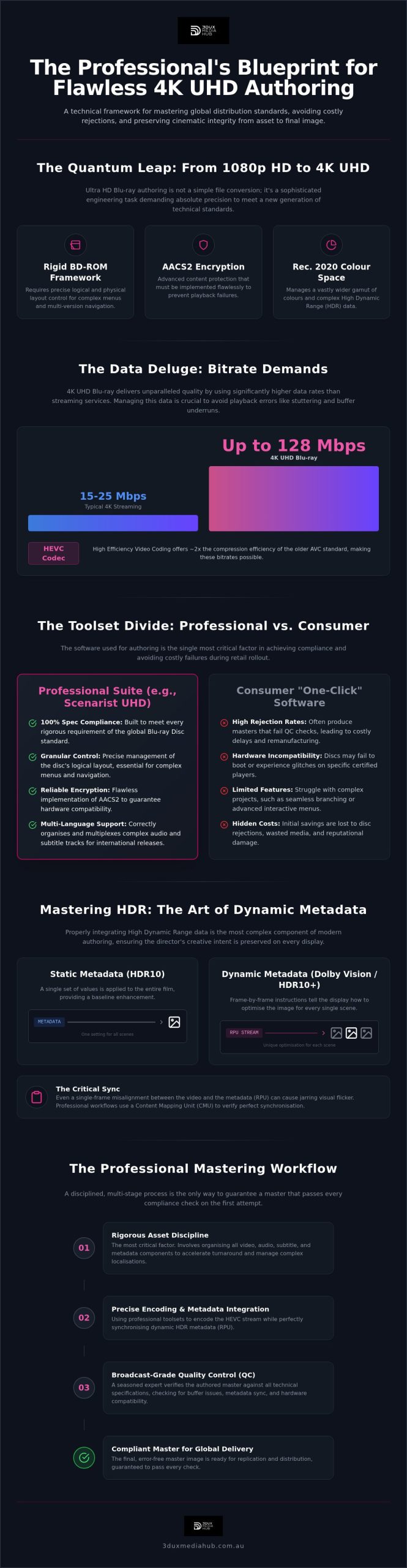
Professional 4K UHD authoring is a sophisticated technical architecture, not a simple file conversion. It represents a massive leap from the standard 1080p Blu-ray era. While high-definition discs were relatively forgiving, the Ultra HD Blu-ray specifications demand absolute precision. These 4K UHD authoring requirements involve managing Rec. 2020 colour spaces and complex high dynamic range (HDR) data within a rigid BD-ROM framework. A professional workflow must account for every stage of the process, from initial asset ingestion to the final multiplexing of the master image.
Success depends on a multi-stage approach that prioritises technical compliance. Attempting to bypass these stages with consumer-grade software often results in discs that fail to boot or experience playback issues on specific hardware players. At 3DUX, we treat the authoring process as a rigorous engineering task. This ensure that your high-value film assets are protected and delivered with the highest possible fidelity.
Understanding HEVC and Bitrate Management
High Efficiency Video Coding (HEVC) is the industry cornerstone for 4K content. It offers roughly double the compression efficiency of the older AVC standard, yet it requires far more processing power and technical oversight. Bitrate stability is non-negotiable for dual-layer (BD66) and triple-layer (BD100) discs. UHD Blu-ray supports video bitrates of up to 128 Mbps, which is significantly higher than the 15 to 25 Mbps typically seen in 4K streaming services.
Managing these peak bitrates is a delicate technical trade-off. If the bitrate spikes too high during a complex scene, it can cause buffer underruns on hardware players. This leads to stuttering or complete playback failure. Conversely, if the bitrate is too low, the cinematic transparency is lost to compression artefacts. Our workflow involves constant monitoring of the buffer levels to ensure the image remains pristine without exceeding the physical limits of the disc media.
Professional Toolsets: Scenarist vs Consumer Alternatives
The gap between professional mastering suites and consumer “one-click” software is vast. Professional tools like Scenarist UHD are the global benchmark for achieving 100% spec compliance. These suites allow for the precise control of the disc’s logical and physical layout. This is essential for managing complex interactive menu structures and ensuring seamless branch navigation for multi-version releases.
Consumer alternatives often lack the depth required for commercial film distribution. They might struggle with properly organising multi-language audio tracks or fail to implement AACS encryption correctly. By leveraging professional toolsets and our 20 years of industry experience, 3DUX ensures that every master passes through the authoring gate with zero errors. This eliminates the hidden costs of DIY authoring, such as disc rejections and costly hardware incompatibility issues during the retail rollout.
Mastering HDR and Dolby Vision Integration
HDR is the primary justification for the UHD premium. It is also the most complex component of modern 4K UHD authoring requirements. Integrating HDR10, HDR10+, and Dolby Vision metadata requires a precise technical architecture. While HDR10 provides a static baseline, dynamic formats offer frame-by-frame optimisation. Mastering for Dolby Vision often involves authoring a Full Enhancement Layer (FEL). This 12-bit architecture adds a secondary video stream to the base layer. It reconstructs the original 12-bit master with absolute precision. Managing this within a professional Dolby Vision workflow ensures that high-light details and shadow transitions remain intact. With the 2026 rollout of Dolby Vision 2, this metadata management becomes even more critical for maintaining cinematic intent across the newest high-end displays.
Metadata Management and Sync
Maintaining synchronisation between the primary HEVC video stream and the Reference Processing Unit (RPU) is critical. The RPU is a stream of dynamic metadata that instructs the display on how to map the high dynamic range signal to its specific hardware capabilities on a scene-by-scene basis. A common pitfall in high-end mastering is a metadata offset. Even a single frame of misalignment can cause jarring visual artefacts or “flicker” during scene transitions. We use the Content Mapping Unit (CMU) to verify that the metadata accurately reflects the creative intent of the grade. This isn’t a job for automated scripts. It requires a seasoned expert to monitor the output and ensure the metadata doesn’t conflict with the physical disc constraints or the player’s processing buffer.
The Mapping Process: HDR to SDR
Despite the focus on HDR, SDR displays still represent a significant portion of the global market. A professional master must include robust SDR trim passes to ensure backward compatibility. Using professional tools allows us to verify that the down-conversion maintains the director’s intent without washing out colours or losing detail in the blacks. This requires side-by-side QC of the HDR and SDR assets on calibrated monitors to identify any mapping errors before they reach the consumer. Our Professional Video Encoding Services integrate these checks into the core authoring timeline. It isn’t just about making the HDR look good. It’s about ensuring every viewer, regardless of their screen, sees the best version of your film. If you want to ensure your master passes every compliance check, 3DUX offers the technical authoring support to get it right the first time.
Efficiency Strategies: From Asset Preparation to Final Image
Asset discipline is the primary driver of workflow speed. Without a structured approach to Asset preparation for UHD authoring, the entire project timeline risks collapse. Professional workflows move beyond simple exports. We employ parallel processing techniques where encoding occurs simultaneously with menu design and metadata assembly. This reduces idle time. It ensures the technical architecture is ready as soon as the final HEVC streams are verified. Meeting modern 4K UHD authoring requirements demands this level of synchronisation to avoid the bottleneck of sequential processing.
Streamlining Asset Conforming and Localisation
Global releases demand a complex matrix of audio tracks and subtitle streams. Achieving frame-accurate sync between localised audio and the 4K master is a primary technical hurdle. Any drift, even by a few milliseconds, is amplified on high-end home cinema systems. Proper Film Localisation: Audio Conforming ensures every language variant maintains the integrity of the original mix. Subtitle integration also requires careful management to avoid buffer spikes. If the subtitle bitrate is too high during a peak video action sequence, it can trigger a playback failure. We organise these assets early to ensure they fit within the strict logical specifications of the BD-ROM format. This proactive organisation prevents the last-minute scrambles that often lead to QC rejections.
Automating Technical QC Checkpoints
A “First Time Right” philosophy is essential for high-stakes film distribution. We implement automated verification during the encoding phase to catch technical errors before they reach the authoring stage. This reduces manual review time and minimises the need for costly re-renders. Our pre-authoring checks focus on several critical areas:
- Illegal colour values in the HDR10 or Dolby Vision master.
- Inconsistent metadata flags that confuse hardware players.
- Audio phase issues or channel mapping errors in localised tracks.
- Buffer violations in the multiplexed HEVC stream.
Navigating Technical Compliance and Global Delivery
Achieving technical compliance is the final, most critical gate in the distribution chain. While previous stages focus on asset integrity, this phase ensures the final master is physically and logically compatible with the global replication infrastructure. Meeting 4K UHD authoring requirements means delivering a precise Cutting Master Format (CMF) image. This file contains the primary content, interactive layers, and the essential AACS encryption keys. Unlike standard Blu-ray, UHD masters are region-free by specification, but they require rigorous adherence to BD-ROM logical standards to ensure they boot on every player from high-end consoles to dedicated cinema decks.
Avoiding Common Authoring Rejections
Replication plants are unforgiving. A single logical error can result in a rejected master, causing expensive delays in your retail rollout. The top three reasons for rejection include buffer violations during the multiplexing stage, incorrect layer-break positioning for triple-layer BD100 discs, and invalid metadata flags in the HEVC stream. Managing these issues requires more than just software. It requires a deep understanding of how different hardware players interpret the disc’s file system. For international releases, handling frame rate and standards conversion is equally vital. Our Broadcast Standards Conversion Guide outlines the technical steps needed to ensure your content meets the specific requirements of global territories without compromising visual quality.
The Role of Quality Control in Distribution
Automated verification tools are excellent for catching bitrate spikes, but they cannot replace a human-in-the-loop QC process. Professional broadcast-grade QC involves a frame-by-frame review to identify visual glitches, such as “dead pixels” in the master or compression artefacts that only appear during specific lighting conditions. We also verify the entire interactive experience. This includes testing menu navigation, subtitle synchronisation, and audio track switching across multiple hardware platforms to ensure a seamless consumer experience. Our approach to 2026 Blu-ray Quality Control is designed to catch these nuances before the disc enters mass production. 3DUX acts as a “safe pair of hands” for your film, ensuring that every master is technically perfect and ready for the world. If you need a partner to manage your 4K UHD authoring requirements and global delivery, contact our technical team today to secure your release schedule.
Why Professional Mastering Beats In-House Software
Relying on consumer-grade “creator” software for a commercial film release is a high-risk strategy. While DIY tools promise ease of use, they frequently fail to meet the rigorous 4K UHD authoring requirements demanded by global replication plants. The hidden costs of in-house authoring often far outweigh the initial savings. A single master rejection can derail a retail launch, lead to missed shipping windows, and incur significant financial penalties. Professional mastering isn’t just about software. It’s about access to high-end encoding hardware and a technical architecture that consumer applications simply cannot emulate. We provide the technical certainty that a project will boot on every player, from legacy decks to the latest 2026 hardware releases.
The 3DUX Advantage: Reliability and Speed
3DUX Media Hub brings over 20 years of technical expertise to every project. We don’t just “burn a disc”. We manage complex technical assets through a proven workflow designed for speed and reliability. Our facility uses broadcast-grade encoding engines that ensure cinematic transparency at every bitrate. This level of precision is essential for Australian distributors who need to compete on the global stage. We handle the heavy lifting of metadata synchronisation and multi-language localisation, providing a fast turnaround without compromising on quality. When you partner with us, you’re securing a “safe pair of hands” for your most valuable intellectual property. Our team understands the nuances of the 2026 landscape, including the integration of Dolby Vision 2 and HDR10+ Advanced metadata.
Ensuring a Flawless Retail Release
The transition from a Digital Cinema Package (DCP) to a consumer Ultra HD disc is a delicate process. It requires more than just a file format change. It demands a thorough understanding of colour space conversions and HDR mapping. Our team ensures that the director’s intent is preserved from the cinema screen to the home theatre. We verify every master against the latest BD-ROM logical specifications to guarantee 100% hardware compatibility. This commitment to broadcast-quality QC means your release works perfectly on every player, every time. Don’t risk your reputation on unproven software. Contact 3DUX today to discuss your next project and ensure your master meets all 4K UHD authoring requirements for a flawless global delivery.
Securing Your Global Release with Technical Precision
Mastering the technical landscape of 2026 requires more than just high-speed encoding. It demands a disciplined architecture that integrates advanced HDR metadata with absolute precision. By prioritising asset organisation and rigorous quality control, you ensure your film meets all 4K UHD authoring requirements for a zero-rejection delivery. This streamlined approach reduces technical overhead and protects your most valuable intellectual property from the risks of hardware incompatibility.
3DUX Media Hub brings over 20 years of industry-leading technical experience to your production. We specialise in global distribution and complex content localisation; providing the broadcast-grade QC necessary for a flawless retail launch. Don’t let technical hurdles delay your project. Partner with 3DUX for Professional 4K UHD Authoring and experience the confidence of a master that works first time, every time. Your cinematic vision deserves a partner that understands the high stakes of the entertainment industry.
Frequently Asked Questions
What is the standard bitrate for a professional 4K UHD Blu-ray?
Professional 4K UHD Blu-ray supports video bitrates of up to 128 Mbps. This is significantly higher than the 15 to 25 Mbps found on most streaming platforms. Higher bitrates ensure cinematic transparency and maintain detail in complex scenes. It’s the primary reason film enthusiasts still prefer physical discs over digital alternatives.
How long does the UHD authoring workflow typically take for a feature film?
The timeline depends on the complexity of the assets and interactive features, but a standard feature typically requires two to four weeks. This includes encoding, menu design, and rigorous QC passes. 3DUX specialises in fast turnaround to meet tight global distribution schedules while ensuring every master is technically perfect.
What are the main differences between HDR10 and Dolby Vision in authoring?
HDR10 uses static metadata to set brightness levels for the entire film, whereas Dolby Vision uses dynamic metadata for frame-by-frame optimisation. Dolby Vision authoring requires a secondary enhancement layer (FEL) to reach 12-bit precision. Meeting these specific 4K UHD authoring requirements ensures the best possible image on premium displays like the 2026 Hisense and Samsung lineups.
Can I use a DCP as the source for UHD Blu-ray authoring?
Yes, a DCP can serve as a source, but it requires professional standards conversion to move from the XYZ colour space to Rec. 2020. The JPEG 2000 files must be decoded and re-encoded into HEVC. This process must be handled carefully to preserve the original theatrical grade and avoid colour shifting during the transition.
Why do I need professional QC if my authoring software says the disc is compliant?
Authoring software only verifies logical and physical specification compliance; it cannot detect visual glitches or creative errors. Professional broadcast-grade QC identifies “dead pixels,” compression artefacts, and navigation loops that automated tools miss. This is your insurance against a costly retail recall and ensures a premium consumer experience.
What file formats are required to begin the UHD authoring process?
We typically require high-bitrate mezzanine files like ProRes 4444 XQ or DNxHR HQX. For HDR projects, you must also provide the Dolby Vision XML metadata and the original colour-graded master. Having organised assets from the start is essential for meeting 4K UHD authoring requirements efficiently and avoiding delays in the mastering chain.
How does 3DUX Media Hub handle multi-language localisation for UHD?
3DUX manages multi-language releases through rigorous audio conforming and subtitle synchronisation. We ensure every language track maintains frame-accurate sync with the 4K master. Our workflow supports complex interactive menus that allow seamless switching between multiple global territories; providing a consistent experience for viewers worldwide.
Is physical media still a viable distribution strategy in 2026?
Physical media remains a vital strategy for high-value assets and collector editions. UHD Blu-ray offers a bitrate and audio fidelity that streaming cannot match. For distributors, it provides a premium revenue stream that justifies the investment in professional authoring and global delivery; particularly for titles requiring the highest possible quality.