A stunning title sequence is worthless if it triggers a QC rejection at the final hurdle of global distribution. In high-stakes film mastering, motion graphics are technical assets that must be engineered for interactivity and strict compliance. You likely understand the frustration of working with designers who don’t grasp the rigid constraints of disc authoring or the nuances of Australian broadcast standards. Using professional motion graphics services for film post-production ensures your creative vision survives the transition from the edit suite to the consumer’s screen without a hitch.
You deserve a partner who views motion design through the lens of a mastering engineer. This guide shows you how to elevate your project using technical motion graphics, from seamless 4K UHD interactive menus to precise content localisation for international markets. We’ll break down the 2026 standards for broadcast-ready assets and explain how to avoid the common formatting errors that stall global delivery. Whether you’re preparing a local feature or a high-end streaming series, these insights will help you secure a fast turnaround and a safe pair of hands for your most valuable media assets.
Key Takeaways
- Professional motion design for film mastering demands technical engineering to avoid QC rejections and ensure global compliance.
- Utilise motion graphics services for film post-production to synchronise 4K UHD menus and frame rates with your feature content.
- Streamline global distribution by integrating dynamic localisation for titles and narrative text within the mastering workflow.
- Navigate the journey from technical briefing to a broadcast-ready master with a focus on precision and industry-standard protocols.
- Partner with experienced specialists to protect high-value assets and meet aggressive delivery timelines for international markets.
The Role of Motion Graphics in High-End Film Post-Production
The mastery of these assets requires a blend of creative artistry and engineering precision. A credit roll isn’t simply text moving up a screen; it’s a carefully timed sequence that must account for flicker, legibility, and specific frame rate synchronisation. For a professional finish, every graphic element must match the grain structure and colour profile of the original master. This ensures the viewer’s transition from the feature content to the interactive menu is seamless and immersive.
Beyond Aesthetics: The Functionality of Film Graphics
Effective film graphics prioritise the user experience across physical and digital media. An interactive menu must be intuitive, guiding the viewer through chapters and bonus features without breaking the immersion established by the film’s director. Achieving this visual consistency requires a deep understanding of the original colour grade. We ensure the graphics don’t just sit on top of the video but exist within the same visual space.
Localisation is where “invisible” graphics become critical. This involves replacing narrative text, location markers, or even signage within the frame to suit international markets. When executed correctly, the international viewer is never pulled out of the story by jarring, mismatched text. This level of detail is a hallmark of premium motion graphics services for film post-production.
Meeting Global Distribution Standards
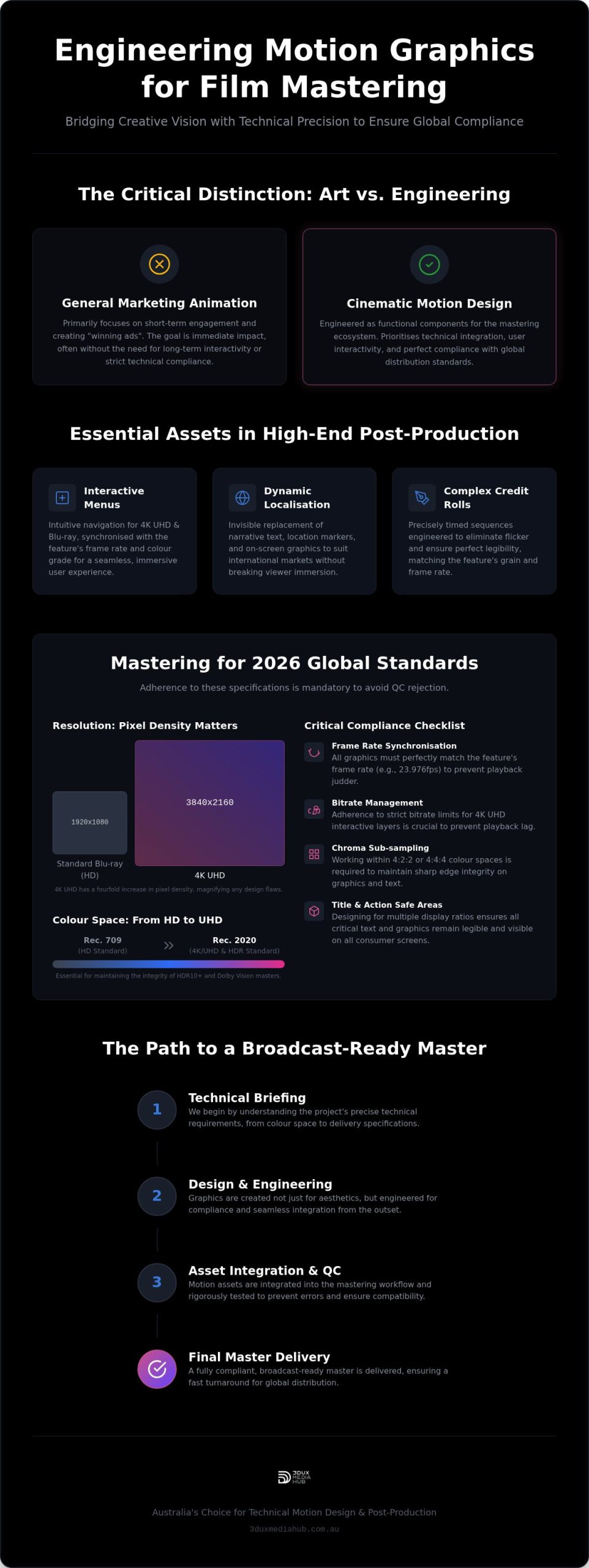
Major distributors demand specialised motion assets that meet rigorous retail and broadcast specifications. In the 2026 landscape, this means designing for HDR10+ and Dolby Vision workflows where peak brightness and colour gamuts are strictly monitored. Incorrectly formatted graphics lead to immediate QC rejections, which can delay global delivery and inflate budgets. Professional technical design must account for several factors:
- Bitrate Management: Adhering to current limits for 4K UHD interactive layers to prevent playback lag.
- Frame Rate Sync: Ensuring graphics perfectly match the feature’s 23.976fps or 25fps delivery.
- Chroma Sub-sampling: Working within 4:2:2 or 4:4:4 spaces to maintain edge integrity.
- Safe Areas: Designing for multiple display ratios to ensure text remains legible on all consumer screens.
Navigating these technical requirements is essential for any project destined for global retail. By treating motion graphics as technical assets from the start, we eliminate the friction between the creative edit and the final, broadcast-ready master.
Technical Specifications: Motion Graphics for 4K UHD and Blu-ray Menus
Mastering for physical media in 2026 requires more than just high-resolution exports. It demands strict adherence to international digital standards. Standard Blu-ray operates at 1920 x 1080, while 4K UHD jumps to 3840 x 2160. This fourfold increase in pixel density means any technical flaw in the motion design is magnified on large screens. When you source professional motion graphics services for film post-production, your assets must be rendered in the correct colour space. We transition from the Rec. 709 standard used in HD to Rec. 2020 for 4K projects. This shift is vital for maintaining the integrity of HDR10 and Dolby Vision masters.
Frame rate synchronisation is equally critical. If your feature film is mastered at 23.976fps, your menu assets and transitions must match this exactly. Any discrepancy leads to playback judder or “hiccups” when moving between the menu and the feature. We also utilise advanced alpha channel management for interactive overlays. These transparent layers allow button highlights and navigation cues to sit cleanly over background video without affecting the underlying image quality.
Designing for Interactivity
The Interactive Graphics (IG) layer is a dedicated stream within the Blu-ray specification. It handles the button mapping and navigation flow. Designers must account for three specific button states: normal, selected, and activated. Managing the bitrate of these elements is a delicate balancing act. If the motion menu background consumes too much bandwidth, the IG layer may become unresponsive or cause playback stutter. We optimise these assets to ensure the remote control input feels instantaneous and fluid.
Static vs. Motion Menus: Which Suits Your Release?
Motion menus provide a high-end, cinematic feel through looped video and dynamic transitions. They are the preferred choice for major studio releases aiming for a premium consumer experience. Conversely, clean static menus offer a cost-effective solution for independent films or archival releases. They ensure fast loading times and clear navigation without the overhead of additional video encoding. Learn about static and motion menu design for Blu-ray to determine the best approach for your specific distribution goals.
For projects requiring precise technical execution, partnering with a specialist in 4K UHD authoring ensures your master meets every global retail standard.
Content Localisation and Dynamic Graphics for Global Delivery
Global distribution demands more than simple subtitle files. For a feature film to resonate in international markets, on-screen text, main titles, and location markers must be seamlessly integrated into the local language version. This process, often referred to as “burnt-in” text localisation, requires sophisticated motion graphics services for film post-production. We don’t just swap text; we recreate the original typography, textures, and animation paths to ensure the localised version is indistinguishable from the master.
Maintaining creative intent is the primary challenge. If a title sequence uses custom hand-drawn lettering or complex 3D integration, the localised version must mirror those artistic choices exactly. We also address the technical hurdle of subtitle legibility. When text sits against complex, high-contrast moving backgrounds, we apply subtle drop shadows or backing plates that remain “invisible” to the viewer while ensuring compliance with international readability standards.
Audio Conforming and Visual Synchronisation
Visual elements never exist in a vacuum. Localised graphics must align perfectly with the newly conformed audio tracks. If a location marker appears on screen, it must trigger in sync with the corresponding foley or dialogue cues in the target language. We also manage the technical complexities of re-timing graphics for different regional delivery standards. While digital formats have standardised much of the industry, subtle variations in frame rate can still cause drift over a feature-length project. Professional audio conforming for international film release ensures that your visual and auditory assets remain perfectly locked across every version.
Preparing Assets for Global QC
Quality Control (QC) is the final gatekeeper in the mastering process. Major streaming platforms and broadcasters employ rigorous automated and manual checks that often flag graphic-related issues. Common failures include text falling outside of title-safe zones or “illegal” colours that exceed broadcast luminance limits. We take a proactive approach to prevent these setbacks.
- Safe Zone Verification: Every localised asset is checked against 16:9 and 4:3 safe areas to ensure visibility on all consumer displays.
- Luminance and Chrominance Checks: We monitor text brightness to prevent bleed and ensure compliance with HDR standards.
- Consistency Audits: Our team verifies that terminology remains consistent across titles, subtitles, and metadata.
By implementing a “first-time-right” strategy, we eliminate the need for costly re-renders and help you meet tight international delivery dates with total confidence. This methodical approach ensures your project passes through global mastering pipelines without technical friction.
The Post-Production Workflow: From Brief to Broadcast-Ready Master
Success in film mastering begins with a precise technical brief. We define the resolution, frame rate, and specific delivery targets before the first pixel is moved. This foundational stage ensures our motion graphics services for film post-production align perfectly with your final output, whether you’re targeting a 4K UHD physical release or a global streaming master. We then move into design and prototyping. This phase establishes a visual language for menus and titles that respects the film’s aesthetic while prioritising intuitive user navigation.
Asset rendering requires high-bitrate mezzanine formats like ProRes 4444 to preserve critical alpha channels and 12-bit colour depth. These assets are then integrated during the authoring process, where graphics are multiplexed with encoded video and audio streams. This isn’t a simple overlay. It’s a complex technical task requiring frame-accurate precision to ensure every transition and menu interaction performs flawlessly on consumer hardware. Final QC is the ultimate gatekeeper. We test every master on professional reference players and displays to catch subtle errors that automated software emulation might miss.
Collaboration Between Creative and Technical Teams
3DUX acts as the critical bridge between a director’s creative vision and a distribution engineer’s technical requirements. We provide proactive feedback on source assets early in the timeline to avoid “fix-it-in-post” scenarios that drain budgets. Managing revisions is a core part of our service. We utilise modular workflows to implement creative changes without derailing the mastering timeline. This keeps your project on track for its global release date without compromising on technical integrity.
Encoding and Compression for Graphics
Motion menus often feature complex gradients and subtle textures that are highly prone to banding and compression artifacts. We apply high-efficiency encoding techniques specifically tuned for graphic-heavy content. This preserves smooth transitions in your design, even when working within the bitrate constraints of standard Blu-ray or DVD. Professional video encoding services for global distribution are essential to maintain this level of visual quality across all formats.
If you’re ready to secure a “safe pair of hands” for your next project, explore our full suite of motion graphics services for film post-production and mastering.
Why 3DUX Media Hub is Australia’s Choice for Technical Motion Design
With over 20 years of industry experience, 3DUX Media Hub has earned its reputation as a reliable partner for high-stakes media projects. We understand that in the film and television sector, precision isn’t optional. A single technical oversight in a credit roll or a menu interaction can derail a global release. Our motion graphics services for film post-production provide the technical rigour required to navigate these complexities. We offer a comprehensive mastery of the authoring process, managing everything from initial design to the final disc master in-house.
Our commitment to broadcast-grade quality control (QC) is absolute. We don’t just check for visual errors; we verify the underlying data structures of every graphic asset. This “safe pair of hands” approach ensures that your high-value assets are protected throughout the mastering workflow. We operate with a no-nonsense philosophy, focusing on the “how” and “what” of technical delivery to meet aggressive distribution timelines. This efficiency is vital for maintaining the integrity of sensitive delivery schedules.
The Advantage of a Specialist Mastering House
Generalist creative agencies often excel at aesthetic design but lack the technical depth required for film mastering. They may not understand the bitrate constraints of 4K UHD or the specific requirements of the Interactive Graphics (IG) layer in Blu-ray authoring. 3DUX fills this gap. We invest in high-end hardware and utilise advanced encoding algorithms that generalists simply don’t access. Our workflow is designed to eliminate common failures like banding in gradients or unresponsive menu navigation. Explore our 4K UHD authoring services for film to understand how we engineer graphics for maximum performance.
Ready to Master Your Next Project?
Technical motion design is the final, critical step in your project’s journey to the consumer. Don’t leave your global compliance to chance. We invite you to contact us for a technical consultation to discuss your specific localisation or authoring needs. Whether you are preparing a local feature or an international series, we provide the expertise to ensure a seamless delivery. Our team is ready to provide project quotes and technical feedback to help you achieve a broadcast-ready master with a fast turnaround.
Partner with a veteran team that understands the high stakes of the entertainment industry. Reach out to 3DUX Media Hub today and secure the technical excellence your project deserves. We are your proactive partner for global delivery and consumer connection.
Secure Your Global Release with Technical Precision
Mastering a feature film for the 2026 global market requires more than creative flair; it demands engineering excellence. We’ve explored how technical motion graphics bridge the gap between your director’s vision and the rigid requirements of 4K UHD and Blu-ray authoring. From frame-accurate synchronisation to seamless content localisation, every element must be engineered to pass rigorous broadcast-grade QC checks. By utilising professional motion graphics services for film post-production, you eliminate the risk of technical rejections and ensure your project is ready for international distribution.
With over 20 years of technical post-production experience, we provide a safe pair of hands for your most valuable media assets. Our workflow includes broadcast-grade QC as standard, specialising in the high-bitrate demands of 4K UHD and global delivery. Don’t leave your final master to chance. Contact 3DUX Media Hub for professional motion graphics and film mastering today to discuss your project’s specific requirements. We look forward to helping you connect with audiences worldwide through a flawless, compliant release.
Frequently Asked Questions
What is the difference between creative and technical motion graphics for film?
Creative motion graphics focus on aesthetics and storytelling; technical motion graphics focus on delivery standards and interactivity. While creative design establishes the visual look, technical design ensures that assets meet strict resolution, frame rate, and colour space requirements for mastering. Our motion graphics services for film post-production bridge this gap by engineering visual assets that are both cinematic and fully compliant with global distribution specifications.
How do motion graphics impact the bitrate of a 4K UHD Blu-ray?
Motion graphics, particularly complex menus, consume a portion of the total disc bandwidth. High-bitrate video backgrounds can starve the primary feature or the Interactive Graphics (IG) layer of necessary data, leading to playback stutter. We manage this by using high-efficiency encoding to keep the background bitrate optimal. This ensures that navigation remains responsive while preserving the visual integrity of the 4K UHD master.
Can you localised main titles and credits for international distribution?
Yes, we provide comprehensive content localisation for main titles, narrative text, and credit rolls. This process involves recreating the original typography and animation paths in the target language to maintain creative intent. We ensure that localised graphics are “burnt-in” with the same grain and colour profile as the master. This results in a seamless experience for international audiences without the need for simple, jarring subtitle overlays.
What file formats are required for motion menu design?
We typically require high-bitrate mezzanine formats like ProRes 4444 or DNxHR for initial design assets. These formats preserve critical alpha channels and 12-bit colour depth necessary for HDR mastering. For the final authoring stage, these graphics are encoded into H.265 (HEVC) for 4K UHD or H.264 (AVC) for standard Blu-ray. Using these professional motion graphics services for film post-production ensures your source files are handled with maximum precision.
Do your motion graphics services include quality control testing?
Every graphic asset we produce undergoes rigorous in-house broadcast-grade quality control (QC). This includes checking safe zones, luminance levels, and frame rate synchronisation on professional reference hardware. We don’t rely solely on software emulation. This methodical approach identifies potential failures before distribution; ensuring your master passes through global retail and broadcast pipelines without technical friction or the need for costly re-renders at the final stage.
How long does the menu design and authoring process typically take?
Timelines depend on project complexity, but a standard motion menu and authoring package often takes between two to four weeks. This includes the initial technical briefing, design prototyping, asset rendering, and final QC. We prioritise a fast turnaround for global distribution assets while maintaining high technical standards. For urgent retail deadlines, we recommend providing all source assets and localisation requirements during the initial technical briefing phase.
Are motion graphics necessary for digital-only film delivery?
Motion graphics remain essential for digital-only delivery, particularly for title sequences, localisation, and branded transitions. While digital platforms don’t use disc-based interactive menus, they still require compliant localised titles and narrative markers. Professional graphics ensure your film maintains a high-end cinematic feel across all streaming services. They also help meet the strict technical delivery specifications required by major global platforms like Netflix, Stan, and Amazon Prime.
How do you ensure HDR compliance in motion graphic design?
We ensure HDR compliance by designing within the Rec. 2020 colour space and monitoring peak brightness levels. Graphics must be carefully graded to match the HDR10 or Dolby Vision profile of the feature film to prevent “blooming” or clipping. We use professional 10-bit and 12-bit workflows to maintain smooth gradients and edge integrity. This precision ensures that your interactive elements and titles look consistent on high-dynamic-range consumer displays.