A single frame of sync drift is the difference between a broadcast-ready masterpiece and a costly technical rejection from a global streaming giant. You’ve spent months perfecting the mix, only to watch it fall apart during the final stages of international mastering. It’s a common frustration; seeing your creative vision compromised by pitch shifts or frame rate conversions is enough to stall any project’s global momentum. Rejection from international broadcasters due to QC failure isn’t just a delay, it’s a hit to your reputation and your budget.
Mastering the technicalities of audio conforming for international distribution is the only way to protect your assets. This guide provides the expert framework needed to ensure your film meets every global delivery standard without sync drift or quality loss. We’ll examine how to achieve frame-accurate sync across all localised versions, maintain broadcast-compliant audio levels, and manage the seamless integration of M&E tracks for foreign dubbing. By the end, you’ll have the technical roadmap to navigate the fragmented 2026 media landscape with total confidence.
Key Takeaways
- Learn how to calculate exact speed adjustments to eliminate sync drift during 24fps, 25fps, and 23.976fps frame rate conversions.
- Master the technical complexities of audio conforming for international distribution to ensure every localised version meets strict global delivery standards.
- Discover the essential requirements for Music and Effects (M&E) tracks to facilitate high-quality foreign dubbing without losing creative intent.
- Standardise asset naming conventions and delivery manifests to streamline your workflow and avoid costly broadcast QC rejections.
- Gain insights into professional mastering strategies that protect high-value assets through precision encoding and expert technical oversight.
Defining Audio Conforming for International Distribution
Audio conforming is the technical process of re-aligning a soundtrack to a new video master. In the context of international broadcasting, this is rarely a simple task. Each territory often receives a unique visual cut, whether for local censorship, duration constraints, or different opening credits. Professional audio conforming for international distribution ensures that every frame of audio matches these visual shifts with mathematical precision. It’s the bridge between a creative mix and a technically compliant deliverable.
Simple syncing is what happens in a standard edit suite. Professional technical conforming is a different beast altogether. It involves managing complex frame rate shifts, sample rate conversions, and phase alignment across multiple stems. Without this rigour, you risk sync drift. This is where the sound slowly slides away from the picture over the duration of the programme. For a feature film or a high-end series, even a two-frame drift is enough to trigger a QC failure and stall your global release.
The Critical Link Between Picture and Sound
Visual edits are inevitable in global markets. A scene might be trimmed for a specific market, or a commercial break might be inserted. These changes break the original audio mix. Maintaining the integrity of the original mix across these versions requires a deep understanding of audio conforming for international film release. This is about brand protection. It ensures the audience in Sydney hears exactly what the director intended for the audience in London, regardless of the local technical constraints or visual cuts.
Why Standardisation Matters for Global Compliance
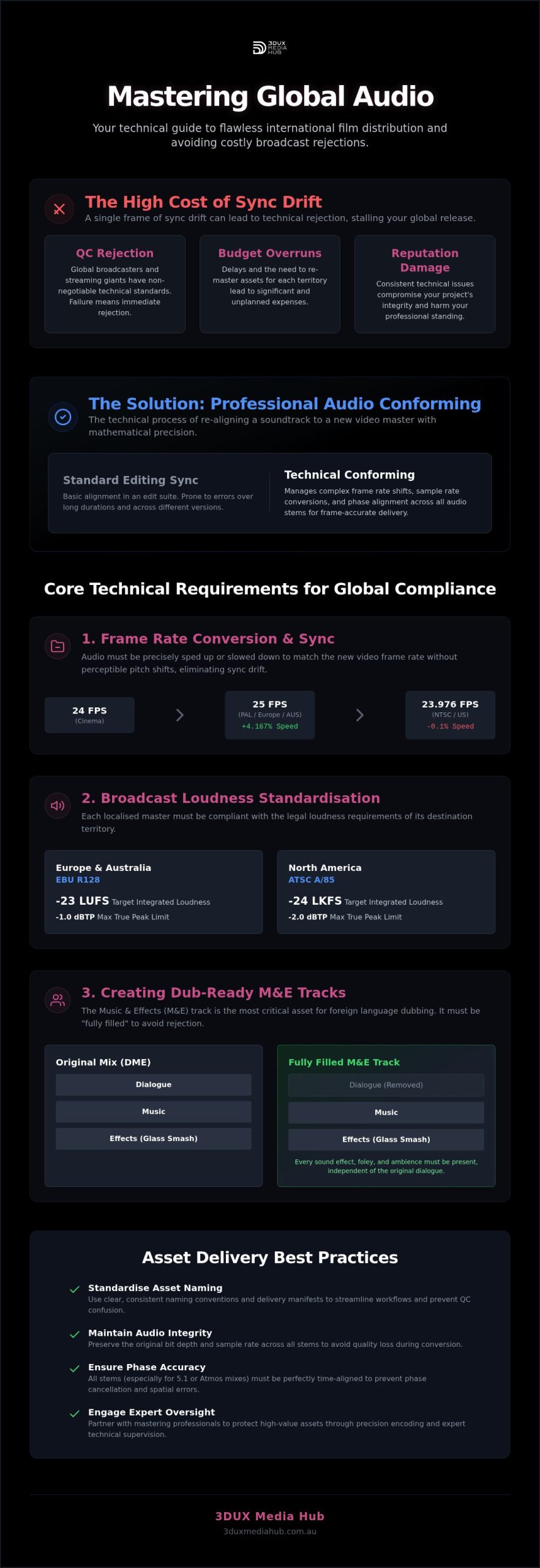
Technical rejection is the enemy of distribution. Broadcasters have non-negotiable standards that vary by region. In Europe and Australia, we follow EBU R128. In the US, it’s ATSC A/85. These aren’t suggestions. They’re legal requirements for loudness and peak levels. Conforming ensures these levels are baked into every localised master. An amateur sound, where levels jump between scenes or versions, is the fastest way to get your content flagged by QC. Professional conforming prevents these issues by standardising your assets against the following:
- EBU R128: The -23 LUFS target for Australian and European markets.
- ATSC A/85: The -24 LKFS target for North American delivery.
- True Peak Limits: Precise monitoring to ensure no digital clipping occurs during format conversion.
The Technical Mechanics of Multi-Language Asset Localisation
Localisation is far more than a simple translation of dialogue. It requires a surgical approach to audio stems to ensure the creative soul of a project remains intact across borders. A finished master mix is practically useless for foreign markets unless you have preserved the Dialogue, Music, and Effects (DME) as discrete, high-fidelity elements. When executing audio conforming for international distribution, these stems allow local engineers to strip and replace the original language without disturbing the complex sound design or the musical score. This modularity is the foundation of any successful global release strategy.
The Music and Effects (M&E) track is the most critical asset in your delivery package. It must be “fully filled.” This means every foley sound, background ambience, and sound effect present in the original English mix must exist independently of the dialogue. If a character drops a glass while speaking, that glass smash must be audible on the M&E track. If it isn’t, the foreign dub will have a jarring silence where the sound should be. High-end distributors will reject any M&E track that isn’t comprehensive, as it forces them to recreate sound design at their own expense.
Managing Audio Stems and M&E Tracks
Organising a “foreign-ready” audio package requires strict adherence to technical delivery manifests. Stems must be phase-accurate and perfectly time-aligned to the video master. For projects using 5.1 surround or immersive Dolby Atmos, the complexity increases significantly. Every channel must be mapped correctly to prevent phase cancellation or incorrect spatial positioning in the localised version. Partnering with experts in video and audio encoding ensures these spatial relationships remain intact across every territory, regardless of the playback format.
Bit Depth and Sample Rate Integrity
Maintaining the highest possible fidelity is a non-negotiable requirement for professional delivery. 24-bit audio is the industry standard. It provides the dynamic range necessary for both theatrical environments and high-end home cinema systems. While some web-based platforms might accept 16-bit files, delivering a 24-bit master is the only way to ensure your content passes rigorous broadcast QC.
Sample rate integrity is equally vital. Most broadcast masters require a standard 48kHz, but high-end theatrical releases often demand 96kHz. Converting between these rates requires sophisticated resampling algorithms to avoid aliasing or digital artefacts. These technical glitches are often subtle on headphones but become glaringly obvious when amplified through professional theatre systems. Precision conforming protects the audio’s dynamic range and frequency response through every stage of the encoding process.
Resolving Sync Drift and Frame Rate Discrepancies
Sync drift is the silent killer of international deliverables. It occurs when the temporal relationship between audio and video is compromised during frame rate conversion. When preparing audio conforming for international distribution, you must account for the physical speed change required to move between cinematic and broadcast standards. Converting a 24fps master to 25fps PAL requires a 4.166% speed increase. Conversely, shifting from 23.976fps NTSC to 24fps requires a 0.1% adjustment. These shifts are minute, but over a 90-minute feature, they result in massive progressive drift that ruins the viewer experience.
Progressive drift isn’t a simple fixed offset. It’s a cumulative error. If the audio is out by just one frame every few minutes, the climax of your film will be seconds out of sync. Correcting this requires precise mathematical re-sampling. We calculate the exact duration of the new video master and conform the audio stems to match that length down to the millisecond. This ensures the audio remains frame-accurate from the opening logo to the final credit roll. It’s the only way to avoid the embarrassment of a high-profile release where the lips don’t match the lines.
The Science of Pitch Correction
Speeding up audio by 4% naturally raises the pitch by nearly a semitone. This makes dialogue sound unnatural and shifts the musical key of the score. Professional conforming uses advanced time-stretching algorithms to decouple duration from pitch. This allows us to shorten the audio without changing its tonal frequency. Pitch-correction in a 4% PAL speed-up scenario involves digitally re-sampling the audio to maintain the original tonal frequency while the temporal duration is compressed to match the faster frame rate. This preserves the director’s intent and ensures the lead actor’s voice remains recognisable in every market.
Automated vs. Manual Sync Checks
Automated tools are useful for detecting large-scale errors, but they’re no substitute for a trained ear. Software often misses subtle lip-sync discrepancies, especially during fast-paced dialogue or complex action sequences. Relying solely on automation is a gamble that often leads to broadcast rejection. We employ a rigorous manual QC process to verify every transition and dialogue exchange. This frame-accurate approach is why our Blu-ray quality control services are trusted by distributors to catch sync errors before they reach the manufacturing or broadcast stage. It’s about providing a safe pair of hands for your high-value assets.
Manual checks also identify phase issues that can occur during the re-sampling process. By listening to the stems in isolation and as a full mix, we ensure that the spatial integrity of the 5.1 or Atmos environment is preserved. This level of detail is what separates a professional conform from a standard edit suite export.
Preparing Audio Assets for Global Technical Compliance
Compliance is the final hurdle in the distribution chain. It transforms a creative project into a commercial asset. Standardising your asset delivery is about more than just organisation; it’s about preventing costly delays in the ingestion process. When performing audio conforming for international distribution, every file must follow a strict naming convention that includes the title, version, language, and channel configuration. A ‘Final_Mix_V2’ label is useless to a global broadcaster. Precision naming allows automated ingestion systems to route your content correctly without human intervention.
A comprehensive audio delivery manifest serves as the single source of truth for your project. This document must detail every technical attribute of the audio files, including sample rates, bit depths, and timecode start points. It also tracks the specific loudness targets met for each territory. If you’re delivering to both North America and Europe, your manifest should clearly distinguish between the -24 LKFS and -23 LUFS versions. This level of documentation provides a clear audit trail and simplifies the work of the distributor’s acquisition team.
Technical Specifications for Delivery
Delivery formats vary based on the destination platform. High-fidelity uncompressed WAV or AIFF files are the standard for archival and mastering. However, consumer delivery often requires encoded formats like AC3 for DVD or DTS-HD for Blu-ray. Correct channel mapping is vital. A standard 5.1 layout typically follows the L, R, C, LFE, Ls, Rs order, but some broadcast standards might deviate. To ensure total compatibility, your professional video encoding services must be perfectly aligned with these audio masters. Discrepancies in metadata or timecode offsets between the video and audio streams will trigger an immediate QC failure.
QC Protocols for International Distributors
The ‘Three-Point Check’ is our baseline for audio localisation. We verify sync and quality at the head, middle, and tail of the programme. This identifies if a drift issue is constant or progressive. Interpreting a technical QC report requires an expert eye. A ‘minor’ warning about a momentary peak might be ignorable, but a ‘major’ flag on M&E holes requires immediate remediation. Documenting every creative choice, such as intentional silence or distorted dialogue, prevents these elements from being flagged as technical errors.
Metadata accuracy is the final layer of protection. It ensures that digital platforms display the correct language tags and that physical media players trigger the right audio stream by default. Incorrect metadata leads to a poor consumer experience and can result in the product being pulled from digital storefronts. For precision asset preparation and global compliance, partner with the experts at 3DUX Media Hub to secure your distribution window.
Professional Mastering Solutions for Australian Film Distributors
Australian film distributors face a unique set of challenges when pushing local content into a fragmented global market. The transition from a locked creative edit to a retail-ready master requires more than just a standard export. It demands a specialised technical partner who understands the nuances of international delivery. At 3DUX Media Hub, we bring over 20 years of industry experience to every project. We operate as a proactive technical partner, ensuring your high-value assets are handled with a ‘safe pair of hands’ philosophy. Our workflows are designed to streamline the path from post-production to global retail. We cater to both independent producers and major studio releases with equal rigour and technical precision.
The goal is to remove the friction between the finishing room and the consumer. By managing the technical complexities of audio conforming for international distribution, we allow distributors to focus on their core business of sales and marketing. We take the guesswork out of compliance. Whether you are dealing with a single territory or a multi-region rollout, our team provides a centralised point of contact for all mastering and localisation needs. This approach reduces the risk of version-control errors and ensures that the master file delivered to a broadcaster in Paris is as technically sound as the one sent to a streaming platform in New York.
3DUX Media Hub Technical Excellence
Our approach to audio conforming and localisation is exhaustive. We don’t just align tracks; we interrogate every stem for technical integrity and phase accuracy. Our broadcast-grade QC protocols are designed to eliminate the risk of international rejection before it happens. We understand the high stakes of delivery deadlines and the cost of missed windows. Because of this, we prioritise fast turnaround times without compromising the precision required for high-fidelity audio encoding. Every localised version is checked against the delivery manifest to ensure it meets the specific requirements of the target territory, from loudness levels to channel mapping.
Partnering for Global Success
We provide comprehensive support through 4K UHD and Blu-ray authoring, alongside specialised video and audio encoding. By acting as a modular, technical-first mastering partner, we handle the heavy lifting of standards conversion and content localisation. This partnership ensures that your content is compliant, synchronised, and ready for the world stage. We provide the technical certainty required for a successful global launch, protecting your creative vision through every stage of the mastering process. Your project deserves a technical finish that matches its creative ambition. Contact us to get your project ready for the world stage.
Mastering Your Global Technical Delivery
Technical excellence in the 2026 distribution landscape is the baseline for commercial success. It’s the difference between a seamless global launch and a costly technical rejection. You now have the technical roadmap to navigate frame rate conversions, manage complex M&E stems, and standardise your delivery manifests for any territory. Implementing precise audio conforming for international distribution ensures your creative vision remains intact while meeting the rigid standards of global broadcasters and streaming platforms.
Don’t let technical complexities stall your project’s international momentum. With 20+ years of technical mastering experience and broadcast-grade quality control as standard, we provide the technical certainty your release requires. We are specialists in 4K UHD and international localisation, acting as a safe pair of hands for your high-value assets. Secure your global release with professional audio conforming from 3DUX Media Hub. Your content is ready for the world stage; we’ll make sure it sounds that way.
Frequently Asked Questions
What is the difference between audio syncing and audio conforming?
Audio syncing refers to the manual alignment of sound to picture within an edit suite. In contrast, audio conforming for international distribution is a technical mastering process that ensures frame-accurate alignment across different frame rates and visual cuts. It involves mathematically re-sampling the audio to match the new video master’s duration while maintaining phase integrity and sample rate consistency across all stems.
Why does my audio go out of sync when converting from 24fps to 25fps?
This occurs because of the 4.166% speed increase required to convert cinematic 24fps to the PAL 25fps broadcast standard. If the audio duration isn’t adjusted to match this faster frame rate, the sound will progressively drift away from the picture. Over a feature film’s length, this discrepancy results in a massive loss of lip-sync that triggers immediate rejection from global distributors.
What are M&E tracks and why are they required for international distribution?
Music and Effects (M&E) tracks are discrete stems containing every sound element except the original dialogue. They are mandatory for international delivery because they allow foreign territories to dub the dialogue into local languages without re-recording the score or foley. A ‘fully filled’ M&E track is essential for maintaining the creative soul of the film while ensuring it is ready for global localisation.
How do I fix the pitch change that happens during a PAL speed-up?
You must use professional time-stretching algorithms that decouple duration from tonal frequency. A standard speed increase raises the pitch by nearly a semitone, making voices sound unnatural. Technical conforming applies a pitch-correction pass during the speed-up, ensuring the dialogue and musical score remain in their original key while the temporal length is compressed to fit the 25fps master.
What is the industry-standard loudness level for international broadcast?
Loudness standards vary by territory, but EBU R128 and ATSC A/85 are the primary benchmarks. For Australian and European markets, the target is -23 LUFS with a -1 dBTP maximum peak. North American broadcasters typically require -24 LKFS. Professional audio conforming for international distribution ensures your masters are tailored to these specific target levels to avoid the ‘amateur’ sound that leads to QC failure.
Can I use the same audio master for both streaming and Blu-ray release?
It’s generally not recommended because streaming platforms and physical media have different technical constraints. Streaming often requires specific loudness profiles and highly compressed codecs like AAC or Dolby Digital Plus. Blu-ray releases demand higher fidelity uncompressed PCM or lossless DTS-HD Master Audio. Each format requires a unique conform to account for the specific dynamic range and channel mapping of the playback environment.
What happens if my audio fails a technical QC for a global distributor?
A QC failure results in a technical rejection notice and stalls your distribution window. You’ll receive a report detailing ‘Major’ or ‘Critical’ errors, such as M&E holes or sync drift. Fixing these issues after the fact is significantly more expensive and time-consuming than getting it right during the initial mastering phase. It often requires a full re-conform and re-delivery of all assets to meet compliance.