
A flawless master file in the edit suite doesn’t guarantee a successful transmission. In 2026, professional video encoding for broadcast delivery is the final technical gatekeeper between your vision and a global audience. One minor metadata error or an out-of-spec bitrate can trigger an immediate rejection from major networks, leading to missed distribution deadlines and costly rework. You shouldn’t have to worry about your creative hard work being sidelined by a technicality.
We know the pressure of managing fragmented global delivery standards while trying to maintain the integrity of your original grade. It’s a high-stakes environment where technical precision is the only way to ensure your content reaches the viewer exactly as intended. This guide provides the roadmap to master broadcast-grade encoding and ensure your content passes every QC check. We’ll outline the critical 2026 specifications, methods for preserving cinematic intent during standards conversion, and how to organise your workflow for rapid international distribution.
Key Takeaways
- Understand why standard NLE presets fail to meet rigorous network specifications and how professional mastering ensures your content is broadcast-ready.
- Explore the technical advantages of HEVC for 4K UHD and the role of IMF in streamlining global versioning and localisation.
- Identify why human-led quality control is essential to safeguard high-value assets against the limitations of automated “Auto-QC” software.
- Learn to navigate fragmented global spec sheets using professional video encoding for broadcast delivery to eliminate the risk of technical rejections.
- Discover how to maintain cinematic intent during complex standards conversion for international distributors and fast-paced delivery schedules.
What is Professional Video Encoding for Broadcast Delivery?
Professional video encoding for broadcast delivery is the specialised process of transforming high-resolution master files into compliant mezzanine formats. Unlike simple file compression for web use, broadcast encoding serves as a technical bridge. It ensures that content remains visually identical to the master while adhering to the rigid delivery specifications mandated by global networks. It’s the final step in the mastering chain that turns a creative asset into a technical deliverable.
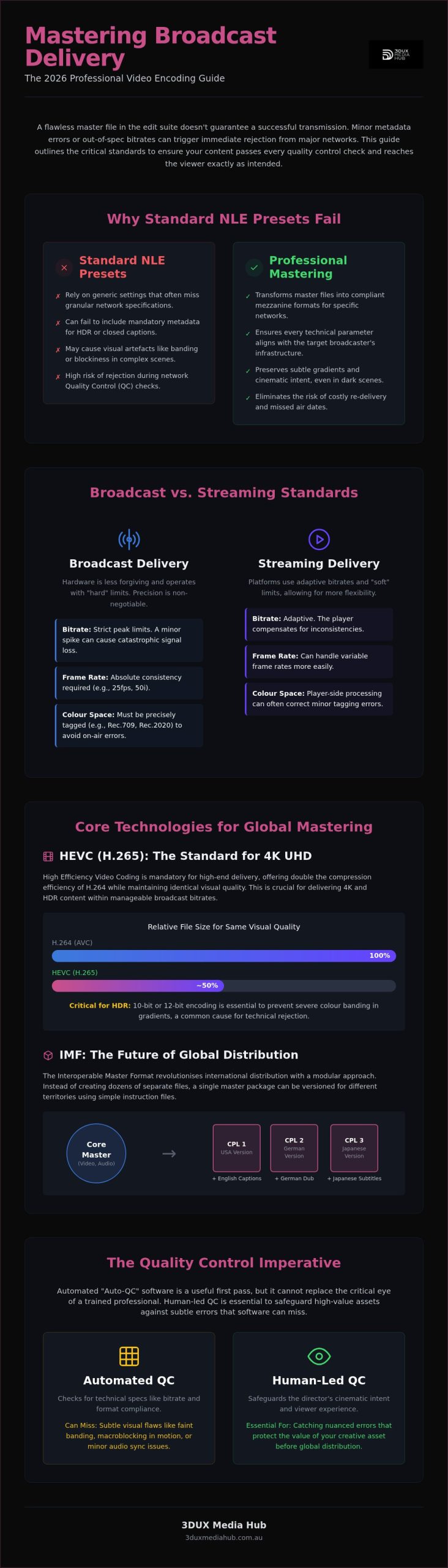
Standard non-linear editors (NLEs) provide “broadcast” presets, but these often fall short of the granular requirements found in a network’s technical spec sheet. A generic preset might miss specific VBV (Video Buffering Verifier) buffer sizes or fail to include the mandatory metadata flags for HDR or closed captions. Relying on consumer-grade tools risks immediate rejection during the Quality Control (QC) phase. Professional encoding requires dedicated software and hardware that can handle the complexities of high-bitrate mastering without introducing artefacts.
The Role of the Mezzanine File
The mezzanine file acts as the high-quality intermediate between the post-production master and the broadcast transmission. It is the “Gold Standard” of your asset. For Australian broadcasters, industry staples such as ProRes 422 HQ and DNxHR are frequently required. These formats provide a balance between file size and data retention, allowing for high-fidelity reproduction at the station level.
Using professional encoding tools ensures high-bitrate delivery that prevents visual degradation. In dark, cinematic scenes, low-quality encoding often results in banding or blockiness. Professional mastering preserves the subtle gradients in shadows and highlights. This keeps the director’s original intent intact throughout the entire distribution chain.
Broadcast vs. Streaming Standards
Technical compliance extends to frame rates and colour spaces. While web players can handle variable frame rates, television delivery demands absolute consistency. Similarly, an incorrect colour space tag, such as mislabelling Rec.2020 as Rec.709, can lead to washed-out or oversaturated images on the viewer’s screen. Professional encoding ensures every technical parameter aligns with the target network’s infrastructure, avoiding the expense of re-delivery and missed air dates.
Core Codecs and Containers for Global Mastering
Selecting the right codec and container is the most critical decision in the mastering process. It’s a balance of data density and visual fidelity. Professional video encoding for broadcast delivery has moved beyond simple H.264 wrappers. In 2026, global distributors require formats that support high dynamic range (HDR), wide colour gamuts, and multiple audio configurations within a single package. Mastering these standards is the only way to ensure your content is accepted by premium networks and streaming platforms alike.
HEVC Video Encoding for 4K and Beyond
High Efficiency Video Coding (HEVC or H.265) is now the mandatory standard for high-end delivery. It is the primary engine behind modern 4K UHD authoring services. HEVC provides roughly double the data compression of the older H.264 standard while maintaining identical visual quality in a 2026 broadcast environment. This efficiency allows for 4K resolution and HDR metadata to be delivered at bitrates that are manageable for satellite and terrestrial transmission.
Achieving cinematic quality with HEVC requires sophisticated encoding passes. We focus on per-frame allocation to ensure that complex textures, such as film grain or water, don’t break down into macroblocks. For HDR content, 10-bit or 12-bit encoding is essential. Using 8-bit depth for HDR assets leads to severe banding in gradients, a common cause for technical rejection. High-bit depth encoding preserves the smooth transitions in skies and shadows that define a professional grade.
IMF: The Future of Distribution
The Interoperable Master Format (IMF) has revolutionised how Australian distributors manage international sales. Rather than exporting dozens of flattened master files for different territories, IMF uses a modular approach. It consists of a “Composition Playlist” (CPL) that references “essence files” like video, audio, and timed text. This structure makes content localisation significantly faster and more accurate.
- Efficiency: Only the changes (such as a localised title card or a censored scene) are stored as additional assets.
- Compliance: The Output Profile List (OPL) ensures the package meets specific network requirements automatically.
- Scalability: One IMF package can generate versions for airline edits, streaming, and terrestrial broadcast without re-encoding the entire film.
Local distributors are increasingly adopting IMF to reduce storage costs and speed up delivery cycles. If you are preparing a high-value asset for global markets, our team can help you organise your mastering workflow to meet these rigorous international standards. Balancing file size with visual integrity is a technical challenge, but the right codec strategy ensures your content remains future-proof and ready for any screen.
Why Professional QC is Vital for Film Distributors
Relying solely on automated software is a common pitfall for modern distributors. While “Auto-QC” tools are excellent at flagging metadata mismatches or bitrate spikes, they are blind to creative anomalies. A software check won’t notice a boom mic dipping into a shot or a subtle audio dropout that occurs only in the left channel. Professional video encoding for broadcast delivery must be paired with a comprehensive human review to ensure the asset is truly air-ready and visually perfect.
Technical “deal-breakers” often lurk in the fine details of a master file. Dead pixels, legal colour violations, and out-of-phase audio can trigger an immediate fail from network engineers. These issues aren’t just aesthetic; they are compliance failures. For instance, “illegal” colours that exceed the 700mV broadcast limit can cause signal interference in certain transmission infrastructures. A professional lab acts as a “safe pair of hands,” catching these errors before they leave the facility and protecting the distributor’s reputation.
The 3DUX Approach to Broadcast QC
We combine high-speed automated compliance testing with rigorous frame-by-frame inspection by seasoned technicians. This hybrid model is particularly vital for high-fidelity releases, where we apply the same standards used in 2026 Blu-ray quality control to identify glitches before the authoring stage. Our clients receive detailed QC reports that pinpoint exact timecodes and error types. This transparency allows editors to fix issues at the source, ensuring the next version is technically flawless.
Avoiding the ‘Rejection Loop’
The “rejection loop” is a costly cycle of failed deliveries and technical re-submissions. Every time a network rejects a file, it delays the release and potentially incurs additional processing fees from the broadcaster. Professional encoding services streamline this path by delivering a compliant file the first time, every time. A single broadcast rejection can cost a distributor thousands of dollars in missed advertising revenue and emergency re-mastering fees. By investing in professional QC, you protect your margins and maintain your standing with global networks.
Our team understands the high stakes of the entertainment industry. We focus on the “how” and “what” of the technical process to ensure your high-value assets are handled with precision. With over 20 years of experience, we provide the technical gatekeeping required to navigate the increasingly complex global delivery landscape of 2026.
The Broadcast Delivery Checklist: Preparing for Success
Success in global distribution hinges on preparation. Professional video encoding for broadcast delivery is not a “set and forget” task. It requires a rigorous validation of every technical layer before the file leaves the lab. Missing a single requirement on a network spec sheet can result in a technical fail and a delayed premiere. Follow this five-step checklist to ensure your master asset is ready for any market.
- Step 1: Obtain the Technical Spec Sheet. Never assume a generic “broadcast” export will work. Every network, from the ABC to international streamers, has unique requirements for bitrates, GOP structures, and metadata.
- Step 2: Apply broadcast standards conversion services. If your master is 24p and the target is a 50Hz territory, professional conversion is mandatory to avoid motion stutter.
- Step 3: Organise Audio Mapping. Ensure surround sound and stereo downmixes are on the correct tracks. Multi-language tracks must be clearly labelled according to international ISO standards.
- Step 4: Integrate Accessibility Assets. Closed captions and subtitles must be synchronised perfectly with the video essence, often delivered as SMPTE-TT or SRT sidecar files.
- Step 5: Final Validation. Use high-speed, encrypted transfer protocols to move your validated master to the broadcaster’s ingest point.
Standards Conversion: PAL, NTSC, and 24p
High-quality standards conversion is more than a simple frame rate change. It’s a complex mathematical process. When converting 24fps film to 25fps for Australian television, maintaining pitch-perfect audio is essential. Without professional pitch correction, the audio will sound slightly higher, which breaks the cinematic experience. For fast-paced content like sport or action, we utilise motion-compensated conversion. This ensures fluid movement without the “ghosting” artefacts typical of cheaper software-based conversions.
Localisation and Metadata
Localising a film for global markets requires that audio conforming for international film release matches the new video master exactly. Any drift in sync, even by a single frame, is grounds for rejection. Technical metadata, or the SLATE, must be embedded correctly. This allows network ingest systems to identify the asset, its aspect ratio, and its audio configuration automatically. Modern workflows often rely on XML sidecar files to carry this data, ensuring the file remains compliant throughout the distribution chain.
Choosing a Professional Encoding Partner in Australia
Selecting the right technical partner is a strategic decision for any film or television distributor. Technical standards shift constantly. We stay ahead. Professional video encoding for broadcast delivery requires more than just high-end hardware; it demands a deep understanding of the global delivery ecosystem. With principals boasting over 20 years of industry experience, we provide the technical gatekeeping required to ensure your assets are accepted on the first attempt. We act as a safe pair of hands for your high-value content.
Our solutions are built for scalability. Whether you are mastering a flagship 4K UHD feature or a standard definition DVD release for a niche market, the quality remains uncompromising. We understand the pressure of distribution deadlines. Our workflow is designed for fast turnaround without sacrificing the technical precision needed for broadcast-grade quality. We don’t just process files; we manage the integrity of your creative vision.
Comprehensive Mastering Services
We provide a centralised hub for all post-production delivery needs. By integrating our video encoding services Sydney with a national capability, we support distributors across Australia and beyond. Our expertise extends to complex menu design and motion graphics for physical media, ensuring a premium user experience on Blu-ray and DVD. We bridge the gap between the edit suite and the end consumer, regardless of the delivery platform.
Global distribution requires a partner who understands both local and international nuances. From specific Australian network requirements to the rigorous specifications of global streaming giants, we standardise your workflow. We handle the technical heavy lifting, allowing you to focus on your release strategy. Our team ensures that every asset, from the primary video essence to the localised audio tracks, is perfectly synchronised and compliant.
Get Your Content Delivery-Ready
Reliability is the cornerstone of 3DUX Media Hub. National distributors choose us because we provide direct access to technical experts who understand the stakes. You won’t be dealing with a faceless helpdesk. You’ll be talking to seasoned industry veterans who can troubleshoot complex metadata issues or standards conversion challenges in real time. This personal service is what sets us apart in a highly automated industry.
Don’t risk your distribution schedule with unverified workflows or “Auto-QC” shortcuts. Ensure your content passes every technical hurdle and reaches its audience without a hitch. Technical precision. Fast turnaround. No excuses. Contact 3DUX Media Hub today to organise your next broadcast delivery master and experience the difference that 20 years of expertise makes.
Future-Proof Your Content for Global Distribution
Technical compliance is the ultimate gatekeeper in modern media distribution. As standards evolve, the margin for error shrinks. Ensuring every metadata flag and colour space tag aligns with network requirements is the only way to avoid the costly rejection loop. Professional video encoding for broadcast delivery provides the technical foundation your content needs to scale across global markets without losing its cinematic integrity or missing critical air dates.
3DUX Media Hub brings over 20 years of industry experience to every project. We provide broadcast-grade QC and fast turnaround times, acting as a reliable partner for national and international distributors. Our team handles the technical complexities of standards conversion and localisation so you can focus on your audience. Secure your global release with 3DUX professional encoding services and ensure your master assets are technically flawless. Your vision deserves a perfect delivery.
Frequently Asked Questions
What is the difference between H.264 and HEVC for broadcast?
HEVC (H.265) provides double the data compression efficiency of H.264 at the same visual quality. This makes it the mandatory standard for 4K UHD and HDR mastering in 2026. While H.264 is still used for legacy HD content, HEVC allows broadcasters to deliver premium resolutions at manageable bitrates. It is the core engine behind modern high-efficiency professional video encoding for broadcast delivery.
Why did my master file get rejected for ‘illegal colours’?
Rejections for “illegal colours” happen when your video signal exceeds the strict voltage limits of broadcast hardware. Colours that fall outside the Rec.709 or Rec.2020 legal gamut can cause signal distortion and visual clipping on consumer screens. Professional mastering includes hardware-accurate gamut limiting. This ensures your grade remains vibrant while staying within the 700mV limits required by network engineers to pass technical QC.
Can I use a software encoder for professional broadcast delivery?
High-end software encoders are used in professional environments, but they are far more advanced than the presets in your standard NLE. Professional systems provide granular control over VBV buffer sizes, GOP structures, and metadata flags that generic software often ignores. Relying on basic software risks technical rejection. We use enterprise-grade encoding engines to ensure every deliverable meets the exact specifications found on a network’s technical spec sheet.
How much does professional video encoding cost for a feature film?
Encoding costs are determined by the project’s technical complexity rather than a flat rate. Factors include the film’s total runtime, the delivery resolution, and the number of localised versions needed for global distribution. Each master requires a specific level of engineering and QC to guarantee compliance. We recommend consulting with our technical team to receive a detailed quote based on your specific delivery schedule.
What is a mezzanine file and why do I need one?
A mezzanine file is a high-quality, high-bitrate intermediate file that serves as your distribution master. Formats like ProRes 422 HQ or DNxHR are industry staples because they retain maximum detail while being manageable for network ingest. You need a mezzanine master to ensure that broadcasters can create transmission copies without visual degradation. It acts as the “Gold Standard” asset for all future versions.
What is standards conversion and when is it required?
Standards conversion is the mathematical process of changing frame rates or resolutions for different international markets. It is required whenever you deliver content between regions with different broadcast systems, such as moving from a 24p film master to a 50Hz Australian television signal. Professional conversion uses motion compensation to prevent stuttering and includes audio pitch correction to maintain the natural sound of voices and music.
How long does the professional QC process take for a TV series?
Turnaround times for a TV series depend on the volume of content and the complexity of the delivery specs. Typically, a single 60-minute episode can be fully encoded and QC-checked within 24 to 48 hours. We prioritise efficiency for national distributors facing tight deadlines. This fast turnaround never compromises on the rigorous human and automated inspections required to ensure your series passes network ingest on the first attempt.
Do you provide subtitle integration for international delivery?
Subtitle and closed caption integration is a core part of our localisation and professional video encoding for broadcast delivery. We handle everything from embedding data directly into the video stream to providing compliant sidecar files like SMPTE-TT or SRT. Our team ensures that all accessibility assets are synchronised perfectly with the master essence, meeting the strict legal and technical requirements of broadcasters in every target territory.