A single frame rate error can disqualify your entire production from a global broadcast deal. You’ve spent months perfecting the colour grade and sound mix, yet the technical standards conversion PAL to NTSC remains a high-stakes hurdle. Most producers rightly fear the judder or ghosting artifacts that plague poorly executed conversions. It’s frustrating to see your cinematic vision compromised by stuttering motion or unnatural audio pitch shifts during the final stage of distribution.
Mastering this process is about more than just ticking a box; it’s about preserving the integrity of your work for international audiences. This guide outlines how to achieve a broadcast-ready NTSC master that meets 2026 technical specifications without losing that essential filmic look. We’ll examine motion-compensated processing, audio correction techniques, and the strict quality control requirements demanded by global broadcasters. You’ll learn exactly how to navigate these complexities to ensure your content is ready for the world stage.
Key Takeaways
- Understand the critical 25fps to 29.97fps frame rate transition to eliminate motion judder and maintain cinematic fluidness.
- Discover why professional software-based standards conversion PAL to NTSC is mandatory for meeting stringent 2026 broadcast specifications.
- Learn how to manage resolution shifts and audio pitch corrections to ensure your master remains technically sound for global delivery.
- Optimise your delivery workflow by preparing high-bitrate source files and uncompressed audio for 4K UHD and Blu-ray authoring.
- Gain insights into the rigorous quality control standards required to pass international broadcast inspections on the first attempt.
What is Standards Conversion PAL to NTSC?
Standards conversion is the technical process of reformatting video signals between different international broadcast systems. Historically, these systems were defined by analogue legacy: PAL (Phase Alternating Line), used across Australia, Europe, and much of Asia; and NTSC (National Television System Committee), the standard for North America and Japan. While the industry has shifted to digital file-based workflows, the underlying frame rate and resolution disparities persist. Professional standards conversion PAL to NTSC remains a critical requirement for any producer looking to monetise content in the lucrative North American market.
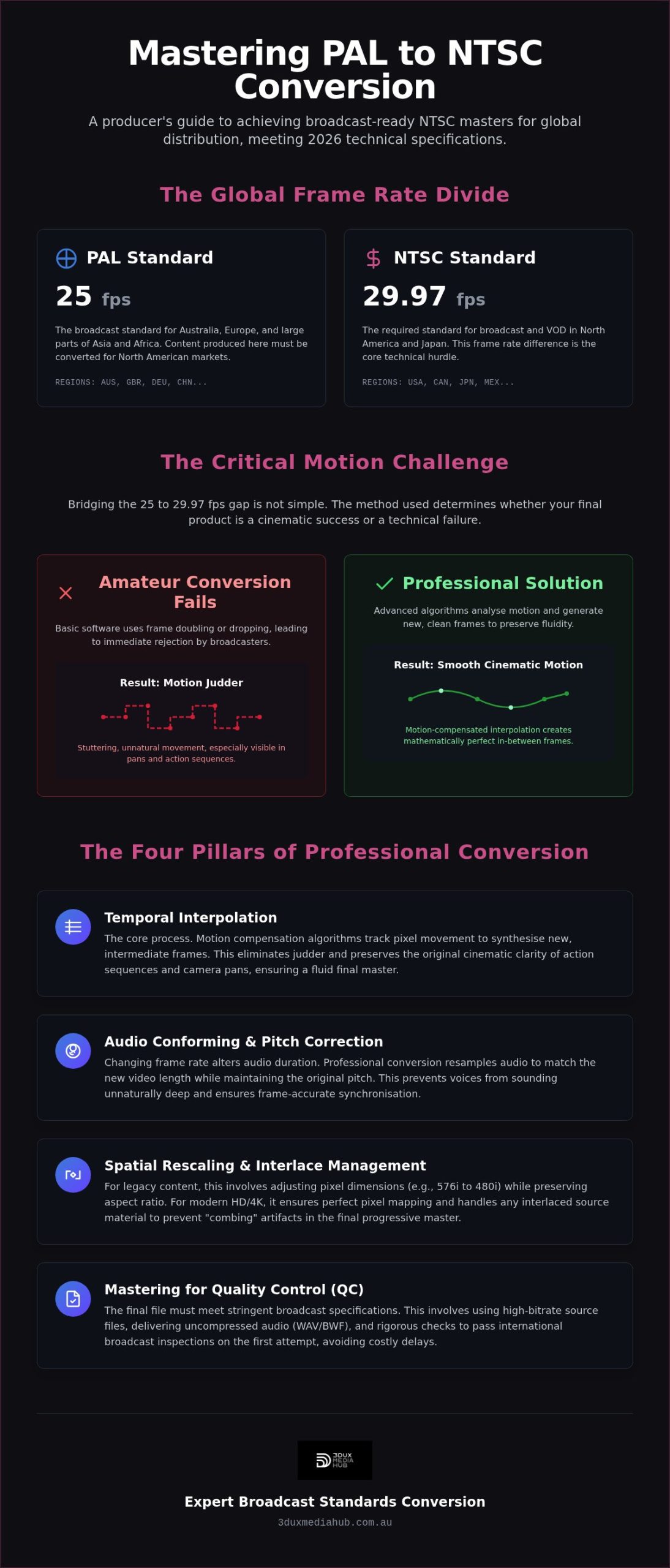
The primary hurdle isn’t just the resolution difference between PAL’s 576 lines and NTSC’s 480. Instead, the complexity lies in temporal conversion. PAL operates at 25 frames per second (fps), while NTSC requires 29.97 fps. Bridging this gap without introducing visual artifacts requires a deep understanding of the Technical Mechanics of Professional Conversion. In 2026, where 4K masters are the baseline, the precision of this conversion determines whether a film passes through a global broadcaster’s quality control (QC) gate or gets sent back for costly remediation.
The Global Divide: PAL vs. NTSC Regions
International licensing deals are strictly governed by technical delivery specifications. If you’ve produced a documentary in Australia, your master file is likely 25fps. To secure a broadcast slot or VOD placement in the United States, Canada, or Japan, that file must be converted to NTSC standards. Global streaming platforms often demand specific frame rates for their primary masters. Failing to provide a clean, motion-compensated conversion can stall a distribution deal indefinitely. It’s about ensuring your content is compatible with the infrastructure of the target territory.
Why “Simple” Conversion Fails
Basic software exports often rely on frame doubling or dropping to hit the target rate. This results in “judder”, a stuttering effect particularly visible during camera pans or fast action. High-end standards conversion PAL to NTSC avoids these pitfalls by using motion-compensated interpolation. This process tracks pixels across frames to create new, mathematically accurate frames that preserve the original cinematic look. Without this level of technical rigour, your production risks immediate rejection during broadcast QC. It’s the difference between a professional master and an amateur export that compromises your film’s visual integrity.
The Technical Mechanics of Professional Conversion
Professional standards conversion PAL to NTSC is a precision operation. It involves remapping both spatial and temporal data while preserving the integrity of the original source. In the standard definition era, this meant moving from PAL’s 576i to NTSC’s 480i. In modern HD and 4K environments, the focus shifts almost entirely to frame rate management. PAL content shot at 25fps must be converted to 29.97fps for North American broadcast or 23.976fps for cinematic distribution. Simply stretching the video or dropping frames leads to spatial aliasing and temporal stutter that modern audiences won’t tolerate.
The process requires four critical technical adjustments:
- Spatial Rescaling: Adjusting the pixel count while preserving aspect ratio and avoiding aliasing artefacts.
- Temporal Interpolation: Creating new frames to fill the gap between 25 and 29.97 fps.
- Interlace Management: Handling field-based content to prevent “combing” effects.
- Audio Resampling: Correcting the pitch and duration of the soundtrack to match the new video length.
Motion Compensation and Temporal Interpolation
Achieving fluid motion is the most difficult aspect of any conversion. Basic systems use frame doubling, which causes a noticeable “judder” during camera movements. Professional software uses sophisticated temporal interpolation to analyse pixel movement across multiple frames. Motion compensation is a pixel-tracking algorithm used to synthesise intermediate frames. This ensures that action-heavy sequences, like car chases or sports, retain their original clarity. Without this level of analysis, the converted footage looks “cheap” and fails to meet the high standards of global distributors.
Audio Conforming and Pitch Correction
When you alter the frame rate, the audio duration changes. If you simply stretch the audio to match a new video length, the pitch will drop, making voices sound unnaturally deep. Professional standards conversion PAL to NTSC involves audio conforming that maintains the original pitch while ensuring frame-accurate sync. This is especially relevant when dealing with the “4% speed-up” often used to move film (24fps) to PAL (25fps). Reversing this for an NTSC master requires precise mathematical correction. It requires advanced time-stretching algorithms that don’t introduce digital “warbling” or phase issues. Your final master must also comply with regional loudness standards, such as EBU R128 or ATSC A/85. If your current workflow isn’t hitting these targets, you might consider our broadcast standards conversion services to ensure your content is delivery-ready.
Professional Conversion vs. Consumer Hardware
Real-time hardware converters found on marketplaces like eBay are designed for legacy consumer electronics, not professional distribution. These devices prioritise speed over quality. They often result in severe visual degradation that would be laughed out of a broadcast suite. For high-value media assets, professional standards conversion PAL to NTSC requires a non-real-time, software-driven approach. This method allows for deep frame analysis and pixel-level interpolation that hardware chips simply cannot process on the fly. It’s the only way to ensure your content meets the strict technical requirements of 2026 distribution platforms.
The industry standard relies on high-bitrate masters and uncompressed audio. Using cheap hardware introduces “combing” and aliasing that instantly disqualify a file during technical delivery. The hidden costs of using sub-standard tools are immense. A single QC failure can lead to missed distribution windows, penalty fees, and the need for a complete re-mastering session. It’s always more cost-effective to get the conversion right the first time than to fix a botched attempt later.
Meeting Broadcast QC Requirements
Broadcasters and streaming platforms employ rigorous automated and manual checks to identify conversion artefacts. Ghosting and motion blur are common signs of poor frame rate blending. Professional broadcast quality control services ensure every frame is inspected for technical compliance. This is especially critical for physical media like 4K UHD or Blu-ray. On these formats, technical errors are permanent once the disc is authored. We check for:
- Interlace field order errors and “combing”
- Spatial aliasing on fine details and textures
- Temporal judder during high-motion sequences
- Digital “ghosting” from poor frame blending
Preserving Cinematic Integrity
Maintaining the original “look” of your film is paramount. During the standards conversion PAL to NTSC process, colour space shifts can occur if the transition isn’t managed within a colour-managed workflow. Professionals ensure that Rec. 709 or Rec. 2020 colour profiles remain accurate to the original grade. Aspect ratio management is another critical factor. Whether you use letterboxing or anamorphic scaling, the goal is to prevent horizontal or vertical stretching. This precision extends to motion graphics and subtitles. They must remain legible and correctly positioned after any resolution or frame rate changes to ensure a seamless viewer experience.
Best Practices for Mastering and Global Delivery
Successful distribution starts long before the file reaches the ingest server. You must identify target market delivery specifications before the first frame is processed. A master intended for North American broadcast has different header requirements than one for a Japanese VOD platform. Mastering the standards conversion PAL to NTSC requires a clean, high-bitrate source to avoid amplifying existing compression artefacts. If your source file is compromised, the conversion process will only make those flaws more apparent to QC technicians.
Metadata management is the final technical hurdle. Ensure technical headers and sidecar files reflect the new NTSC parameters. Correct metadata ensures that playout servers and VOD ingest systems interpret the file correctly. This includes setting correct aspect ratio flags and colour space tags. If you need a partner to handle these technical complexities, explore our standards conversion solutions to guarantee a broadcast-ready result.
Source File Requirements
Mezzanine codecs like Apple ProRes 422 HQ or Avid DNxHR are the industry standard for source masters. These provide the necessary data overhead for motion-compensated processing. Compressed H.264 or H.265 files are unsuitable for professional work; they lack the temporal detail needed for clean interpolation. You should also provide 10-bit sources where possible to maintain colour gradients during the resolution shift. Organise your multi-channel audio tracks early. Separate dialogue, music, and effects (DME) stems are essential for professional film content localisation. Always check for baked-in interlacing or field-order issues in the source before conversion begins. Converting a “dirty” master only compounds technical errors and leads to immediate rejection.
The Conversion Workflow Checklist
Follow a methodical sequence to ensure compliance with international delivery standards. A modular approach allows for targeted fixes if a specific element fails a preliminary check. We recommend this four-step process:
- Step 1: Technical Assessment. Review the source master for frame rate consistency, resolution, and colour space accuracy.
- Step 2: Algorithm Selection. Use motion-compensated processing for cinematic content. Linear conversion is rarely acceptable for professional delivery in 2026.
- Step 3: Audio Correction. Apply pitch correction and resynchronisation. Ensure the audio matches the new NTSC duration without digital warbling.
- Step 4: Final Compliance. Perform a full technical QC against the specific delivery sheet provided by the broadcaster or platform.
3DUX Media Hub: Expert Broadcast Standards Conversion
3DUX Media Hub operates at the intersection of technical precision and artistic integrity. With over 20 years of industry experience, we provide a definitive solution for producers requiring standards conversion PAL to NTSC. Our facility is designed to handle high-value media assets with the urgency and technical rigour that global distribution demands. Whether you’re preparing a 4K UHD master or authoring a Blu-ray for the North American market, our workflow ensures your content exceeds the benchmark for international broadcast. We act as a proactive partner, ensuring your assets are ready for global delivery without the risk of technical rejection.
Our broadcast standards conversion services are built on a foundation of rigorous quality control. We understand that a single technical oversight can derail a licensing deal. Our technicians perform frame-by-frame analysis to ensure zero temporal artifacts or spatial aliasing. This commitment to excellence makes us a reliable partner for time-sensitive film festival submissions and strict broadcast deadlines. We provide comprehensive mastering for global distribution across 4K UHD, Blu-ray, and DVD, ensuring your project remains compliant across all physical and digital formats.
Tailored Solutions for Film Distributors
Every cinematic project has unique technical requirements. We offer customised conversion paths that respect the original frame rate and intent of the filmmaker. Our video encoding services support a vast range of delivery formats, from uncompressed mezzanine files to platform-specific VOD masters. We also manage complex content localisation, integrating multi-language audio tracks and subtitle files. This end-to-end approach simplifies the distribution chain. You focus on the creative release while we manage the technical compliance and asset preparation.
Why Industry Veterans Trust 3DUX
In an industry where high-value assets are on the line, 3DUX is the “safe pair of hands” for your production. We don’t just export files; we master them. Our deep understanding of global delivery specifications ensures that your standards conversion PAL to NTSC is technically flawless. We maintain the artistic vision of the filmmaker while meeting the uncompromising demands of international distributors. This balance of technical expertise and personal service is why industry veterans continue to trust us with their most critical assets. We move your project toward a point of global connection with speed, precision, and absolute reliability.
Securing Your Global Distribution Future
Navigating international delivery requirements doesn’t have to be a technical bottleneck. Professional standards conversion PAL to NTSC is the final, critical step in protecting your cinematic investment and ensuring your content is ready for the world stage. By prioritising motion-compensated interpolation and precise audio conforming, you eliminate the risk of “judder” and QC rejections that stall distribution deals. High-quality masters and uncompressed audio sources remain the bedrock of a successful 2026 delivery workflow.
3DUX Media Hub brings over 20 years of technical mastering experience to every project. Our broadcast-grade QC and high-efficiency video encoding ensure your film meets the most stringent global standards. We act as your proactive partner, handling the complexities of frame rate transitions and localisation so you can focus on your next production. Don’t leave your global release to chance with sub-standard tools. Enquire about our professional standards conversion services today and take the next step toward a seamless international launch. Your vision deserves a flawless presentation in every territory.
Frequently Asked Questions
What is the difference between PAL and NTSC standards?
PAL (Phase Alternating Line) operates at 25 frames per second with 576 lines of resolution, common in Australia and Europe. NTSC (National Television System Committee) uses 29.97 frames per second and 480 lines, used in North America and Japan. The primary difference lies in the frame rate and the frequency of the regional electrical grid. These legacy standards still dictate modern digital delivery specifications for international broadcast and physical media.
Does standards conversion affect the audio of my film?
Audio is significantly impacted because changing the frame rate alters the total duration of the video. If you convert 25fps to 23.976fps, the video slows down, causing the audio pitch to drop. Professional standards conversion PAL to NTSC includes pitch correction and resampling to ensure the soundtrack remains in sync. We maintain the original cinematic tone while meeting regional loudness standards like EBU R128 or ATSC A/85.
Can I convert PAL to NTSC using standard editing software?
You can perform a basic export, but standard NLE software often lacks the sophisticated motion-compensated algorithms required for broadcast. Simple exports usually result in frame blending or dropping, which creates visible stuttering. Professional services use dedicated software that tracks pixel movement to synthesise new frames. This ensures a fluid master that passes the rigorous quality control checks required by international distributors and streaming platforms.
What is “judder” and how do professional services prevent it?
Judder is a rhythmic stuttering or shaking effect seen during camera pans or fast action sequences. It occurs when frame rates don’t align correctly, causing the playback to skip or repeat frames. We prevent this by using temporal interpolation and motion compensation. These algorithms analyse the vector of moving objects between frames to create mathematically accurate intermediate frames. This preserves the original smooth motion and cinematic integrity of your production.
Is standards conversion still necessary for 4K UHD distribution?
It remains absolutely essential because global broadcast and VOD platforms still adhere to specific regional frame rate requirements. While 4K has standardised resolution, the temporal standards still divide the global market. A 25fps 4K master produced in Australia must undergo standards conversion PAL to NTSC to be accepted by North American networks. Proper conversion ensures your high-resolution assets are compatible with international playout infrastructure and technical delivery sheets.
How long does a professional standards conversion take?
Turnaround times depend on the length of the content and the complexity of the motion compensation required. A standard feature film usually takes between two to five business days for processing and full technical QC. We prioritise efficiency for time-sensitive film festival deadlines and broadcast windows. Our modular workflow allows us to handle multiple assets simultaneously while maintaining the precision required for global distribution and high-end mastering projects.
Why did my converted master fail broadcast quality control?
Failures usually stem from technical artefacts like “combing”, ghosting, or incorrect field orders. Automated QC systems at major broadcasters detect even minor temporal inconsistencies or spatial aliasing. If you used a real-time hardware converter or a basic software export, the resulting file likely lacked the necessary motion metadata or audio pitch correction. Professional mastering ensures every frame meets the specific delivery specifications and technical headers required by the target platform.
What file formats are required for professional conversion?
We require high-bitrate mezzanine files to ensure the best possible results. Preferred formats include:
- Apple ProRes 422 HQ or ProRes 4444
- Avid DNxHR or DNxHD
- Uncompressed 10-bit YUV files
Providing uncompressed audio stems or a high-sample-rate WAV master is also critical. Using compressed H.264 or H.265 sources limits our ability to track motion accurately and can lead to visible compression artefacts in the final master.