
A single metadata error or a slight bitrate spike can trigger an immediate global rejection, stalling your release and burning through your distribution budget. In the high-stakes world of international delivery, a robust UHD authoring workflow is the only thing standing between a successful premiere and a costly technical failure. You already know that the transition to 4K involves more than just higher resolution. It’s a minefield of HDR10 versus Dolby Vision integration and complex HEVC encoding parameters that can baffle even seasoned post-production teams. The pressure to deliver zero-error masters to global platforms has never been higher for Australian distributors.
This article provides the technical roadmap you need to master these complexities with a high-efficiency, professional pipeline. We’ll deliver a fail-safe technical checklist, demystify high-bitrate encoding, and ensure your assets are ready for seamless global distribution in 2026. From managing HEVC bitrate limits on BD-100 discs to final broadcast-quality QC, we’re covering the essential steps to keep your workflow fast and your output flawless. It’s time to move beyond the confusion and organise your process for the global stage.
Key Takeaways
- Learn why a professional UHD authoring workflow requires more than just high resolution, focusing on the technical integration of HDR10 and Dolby Vision.
- Identify the optimal master file formats, including ProRes 4444 and DNxHR, to ensure maximum visual transparency through the HEVC encoding stage.
- Evaluate the benefits of motion versus static menus to create a premium, seamless interactive experience for global audiences.
- Implement a rigorous two-tier QC process that combines technical verification with visual checks to prevent expensive distribution rejections.
- Establish a high-efficiency production pipeline that meets the strict compliance standards of international film and TV distributors.
What is a Professional UHD Authoring Workflow?
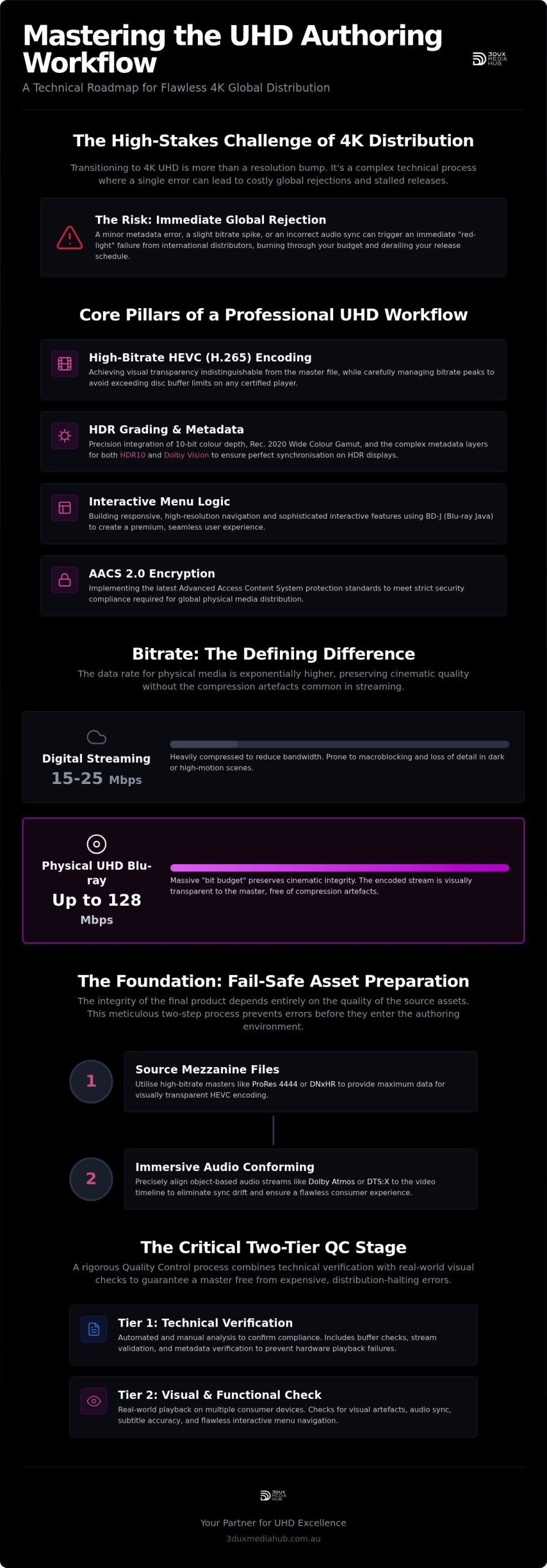
A professional UHD authoring workflow is the rigorous technical backbone of high-end media distribution. It represents the end-to-end process of transforming raw master files into compliant 4K UHD assets that function flawlessly across every certified player. This transition from standard high-definition to the Ultra HD Blu-ray format isn’t just a simple resolution bump. It requires a sophisticated understanding of HEVC encoding, AACS 2.0 encryption, and the complex metadata layers that drive modern HDR displays. For Australian film distributors, this “no-nonsense” technical discipline is vital for securing global shelf space.
While standard Blu-ray capped at 1080p, the jump to UHD introduces a complex stack of technical requirements where resolution is only half the story. The real challenge lies in managing 10-bit colour depth, Wide Colour Gamut (Rec. 2020), and High Dynamic Range (HDR) metadata. A professional workflow ensures these elements are synchronised perfectly. Key components include:
- High-bitrate HEVC (H.265) encoding: Achieving visual transparency without exceeding disc buffer limits.
- HDR Grading and Metadata: Precision integration of HDR10 and Dolby Vision layers.
- Interactive Menu Logic: Building responsive, high-resolution navigation using BD-J.
- AACS 2.0 Encryption: Implementing the latest content protection standards for global security compliance.
The Difference Between Digital Delivery and Physical UHD Mastering
Bitrate is the defining factor. While streaming platforms often compress 4K content down to 15 or 25 Mbps, the physical disc format supports bitrates up to 128 Mbps. This allows for a “Primary Video Stream” that maintains cinematic integrity without the macroblocking or artefacts common in digital-only delivery. Professional authoring also handles the technical overhead of BD-J (Blu-ray Java). This programming language enables the sophisticated interactive features and dynamic menus that consumers expect from a premium physical release. It’s a level of interactivity that simple streaming files can’t replicate.
Why Independent Filmmakers Need Professional Authoring
Prosumer “all-in-one” tools often lack the granular control needed for commercial compliance. These platforms frequently skip the rigorous buffer checks and metadata verification required by international replicators. Independent creators who bypass professional services often face expensive “red-light” rejections at the QC stage. A professional authoring partner acts as a proactive technical expert, ensuring your master is organised for global distribution from the start. It provides a “safe pair of hands” to manage the complex UHD authoring workflow, allowing you to focus on the creative release while ensuring the technical assets are fail-safe.
Asset Preparation and HEVC Video Encoding for 4K
The foundation of any high-end UHD authoring workflow begins with the integrity of the source assets. To maintain cinematic quality through the encoding pipeline, we require mezzanine files in ProRes 4444 or DNxHR formats. These high-bitrate masters provide the necessary data for the High Efficiency Video Coding (HEVC) standard to operate effectively. The goal is visual transparency. We want the encoded stream to be indistinguishable from the master while adhering to the strict physical constraints of the disc format.
Audio conforming is equally critical. Preparing immersive streams like Dolby Atmos or DTS:X requires precise alignment with the video timeline. Any drift in the object-based metadata can ruin the consumer experience. We ensure all audio components are correctly mapped before they enter the authoring environment. This meticulous preparation prevents the synchronisation errors that often lead to technical rejections during the final delivery phase.
Optimising Bitrates for BD-66 and BD-100 Discs
Managing the “bit budget” is a precise calculation. A BD-66 disc offers limited real estate compared to a triple-layer BD-100, which supports peaks up to 128 Mbps. For grain-heavy film masters or complex action sequences, professional video encoding services are essential. We manage these bitrate peaks to prevent buffer underruns on older UHD hardware, ensuring smooth playback across all devices. If you need to ensure your high-value assets meet these technical benchmarks, partnering with a specialist technical hub is the safest approach.
Mastering the HDR Layer
HDR implementation is where many workflows stumble. We manage both static HDR10 and dynamic Dolby Vision metadata layers to ensure the director’s vision remains intact. HDR10 provides a baseline for all 4K displays, while Dolby Vision offers scene-by-scene optimisation for premium screens. Validating colour space conversions to Rec. 2020 is a non-negotiable step in our process. We check every frame to ensure backwards compatibility for standard 4K displays while pushing the limits of peak brightness on high-end panels. This dual-layer approach guarantees that your content looks its best, regardless of the viewer’s hardware. It’s a technical balancing act that requires a seasoned “safe pair of hands” to execute correctly.
Interactive Design: 4K UHD Disc Menu Principles
A professional UHD authoring workflow treats the menu system as a vital extension of the feature film. It’s the first point of interaction for the consumer. Seamless navigation during playback is now an industry baseline. However, managing 4K graphics assets presents a significant technical hurdle for many post-production houses. High-resolution imagery and complex button overlays can lead to sluggish response times if the assets aren’t optimised for the player’s memory buffer. We ensure every asset is sized and compressed to maintain peak performance.
Choosing between motion and static menus depends on your film’s brand identity and target audience. While static menus offer ultra-fast loading, motion menus provide a premium, cinematic entry point that sets the stage for the film. We focus on balancing these aesthetic choices with absolute technical stability. This involves rigorous testing of graphics layers to ensure that navigation remains snappy, even on entry-level UHD players found in the Australian market.
Advanced Motion Menu Design
Motion graphics create an immersive first impression. We design interactive Blu-ray menus that feel modern and responsive by utilising advanced BD-J programming. The technical workflow involves linking high-bitrate video loops with precise navigation buttons. This ensures there are no visible “hitches” when a user selects a menu item. Every transition must be frame-accurate. This maintains the illusion of a single, continuous experience from the moment the disc loads.
Localisation and Global Asset Integration
For Australian distributors targeting international markets, the menu must organise multi-language assets and subtitle tracks efficiently. This is where audio conforming for international film release is vital. We align localised audio streams and subtitle files to ensure timing and font rendering are perfect across all regions. Integrating these assets requires following Dolby Vision best practices so menu brightness matches the feature’s HDR metadata. We also manage complex disc logic for censored and uncensored cuts on a single master. This streamlined UHD authoring workflow makes your release global-ready from day one.
The Critical QC Stage: Avoiding Technical Rejections
Quality control is the final safety net for any professional UHD authoring workflow. It represents the difference between a seamless global launch and a catastrophic technical failure. For Australian film distributors, the cost of a technical rejection extends beyond the immediate financial hit; it damages critical relationships with international retailers and streaming platforms. We treat QC as a rigorous technical discipline, not a cursory viewing session. Every master undergoes a multi-layered verification process to ensure it is bulletproof before it leaves our facility.
Distinguishing between visual QC and technical verification is essential for a successful release. Visual QC, or “eye-on-glass,” involves seasoned technicians looking for encoding artefacts, dropped frames, or audio synchronisation drifts that software might miss. Technical verification, however, is a deep dive into the disc’s logical structure. We look for the “silent killers” of distribution: AACS encryption errors, buffer underruns caused by bitrate spikes, and broken BD-J menu links. These issues often remain invisible on software players but cause immediate failures on consumer hardware.
Professional Quality Control Protocols
Our protocol begins by running the final master through the Scenarist UHD Verifier. This industry-standard tool ensures absolute spec compliance with the Blu-ray Disc Association standards. We don’t rely solely on automated tools. We conduct 2026 Blu-ray quality control services across a fleet of physical hardware players. This includes testing on various display brands like Sony, LG, and Samsung to verify that HDR metadata triggers correctly. If the Dolby Vision layer doesn’t handshake perfectly with the display, the viewer won’t see the intended grade. We catch these discrepancies early.
Broadcast and Standards Compliance
A professional UHD authoring workflow must also account for secondary delivery requirements. We ensure the master meets broadcast standards conversion services for digital-only platforms. This involves verifying subtitle positioning for different aspect ratios to ensure text remains within title-safe zones on all screens. Every step of our QC process is documented for distributor sign-off, providing a transparent audit trail of technical excellence. This methodical approach ensures your high-value assets are ready for any market, anywhere in the world. Secure your next release with professional QC services that guarantee technical compliance.
Partnering with 3DUX Media Hub for UHD Excellence
Executing a high-end UHD authoring workflow requires deep technical expertise and a proactive approach to problem-solving. With over 20 years of industry experience, 3DUX Media Hub provides the precision and speed needed for high-stakes film distribution. We aren’t just a service vendor. We act as a proactive technical partner that understands the immense pressure of international delivery dates. Our Australian technical centre is built to handle complex metadata, high-bitrate encoding, and rigorous quality control, delivering cinematic results with a fast turnaround.
Our team specialises in high-efficiency HEVC and Dolby Vision encoding. We stay ahead of the curve by constantly updating our protocols to match the latest global standards. Whether you are an independent filmmaker or a major national distributor, we provide a reliable, high-tech solution for your media assets. We focus on the technical details so you can focus on the commercial success of your release. Every project benefits from our seasoned perspective and results-driven methodology.
Our ‘Safe Pair of Hands’ Philosophy
Distributors across Australia trust us with their most valuable film assets because we offer a “safe pair of hands” for high-value content. We provide a modular workflow that adapts to your specific project needs. Some distributors require only specialist video and audio encoding for digital platforms. Others need a full-service UHD authoring workflow that includes motion menu design, multi-language localisation, and standards conversion. This flexibility allows us to integrate seamlessly into your existing post-production pipeline without adding unnecessary layers of complexity.
We prioritise technical precision at every stage. Our modular approach ensures that even the most grain-heavy film masters or complex multi-language releases are handled with care. By maintaining a sharp focus on compliance and buffer management, we eliminate the technical risks that lead to costly rejections. We provide a professional, no-nonsense service that guarantees your master is ready for the global stage.
Get Your Project Started Today
Submitting your master files for a technical audit is a direct and efficient process. We coordinate closely with your localisation and marketing teams to ensure every asset, from the primary video stream to the subtitle tracks, is organised correctly. This proactive coordination prevents last-minute metadata errors and synchronisation issues. Our technical team provides a thorough assessment of your source files before the authoring process begins, identifying potential hurdles early. Contact 3DUX Media Hub to organise your UHD authoring project and secure a fail-safe delivery for your next film release.
Future-Proofing Your Global Distribution Strategy
Mastering the technical requirements of the 2026 media landscape is essential for any distributor aiming for international success. A robust UHD authoring workflow ensures your high-value assets transition from the grade to the consumer’s screen without a single metadata error or playback hitch. By prioritising high-bitrate HEVC encoding and rigorous hardware-based QC, you eliminate the risk of technical rejections from global platforms. This methodical approach protects your investment and maintains your reputation for technical excellence.
3DUX Media Hub brings over 20 years of industry experience in Australia to every project. We specialise in Dolby Vision and HEVC technical compliance, offering full-service localisation and QC support. Our “safe pair of hands” philosophy ensures your cinematic vision remains intact while meeting the strictest global distribution standards. Whether you need complex motion menus or precise standards conversion, our team is ready to deliver results that exceed expectations every time.
Secure your film’s global release with professional UHD authoring at 3DUX Media Hub. We look forward to helping you reach audiences worldwide with technical precision and ease. It’s time to take your content to the global stage with total confidence.
Frequently Asked Questions
What is the standard turnaround time for a professional UHD authoring project?
Professional turnaround typically ranges from two to four weeks depending on the complexity of the interactive menus and the volume of localisation required. Simple feature-only projects move faster, while those requiring extensive motion graphics and multi-language audio conforming take longer. We prioritise efficiency to meet strict global distribution deadlines. This timeline includes rigorous quality control stages to ensure the final master is fail-safe before delivery to the replicator.
Do I need to provide a separate master for Dolby Vision and HDR10?
You don’t need separate masters because Dolby Vision is designed as an enhancement layer that sits on top of a standard HDR10 base layer. During a professional UHD authoring workflow, we integrate the dynamic metadata into the HEVC stream. This ensures the disc remains backwards compatible with standard HDR10 displays while offering the superior scene-by-scene optimisation of Dolby Vision for premium hardware. Providing a single high-quality mezzanine file is the industry standard.
Can you author 4K UHD discs from a DCP (Digital Cinema Package) source?
Yes, we can author from a Digital Cinema Package, though it requires a technical conversion process. DCPs use the XYZ colour space and JPEG 2000 compression, which must be converted to Rec. 2020 and HEVC for the Ultra HD Blu-ray format. We handle the standards conversion and colour mapping to ensure the cinematic look is preserved. It’s often better to provide the original ProRes 4444 or DNxHR master if available to avoid unnecessary compression generations.
What is the difference between a BD-66 and a BD-100 disc for authoring?
The primary difference lies in storage capacity and peak bitrate capabilities. A dual-layer BD-66 disc holds 66GB and supports bitrates around 92 Mbps. A triple-layer BD-100 disc offers 100GB of space and allows for peaks up to 128 Mbps. For long features with high-bitrate immersive audio and grain-heavy film masters, the BD-100 is the preferred choice to maintain visual transparency and avoid player buffer issues during complex scenes.
How do you handle multi-language subtitle integration for global releases?
We manage localisation by integrating frame-accurate subtitle assets into the disc’s logical structure. This involves converting text-based files into compliant image-based formats that render correctly across all certified UHD players. We verify font styles, sizes, and positioning to ensure they remain within title-safe zones. Our process includes testing each language track against the primary video stream to guarantee that timing remains perfect for global audiences regardless of the region.
Is it possible to include bonus features in standard HD on a 4K UHD disc?
It is entirely possible to include standard HD (1080p) bonus features on a 4K UHD disc. The Ultra HD Blu-ray specification supports mixed resolutions, allowing distributors to preserve disc space for the main feature’s high-bitrate HEVC stream. We encode these assets to ensure they upscale cleanly on 4K displays. This approach is a common strategy for Australian distributors who want to provide comprehensive special editions without compromising the primary film’s visual quality.
Why should a distributor choose a professional authoring house over in-house software?
Professional authoring houses use industry-standard tools like Scenarist UHD, which offer granular control over disc logic and buffer management that prosumer software cannot match. In-house tools often lack the rigorous verification features needed to prevent global distribution rejections. By partnering with a specialised hub, you gain access to 20 years of technical expertise and hardware-based QC. This reduces the risk of costly errors and ensures your project is compliant with international standards.
What technical specs do I need to provide for professional HEVC encoding?
For optimal results, you should provide a 10-bit ProRes 4444 or DNxHR mezzanine file in the Rec. 2020 colour space. The file must match the intended frame rate of the release, typically 23.976 or 24 fps for cinematic content. You also need to supply the corresponding HDR10 or Dolby Vision metadata files. Providing these high-quality assets at the start of the UHD authoring workflow ensures the final HEVC stream maintains maximum visual integrity.