65% of global consumers prefer to watch content in their native language, but a single frame rate mismatch or audio sync error can trigger an immediate technical rejection from major streaming platforms. You’ve poured everything into your production. Now, the pressure to deliver across multiple territories often leads to the same recurring headache: managing a chaotic mess of audio stems and subtitle files. Implementing a rigorous localisation quality control workflow is no longer just a safeguard; it’s a technical necessity for any producer aiming for a seamless global launch in 2026.
We understand the stress of facing a “fail” report from a global distributor. It’s frustrating when technical hurdles stand between your vision and a worldwide audience. This article provides the technical roadmap to mastering your assets for international compliance while preserving every bit of cinematic quality. We’ll examine the specific steps required to create a single, compliant master asset. We cover everything from 4K UHD encoding to complex audio conforming across different broadcast standards. You’ll gain the expertise needed to navigate international delivery specs with total confidence.
Key Takeaways
- Learn why 2026 delivery standards require a sophisticated technical approach to HDR10 and Dolby Atmos integration for international markets.
- Implement a robust localisation quality control workflow to ensure dubbed audio tracks and complex subtitle files align perfectly with your 4K master.
- Discover why professional technical mastering is superior to simple translation for preserving the cinematic look of your film across every language.
- Master the preparation of your source assets, including ProRes files and clean M&E stems, to prevent technical rejections from global streaming platforms.
- Understand how leveraging 20 years of technical authoring experience ensures your content meets international broadcast standards with a single compliant master asset.
The Evolution of Technical Localisation Quality Control in 2026
International film distribution in 2026 is a high-stakes engineering challenge. It’s no longer sufficient to treat translation as a post-script. High-end media localisation now demands a rigorous localisation quality control workflow that treats every language version as a unique technical master. This shift has been driven by the uncompromising standards of global streaming giants. They don’t just want the right words; they want bit-for-bit perfection across diverse hardware ecosystems. You’re no longer just delivering a story. You’re delivering a complex technical package.
Beyond Translation: The Technical Definition
Linguistic accuracy is only 50% of the mastering job. While the script must resonate culturally, the file must perform technically. Technical localisation is the precise synchronisation of cultural, linguistic, and technical metadata. It involves asset conforming, where dubbed audio and localised subtitles are mapped to the master video with frame-level accuracy. This includes the post-production process of replacing original dialogue with localised tracks while maintaining the integrity of the mix. If the technical metadata doesn’t align, the asset is useless for export. You must ensure compliance with international broadcast standards before the first byte is uploaded.
The High Stakes of Global Distribution
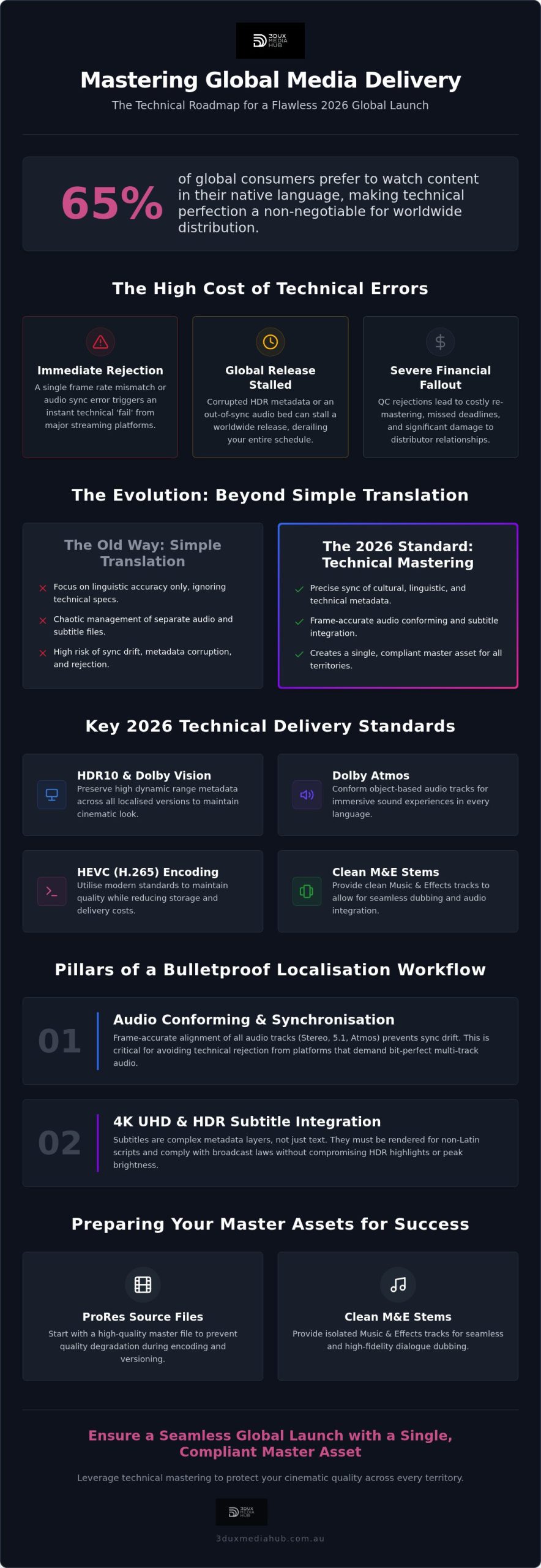
The financial fallout of a QC rejection in international markets is severe. A single out-of-sync audio bed or a corrupted HDR10 metadata layer can stall a global release. Modern distributors demand delivery-ready masters from the outset. Managing dozens of language versions without bloating storage or compromising bitrates requires a disciplined technical approach. Every version must be as clean as the original master.
Distributors now expect assets to support advanced formats by default. These requirements include:
- HDR10 and Dolby Vision: Preservation of high dynamic range metadata across all localised versions.
- Dolby Atmos: Conforming object-based audio tracks for immersive experiences in every language.
- HEVC Encoding: Utilising H.265 standards to maintain cinematic quality while reducing delivery costs.
- M&E Stems: Providing clean Music and Effects tracks that allow for seamless dubbing and audio integration.
The Technical Pillars of a Media Localisation Workflow
A robust localisation quality control workflow relies on four technical pillars. It isn’t just about the picture; it’s about the technical marriage of audio, text, and metadata. You need a system that handles global delivery without compromising the source material. Precision at this stage prevents expensive re-runs and ensures your content is accepted by distributors on the first attempt.
Audio Conforming and Multi-Track Synchronisation
Cinematic content often suffers from sync drift during the dubbing process. When you’re managing long-form features, even a few milliseconds of lag can ruin the viewer experience. We specialise in audio conforming for international film release, ensuring that every dubbed track-whether it’s a stereo mix, 5.1, or full Dolby Atmos-aligns perfectly with the 4K master. This requires frame-accurate alignment of M&E stems and dialogue tracks. It prevents technical rejection from major streaming platforms that demand bit-perfect multi-track audio across all languages.
Subtitle Integration for 4K UHD and HDR
Subtitles are complex metadata layers in the HDR era. There’s a critical technical distinction between closed captions for accessibility and forced narratives for foreign dialogue. Managing SRT and STL files for 4K UHD requires careful attention to font rendering and character sets, particularly for non-Latin scripts. High-end distribution demands that subtitles remain readable without compromising HDR highlights or peak brightness. Every line must comply with international broadcast laws while maintaining the original cinematic intent. We handle the heavy lifting of burnt-in options and sidecar files for global compliance.
Frame Rate and Standards Conversion Mastery
Frame rate conversion is the silent killer of global delivery. Moving between 23.976 fps, 25 fps, and 29.97 fps can introduce motion judder or audio pitch shifts if handled poorly. High-quality motion-compensated conversion is essential to preserve cinematic motion. Without it, your content will fail the rigorous checks within a disciplined localisation quality control workflow. We provide expert broadcast standards conversion services to ensure your assets are compliant across all territories, from PAL regions to NTSC markets.
Metadata and Accessibility Management
Metadata acts as the digital glue for your asset. You must organise language tags, audio descriptions, and accessibility features into a single, compliant package. This ensures the viewer’s hardware identifies the correct tracks immediately. It’s more than simple file naming; it’s deep-level metadata mapping that meets 2026 streaming requirements. If you want to ensure your high-value assets are distribution-ready, you can rely on 3DUX Media Hub for precision engineering and technical expertise.
Why Technical Mastering Outperforms Simple Translation
Handing your film to a standard translation agency is a risk. While they might get the dialogue right, they often lack the engineering depth to handle high-value media assets. Professional technical mastering ensures that your localisation quality control workflow includes rigorous encoding and bitrate management. Without this, you risk losing the cinematic look that defines your production. High-end encoding protects the visual integrity of your 4K UHD assets while accommodating the technical weight of multiple language tracks.
A specialist provider understands that localisation is an engineering task. It’s about more than just words on a screen; it’s about how those words and audio tracks interact with the master file. Non-specialist agencies often return files that fail distributor specs because they don’t account for legal signal levels or metadata headers. We treat every language version as a new master, not a secondary file. This level of precision is essential for a successful global release.
The Role of Human-Led Broadcast Quality Control
Automated QC tools have their place, but they’re insufficient for premium entertainment. A machine can’t always detect a slight sync drift in a dubbed dialogue track or a subtle dropout in a 5.1 mix. Human-led broadcast QC involves visual and audible checks for every frame. Our experts monitor for legal luminance and chrominance levels to ensure compliance with international broadcast standards. This level of scrutiny is a core part of our Blu-ray quality control services. It guarantees that your asset is truly distribution-ready without the risk of technical rejection.
Localising for Physical Media: 4K UHD, Blu-ray, and DVD
Physical media remains a critical revenue stream for high-end film distribution. However, localising a disc is vastly different from a streaming file. You must manage finite disc space while adding multiple high-definition audio tracks. Adding five language versions in Dolby Atmos requires expert bitrate management to avoid compromising the primary video stream. Navigation is another hurdle. Every button and menu item must be localised and tested for technical logic. We specialise in interactive Blu-ray menu design, ensuring a seamless experience for international audiences. Our team organises complex navigation structures so that your global release feels like a local production in every territory.
This technical approach prevents the common pitfalls of simple translation. It ensures your content looks, sounds, and functions perfectly, regardless of the language or platform. By prioritising technical mastering, you secure your investment and maintain your reputation with global distributors.
Preparing Your Master Assets for the Localisation Workflow
Technical precision starts at the source. If your master files are poorly organised, your localisation quality control workflow will stall before the first dub is recorded. Professional distributors don’t have time for messy deliveries. You need a structured approach to asset preparation to ensure a smooth transition from post-production to global release. High-quality inputs are the only way to guarantee high-quality outputs.
The Critical Importance of Clean M&E Stems
Music and Effects (M&E) tracks are the foundation of any international dubbing project. They allow local voice talent to be layered over the original soundscape without losing the ambient detail. A “dirty” M&E track, which contains remnants of the original dialogue, is a primary cause for technical rejection. It ruins the immersion and forces expensive re-mixes. You must ensure your audio stems are fully conformed and free of bleed before they enter the mastering stage. This preparation is vital for ensuring your audio is ready for global conforming and seamless integration.
Master File Specifications for 2026 Global Delivery
2026 delivery standards demand uncompromising bitrates and modern codecs. For 4K UHD delivery, ProRes 422 HQ or DNxHR remain the industry benchmarks for mezzanine files. However, as HEVC (H.265) becomes the standard for final delivery, your master must be robust enough to survive multiple encoding passes. You also need to account for HDR10 and Dolby Vision metadata. These layers must be correctly mapped to ensure the visual intent remains consistent across different territories. We provide expert 4K UHD authoring services that handle these complexities, ensuring your assets meet the specific requirements of major streaming platforms.
Accurate subtitle placement also requires time-coded scripts. These scripts must align perfectly with your master’s timecode to prevent sync errors during the localisation quality control workflow. Don’t leave this to chance; verify your timecodes before export.
Use this final checklist before sending your assets for mastering:
- Video Master: ProRes 422 HQ or DNxHR HQX at native frame rate.
- Audio Stems: 24-bit LPCM files, including 5.1 and Stereo mixes.
- Clean M&E: Verified tracks with zero dialogue bleed.
- Subtitles: Time-coded SRT or STL files matched to the master.
- Metadata: XML sidecars for HDR and accessibility tags.
Properly prepared assets reduce turnaround times and eliminate the risk of failed QC reports. If you want to ensure your high-value media is distribution-ready, contact 3DUX Media Hub today to standardise your master assets for international delivery.
Optimising Your Global Release with 3DUX Media Hub
A successful international launch requires more than just technical compliance. It demands a partner who understands the high stakes of the entertainment industry. 3DUX Media Hub bridges the gap between your final post-production export and the global market. We don’t just process files; we engineer assets for maximum compatibility and cinematic impact. Our localisation quality control workflow is designed to catch the errors that automated systems miss. This ensures your content is accepted by global streaming platforms and broadcasters on the first attempt.
Major distributors trust us because we act as a reliable service partner rather than a passive vendor. We understand that global distribution windows are often tight. Speed is essential, but it cannot come at the expense of precision. Our facility is equipped to handle complex multi-language projects with fast turnaround times. We manage everything from motion menu design to broadcast-grade QC, ensuring every version of your film is delivery-ready. Our commitment to accuracy means your localised masters will maintain the same visual and auditory excellence as the original edit.
Starting Your Technical Localisation Project
Every production has unique requirements. Whether you’re an independent filmmaker preparing for a festival run or a major studio coordinating a multi-territory release, we customise our services to fit your needs. Our localisation quality control workflow scales with your project, providing the same level of rigorous engineering to every client. We offer specialised packages for 4K UHD authoring, standards conversion, and audio conforming to ensure your technical metadata is flawless.
Don’t leave your global distribution to chance. A technical consultation can help you standardise your assets and avoid the common pitfalls of international delivery. We provide project-based quotes that reflect the specific technical needs of your series or feature film. Our team is ready to help you navigate the complexities of 2026 delivery specs with confidence and speed. Contact 3DUX Media Hub today to discuss your technical requirements and secure a compliant, high-quality master for your global audience.
Securing Your Global Distribution Future
Mastering your global release in 2026 requires a shift from simple translation to rigorous technical engineering. You’ve seen how a disciplined localisation quality control workflow protects your cinematic vision while ensuring bit-perfect compliance with international streaming standards. By prioritising clean M&E stems and professional 4K UHD encoding, you eliminate the risk of technical rejection and costly delays. High-value assets demand a higher standard of technical scrutiny before they ever reach a distributor’s server.
3DUX Media Hub stands as an authoritative partner for global film distributors. With over 20 years of technical media experience, we specialise in 4K UHD authoring and broadcast-grade QC. We bridge the gap between your final edit and a worldwide audience, providing the safe pair of hands your assets deserve. Don’t let technical hurdles stall your international launch or compromise your cinematic quality in foreign territories.
Ready to standardise your masters for a seamless global delivery? Enquire about your localisation project with 3DUX Media Hub today. We look forward to helping you reach every audience with total technical confidence and precision.
Frequently Asked Questions
What is the difference between translation and localisation in film?
Localisation is a technical mastering process that goes beyond simple translation. While translation focuses on dialogue, localisation involves asset conforming, metadata management, and technical compliance for specific territories. It ensures your 4K master remains bit-perfect while accommodating dubbed audio and culturally relevant subtitles. This holistic approach is essential for a successful global launch, as it addresses the underlying technical metadata that distributors require for a seamless viewer experience across different hardware.
Do I need separate M&E tracks for every language version?
You don’t need a separate M&E track for every language, but you do need one pristine, clean M&E master. This track must contain all music and sound effects with zero dialogue bleed from the original version. A single high-quality M&E stem allows us to conform multiple dubbed tracks efficiently. If your M&E tracks are dirty, it will cause delays in the dubbing process and risk technical rejection from major streaming platforms.
How does frame rate conversion affect my film’s quality during localisation?
Frame rate conversion can introduce motion judder or audio pitch shifts if not handled with precision. When moving between 24 fps and 25 fps for different broadcast regions, we use high-quality motion-compensated conversion. This ensures the cinematic motion of your film is preserved without visual artefacts. Poorly executed conversions are a common cause of failure, making it vital to use professional standards conversion services during the technical mastering phase.
Can 3DUX Media Hub handle 4K UHD localisation with Dolby Atmos?
Yes, we are specialists in 4K UHD authoring and high-end audio conforming including Dolby Atmos. Our team manages the technical complexities of object-based audio across multiple language versions. This ensures your immersive soundscape remains intact for international audiences. We provide the technical expertise needed to package these high-value assets into a single compliant master that meets the rigorous delivery specifications of global streaming services and high-end physical media.
What file formats should I provide for professional technical localisation?
For professional technical localisation, we recommend providing mezzanine-level files such as ProRes 422 HQ or DNxHR HQX. Audio should be delivered as 24-bit LPCM files, including full mixes and clean M&E stems. Subtitles are best provided as time-coded SRT or STL files. Providing these high-quality source assets ensures that the final encoded versions maintain cinematic integrity while allowing for the rigorous technical checks required by a professional localisation quality control workflow.
How long does the technical localisation process typically take?
Turnaround times depend on the volume of languages and the complexity of the assets, but we prioritise fast delivery for tight distribution windows. A single-language feature film conforming project might take a few business days, while a multi-language series requires more coordination. We focus on efficiency and precision to ensure your content meets its global release date without compromising on broadcast-grade quality or technical compliance across all territories.
Is professional QC included in the localisation service?
Yes, broadcast-grade QC is integrated into every stage of our localisation quality control workflow. We perform visual and audible checks for sync, legal signal levels, and metadata accuracy. Unlike automated tools, our human-led QC detects subtle issues like dialogue drift or compression artefacts. This rigorous process guarantees that your assets are distribution-ready and compliant with international broadcast standards, significantly reducing the risk of technical rejection by global platforms.
Do you provide localisation for both digital and physical media?
We provide comprehensive localisation services for both digital streaming platforms and physical media like 4K UHD, Blu-ray, and DVD. This includes everything from video encoding and audio conforming to interactive menu design for international markets. Whether you’re delivering a master file for a global streamer or authoring a multi-language disc for retail, we ensure your technical assets are optimised for the specific requirements of each distribution channel.