Your film looks stunning in the grading suite, but will it survive the rigorous automated QC of a global streaming giant? It’s a valid concern when a single metadata error or an unoptimised bitrate can trigger an immediate technical rejection. Navigating professional HDR video encoding services requires more than just a simple transcode. It demands a precision-engineered approach to mastering that bridges the gap between your creative intent and strict delivery specifications.
You’ve likely felt the pressure of managing competing standards like HDR10+ Advanced and Dolby Vision 2 while trying to keep file sizes manageable without sacrificing the depth of your colours. We understand that the stakes are high when your reputation is on the line. This guide will help you master the technical complexities of HDR encoding to ensure your film meets the highest global delivery standards for 4K UHD and streaming. We’ll examine the path to a bit-perfect HDR master, compliance with SMPTE and ITU standards, and the specific requirements for seamless global distribution.
Key Takeaways
- Understand the fundamental shift from SDR to HDR and how expanded luminance and colour volume enhance the viewer experience.
- Learn the critical differences between HDR10 and Dolby Vision to determine which metadata standard best suits your distribution goals.
- Master the professional HEVC workflow by engaging HDR video encoding services that prioritise bit-perfect technical precision.
- Ensure global compliance by meeting rigorous SMPTE and ITU standards to prevent costly technical rejections from streaming platforms.
- Discover how integrating encoding with professional 4K UHD authoring creates a seamless, distribution-ready master for the international market.
The Evolution of Cinematic Quality: Why HDR Video Encoding is Vital in 2026
High Dynamic Range (HDR) has redefined the technical benchmarks for professional film distribution. While 4K resolution provides pixel density, HDR delivers the depth and vibrancy that modern audiences demand. It isn’t just about brightness; it’s about the expanded range between the darkest shadows and the most brilliant highlights. Utilising professional HDR video encoding services ensures your content doesn’t just meet basic specs but excels in a competitive global market. In 2026, 4K resolution alone is the baseline. HDR is the differentiator that defines premium quality.
Luminance, Contrast, and the Wider Colour Gamut
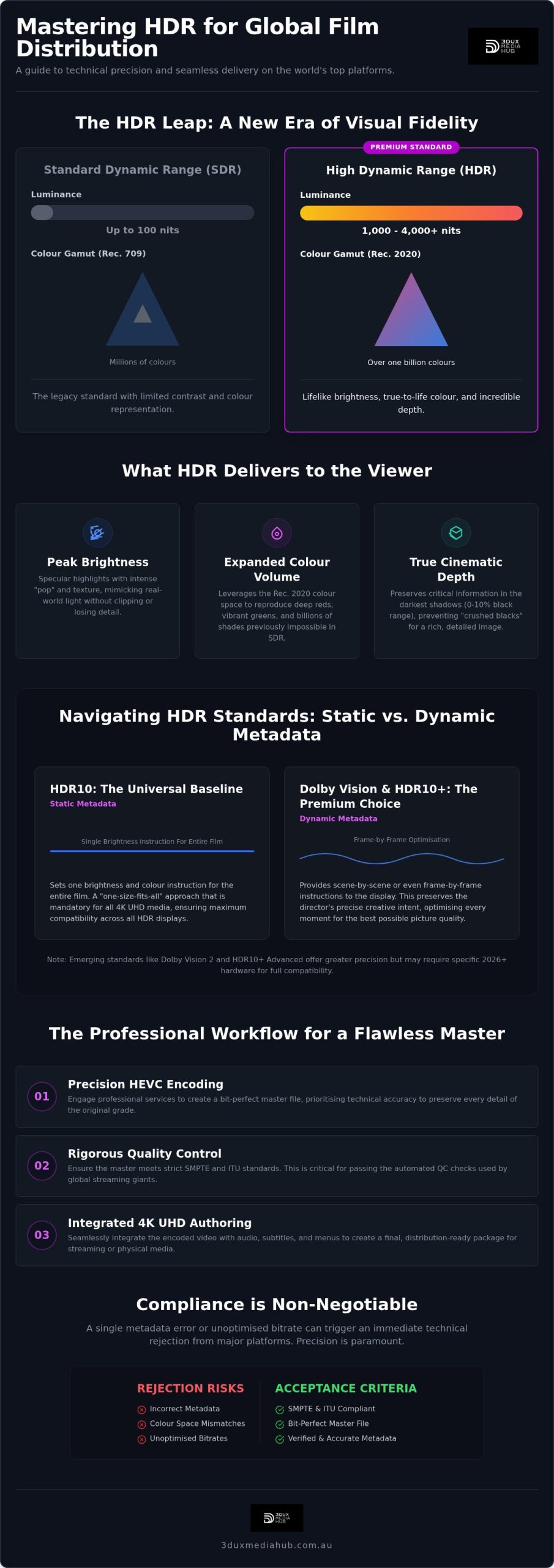
Contrast ratios are the foundation of this technological shift. Standard Dynamic Range (SDR) is traditionally capped at 100 nits. Modern HDR masters frequently target 1,000 to 4,000 nits, allowing for specular highlights that mimic the intensity of real-world light. This isn’t merely for show. It allows for detail retention in areas that would previously be “blown out” or crushed into black. By leveraging the Rec. 2020 colour space, we can encode a significantly wider gamut than the old Rec. 709 standard. This provides access to highly saturated colours that feel tangible and lifelike. Understanding the nuances of High-Dynamic-Range (HDR) television is essential for any distributor looking to maintain visual integrity across various display technologies.
- Peak Brightness: Precise control over nits ensures highlights have “pop” without losing texture.
- Colour Volume: Rec. 2020 enables the reproduction of deep reds and vibrant greens previously impossible in SDR.
- Detail Retention: Advanced encoding preserves information in the 0% to 10% black range for true cinematic depth.
The Impact of HDR on Consumer Perception
Audiences now equate HDR with a “premium” viewing experience. It creates a window-like effect that draws the viewer into the scene. For the 4K UHD Blu-ray market, HDR is no longer optional; it’s the primary selling point for physical media collectors. High-end streaming platforms have followed suit, often mandating HDR for all original commissions to ensure a consistent, high-quality brand image. Beyond the immediate visual impact, HDR adds significant commercial value to your library. It increases the longevity of your assets by ensuring they remain compatible with the next decade of display hardware. Mastering in HDR today prevents your content from looking dated tomorrow.
Navigating HDR Standards: HDR10 vs. Dolby Vision for Distribution
Choosing the correct standard is a critical commercial decision that impacts every stage of the mastering process. HDR10 serves as the universal baseline. As an open standard, it is mandatory for all 4K UHD media, ensuring your film is playable on any HDR-capable display. However, it relies on static metadata, which can limit the visual impact of high-contrast scenes. These standards form the , ensuring that content remains compliant with global delivery specifications. For projects requiring more nuance, dynamic metadata formats like Dolby Vision and HDR10+ provide the solution.
Static vs. Dynamic Metadata
The technical difference lies in how instructions are sent to the viewer’s screen. Static metadata (HDR10) sets a single brightness level for the entire film. If your film moves from a dark interior to a bright exterior, the display must find a compromise. Dolby Vision and HDR10+ solve this with dynamic metadata, providing scene-by-scene or even frame-by-frame instructions. This ensures the creative intent is preserved regardless of the display’s peak brightness. As of August 2026, we’re seeing the introduction of Dolby Vision 2 and HDR10+ Advanced. While these offer even greater precision, they currently require specific 2026 hardware from manufacturers like Hisense and Samsung for full compatibility. Professional HDR video encoding services must account for these emerging standards while maintaining solid backwards compatibility.
Selecting the Right Standard for Your Release
Your distribution strategy dictates your technical requirements. Most major streaming platforms, such as Netflix and Disney+, mandate Dolby Vision for their original content. While there are licensing costs involved, the benefit is a “bit-perfect” representation of your grade on consumer hardware. For broadcast and live events, Hybrid Log-Gamma (HLG) is the standard of choice. It’s unique because it doesn’t require metadata and is backwards compatible with SDR displays, making it ideal for the bandwidth-constrained environments of terrestrial and satellite TV.
We generally recommend a multi-standard approach for global releases. By mastering in Dolby Vision, you automatically generate an HDR10-compliant base layer, covering both premium and entry-level displays. If you’re managing complex assets for an international premiere, consulting with an encoding specialist can help you navigate these licensing and technical hurdles efficiently. It’s about finding the balance between maximum reach and peak visual quality. Our role is to ensure your master meets the specific technical specifications of every territory you target.
The Professional Encoding Workflow: Achieving Cinematic Quality
Achieving a cinematic master requires more than just high-performance hardware. It’s about the technical chain from the final grade to the delivery file. Professional HDR video encoding services act as the final gatekeeper of quality. This stage ensures that the luminance and colour volume meticulously crafted in the grading suite actually reach the consumer’s screen without degradation. Precision is the baseline. We don’t guess; we measure.
From Grading Suite to Encoder
Standardising file formats is the first step. While Prores 4444 XQ is a robust mezzanine format, many high-end workflows still prefer uncompressed DPX sequences for absolute transparency. We manage the delicate colour space conversion from DCI-P3 to Rec. 2020 during this phase. Maintaining the integrity of the creative grade is paramount. Many studios are now adopting a single-master HDR workflow to streamline delivery across multiple platforms. This approach ensures visual consistency across various territories while reducing the overhead of managing separate SDR and HDR pipelines.
High Efficiency Video Encoding (HEVC) Deep Dive
HEVC (H.265) is the industry standard for 4K and HDR content for a reason. It offers roughly double the data compression of its predecessor, H.264, while maintaining superior image quality. This efficiency is vital when managing the massive data loads of 10-bit or 12-bit HDR video. We optimise encoding parameters specifically for high-motion and low-light sequences where compression artefacts are most likely to appear. The goal is visual transparency. Every frame must look exactly as the colourist intended.
Bitrate management is where technical expertise meets visual artistry. While streaming platforms often push for lower bitrates to save bandwidth, physical media and premium VOD services require high bit rate video encoding to preserve fine grain and texture. We utilise multi-pass encoding to analyse the complexity of every frame. This allows the encoder to allocate more data to difficult, high-detail scenes and less to static shots. The result is a master that looks transparent to the source, even at efficient file sizes.
- Multi-pass analysis: Ensures consistent quality by adjusting the data rate based on scene complexity.
- Artefact suppression: Specific tuning for grain preservation and noise reduction.
- Metadata injection: Precise frame-wrapping of Dolby Vision or HDR10+ metadata into the HEVC stream.
Compliance and Quality Control: Meeting Global Delivery Specs
Technical compliance is the final hurdle in the mastering chain. It’s where creative vision meets the rigid requirements of global distributors. Professional HDR video encoding services must adhere strictly to SMPTE ST.2084 (PQ curve) and ST.2086 (Mastering Display Metadata). These standards ensure your content’s luminance and colour volume are correctly interpreted by consumer hardware. Without absolute precision, your film risks looking washed out or overly dark on the viewer’s screen. We treat compliance as a non-negotiable baseline for every project.
Automated vs. Manual Quality Control
Automation is efficient but insufficient. We use software tools to scan for gamut violations and brightness peaks that exceed target nit levels. However, machines cannot detect subtle encoding artefacts or creative inconsistencies. A human eye check is mandatory. Our technicians perform a 100% linear watch-through on calibrated reference monitors. This rigorous approach is a core component of our 2026 Blu-ray quality control services, ensuring every frame is technically perfect.
Global Delivery Specification Compliance
Every platform has its own rulebook. The UHD Blu-ray “White Book” specs are notoriously strict regarding bitrate and buffer management. Streaming giants have also updated their requirements. For instance, the February 2026 update to the Warner Bros. Discovery master technical specifications requires HDR content to be delivered as an IMF package with Dolby Vision metadata frame-wrapped into the video MXF file. We also manage broadcast standards conversion services to adapt your master for regional requirements without losing the HDR impact.
Final asset preparation involves more than just the video stream. We handle the assembly of localised audio tracks and synchronising subtitles within the HDR container. This modular process ensures that trailers and promotional materials match the quality of the main feature. We provide a consistent experience across all assets, ensuring your project is ready for immediate global deployment.
Don’t leave your distribution to chance. Secure a compliant, distribution-ready HDR master with our expert team today.
The 3DUX Advantage: Integrated HDR Encoding and Authoring
Most providers treat encoding as a standalone process. We don’t. By integrating our HDR video encoding services with full-scale 4K UHD authoring services, we eliminate the friction between the technical master and the final delivery format. This end-to-end approach ensures your creative intent isn’t lost during the transition from file to disc or streaming package. We bridge the gap between complex technical standards and the consumer’s viewing experience.
Streamlined Authoring and Encoding Workflow
Efficiency is built into our pipeline. Handling both encoding and authoring under one roof reduces asset handling errors. It prevents the project delays often caused by shipping massive files between different vendors. We specialise in customising interactive menus for 4K UHD and Blu-ray releases, ensuring the user experience matches the high-fidelity video. Complex audio conforming for international film release is managed alongside the video stream to ensure perfect synchronisation across all localised versions. This modular workflow allows us to maintain fast turnaround times without compromising on technical precision.
Technical Partnership for Distributors
We act as a proactive partner, not just a vendor. Our team identifies technical hurdles before they reach the distributor’s desk. This includes checking metadata flags, verifying colour space headers, and ensuring bitrate spikes don’t exceed buffer limits. Whether you’re managing a single independent film or a massive studio catalogue, our solutions are designed to scale. We provide the technical backbone that allows you to focus on the commercial aspects of your release.
With over 20 years of technical media experience, 3DUX is a “safe pair of hands” for your most valuable assets. We understand the nuances of the Australian and international markets. Our focus remains on delivering a bit-perfect master that passes QC the first time. This level of expertise makes us the preferred choice for professional media authoring in Australia, offering a level of personal service and physical media expertise that cloud-only providers cannot match.
- 20+ Years Experience: Decades of practical knowledge in digital media and broadcast standards.
- HEVC Specialisation: Expert-level tuning for high-efficiency 4K video encoding.
- Localisation Expertise: Seamless preparation of assets for global market entry.
- End-to-End Delivery: Comprehensive services from initial encoding to final disc authoring or streaming master.
Preparing Your Content for the Global Stage
Mastering the technical landscape of HDR is no longer optional for filmmakers seeking international distribution. It requires a meticulous balance of bit-perfect encoding, dynamic metadata management, and rigorous broadcast-grade QC. By choosing professional HDR video encoding services, you ensure your creative vision translates accurately across every screen. Whether your target is a premium 4K UHD Blu-ray release or a global streaming premiere, the technical integrity of your master is your most valuable asset.
3DUX Media Hub provides the authoritative technical backbone needed for high-stakes media releases. With over 20 years of industry experience, we offer a safe pair of hands for your content, providing national service delivery backed by comprehensive global distribution support. Our integrated approach ensures your assets are fully compliant with the latest SMPTE and ITU standards, effectively eliminating the risk of technical rejections.
Ready to finalise your master for the global market? Contact 3DUX Media Hub for professional HDR encoding and mastering services. We’re here to help. Our team navigates the complexities of modern delivery specs with precision and speed. Your film deserves a flawless premiere on the world stage.
Frequently Asked Questions
What is the difference between HDR10 and Dolby Vision for film encoding?
HDR10 uses static metadata, while Dolby Vision utilises dynamic metadata for scene-by-scene optimisation. HDR10 is the open-standard baseline for all 4K UHD media. Dolby Vision provides more nuance by adjusting the image to the specific capabilities of the viewer’s display. Most high-end streaming platforms now mandate Dolby Vision for original commissions to ensure the creative intent is preserved across the widest range of consumer hardware.
Can I encode HDR video from an SDR source?
It’s technically possible through a process called up-mapping, but it doesn’t create a “true” HDR master. This conversion uses software to expand the luminance and colour range of the SDR original. While it can enhance the look of legacy content, it lacks the original bit-depth and highlight detail of a native HDR grade. For professional global distribution, we always recommend starting with a native HDR colour-graded master.
What file formats do I need to provide for professional HDR encoding?
We typically require high-bandwidth mezzanine files to ensure absolute technical transparency. The industry standards for professional HDR video encoding services are ProRes 4444 XQ or uncompressed 16-bit DPX sequences. These formats preserve the massive colour volume and bit-depth required for a bit-perfect master. Providing a clean, graded master without baked-in graphics or subtitles allows for the most efficient localisation and encoding workflow for the global market.
How much does HDR video encoding cost for a feature film?
Costs for feature films vary based on the project’s duration, the chosen standards, and the complexity of the metadata requirements. Factors such as Dolby Vision licensing, the number of localised versions, and whether you require integrated 4K UHD authoring will influence the final budget. We recommend contacting our team for a specific quote tailored to your film’s technical specifications and intended global delivery platforms.
Why is HEVC used for 4K UHD HDR encoding instead of H.264?
HEVC (H.265) is used because it offers roughly double the compression efficiency of H.264 at the same quality level. This is vital for 4K HDR content, which involves significantly larger data loads due to 10-bit or 12-bit depth and wider colour gamuts. HEVC is the mandatory codec for 4K UHD Blu-ray “White Book” specifications and is the standard format used by global streaming giants for high-efficiency, high-quality delivery.
What is the role of metadata in HDR video playback?
Metadata acts as a set of instructions that tells the display how to map the video signal to its specific hardware limits. Static metadata (SMPTE ST.2086) sets a single instruction for the entire film. Dynamic metadata (ST.2094) provides frame-by-frame instructions. This ensures that peak highlights and shadow details are rendered correctly, regardless of whether the viewer is using a 400-nit entry-level screen or a 1000-nit reference display.
How does 3DUX ensure my master will be accepted by global streaming platforms?
We follow a rigorous compliance checklist based on the latest master technical specifications from platforms like Netflix, Amazon, and Apple. This includes meeting SMPTE standards and delivering content in compliant IMF packages. Our 20+ years of experience and broadcast-grade QC process identify metadata errors or gamut violations before submission. We act as a proactive partner, ensuring your master passes both automated and human inspection on the first attempt.
Is professional QC necessary if my colourist already checked the file?
Yes, because a colourist focuses on the creative grade, whereas a technical QC specialist looks for encoding artefacts and compliance errors. Professional QC involves a 100% linear watch-through on calibrated reference monitors to detect issues like dead pixels, buffer overruns, or metadata mismatches. This final check is the only way to guarantee your high-value assets meet the strict delivery standards of the global entertainment and streaming industry.