A single decibel shouldn’t be the difference between a global premiere and a costly technical rejection. You’ve poured months into your production, but failing to meet specific audio loudness standards for broadcast can stall your delivery and tarnish your professional reputation. It’s an all-too-common scenario: a master file is bounced back because it doesn’t align with Free TV Australia’s OP-59 or the latest EBU R128 requirements. We understand the pressure of high-stakes delivery. You need your content to sound consistent and professional, whether it’s viewed on a cinema screen or a mobile device.
This 2026 compliance guide provides the technical clarity you need to navigate the evolving regulatory landscape. You’ll master the latest requirements, including the July 2026 updates to ATSC A/85 and the new streaming loudness laws that are reshaping the industry. We’ll outline a precise, repeatable workflow for audio conforming and quality control that protects your creative vision. By the end of this article, you’ll have a definitive roadmap to ensure your film or TV projects pass every QC gate without a hitch.
Key Takeaways
- Understand the precise LUFS and True Peak targets for major regions, including Australia’s OP-59 and Europe’s EBU R128 standards.
- Master the technical metrics of audio loudness standards for broadcast to ensure your content maintains professional consistency on every screen.
- Implement a robust mastering and QC workflow that identifies technical errors before they lead to costly delivery rejections.
- Navigate the 2026 updates to the CALM Act and ATSC A/85 to maintain compliance across both traditional broadcast and streaming platforms.
- Discover how expert standards conversion and audio conforming protect the cinematic integrity of your high-value assets during global distribution.
Understanding Audio Loudness Standards for Broadcast in 2026
Loudness standards are strict technical regulations that ensure consistent audio levels across all broadcast programmes. They act as a mandatory framework for creators and engineers alike. Without these rules, the “ad-blare” effect would remain a constant source of viewer frustration. Beyond simple convenience, these regulations protect consumer hearing from sudden, aggressive volume spikes. In 2026, audio loudness standards for broadcast have expanded to encompass immersive and object-based formats like Dolby Atmos. This ensures that even complex, multi-dimensional soundscapes remain within safe and predictable limits for the audience regardless of their playback system.
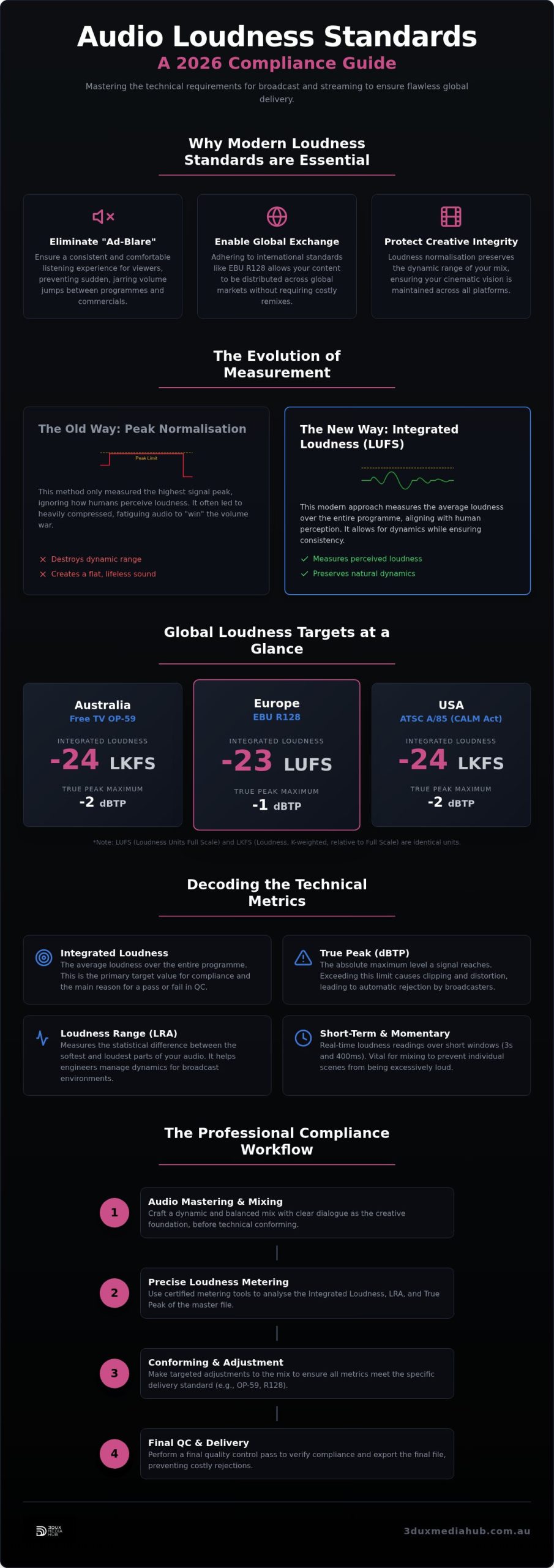
The industry has shifted decisively from peak-based metering to integrated loudness measurement, typically expressed in LUFS or LKFS. This change reflects a move toward human-centric engineering. We no longer just measure the electrical ceiling of a signal; we measure how the audience actually perceives the sound. This transition is essential for maintaining cinematic integrity while meeting the rigid requirements of modern distribution networks.
The Core Objectives of Loudness Regulation
The primary goal is a seamless listening experience. Viewers shouldn’t have to reach for the remote when switching between a high-octane action film and a nightly news bulletin. Dialogue intelligibility is another critical factor. Standards ensure that speech remains clear, even when layered over dense sound effects or music beds. For producers, these regulations facilitate international content exchange. Adhering to established norms like EBU R128 ensures your production meets the technical requirements of global markets without needing a complete, expensive remix. It’s about ensuring your content sounds professional on any screen, in any country.
Why Peak Normalisation is No Longer Sufficient
Traditional peak normalisation focuses on the highest electrical signal level. It doesn’t account for how the human ear perceives “loudness”. A heavily compressed track can sound much louder than a dynamic one, even if they share the same peak value. Relying solely on peak-limiting often destroys dynamic range, resulting in a flat, fatiguing sound that viewers find unpleasant. Modern audio loudness standards for broadcast rely on the ITU-R BS.1770 algorithm. This standardises measurement based on perceived intensity rather than electrical peaks. It allows for natural dynamics and “breathing room” in a mix while keeping the overall programme level consistent. It’s a more sophisticated approach that rewards high-quality mixing rather than just “loud” mixing.
Decoding the Technical Metrics: LUFS, LKFS, and True Peak
Mastering audio loudness standards for broadcast requires a granular understanding of how digital audio behaves across different playback systems. We move beyond simple “volume” into four key metrics: Integrated Loudness, Loudness Range, True Peak, and Short-term values. Each serves a specific purpose in ensuring technical compliance and listener comfort. These metrics aren’t just suggestions; they are the benchmarks used by automated ingest systems to accept or reject your content.
Loudness Range (LRA) measures the dynamic “width” of your audio track. It quantifies the variation between the softest and loudest passages of a programme. A high LRA might be suitable for a theatrical release, but it often requires compression for broadcast to ensure dialogue isn’t lost during quiet scenes. It helps engineers decide if a mix needs more “glue” or if the dialogue needs to be lifted to meet the target LKFS without losing the cinematic impact of the score.
Integrated Loudness vs. Short-term Measurements
Integrated Loudness is the weighted average of audio intensity over time. This whole-programme average is the primary metric for a technical QC pass or fail. While the integrated value tells the story of the entire file, short-term and momentary meters provide real-time data. Short-term measurements, typically using a 3-second window, are vital for identifying problematic scenes in high-action films where a single explosion might skew the perceived balance. Managing these internal peaks ensures the final product remains within the updated ATSC A/85 Recommended Practice guidelines. It allows for a more nuanced mix that preserves energy while staying compliant.
The Critical Role of True Peak in 2026
Traditional sample peaks only measure the highest digital sample. They often miss “inter-sample peaks” that occur during the reconstruction of the analogue wave. These hidden peaks cause audible distortion in consumer-grade playback systems, particularly on mobile devices with low-powered speakers. In 2026, most delivery platforms enforce a strict limit of -1 dBTP or -2 dBTP to prevent this clipping. It is essential that your high bit rate video encoding doesn’t compromise audio headroom. Pushing the video bit rate too far can occasionally introduce artifacts that affect the final audio output during the multiplexing process.
Maintaining this balance between dynamic range and technical limits is where precision mastering becomes invaluable. If you are unsure about your current mix, our team provides expert broadcast quality QC to ensure every metric hits the mark before you hit the delivery deadline.
Comparison of Global Broadcast Standards: OP-59, EBU R128, and the CALM Act
Global distribution demands a precise grasp of regional variances. While the ITU-R BS.1770 algorithm provides a global foundation, local broadcasters enforce distinct targets. Europe adheres to EBU R128, specifying -23 LUFS and a -1 dBTP ceiling. The United States follows the ATSC A/85:2026-07 revision, targeting -24 LKFS with a -2 dBTP limit as part of the CALM Act. Australia’s Free TV Operational Practice, OP-59 (often referenced with AOP001), also targets -24 LKFS but requires a strict ±1.0 LU tolerance. These audio loudness standards for broadcast are the technical gatekeepers of your content’s international success.
Streaming giants like Netflix and Disney+ have established internal specs that often bypass traditional broadcast norms. Netflix, for example, frequently utilises dialogue-gated measurements targeting -27 LKFS. This ensures consistent dialogue levels across their entire library. If you’re delivering to multiple platforms, you can’t rely on a “one-size-fits-all” master. Standards conversion is no longer just about frame rates; it’s about audio recalibration.
Navigating Regional Variations in 2026
A mix that passes in Los Angeles may fail in Sydney. The 1 LU difference between EBU R128 and OP-59 is enough to trigger a technical rejection. Audio conforming is vital when repurposing masters for different territories. This isn’t just a volume shift; it’s a recalibration of the entire mix. We offer specialised audio conforming for international film release to manage these nuances. This process ensures your content sounds professional on any screen, regardless of the local regulatory environment.
Loudness for Physical Media: Blu-ray and 4K UHD
Physical discs offer more dynamic headroom than broadcast or streaming. High-end consumers expect a cinematic experience that utilises the full range of their sound systems. Dialogue Normalisation (Dialnorm) settings in Dolby Digital and DTS-HD are essential here. This metadata informs the playback hardware how to handle the audio stream. It allows you to preserve the impact of an action sequence without burying the dialogue. Balancing this cinematic scale with domestic listening requirements is a core part of our high-efficiency audio encoding and quality control services. We treat your high-value assets with the precision they deserve, ensuring they meet every technical milestone for global delivery.
The Professional Audio Mastering and QC Workflow for Compliance
Compliance isn’t just a final check; it’s an end-to-end technical process. A professional workflow begins with a rigorous technical assessment of the source audio stems. We evaluate the channel mapping, phase coherence, and existing dynamic range. This stage identifies potential issues like dialogue masking or excessive sibilance before they become baked-in problems during the encoding phase. Mastering for audio loudness standards for broadcast requires this proactive approach to protect the cinematic integrity of high-value assets.
Loudness correction involves both automated and manual passes to hit target LUFS with absolute precision. While software can handle the heavy lifting, the final master depends on technical expertise to ensure the audio remains natural and engaging. This methodical approach is the only way to guarantee your content sounds professional on any screen.
Automated Correction vs. Manual Mastering
Efficiency is critical in modern distribution. We utilise “offline” loudness correction for fast-turnaround projects where speed is the primary driver. However, complex film mixes often require a more nuanced, manual pass. Director’s intent can be easily compromised by aggressive automated levelling that ignores the emotional context of a scene. A manual approach allows us to manage dialogue-to-music ratios with precision. We ensure the score remains impactful while the dialogue stays strictly within the target range. It’s about finding the balance between technical compliance and artistic expression.
The QC Checklist: Avoiding Technical Rejections
Technical rejections cause delivery delays and unforeseen costs. Our exhaustive QC checklist goes beyond simple metering. We employ human ears to detect “unnatural” levelling or artifacts that automated tools might overlook. This is a vital part of our high-efficiency quality control (QC) process.
- Phase and Sync: Verifying absolute alignment between audio and video tracks across all channels.
- Signal Integrity: Identifying and removing clicks, pops, and low-level digital noise.
- Metadata Accuracy: Ensuring the Dialnorm and loudness characteristics are correctly flagged in the bitstream.
Integrating these checks with our 2026 Blu-ray quality control services provides a comprehensive safety net for your physical media releases. This ensures the audio loudness standards for broadcast and physical delivery are met simultaneously.
Final mastering involves preparing the audio for 4K UHD authoring services. This requires high-efficiency encoding that preserves the master’s quality while fitting within strict bit rate budgets. If your project needs a reliable partner to handle these complex technical requirements, our team offers expert standards conversion and audio conforming to guarantee a seamless delivery every time.
How 3DUX Media Hub Ensures Your Content Meets Global Delivery Specs
3DUX Media Hub operates as a specialised technical mastering house. Our principals bring over 20 years of practical industry experience to every project. We manage the complex intersection of high-bitrate video encoding and audio loudness standards for broadcast, ensuring that high-value assets are ready for immediate ingest. Our facility handles everything from legacy SD content to modern 4K UHD masters with the same level of technical precision. We understand that a single technical oversight can lead to a chain of delivery failures. This is why we treat every file with the rigour of a major studio release.
Efficiency is a non-negotiable requirement for distributors facing strict delivery deadlines. We’ve developed high-efficiency workflows for broadcast standards conversion services that don’t sacrifice quality for turnaround time. By combining advanced automated tools with manual technical oversight, we deliver compliant files that pass rigorous quality control every time. Whether it’s conforming audio for a local free-to-air network or preparing a 4K UHD Blu-ray master, our processes are designed for speed and reliability.
A Proactive Partner for Film and TV Distributors
We position ourselves as a “safe pair of hands” for your media assets. Our service goes beyond simple file conversion; we provide detailed technical reporting and transparent QC processes. Every master leaving our hub is accompanied by documentation that verifies its compliance with regional standards like OP-59 or EBU R128. This transparency is vital for content localisation and asset preparation. We tailor our solutions to your specific delivery requirements, ensuring that dialogue intelligibility and dynamic range are preserved across every localised version. You receive a partner that understands the high stakes of the entertainment industry.
Ready for Global Release
Preparing a project for international networks or major streaming platforms requires a deep understanding of varied technical specs. 3DUX acts as a unified authoring and post-production hub, simplifying the path from final mix to global distribution. We handle the intricacies of audio conforming and encoding for every major format, from streaming-ready H.264 to high-end HEVC for physical media. This centralised approach reduces the risk of errors and ensures that your production maintains its cinematic integrity across all platforms. We bridge the gap between the creative vision and the technical reality of audio loudness standards for broadcast.
Don’t let technical rejections delay your premiere. Organise your technical QC and mastering with 3DUX Media Hub today to secure a flawless delivery for your next project.
Secure Your Global Premiere with Technical Precision
Mastering the technical nuances of audio loudness standards for broadcast is the final step in protecting your creative vision. Whether you are targeting Free TV Australia’s OP-59 or the updated ATSC A/85:2026-07 requirements, precision is non-negotiable. Hitting the correct LKFS and True Peak targets ensures your content remains consistent across every platform and avoids the costly delays of a technical rejection. It’s the only way to transform a complex regulatory hurdle into a repeatable path for global delivery success.
3DUX Media Hub provides the technical infrastructure and over 20 years of expertise needed to handle high-value media assets. We specialise in broadcast-grade standards conversion and high-efficiency audio encoding with a focus on fast turnaround for global distribution. Our team acts as a safe pair of hands, ensuring your film or TV project meets every technical milestone before ingest. Streamline your delivery with 3DUX Media Hub’s professional QC and encoding services. Your content deserves to sound its best on every screen around the world.
Frequently Asked Questions
What is the standard loudness for broadcast in Australia?
Free TV Australia’s Operational Practice OP-59 specifies a target of -24 LKFS with a strict ±1.0 LU tolerance. The maximum True Peak must not exceed -2 dBTP. These audio loudness standards for broadcast ensure consistency across all commercial and public networks. Adhering to these precise metrics prevents technical rejections during the ingest process. It’s essential to use a meter compliant with the ITU-R BS.1770 algorithm to verify these levels.
What happens if my audio fails a loudness QC check?
A failure typically results in an immediate technical rejection of the master file. Broadcasters and streaming platforms use automated ingest systems that flag any file falling outside the mandatory tolerance range. You’ll need to recalibrate the mix and resubmit the asset, which causes delivery delays and potential financial penalties. Professional quality control identifies these issues early. We provide detailed technical reporting to help you rectify discrepancies before the final delivery deadline.
Is there a difference between LUFS and LKFS?
LUFS and LKFS are functionally identical and refer to the same measurement scale. LUFS (Loudness Units Full Scale) is the term preferred by the EBU R128 standard, while LKFS (Loudness, K-weighted, relative to Full Scale) is used in the ATSC A/85 and OP-59 standards. Both rely on the ITU-R BS.1770 algorithm to calculate perceived loudness. You don’t need to convert between them as a reading of -24 LUFS equals -24 LKFS.
Can I just use a limiter to hit loudness targets?
Relying solely on a limiter often degrades the audio quality and destroys the dynamic range. While a limiter manages the True Peak, it doesn’t address the integrated loudness over the entire programme. Aggressive limiting can make a mix sound flat and fatiguing for the viewer. A professional workflow involves gain staging and manual adjustments to hit the target LUFS while preserving the cinematic impact and dialogue clarity of the original production.
What is True Peak and why does it matter for broadcast?
True Peak measures the actual peak level of the analogue signal after it is reconstructed from digital samples. Traditional sample-peak meters often miss inter-sample peaks that cause audible distortion in consumer playback hardware. For broadcast, staying below -2 dBTP is critical to ensure the audio remains clean across various devices. This metric is a cornerstone of audio loudness standards for broadcast and prevents clipping during the digital-to-analogue conversion process.
Do streaming platforms like Netflix have different loudness standards than TV?
Yes, streaming platforms often enforce their own internal specifications that differ from traditional terrestrial broadcast. Netflix frequently targets -27 LKFS (±2 LU) using a dialogue-gated measurement. This approach prioritises consistent speech levels across their entire content library. Disney+ and Amazon Prime also have unique delivery requirements. You must tailor your final master to the specific technical delivery specifications of the platform to ensure a successful QC pass.
How do I measure the loudness of my film for international delivery?
You must use a software or hardware loudness meter that supports ITU-R BS.1770-4 or later. Measurement requires a full-programme pass to calculate the Integrated Loudness (I), Loudness Range (LRA), and Max True Peak. For international distribution, you’ll often need to create multiple versions of the audio track. This conforming process ensures the mix aligns with the specific regulatory targets of each territory, such as -23 LUFS for Europe or -24 LKFS for Australia.
What is the target loudness for Blu-ray and DVD authoring?
Physical media allows for significantly more dynamic range than broadcast television. There is no legally mandated loudness target for Blu-ray or DVD, but industry best practice suggests targeting -27 to -24 LKFS. The focus shifts to Dialogue Normalisation (Dialnorm) metadata, which tells the consumer’s receiver how to scale the playback volume. This preserves the cinematic scale of the film while ensuring the dialogue remains intelligible in a domestic listening environment.