A world-class script and stunning visuals won’t save your production if it fails a broadcaster’s technical QC at the final hurdle. In the high-stakes world of international distribution, a single non-compliant audio track or an incorrectly formatted subtitle file can derail a global release schedule and lead to costly rejections. You’ve likely felt the pressure of managing multiple language assets while trying to untangle the complexities of frame rate standards and audio conforming. It’s a technical minefield where precision is the only currency that matters.
This guide empowers you to master the technical intricacies of preparing your content for foreign markets. By leveraging professional TV series localisation services, you can ensure your assets are meticulously prepared to meet the most stringent delivery specifications, including the latest EBU R 128 and ATSC A/85 standards. We’ll explore the essential workflows for asset mastering, subtitle integration, and broadcast-quality quality control. You will learn how to transition from a messy collection of files to a streamlined, distribution-ready package that guarantees a seamless launch across every territory.
Key Takeaways
- Understand why professional TV series localisation services are essential for adapting creative content and technical assets for global markets.
- Master the critical workflows of audio conforming and high-efficiency encoding to meet strict territory-specific delivery specifications.
- Navigate the complex web of global broadcast standards and compliance requirements to secure international distribution deals with confidence.
- Learn how broadcast-grade quality control protects your production from technical rejection through rigorous, frame-by-frame asset verification.
- Discover how an experienced technical partner manages the heavy lifting of 4K UHD mastering to ensure a seamless global release.
What are TV Series Localisation Services in 2026?
Effective TV series localisation services involve far more than simple linguistic translation. In 2026, the process is a high-stakes technical discipline that merges creative adaptation with rigorous media engineering. While a translation agency focuses on the script, a professional localisation hub ensures the entire asset is fit for purpose in a new territory. This includes everything from metadata compliance to the precise alignment of audio tracks with localised visual cues. It’s about making sure the programme feels native to the viewer while meeting the strict delivery specs of international broadcasters.
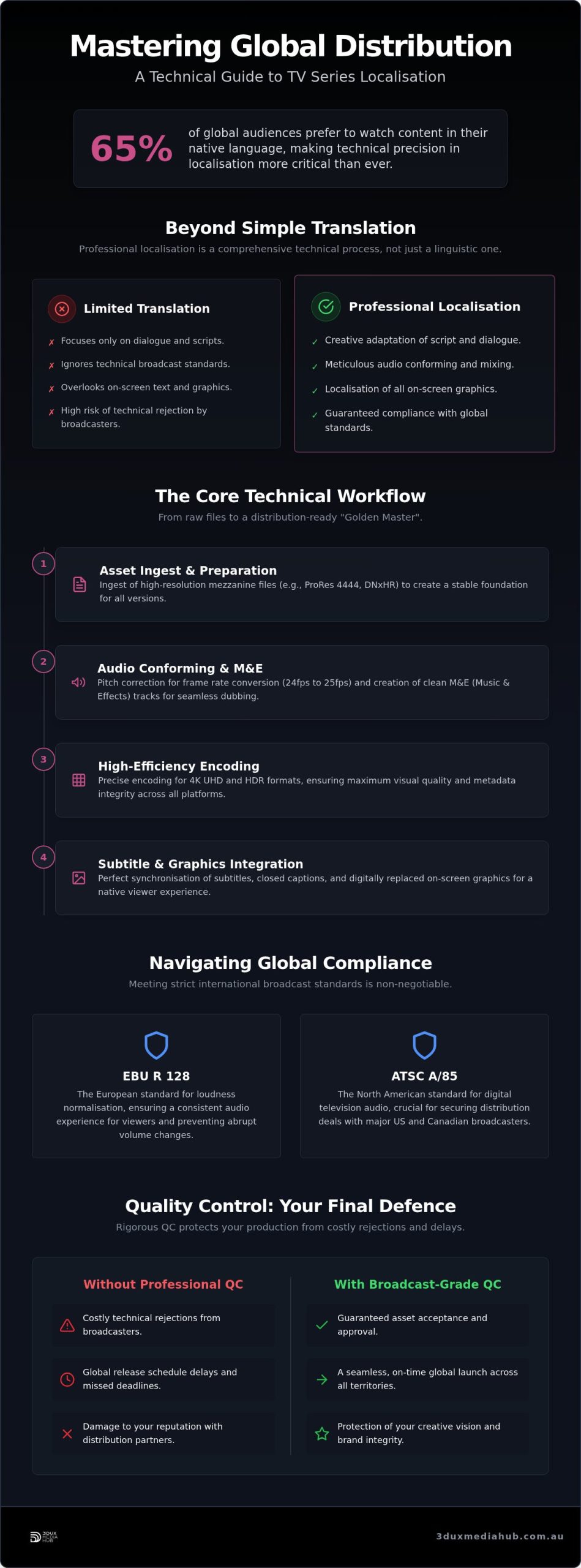
The industry has shifted significantly. We’ve moved beyond standard definition and basic stereo. Modern distribution requires high-dynamic range (HDR) mastering and immersive audio profiles like Dolby Atmos to be maintained across every language version. Research from April 2026 indicates that 65% of global audiences prefer content in their native language. To meet this demand without sacrificing quality, distributors now require technical partners who understand the “how” of file structures as much as the “what” of the dialogue. It’s no longer enough to just get the words right; you have to get the bits and bytes right too.
Beyond Subtitles: The Scope of Localisation
Comprehensive localisation covers every element of the viewer experience. This involves a strategic mix of Dubbing, subtitling, and closed captioning for accessibility. It also extends to the visual plane. On-screen text, such as location markers, newspapers, or mobile phone screens, must be digitally replaced or “burnt-in” with translated graphics that match the original aesthetic. We also prepare marketing assets, ensuring trailers and sizzle reels carry the same technical polish as the main feature. Every asset must be synchronised perfectly to avoid the jarring “uncanny valley” effect of poorly timed audio.
Why Technical Precision Matters for Global Release
Precision is your best defence against expensive broadcast rejections. A minor sync error or a non-compliant loudness level, failing to meet updated standards like ATSC A/85:2026-07, can lead to an entire series being flagged and sent back for remediation. This doesn’t just cost money; it damages your reputation with global platforms. Mastering for the world means creating a robust “Golden Master” that can be efficiently adapted for any region without starting from scratch. High-quality localisation protects your creative vision. It ensures that whether a viewer is in London, Tokyo, or Melbourne, they experience the same emotional impact and technical excellence you intended during production.
The Technical Core: Audio Conforming and Asset Preparation
The success of any global distribution strategy hinges on the integrity of the master assets. Preparing a TV series for a new territory is a rigorous engineering process that begins with the ingest of high-resolution mezzanine files. These master files, often in formats like ProRes 4444 or DNxHR, serve as the source for all subsequent versions. For professional TV series localisation services, managing these assets requires a methodical approach to ensure that every language track and subtitle file aligns perfectly with the primary video stream. This stage is where technical debt is either created or eliminated.
High-efficiency video and audio encoding is the engine of this workflow. As we move into 2026, the demand for 4K UHD and HDR content means files are larger and more complex than ever. Precise encoding ensures that visual quality remains consistent across varying bandwidths while maintaining metadata integrity. This preparation ensures that your content is ready for the rigours of global delivery, preventing the “drift” that often occurs when assets are handled by multiple uncoordinated vendors. It provides a stable foundation for every territory-specific deliverable.
Audio Conforming for International Standards
A critical component of this process is audio conforming for international film release and television distribution. When a series moves between territories, it often encounters different frame rate requirements. For instance, converting from 24fps film standard to 25fps for Australian or European broadcast requires sophisticated pitch correction. Without this, the audio will suffer from a noticeable shift in tone that alienates viewers. We also manage the complex layering of M&E (Music and Effects) tracks. These tracks must be perfectly “clean” of any original dialogue to allow for seamless dubbing. Adopting the EGA Dialogue List Standard ensures that every line is documented with the technical precision required for accurate timing and placement across all language versions.
Preparing Assets for Multi-Platform Delivery
Asset preparation is the systematic organisation of video, audio, and metadata to meet the specific technical requirements of varied delivery targets. SVOD platforms typically demand high-bitrate IMF (Interoperable Master Format) packages with extensive metadata, while linear broadcasters often require specific MXF wrappers and loudness-normalised audio. Organising these assets correctly at the start of the project allows for a much faster turnaround when utilising video encoding services. This logical structure reduces the risk of human error during the final mastering phase. If you need to streamline your delivery pipeline, our team can help you organise your master assets for a flawless global release.
Navigating Global Compliance and Broadcast Standards
Securing an international distribution deal is only half the battle. The real challenge lies in meeting the diverse technical specifications required by broadcasters and streaming platforms across different continents. Each territory operates under its own regulatory framework and technical legacy, making TV series localisation services a critical component of the delivery chain. Compliance isn’t a suggestion; it’s a contractual prerequisite. If your master files fail to meet a broadcaster’s specific loudness levels or subtitle formatting, the release is halted, and your revenue is delayed.
Metadata accuracy is equally vital. In 2026, streaming platforms rely on precise metadata for searchability, regional content ratings, and language tagging. An error in a single XML file can lead to content being mislabelled or hidden from the correct audience. To ensure your programme is accessible and compliant everywhere, you must utilise professional broadcast standards conversion services. This ensures that your content is technically “legal” in every market it enters. It’s about protecting the integrity of the asset while satisfying the gatekeepers of global media.
Meeting Territory-Specific Delivery Specifications
Navigating the gap between EBU standards in Europe and ATSC standards in North America requires deep technical expertise. The updated ATSC A/85:2026-07 standard for loudness in the US differs significantly from the EBU R 128 version 5.0 guidelines used across the UK and EU. Asian and Latin American markets often introduce their own nuances, particularly regarding closed captioning and audio channel mapping. In Australia, local broadcasters have strict requirements for technical metadata and audio peaks that must be met for free-to-air transmission. Managing these variables requires a centralised approach to avoid the fragmentation of your assets across different vendors.
The Role of Professional Standards Conversion
High-quality frame rate conversion is the backbone of global distribution. Converting a series shot at 23.976 fps for a 25 fps PAL market or a 29.97 fps NTSC market is not a simple task. Poorly executed conversions result in “ghosting” or stuttering motion artifacts that degrade the viewer experience. We maintain image integrity during complex processes like HD to 4K upscaling by using advanced motion-compensated algorithms. This ensures that the visual fidelity of your production remains intact, regardless of the delivery format. Professional conversion prevents the technical rejections that plague uncoordinated localisation efforts and ensures your content looks exactly as the director intended.
Quality Control: Protecting Your Content from Rejection
Broadcast-grade quality control (QC) is the final, uncompromising barrier between your production and a successful global launch. While a translation agency might focus on linguistic proofreading, technical QC involves a frame-by-frame scrutiny of the entire media asset. This process ensures that every audio track, subtitle stream, and metadata tag adheres to the precise delivery standards discussed earlier. Professional TV series localisation services rely on this rigorous validation to prevent technical rejections that can stall a distribution deal indefinitely. It is the ultimate safeguard for your brand and your revenue.
The financial risks of bypassing this stage are substantial. A single mastering error discovered after a series has been delivered to an international broadcaster can lead to kill-fees, missed broadcast windows, and the high cost of emergency remediation. We employ a strict eyeballs-on methodology, a standard practice in our Blu-ray quality control services, where a trained operator monitors the content in real-time. This level of oversight produces a comprehensive QC report that serves as a technical guarantee for your distributors, confirming the asset is ready for air without reservation.
Identifying Common Localisation Technical Errors
Technical flaws often emerge during the complex process of multiplexing different language assets. Subtitle sync drift is a frequent issue where timing gradually offsets over the duration of an hour-long episode. We also look for audio phase problems that can occur during the creation of localised stereo or surround mixes. A critical area of focus is the forced narrative, which covers the subtitles required for on-screen text or foreign dialogue within the programme. If these are missing or incorrectly timed, the story logic collapses for the viewer. Metadata errors, such as incorrect language tagging or aspect ratio flags, are also identified and rectified before the final package is wrapped for delivery.
The Importance of Human Oversight in 2026
In 2026, many vendors have pivoted toward AI-driven QC to reduce costs. While automated tools are efficient at detecting black frames or digital silence, they are insufficient for comprehensive TV series localisation services. AI lacks the cognitive ability to detect subtle mastering flaws like slight lip-sync lag or macroblocking in dark scenes that a human operator identifies instantly. A seasoned technical operator provides the safe pair of hands required to manage these complexities. Expert human oversight ensures that every creative nuance is preserved and every technical spec is exceeded. To protect your assets from costly technical failures, book a broadcast-quality QC session with 3DUX Media Hub today.
Partnering with 3DUX for Seamless Localisation
3DUX Media Hub stands as the premier technical partner for producers and distributors requiring high-end TV series localisation services in Australia. We don’t just translate scripts; we engineer your assets for global consumption. With over 20 years of industry experience, we provide a safe pair of hands for high-value media assets. Our deep-rooted expertise in 4K UHD authoring services gives us a distinct advantage when managing complex file structures and the latest HDR standards. We handle the technical heavy lifting of mastering and preparation, allowing you to focus on the creative aspects of your global rollout.
Our Technical Expertise in Media Localisation
Our facilities are purpose-built to meet the rigours of 2026 broadcast and streaming requirements. We offer specialised capabilities in audio conforming and subtitle integration, ensuring every language track aligns perfectly with the visual master. This involves more than just syncing audio; we manage pitch correction, M&E track integrity, and forced narrative placement with clinical precision. Our state-of-the-art encoding and mastering centre supports a wide array of formats, from high-bitrate IMF packages for SVOD platforms to specialised MXF wrappers for linear broadcast. Whether your project is destined for a physical Blu-ray release or a global digital platform, we ensure the final deliverable is technically flawless and fully compliant with territory-specific specs.
Fast Turnaround and Global Distribution Support
Modern distribution cycles operate at a relentless pace. Our workflows are optimised for efficiency, providing the fast turnaround times required for day-and-date global releases. This methodical approach benefits both independent producers and major distributors by reducing the risk of technical bottlenecks. We maintain a proactive commitment to accuracy, identifying potential compliance issues before they lead to costly rejections. Our team understands the high stakes of the entertainment industry; we treat your content with the urgency and precision it deserves. We don’t just act as a vendor; we function as a technical extension of your production team, ensuring every asset is distribution-ready.
Securing a global release requires more than just a great story. It requires a technical partner who understands the intricacies of the international media landscape. Don’t leave your delivery to chance or rely on automated tools that miss the subtle mastering flaws that lead to rejection. Contact 3DUX Media Hub today to discuss your TV series localisation requirements and ensure your content reaches its global audience without technical compromise.
Master Your Global Content Delivery
Achieving a successful international rollout requires a shift in focus from basic linguistic translation to technical media engineering. You’ve seen how precise audio conforming, rigorous broadcast-grade QC, and absolute compliance with global standards like EBU R 128 are the real keys to unlocking new markets. Without this technical foundation, even the most compelling series risks costly rejection at the final hurdle. Managing these complexities doesn’t have to be a burden on your production team. By utilising professional TV series localisation services, you ensure your high-value assets are distribution-ready and technically beyond reproach.
3DUX Media Hub brings over 20 years of technical mastering experience to every project, offering a safe pair of hands for your content. We provide the fast turnaround and global compliance expertise needed to meet modern distribution cycles head-on. Don’t let technical non-compliance stand between your story and its worldwide audience. Enquire about our TV series localisation and technical mastering services today and secure your programme’s global future. Your production deserves a flawless launch in every territory.
Frequently Asked Questions
What is the difference between subtitling and localisation for TV?
Subtitling is a linguistic subset of the broader localisation process. While subtitling focuses specifically on translating dialogue into text, TV series localisation services encompass the entire technical and creative adaptation of the programme. This includes audio conforming for different frame rates, the integration of forced narratives, and the replacement of on-screen graphics. It ensures the programme meets the specific cultural and technical requirements of every target territory.
Why is audio conforming necessary for international TV distribution?
Audio conforming is essential to maintain synchronisation when a series is converted between different frame rates, such as moving from 23.976 fps to 25 fps for Australian broadcast. Without this process, the audio will drift out of sync and suffer from noticeable pitch shifts. It also involves managing M&E tracks to ensure that music and sound effects remain intact while original dialogue is removed for dubbing in a new language.
Can I use AI for my TV series localisation and QC?
AI tools offer speed for initial transcriptions or basic error detection, but they lack the cognitive depth required for high-value TV assets. Automated QC often misses subtle mastering flaws like minor lip-sync lag or artistic inconsistencies in HDR grading. For professional distribution, human oversight remains critical. A seasoned technical operator provides the necessary verification to ensure your comprehensive TV series localisation services pass rigorous broadcaster inspections without the risk of costly rejections.
What are the most common technical standards for global TV delivery?
Global delivery relies on several key technical standards that vary by region. The most common include EBU R 128 for loudness in Europe and the updated ATSC A/85:2026-07 standard used in North America. For ultra-high-definition content, ITU-R BT.2020 defines the parameters for colour space and dynamic range. Adhering to these standards is mandatory for securing distribution deals and ensuring your series is technically compatible with regional broadcast infrastructures.
How long does the localisation and technical mastering process take?
The timeline for localisation and technical mastering depends on the volume of episodes and the complexity of the delivery specs. Our internal workflows are optimised for the fast turnaround cycles required by modern distributors. A typical project involving audio conforming, subtitle integration, and broadcast QC can often be completed within tight windows to support day-and-date global launches. We prioritise efficiency without compromising the technical integrity of the final master.
Do I need different masters for streaming platforms and physical media?
Yes, streaming platforms and physical media have distinct technical requirements. SVOD platforms generally require high-bitrate IMF packages with specific metadata wrappers, while Blu-ray distribution requires BD-CMF masters with interactive menu designs. Each format demands unique encoding profiles and authoring structures. Our team manages these parallel workflows to ensure that your series looks and performs optimally, whether it is being streamed in 4K or played from a physical disc.
What technical assets do I need to provide for localisation?
To begin the localisation process, you must provide high-resolution mezzanine files, typically in ProRes 4444 or DNxHR formats. You also need to supply clean M&E (Music and Effects) tracks that are free of original dialogue, along with accurate scripts or dialogue lists. If your series uses specific branding, providing original fonts and motion graphic project files allows us to replicate on-screen text and titles in the target language with visual consistency.
How does 3DUX Media Hub ensure broadcast compliance for international markets?
3DUX Media Hub ensures broadcast compliance through a combination of 20 years of technical experience and rigorous, eyes-on quality control. We utilise advanced standards conversion tools to manage frame rate transitions and loudness normalisation according to territory-specific regulations. Every asset undergoes a frame-by-frame inspection by a technical operator to verify that all video, audio, and metadata parameters meet the exact delivery specifications provided by your international distribution partners.