A single character encoding error can derail a global distribution deal in seconds. You’ve perfected the colour grade and the atmos mix, yet a minor sync drift in the third act triggers an immediate QC rejection. Professional subtitle integration services aren’t just about translation. They’re about technical precision. We understand the pressure of meeting complex delivery specifications across multiple streaming platforms while managing regional frame rate conversions and ACMA compliance. It’s a high-stakes environment where the smallest technical oversight results in costly delays and damaged reputations.
This guide provides the technical roadmap to mastering your media assets for 2026 broadcast and global distribution standards. You’ll learn how to produce a compliant master file that ensures seamless subtitle rendering across all playback devices while preserving your film’s artistic integrity. We’ll break down the essential workflows for HEVC 4K UHD encoding, character sets, and the rigorous localisation requirements demanded by modern streamers. By the end, you’ll have the expertise to navigate the most demanding delivery schedules with confidence, ensuring your content is ready for a global audience without the risk of technical failure.
Key Takeaways
- Understand why modern subtitle integration is a technical mastering process essential for passing the strict QC requirements of global SVOD and broadcast platforms.
- Master the frame-accurate workflow required to prepare picture locks and ensure global character set compatibility across diverse regional markets.
- Identify the critical technical differences between managing subtitle streams for 4K UHD and Blu-ray authoring versus digital sidecar formats like SRT and VTT.
- Ensure compliance with 2026 ACMA broadcast quotas and international standards by leveraging professional subtitle integration services for your master files.
- Streamline your distribution pipeline and reduce the risk of technical rejection by consolidating encoding, authoring, and localisation with a single expert partner.
The Critical Role of Professional Subtitle Integration in 2026
Subtitle integration is a high-stakes technical mastering task. It’s the final gatekeeper between your production and a global audience. By 2026, the industry has moved beyond simple sidecar text files. We’re now in an era of integrated asset management where subtitles are treated with the same technical rigour as the 4K UHD video stream or the Dolby Atmos mix. Professional subtitle integration services transform raw translation data into frame-accurate, compliant assets ready for international release. This isn’t just about placing text on a screen; it’s about ensuring every character and timecode aligns with the strict metadata requirements of modern delivery pipelines.
This shift is driven by the demands of global SVOD platforms and evolving Australian broadcast standards. High-quality localisation does more than translate dialogue. It preserves the artistic integrity of the film while ensuring a ‘fair go’ for diverse audiences across Australia. Without precise integration, you risk sync drift, character encoding errors, and immediate QC rejection. In a competitive market, a polished, accessible master file significantly increases your content’s international marketability and reach. It allows your project to scale across territories without the need for constant, expensive technical revisions.
Subtitle Types: Burnt-in vs. Selectable Streams
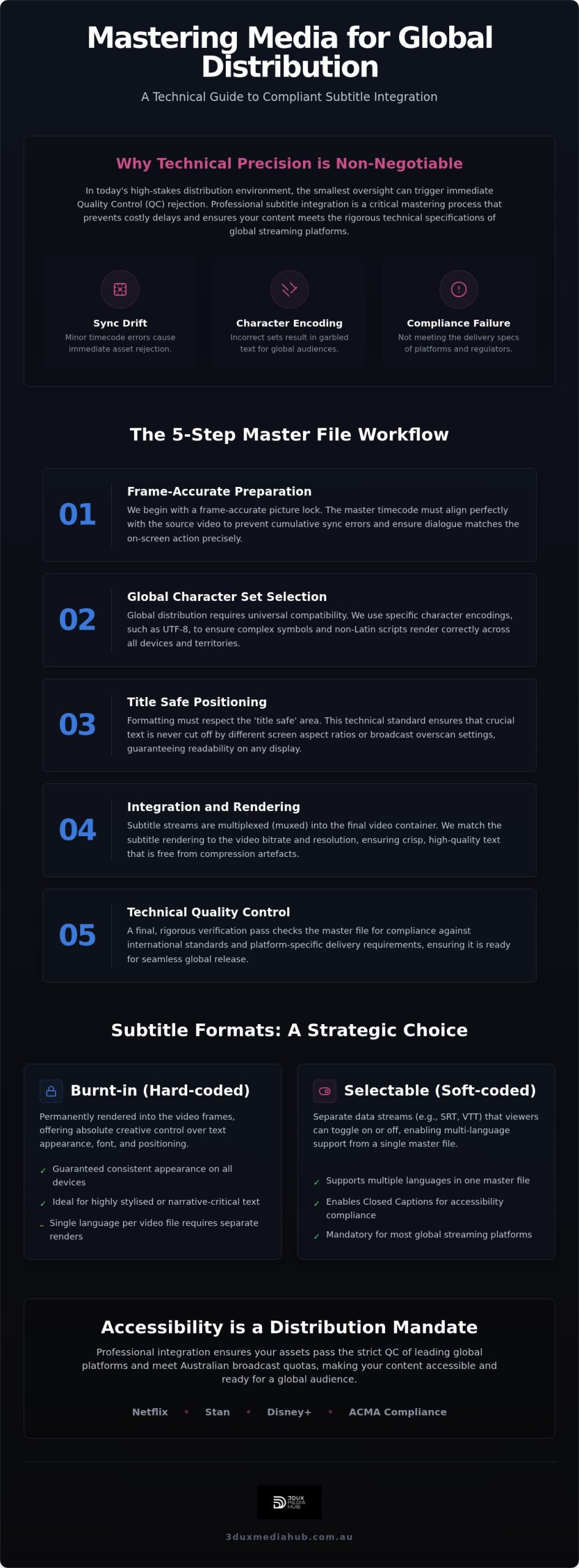
Choosing the right format is a strategic decision. Burnt-in, or hard-coded subtitles, are rendered permanently into the video frames. This is often a creative choice for specific narrative beats or stylised text that must appear exactly the same on every device. However, selectable or soft-coded streams offer the technical advantage of multi-language support within a single master. These selectable streams allow viewers to toggle between languages or turn on Closed Captions (CC). While subtitles focus on dialogue for foreign language viewers, CC includes essential non-speech information like sound effects and speaker identification, making it a critical tool for accessibility and regulatory compliance.
Why Accessibility is a Distribution Mandate
Accessibility isn’t optional. It’s a distribution mandate. Platforms like Netflix, Stan, and Disney+ enforce rigorous delivery specifications that require 100% compliance. In Australia, the ACMA sets strict subtitle quotas for broadcast media to ensure all citizens can access content reliably. Meeting these standards late in the cycle is a costly mistake. Retrofitting subtitles often leads to technical debt, where sync issues and encoding bugs require expensive re-masters. By using professional subtitle integration services early in the authoring process, you ensure your assets pass QC the first time, every time.
The Technical Workflow: From Asset Preparation to Master File
The path from a raw picture lock to a compliant master file is a rigorous technical progression. It’s not a simple overlay process. It’s an engineering task. Professional subtitle integration services manage this transition by ensuring every text element is technically compatible with the final delivery container. This workflow prevents the common pitfalls that lead to QC failure, such as drift or illegible rendering on high-resolution displays.
- Step 1: Frame-Accurate Preparation. We begin with a frame-accurate picture lock. The time-coded master must align perfectly with the source video to prevent cumulative sync errors.
- Step 2: Character Set Selection. Global distribution requires support for diverse languages. We use specific character encodings, such as UTF-8, to ensure complex symbols and non-Latin scripts render correctly across all devices.
- Step 3: Title Safe Positioning. Formatting must respect the ‘title safe’ area. This ensures text isn’t cut off by different screen aspect ratios or broadcast overscan settings.
- Step 4: Integration and Rendering. Subtitle streams are multiplexed into the video container. We match the subtitle rendering to the video bitrate, ensuring crisp text that doesn’t suffer from compression artefacts.
- Step 5: Technical QC. A final verification pass checks for compliance against international standards, ensuring the file is ready for global release.
Encoding and Asset Localisation
Localising content for international markets involves more than just text. It requires precise audio conforming for international film release to ensure the dialogue and subtitles remain in perfect sync. A common challenge is managing frame rate discrepancies. Converting from 23.976 fps to 25 fps for European or Australian broadcast can cause significant drift if not handled at the mastering level. Our process accounts for these variations, ensuring your assets remain frame-accurate regardless of the target territory’s standards.
Technical Specifications for 4K and HEVC
High-resolution mastering introduces new complexities. When using professional video encoding services, the interaction between the HEVC bitrate and the subtitle stream is critical. In 4K UHD and HDR environments, subtitles must be mastered to avoid “blooming” or being overly bright, which can distract the viewer. We optimise subtitle assets for Dolby Vision and HDR10 masters, ensuring the text remains sharp and legible without compromising the high-dynamic-range integrity of the video. If you’re preparing a high-value asset for global release, partnering with a veteran team for professional video encoding and authoring is the most reliable way to ensure your master passes every technical hurdle.
Subtitles for Physical Media vs. Digital Streaming
Physical media delivery presents a unique set of technical hurdles compared to digital streaming. While streaming relies on flexible text-based files, 4K UHD and Blu-ray authoring require a more rigid, bitmap-driven approach. Professional subtitle integration services must navigate these hardware-specific constraints to ensure a consistent experience across every player, from high-end home cinema systems to basic consoles. The choice between physical and digital dictates the entire mastering workflow, from font selection to final multiplexing.
User-interface (UI) design plays a critical role in how viewers interact with these assets. On a disc, the subtitle selection is hard-wired into the navigation logic. If the stream hierarchy isn’t correctly defined, hardware players may default to the wrong language or fail to display the track entirely. We focus on creating a seamless logic that allows for instant language switching without playback interruption. This requires precise mapping of the subtitle streams to ensure they align with the player’s internal register settings.
Integrating Subtitles into Blu-ray and 4K UHD Authoring
In the world of physical media, subtitles are typically pre-rendered as Presentation Graphic Streams (PGS). These are bitmap images, not text. This gives us total control over the font rendering and colour palettes, but it requires rigorous testing. We link these tracks directly to the interactive Blu-ray menu design, ensuring the ‘Subtitles’ menu accurately triggers the correct stream. Readability is the priority. We test every asset on multiple display types to ensure the text remains crisp and the anti-aliasing doesn’t create artefacts on high-resolution 4K screens.
Mastering for Global SVOD Platforms
Digital delivery for SVOD platforms like Netflix or Stan usually involves ‘sidecar’ files such as SRT, VTT, or SCC. These files are delivered alongside the video master, allowing the platform’s player to render the text. Metadata tagging is vital here. Each file must be correctly labelled so the platform’s algorithm can identify the language and accessibility options. Professional subtitle integration services also handle the complexities of different versions. We ensure that if a film has a theatrical cut and a slightly longer home video version, the subtitle timecodes are adjusted with frame-accurate precision for both. This prevents the sync drift that often plagues poorly managed digital releases.
Compliance, Quality Control, and Global Standards
Compliance isn’t just a tick-box exercise. It’s a financial safeguard. By 2026, the ACMA has implemented rigorous subtitle quotas for Australian broadcast media that leave no room for error. If your master file fails to meet these benchmarks, the resulting financial penalties and distribution delays can be catastrophic. International markets are equally demanding. Standards such as EBU-TT and SMPTE-TT provide the technical framework for global release, while the latest WCAG accessibility guidelines ensure your content reaches every viewer regardless of their needs. Professional subtitle integration services ensure your assets meet these global benchmarks before they ever reach the QC bay.
The risk of delivery rejection is high when technical specifications are misunderstood. Many distributors rely on automated tools, but these often miss critical subtitle errors. A common failure is the ‘shot change’ error, where a subtitle persists across a visual cut. This creates a jarring experience and is an automatic fail for many premium SVOD platforms. Relying on professional subtitle integration services provides a human-led verification layer that software simply cannot replicate. We ensure your project remains compliant with both local regulations and international delivery mandates.
Broadcast-Grade Quality Control (QC)
Our QC process is exhaustive. We verify sync, duration, and reading speed, measured in characters per second, to ensure the text is legible and comfortable for the viewer. We check for text overlaps and positioning errors as part of our 2026 Blu-ray quality control services. This prevents subtitles from obscuring critical visual information, lower-third graphics, or hard-coded creative text. Every track is scrutinised to ensure it meets the specific technical profile of the target broadcaster or streaming service.
Standards Conversion and Subtitle Integrity
Managing subtitle assets during broadcast standards conversion services is a complex technical task. Converting between PAL and NTSC formats often breaks the relationship between the timecode and the video frame. This leads to drift that worsens over the duration of the programme. We manage these conversions at the metadata level, ensuring the subtitle integrity remains intact across all global regions. This maintains consistent localisation quality whether your content is destined for an Australian audience or an overseas market. Don’t risk a costly rejection at the final hurdle. Secure your release with professional broadcast QC and subtitle mastering.
Organising Your Professional Subtitle Workflow with 3DUX
Efficiency is the benchmark of a successful distribution strategy. 3DUX Media Hub streamlines the integration of subtitles into your mastering project by treating it as a core technical component rather than an afterthought. By choosing professional subtitle integration services that sit within a broader mastering ecosystem, you eliminate the communication gaps that occur when juggling multiple vendors. We provide a single point of contact for encoding, authoring, and localisation, ensuring that your technical metadata remains consistent from ingest to the final master file.
With over 20 years of technical expertise, we’ve seen every common pitfall in media delivery. We anticipate the sync issues, character encoding errors, and frame rate drift mentioned earlier in this guide. This proactive approach allows for fast turnaround times on urgent distribution deadlines. We understand that in the entertainment industry, time is a high-value asset. Our workflow is designed to move your project through the pipeline with speed and precision, ensuring every asset is ready for global release without the risk of a late-stage QC rejection.
A Holistic Approach to Media Authoring
We combine our subtitle expertise with 4K UHD authoring services to create a premium release. This holistic approach ensures that your subtitle tracks are technically optimised for the specific delivery container, whether it’s a physical disc or a global SVOD platform. We provide customised asset preparation for every major distributor, following their unique technical bibles to the letter. Our technical consulting starts at the ingest phase, identifying potential compliance issues before they become expensive problems.
Next Steps for Your Production
Moving your project into the integration phase is a straightforward process. We require a frame-accurate picture lock and your time-coded master files to begin. If you’re unsure about the state of your current assets, we offer a technical assessment to identify any gaps in your distribution readiness. This ensures that when we finalise your master for global delivery, you can proceed with absolute confidence. Our team is ready to handle your high-value assets with the precision they deserve, ensuring your content connects with audiences across Australia and the world. Reach out today to discuss your project’s specific requirements and secure your distribution timeline.
Secure Your Global Distribution Strategy
Mastering for 2026 requires a technical shift. Moving beyond simple sidecar files to integrated, frame-accurate assets is now the industry standard for high-value releases. Whether you’re delivering to premium SVOD platforms or authoring for 4K UHD, absolute precision in character encoding and sync is the only way to avoid costly QC rejections. By leveraging professional subtitle integration services, you ensure your project meets the strict ACMA quotas and international standards required for a successful release.
3DUX Media Hub provides the technical infrastructure to protect your investment. We bring over 20 years of industry-leading expertise to every project, offering comprehensive global distribution support for 4K UHD and Blu-ray. Our broadcast-grade QC ensures your assets are compliant and ready for the most demanding delivery schedules. Don’t leave your final master to chance. Enquire about our professional mastering and localisation services today. With the right technical partner, your content will reach global audiences with its artistic integrity and technical quality fully intact.
Frequently Asked Questions
Is subtitle integration mandatory for all Australian film releases in 2026?
Subtitle integration is mandatory for all Australian broadcast television under ACMA quotas. While theatrical and streaming releases aren’t governed by the same legislative mandates as broadcast, they face strict commercial requirements. Major global platforms won’t accept a master file that lacks accessible tracks. It’s best to integrate these during the mastering phase to ensure your production is ready for every possible distribution channel without the need for expensive re-authoring.
What is the difference between SRT, STL, and VTT subtitle formats?
These formats serve different delivery containers. SRT is a basic text format used for web video. VTT is the standard for SVOD platforms, supporting metadata and basic styling. STL is a legacy broadcast format often used for EBU standards in Australia. Choosing the correct format is essential when using professional subtitle integration services to ensure technical compatibility with your target platform’s specific delivery requirements and metadata specifications.
Can I add selectable subtitles to a 4K UHD disc after it has been authored?
No, you can’t add selectable subtitles to a 4K UHD or Blu-ray disc once the authoring process is complete. Subtitle streams are multiplexed into the physical stream structure of the disc. Any changes to the language options require a full re-authoring of the project. This involves updating the stream hierarchy, re-linking the interactive menus, and generating a new master image. Proper planning during the ingest phase is critical to avoid these delays.
How do professional subtitle services ensure sync across different frame rates?
Professionals use frame-accurate timecode conversion to manage sync during standards conversion. If a film is shot at 23.976 fps but requires a 25 fps master for Australian broadcast, the subtitles must be re-timed to match the new duration. We use technical offsets and interpolation to ensure the text remains perfectly aligned with the picture lock. This prevents the cumulative drift that often occurs when using automated or consumer-grade conversion tools.
What are the ACMA requirements for subtitles on Australian broadcast television?
The ACMA mandates specific subtitle quotas for primary and multi-channel broadcast services in Australia. By 2026, these requirements cover a significant portion of programming, especially during prime-time windows. Subtitles must be accurate, synchronised, and legible to meet these rigorous standards. Failure to comply results in immediate broadcast rejections and potential regulatory investigation. We ensure your master files are technically compliant with these specific Australian standards before final delivery occurs.
Does adding multiple subtitle streams affect the video quality on a Blu-ray?
Adding subtitle streams doesn’t inherently degrade video quality, but it does consume a portion of the disc’s total bitrate budget. On a 4K UHD or Blu-ray disc, every asset competes for available space. While a single subtitle stream is relatively small, dozens of high-resolution bitmap streams can impact the overall overhead. We manage the multiplexing process to ensure the video bitrate remains high while providing a comprehensive suite of language options for global distribution.
How do I ensure my subtitles are compliant with Netflix and Disney+ specs?
Compliance requires following the specific technical bibles provided by each platform. Netflix and Disney+ have rigorous standards for reading speed, line length, and character encoding. They often require specific sidecar formats like TTML or SCC with precise metadata tagging. Using professional subtitle integration services ensures that your assets are checked against these platform-specific requirements during the final QC pass, significantly reducing the risk of a technical rejection or sync error.
What is the typical turnaround time for professional subtitle integration?
Turnaround times vary based on the project’s complexity and the number of languages required. A standard feature film integration for a single language usually takes three to five business days for mastering and QC. More complex projects involving 4K UHD authoring or multi-language localisation may require a longer schedule. We prioritise efficiency and accuracy to meet urgent distribution deadlines without compromising the technical integrity or compliance of your final master file.