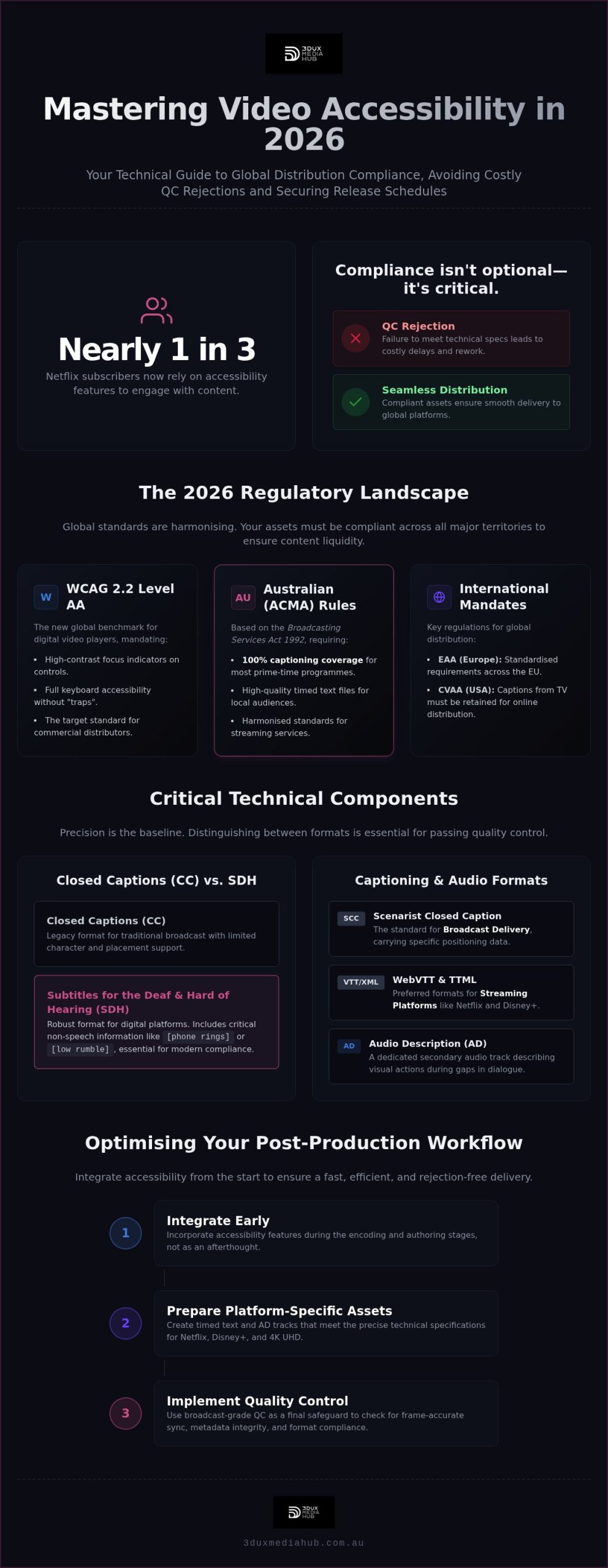
Nearly one-third of Netflix subscribers now rely on accessibility features to engage with their favourite films and series. This isn’t just about inclusivity; it’s a fundamental requirement for global content liquidity. Achieving accessibility compliance for video content has shifted from a post-production afterthought to a critical technical standard that can make or break your distribution deal. If your master files don’t meet the rigorous specifications of major streamers, you’re looking at costly QC rejections and delayed release schedules.
We understand the pressure of navigating the technical gap between closed captions, SDH, and complex audio description workflows. It’s frustrating when international regulations seem to shift just as you’re ready to deliver. This guide provides the clarity you need to master the 2026 distribution landscape, from the latest ADA Title II mandates to WCAG 2.2 best practices. You’ll learn how to streamline your localisation process, satisfy the technical requirements of platforms like Disney+, and ensure your assets pass every quality control check with precision.
Key Takeaways
- Navigate the updated 2026 regulatory landscape, including the mandatory shift towards WCAG 2.2 standards for all digital video assets.
- Identify the critical technical differences between SDH and closed captions to maintain rigorous accessibility compliance for video content.
- Prepare delivery-ready assets that meet the precise audio description and timed text specifications required by Netflix, Disney+, and 4K UHD platforms.
- Optimise your post-production workflow to integrate accessibility features during the encoding and authoring stages for faster turnaround.
- Implement broadcast-grade quality control as a final safeguard to prevent technical rejections and ensure seamless global distribution.
The Regulatory Landscape for Video Accessibility in 2026
WCAG 2.2 and the Evolution of Video Standards
The Web Content Accessibility Guidelines (WCAG) 2.2 Level AA represents the current benchmark for digital video players. This version introduces stricter requirements for how users interact with playback controls. It mandates clear, high-contrast focus indicators and ensures that all player functions remain keyboard-accessible without “keyboard traps”. For commercial distributors, Level AA is the target standard. Meeting this level ensures your content remains compliant across diverse web-based players and dedicated hardware, reducing the risk of technical rejections during the mastering process.
Australian Compliance Requirements for Broadcasters
In Australia, the Broadcasting Services Act 1992 remains the core legislative framework for media accessibility. The Australian Communications and Media Authority (ACMA) enforces strict captioning quotas that distributors must recognise. Most prime-time programmes on primary free-to-air channels require 100% captioning coverage. While streaming services have historically operated with more flexibility, the 2026 landscape shows a clear shift toward harmonised standards across all digital platforms. Local distributors must ensure their masters include compliant, high-quality timed text files to meet these evolving ACMA expectations and satisfy local audience needs.
International distribution requires a broader understanding of regional mandates. The European Accessibility Act (EAA) has standardised requirements across the EU, making accessibility a core component of digital service delivery. In the United States, CVAA regulations govern how video programming is handled when moved from television to the internet. These regulations require that any content aired with captions on TV must retain that accessibility when distributed online. Ensuring your assets are prepared for these global mandates is essential for maintaining content liquidity and avoiding costly rework during the international delivery phase.
Technical Components of Accessible Video Content
Precision is the baseline for accessibility compliance for video content. It isn’t just about providing a text file; it’s about technical synchronisation. You must distinguish between Closed Captions (CC) and Subtitles for the Deaf and Hard of Hearing (SDH). CC files were originally designed for broadcast with limited character support. SDH files are more robust. They include critical non-speech information like [phone rings] or [low rumble], which are essential for satisfying FCC guidelines on CVAA. If your standards conversion process isn’t frame-accurate, your captions will drift. This leads to immediate QC failure.
Metadata plays a silent but pivotal role in digital distribution. Screen readers rely on descriptive text and correctly flagged assets to navigate video libraries. Without precise metadata, your accessible tracks might exist but remain invisible to the end user. High-quality encoding ensures these data packets remain intact through the entire delivery chain, from the mastering suite to the viewer’s device.
Captioning Formats: SCC, VTT, and XML
Broadcast delivery typically requires Scenarist Closed Caption (SCC) files. These carry specific positioning and formatting data necessary for legacy hardware. Streaming platforms prefer WebVTT (VTT) or Timed Text Markup Language (TTML/XML). Authoring for 4K UHD introduces unique hurdles. You must ensure text remains legible against high-dynamic-range (HDR) backgrounds without causing eye strain. Managing multi-language content localisation alongside these accessibility files requires a modular approach. This prevents asset bloat and ensures each language track remains perfectly timed to the master video.
Mastering Audio Description (AD) Tracks
Audio Description is a dedicated secondary audio track that describes visual actions during dialogue gaps. Most broadcasters require a mono or stereo mix at specific bitrates, often between 64kbps and 128kbps for 2026 delivery. The mix must be transparent. The description shouldn’t overpower the original score or dialogue. On physical media, like Blu-ray or 4K UHD discs, these tracks must be correctly flagged in the disc structure. This ensures the player identifies the track as “Audio Description” rather than just a secondary language. Accurate flagging is a critical component of professional video and audio encoding services. It guarantees the user can find and activate the feature without assistance.
Platform-Specific Compliance: Netflix, Disney+, and Blu-ray
Meeting accessibility compliance for video content requires more than adhering to broad guidelines; it demands adherence to the granular technical specifications of individual platforms. Netflix and Disney+ have pioneered some of the most rigorous delivery standards in the industry. For instance, Netflix requires precise Timed Text files and high-bitrate Audio Description (AD) tracks to service their global audience. In 2025, Netflix added over 13,000 hours of audio descriptions across 34 languages, setting a high bar for technical accuracy that distributors must match to avoid delivery rejections. These platforms don’t just ask for accessibility; they mandate it as part of their core delivery packages.
HEVC video encoding plays a critical role in this process. By maintaining higher visual clarity at lower bitrates, HEVC ensures that burn-in subtitles or complex timed text overlays remain sharp and legible across all devices. This is vital for international networks where broadcast quality QC standards are uncompromising. If your master file shows even minor compression artefacts that obscure accessibility features, it won’t pass the final inspection. Technical precision during the encoding stage is your best defence against costly rework.
Accessibility in 4K UHD and Blu-ray Authoring
Physical media presents unique challenges for inclusive design. Beyond the feature film, your interactive Blu-ray menu design must be fully accessible. This involves implementing high-contrast ratios for text and ensuring menu navigation is compatible with screen reader logic. Authoring a 4K UHD disc requires managing multiple accessibility streams, including SDH and AD, within a single disc structure. Each stream must be correctly flagged and synchronised so the hardware can trigger the correct feature based on the user’s system settings. Poorly authored discs often fail to trigger these features automatically, leading to a diminished user experience.
Streaming Platform Delivery Specifications
Streaming platforms frequently reject content due to out-of-sync captions or missing AD tracks. These failures often stem from a lack of technical coordination during the mastering stage. To ensure global liquidity, your assets must align with W3C accessible media guidelines while meeting platform-specific metadata requirements for localisation. Utilising professional video encoding services allows you to bundle all required streams into a compliant IMF or ProRes package. This technical precision prevents the “delivery-rejection-rework” cycle that plagues many independent distribution attempts. It’s about getting the file right the first time.
Integrating Accessibility into the Post-Production Workflow
Efficiency in the post-production suite starts with foresight. Waiting until the final export to address accessibility compliance for video content is a strategic error that often results in technical bottlenecks and versioning conflicts. By organising your assets during the editorial stage, you ensure that dialogue changes and scene timings are reflected in your caption files and audio description scripts from the outset. This proactive approach eliminates the need for emergency re-renders and ensures your master assets are delivery-ready for international markets.
The transition from the edit to the mastering suite requires a modular workflow. This ensures that accessibility data, such as timed text and secondary audio, remains synchronised even if the video master undergoes late-stage changes or standards conversion. Technical precision at this stage is what separates a successful global release from a project mired in QC rejections. It’s about building a robust file structure that supports all required accessibility streams without compromising the primary programme quality.
The Mastering and Authoring Workflow
Step 1 involves preparing the master video file with high efficiency video encoding. This provides the necessary foundation for high-bitrate accessibility streams. Step 2 focuses on conforming audio for AD and multi-language support; ensuring the secondary tracks are phase-aligned with the master mix. Finally, Step 3 integrates timed text files into the authoring environment. This step is critical for 4K UHD and Blu-ray, where the disc navigation must correctly trigger the appropriate SDH or CC track based on the user’s selection.
Professional QC and Compliance Testing
Quality control is the final safeguard against delivery failure. While automated tools can flag basic timing errors, 2026 Blu-ray quality control must include manual accessibility testing. Human oversight is essential for audio description; an AI cannot judge if a description is balanced correctly against the dialogue or if it captures the intended emotional nuance of a scene. Common technical errors, such as character-per-second (CPS) violations or incorrect language flagging, are often only caught during a frame-by-frame professional inspection.
Technical rejections are costly and entirely preventable. To ensure your project meets every global delivery standard without delay, you can partner with 3DUX Media Hub for broadcast-grade quality control.
Why Professional Mastering is Essential for Compliance
Attempting a DIY approach to accessibility is a high-stakes gamble. In 2026, failing to meet accessibility compliance for video content carries significant risks, ranging from immediate platform rejections to long-term legal exposure. Major streaming services and international broadcasters operate with zero tolerance for technical non-compliance. A single out-of-sync caption file or a poorly mixed audio description track can derail a global release. This leads to missed windows, financial penalties, and irreparable brand damage with distribution partners.
3DUX Media Hub provides the technical infrastructure to eliminate these risks. We act as a “safe pair of hands” for your high-value assets, ensuring every file meets the exact specifications of the target platform. Our workflow is designed for content liquidity. We transform complex accessibility requirements into a streamlined mastering process that guarantees 100% technical compliance for global delivery. Precision is our baseline.
Expert Authoring and Localisation Services
We specialise in 4K UHD authoring services that have compliance built into the core architecture. Our team handles the intricate technical mapping required for international markets, ensuring that SDH and AD tracks are correctly flagged and accessible across all playback hardware. Whether you’re preparing for a major film festival or a high-stakes broadcast deadline, we provide the fast turnaround times needed to stay on schedule. We customise every asset to maintain accessibility integrity, regardless of the language or region of the release. This ensures your content remains compliant while reaching the widest possible audience.
The 3DUX Advantage: Precision and Reliability
Our advantage lies in over 20 years of practical industry experience. We’ve mastered the nuances of evolving digital standards and quality control. Our comprehensive QC processes are designed to catch subtle errors that automated systems frequently overlook, such as bitrate inconsistencies in secondary audio tracks or timing drifts during standards conversion. We provide authoritative technical support to film and TV distributors across the country, ensuring your project is handled with the precision it deserves. We are proactive partners in your distribution journey.
Technical rejections are costly and entirely preventable. Contact the experts at 3DUX Media Hub today to discuss your next compliant distribution project and secure your global release with confidence.
Securing Your Global Release for 2026 and Beyond
Achieving accessibility compliance for video content is no longer a secondary consideration; it’s a technical necessity for any distributor targeting the global market. As streaming platforms and broadcasters tighten their quality control requirements, the margin for technical error has vanished. Mastering the integration of WCAG 2.2 standards, frame-accurate timed text, and high-bitrate audio description is the only way to avoid the costly cycle of delivery rejections and technical rework. Staying ahead of these regulations ensures your content remains liquid and ready for any territory.
Don’t leave your distribution timeline to chance. Ensure your content is 100% compliant; contact 3DUX Media Hub for professional mastering and authoring services. With over 20 years of technical expertise and a commitment to broadcast-grade quality control, we provide the global distribution support you need to reach every audience. Your assets are in a safe pair of hands. We’re ready to help you navigate the complexities of 2026 compliance and get your content onto screens worldwide.
Frequently Asked Questions
What is the difference between CC and SDH in video compliance?
Closed Captions (CC) are a legacy broadcast format, often limited in character support and positioning. SDH (Subtitles for the Deaf and Hard of Hearing) is the modern standard for digital and physical media. SDH includes critical non-speech information like [phone rings] or [tense music]. It also supports a wider range of colours and fonts. This makes SDH the preferred choice for 4K UHD and Blu-ray authoring where high visual clarity is required.
Is audio description mandatory for all film releases in 2026?
Major streaming platforms like Netflix and Disney+ now mandate audio description for all new original content. While not every independent film release is legally required to include AD, failing to provide it limits your distribution opportunities. Achieving accessibility compliance for video content is essential for reaching public sector audiences under updated ADA Title II regulations. We recommend including AD in your master package to ensure your project is delivery-ready for any global platform.
How does WCAG 2.2 apply to video content on a website?
What are the most common reasons for accessibility-related QC rejections?
Technical rejections often occur due to caption drift where the text loses synchronisation with the dialogue. Other common reasons for failures include missing non-speech cues in SDH files or incorrect bitrate allocation for audio description tracks. Metadata errors, such as incorrectly flagged language tracks, also trigger rejections. Professional quality control is the only way to catch these technical violations before they reach the platform’s ingest stage and impact your accessibility compliance for video content.
Do I need separate files for Netflix and Amazon accessibility compliance?
Each platform has unique delivery specifications for timed text and audio tracks. Netflix typically requires TTML or XML formats, while Amazon frequently asks for VTT or SCC files with specific positioning data. While you can often derive multiple versions from a single master, each file must be formatted and named according to the platform’s ingest guide. Managing these variations is a core part of our content localisation and asset preparation services.
Can 3DUX Media Hub help with accessibility for 4K UHD Blu-ray authoring?
3DUX Media Hub specialises in 4K UHD and Blu-ray authoring with integrated accessibility features. We ensure that your disc menus are high-contrast and compatible with screen reader logic. Our team authors multiple accessibility streams, including SDH and AD, onto a single disc while maintaining frame-accurate synchronisation. With over 20 years of experience, we handle the technical heavy lifting to ensure your physical media assets pass every compliance check for global distribution.
What file formats are required for broadcast captioning in Australia?
Broadcast captioning in Australia primarily relies on SCC (Scenarist) files or OP-47 data for high-definition delivery. The ACMA enforces these standards under the Broadcasting Services Act 1992 to ensure consistency across free-to-air and subscription television. These files must be embedded correctly within the MXF or ProRes master. Our team provides standards conversion and broadcast-grade encoding to ensure your files meet these rigorous local requirements without technical errors.
How much does it cost to add audio description to a feature film?
The cost of adding audio description depends on the film’s duration, the complexity of the dialogue, and the number of languages required. Feature-length projects with dense action sequences require more intensive scripting and mixing than dialogue-heavy dramas. Because requirements for accessibility compliance for video content vary between streamers, we provide custom quotes based on your specific distribution targets. Contact our team to discuss your project’s technical needs and receive a tailored mastering proposal.