
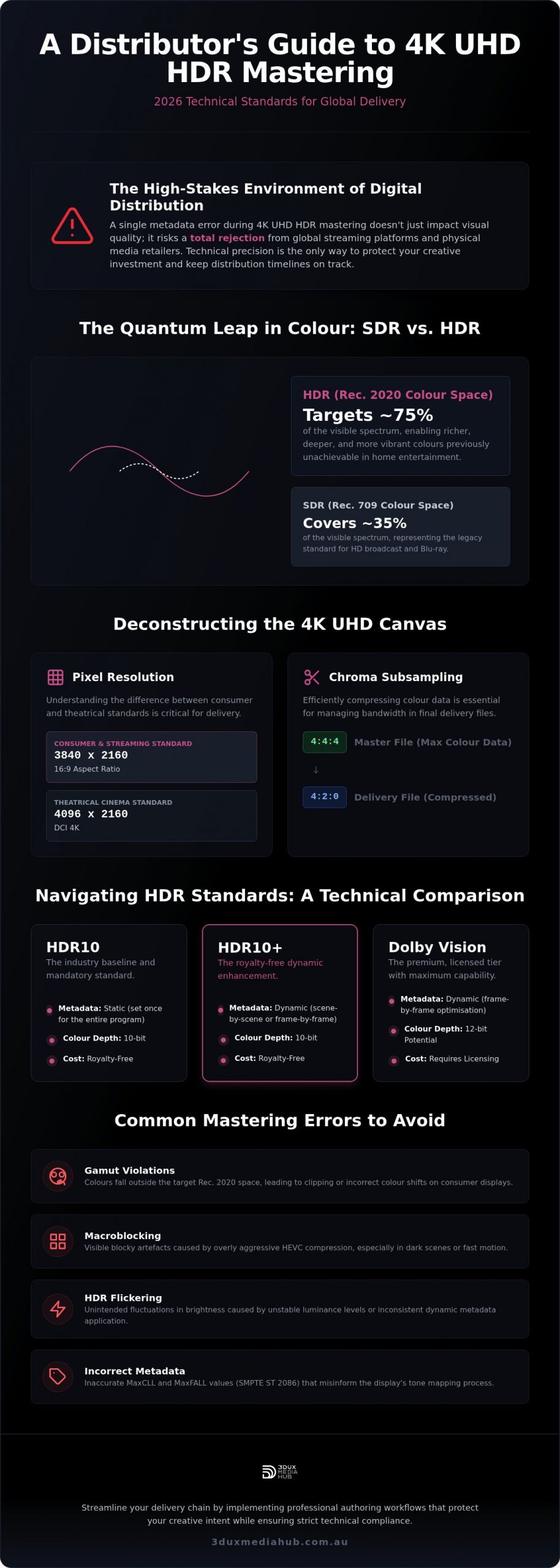
A single metadata error during 4K UHD HDR mastering doesn’t just impact visual quality; it risks a total rejection from global streaming platforms and physical media retailers. You’ve likely dealt with the headache of a failed Quality Control report that cites obscure SMPTE violations or bitrate spikes you thought were safely within limits. It’s a high-stakes environment where technical precision is the only way to protect your creative investment and keep distribution timelines on track.
We understand that balancing massive bitrates with storage constraints while choosing between HDR10, HDR10+, and Dolby Vision often feels like a moving target. This article serves as your comprehensive technical reference for 2026, designed to help you organise your delivery chain and significantly reduce QC failures. We’ll examine the latest HEVC encoding ceilings, mandatory metadata protocols, and the specific workflows required to ensure your content looks identical from a Sydney mastering suite to a consumer’s living room in London or New York.
Key Takeaways
- Master the transition from Rec. 709 to Rec. 2020 colour spaces to ensure your assets meet the latest 2026 global distribution standards.
- Navigate the technical differences between HDR10, HDR10+, and Dolby Vision to select the most effective metadata profile for your target audience.
- Optimise HEVC encoding bitrates to maintain visual fidelity across both high-bandwidth physical discs and storage-constrained streaming platforms.
- Reduce rejection rates by identifying common 4K UHD HDR mastering errors, including gamut violations, macroblocking, and HDR flickering, before they reach the QC stage.
- Streamline your delivery chain by implementing professional authoring workflows that protect your creative intent while ensuring strict technical compliance.
What is 4K UHD HDR Mastering for Professional Distribution?
Professional distribution requires more than just a high-resolution file. 4K UHD HDR mastering represents the final technical gatekeeper in the post-production pipeline. It’s the precise process of preparing a film’s visual data for global delivery across multiple platforms. This stage ensures that the director’s vision remains intact whether viewed on a high-end OLED panel or a standard LED screen. It’s about consistency, technical compliance, and protecting the long-term value of the asset.
The Core Components of 4K UHD Resolution
Standard 4K UHD resolution utilises a grid of 3840 x 2160 pixels. This differs from DCI 4K (4096 x 2160), which is the standard for theatrical cinema projection. For distributors, the focus remains on the 16:9 aspect ratio native to consumer hardware. Within the context of professional authoring, 4K UHD is defined as the delivery standard that provides four times the pixel density of standard high definition. This increase in density requires sophisticated encoding to maintain clarity without introducing noise.
Chroma subsampling also plays a critical role in the mastering process. While original masters often exist at 4:4:4 or 4:2:2 to preserve maximum colour data, final delivery usually requires 4:2:0. This compression manages bandwidth for streaming and physical discs without sacrificing perceived detail. Professional mastering ensures this downsampling happens without introducing artefacts or banding that could trigger a QC failure.
High Dynamic Range (HDR) Explained for Distributors
HDR is about more than just peak brightness. It’s about the expanded contrast ratio between the darkest blacks and the brightest highlights. High-Dynamic-Range Television standards allow for absolute luminance. In this environment, specific pixel values correspond to actual nit levels. This is a significant departure from the relative luminance used in SDR, where “white” was simply the brightest point a specific screen could produce regardless of its actual light output.
Effective 4K UHD HDR mastering preserves detail in deep shadows and specular highlights simultaneously. This prevents the “crushed” blacks or “blown out” skies common in legacy formats. Metadata acts as the essential guide for consumer hardware. It instructs the television on how to map high-luminance values to its specific hardware capabilities. Without accurate metadata, even the best grade will fail to translate correctly in a home environment.
Comparing HDR Standards: HDR10, HDR10+, and Dolby Vision
Distributors must manage a fragmented ecosystem where format choice dictates both cost and reach. HDR10 remains the industry baseline; it’s the mandatory standard for all 4K UHD Blu-ray discs and streaming services. It utilises static metadata and 10-bit colour depth, meaning the luminance parameters are set once for the entire duration of the programme. While efficient, this approach lacks the nuance required for films featuring high-contrast shifts between scenes or complex lighting environments.
HDR10+ and Dolby Vision solve this limitation by introducing dynamic metadata. This allows for scene-by-scene or even frame-by-frame optimisation, ensuring the display adapts its tone mapping to the specific requirements of each shot. Dolby Vision is widely considered the premium tier. It offers 12-bit potential and a dual-layer delivery system that ensures backward compatibility with HDR10 displays. Choosing between these formats depends heavily on your target market and budget. While HDR10+ is royalty-free, Dolby Vision requires licensing but offers deeper penetration in the premium consumer hardware market.
Technical Specifications: SMPTE ST 2084 and ST 2086
The backbone of 4K UHD HDR mastering is the Perceptual Quantizer (PQ) EOTF, standardised as SMPTE ST 2084. This curve replaces the legacy gamma curve to handle the massive luminance range of HDR. ST 2086 defines the static metadata, specifically MaxCLL (Maximum Content Light Level) and MaxFALL (Maximum Frame Average Light Level). These values are vital; they tell the consumer display exactly how to map the content to its own hardware limits without clipping the highlights. You can find detailed requirements for these values in the Warner Bros. Discovery HDR Specifications, which outline strict tolerances for global delivery.
Colour Gamut: Rec. 709 vs. BT.2020
While SDR content relies on the narrow Rec. 709 gamut, 4K UHD demands the expansive BT.2020 container. Mastering for a gamut that currently exceeds most consumer display capabilities is a significant technical challenge. Most professional grading monitors only reach about 95% of the P3 colour space, yet the master must be contained within BT.2020 to remain future-proof. Managing this colour volume requires professional video encoding services to ensure consistency across different display technologies. To ensure your assets are compliant across all global territories, you should consult with an experienced mastering partner to avoid costly QC failures at the delivery stage.
Mastering for Physical Media vs. Digital Delivery Platforms
The technical requirements for 4K UHD HDR mastering diverge significantly depending on the intended delivery method. Physical media remains the gold standard for visual fidelity, offering bitrates up to 100 Mbps. In contrast, digital streaming platforms typically cap bitrates between 15 and 25 Mbps to accommodate home internet speeds. This massive delta means a master created for a 100GB Blu-ray disc will look vastly different from a streaming version if not handled with precision. High-efficiency video coding (HEVC/H.265) is the engine behind both, but the implementation varies. Mastering for disc allows for a “transparent” encode where compression artefacts are virtually non-existent, whereas streaming requires aggressive optimisation to preserve HDR highlights and shadow detail within a narrow bandwidth.
UHD Blu-ray Mastering Requirements
Physical distribution requires absolute technical integrity. Distributors must choose between triple-layer (BD100) or double-layer (BD66) discs based on the feature’s length and complexity. A BD100 is often necessary for long-form content to maintain a high average bitrate without sacrificing peak brightness or grain structure. High-fidelity audio is equally critical; encoding object-based formats like Dolby Atmos or DTS-X alongside the video ensures a premium consumer experience. Utilising professional 4K UHD authoring services is the only way to guarantee disc playability across all global hardware. This includes the creation of interactive Blu-ray menus that function seamlessly in the 4K environment, providing the tactile experience collectors expect.
Mastering for Global Streaming and VOD
Digital delivery demands a different kind of technical rigour. Most major platforms, including Netflix, Apple, and Amazon, now require IMF (Interoperable Master Format) packages. This standardised container organises video, audio, and metadata into a modular structure, making it easier to manage multi-language versions and localisations. Mastering for these platforms involves meeting strict technical metadata requirements that go beyond simple resolution. The ARRI HDR FAQ provides excellent context on why these standards exist and how they affect the final image science. A high-quality mezzanine file serves as the source for all subsequent encodes. It must be robust enough to withstand the platform’s own re-encoding process without introducing banding or macroblocking in dark scenes. Efficiency is key here; every bit must be used to protect the creative intent while staying under the platform’s ceiling.
Technical Quality Control (QC) and Compliance Standards
Technical Quality Control (QC) is the final line of defence for any distributor. It ensures that the high-stakes investment in 4K UHD HDR mastering translates perfectly to the end user. Automated QC systems act as the first gatekeeper. They scan for gamut violations where colours exceed the Rec. 2020 container or for bitrate spikes that could cause playback buffers on consumer hardware. These systems are efficient, but they lack the nuance required to catch subtle creative or technical errors that only a human eye can detect.
Manual QC remains indispensable for identifying subjective visual artefacts. Professional technicians look for banding in gradients, macroblocking in high-motion sequences, and the subtle “HDR flickering” that occurs when dynamic metadata doesn’t align with the video stream. Utilising specialised Blu-ray quality control services is essential to avoid the catastrophic expense of a product recall. A single mastering error can render a physical release unwatchable on certain hardware, leading to significant financial and reputational damage. We ensure every asset meets global broadcast and digital delivery specifications before it leaves our facility.
Common Mastering Errors and How to Avoid Them
Incorrect metadata flagging is a frequent culprit for “washed out” images. If the display doesn’t receive the correct EOTF instructions, it may treat HDR content as SDR, resulting in a flat, grey appearance. Inconsistent black levels across different formats (HDR10 vs. Dolby Vision) can also alienate viewers who expect a premium experience. In the high-resolution 4K environment, even minor imperfections like digital noise or “dead pixels” in the master become glaringly obvious and can trigger a technical rejection.
The Mastering Report: A Distributor’s Essential Document
Every master should be accompanied by a comprehensive technical QC report. This document acts as the “birth certificate” for the asset, tracking peak luminance levels, audio sync, and subtitle accuracy. It serves as a vital verification tool for standards conversion and ensures that content localisation hasn’t compromised the original file’s integrity. A detailed report confirms that the master is future-proof for the 2026 distribution landscape. It provides the confidence needed to move forward with global scaling and platform delivery.
To secure your assets against technical failure and ensure global compliance, contact 3DUX Media Hub for professional QC and mastering solutions.
Professional 4K UHD HDR Mastering with 3DUX Media Hub
Success in the 2026 distribution market requires a technical partner who understands that 4K UHD HDR mastering is a precise science. At 3DUX Media Hub, we leverage over 20 years of technical expertise in the Australian media landscape to protect your high-value assets. We don’t just process files; we ensure every frame meets the rigorous standards required for global interoperability. Our facility utilises state-of-the-art HEVC encoding to achieve maximum visual fidelity. We balance peak bitrates with efficiency, ensuring your content remains transparent to the original master while staying within platform-specific ceilings.
Distributors face immense pressure to deliver across fragmented ecosystems. We provide a “safe pair of hands” for the entire process, from initial encoding to final delivery. Our workflows are designed for speed and technical precision, offering:
- Advanced Dolby Vision and HDR10+ metadata authoring.
- High-efficiency HEVC (H.265) encoding for 4K UHD.
- Comprehensive technical QC for physical and digital distribution.
- Fast turnaround times to meet tight global release windows.
- Rigorous compliance checks against platform-specific delivery specifications.
End-to-End Mastering and Authoring Solutions
The SERP gap in most mastering discussions is the critical role of authoring. A master is only as good as its delivery container. We specialise in custom 4K UHD menu design and motion graphics, providing a premium tactile experience for physical media collectors. Our team handles complex localisation and subtitle integration for international territories, ensuring your film is ready for a worldwide audience. For distributors targeting multiple regions, our broadcast standards conversion services ensure your assets are technically compliant with varying frame rates and regional broadcast requirements.
Partnering for Success in Film Distribution
Technical excellence is only half the equation. We prioritise transparent communication and methodical project management to ensure you’re never in the dark regarding your delivery timelines. You gain direct access to technical experts who understand the stakes of high-end film delivery. We don’t hide behind account managers; you speak with the people actually handling your pixels. This no-nonsense approach allows us to solve complex technical challenges quickly, reducing the risk of QC failures and costly delays. Whether you’re releasing a boutique 4K Blu-ray or delivering a tentpole feature to global VOD platforms, we provide the precision required to preserve your creative intent.
Ready to secure your content for global distribution? Contact 3DUX Media Hub for your next 4K UHD HDR mastering project and ensure your assets meet the highest industry standards.
Mastering the Future of Global Delivery
Navigating the technical landscape of 2026 requires a meticulous approach to metadata, bitrates, and format compliance. We’ve explored how the right choice between HDR10+ and Dolby Vision, combined with rigorous Quality Control, protects your creative vision and prevents costly distribution delays. Whether you’re targeting high-bitrate physical media or the strict specifications of global streaming platforms, precision is the only way to ensure your content looks exactly as intended in every territory.
With over 20 years of technical expertise, 3DUX Media Hub acts as your safe pair of hands for high-value assets. We specialise in 4K UHD, Blu-ray, and DVD authoring, providing the fast turnaround and technical rigour essential for modern film distribution. Don’t leave your 4K UHD HDR mastering to chance when global delivery standards are this demanding. It’s about more than just resolution; it’s about reliability and technical excellence.
Secure your 4K UHD HDR master with 3DUX Media Hub today to guarantee your next release meets every technical benchmark with ease. Your audience deserves the best possible viewing experience; let’s ensure you deliver it.
Frequently Asked Questions
What is the difference between HDR10 and Dolby Vision for film mastering?
HDR10 is the industry’s static baseline, applying a single set of metadata across the entire film. In contrast, Dolby Vision employs dynamic metadata to optimise contrast and colour on a scene-by-scene or frame-by-frame basis. This allows for superior tone mapping on consumer displays with varying peak brightness levels. Dolby Vision also supports 12-bit colour depth, whereas HDR10 is limited to 10-bit.
Do I need a separate master for physical 4K UHD discs and streaming?
Yes, you typically require distinct encodes to maximise quality across different bandwidths. Physical UHD discs support bitrates up to 100 Mbps, allowing for a virtually transparent master with minimal compression. Streaming platforms operate within a much tighter 15-25 Mbps window. Professional 4K UHD HDR mastering ensures that each delivery format is optimised to its specific bitrate ceiling without introducing macroblocking or banding.
What is the recommended bitrate for a professional 4K UHD HDR master?
Professional standards dictate 100 Mbps for physical media and approximately 25 Mbps for premium streaming delivery. However, the mezzanine files used for mastering, such as ProRes 4444 XQ, are significantly larger. These files often exceed 1 Gbps to preserve maximum data during the authoring process. This ensures the final HEVC encode remains faithful to the original colour grade and grain structure.
How does 4K UHD HDR mastering impact my film localisation strategy?
Localisation becomes technically more complex in HDR because subtitles and graphics must be graded to match the high-luminance environment. If subtitles aren’t correctly limited, they can appear painfully bright or “sear” the image. Metadata must also be carefully managed across all localised versions to ensure the tone mapping remains consistent. We specialise in synchronising these elements to protect your creative intent in every global territory.
What technical metadata is required for a 4K UHD HDR delivery?
Every delivery requires SMPTE ST 2084 (PQ) and ST 2086 (static metadata) as the absolute minimum. This includes specific MaxCLL (Maximum Content Light Level) and MaxFALL (Maximum Frame Average Light Level) values. Dynamic formats require additional metadata packets, such as ST 2094-10 for Dolby Vision. Accurate metadata is vital; it’s the only way to tell a consumer’s television how to display your content correctly.
Can 3DUX Media Hub handle the conversion from DCP to 4K UHD master?
We provide expert standards conversion services to transform theatrical DCP assets into distribution-ready masters. This involves a precise colour space transformation from the theatrical P3-DCI gamut to the Rec. 2020 container used in home entertainment. We also manage the complex EOTF mapping required to ensure the theatrical grade translates accurately to the luminance range of consumer HDR hardware.
Why is professional quality control vital for 4K HDR releases?
Professional QC identifies subjective visual artefacts that automated systems often miss, such as banding, flickering, or subtle macroblocking. In the high-resolution 4K environment, minor technical errors become glaringly obvious and can trigger platform rejections or expensive physical recalls. Our “safe pair of hands” approach ensures your assets meet strict global compliance standards before they reach the consumer.
What are the storage requirements for a 4K UHD HDR mezzanine file?
Storage demands are substantial, as a high-quality 4K UHD HDR mezzanine file can consume between 500GB and 1TB per hour of content. A standard 90-minute feature in ProRes 4444 XQ often exceeds 1.5 TB. Distributors must organise high-speed storage arrays and robust data transfer protocols to manage these massive assets. We help you navigate these constraints to ensure a fast turnaround for your global release.