A simple software export is not a professional standards conversion strategy. If you believe a basic frame rate change in your editing suite preserves your creative intent, you are likely delivering a compromised product to your international partners. Achieving elite PAL to NTSC conversion quality requires more than just ticking a box. It demands a rigorous mathematical approach to motion estimation and spatial scaling that consumer tools simply cannot replicate.
You know the frustration of seeing a high-value asset plagued by motion judder or ghosting after a regional transfer. These technical failures often lead to broadcast rejections and expensive re-works. This guide establishes the technical benchmarks for professional-grade standards conversion, helping you avoid the resolution loss and audio pitch shifts typical of basic hardware. We will examine the essential processes for artifact-free motion and pixel-perfect scaling. This ensures your content remains compliant with global delivery specifications while retaining its original cinematic look and sound.
Key Takeaways
- Identify the fundamental timing and resolution gaps between regional standards to prevent technical compliance failures during global delivery.
- Learn why motion-compensated processing is essential for maintaining high PAL to NTSC conversion quality and avoiding unsightly ghosting or judder.
- Leverage optical flow technology to generate seamless frames that preserve the fluid motion and cinematic integrity of your original footage.
- Address the 4% speed variance in regional transfers with precise audio conforming and pitch correction techniques to maintain sonic accuracy.
- Implement broadcast-grade quality control protocols to ensure your localised assets are ready for immediate acceptance by international broadcasters.
Understanding the Technical Divide: PAL vs. NTSC in 2026
Regional video standards are not merely relics of the analogue era. Even in a digital-first landscape, the legacy of PAL and NTSC dictates the timing, refresh rates, and metadata of every file destined for international broadcast. For Australian producers, the primary challenge lies in the fundamental hardware differences between the 50Hz power grids of Europe and Australasia and the 60Hz systems used in North America and Japan. This discrepancy creates a hard technical barrier that simple software exports cannot bridge without compromising the PAL to NTSC conversion quality.
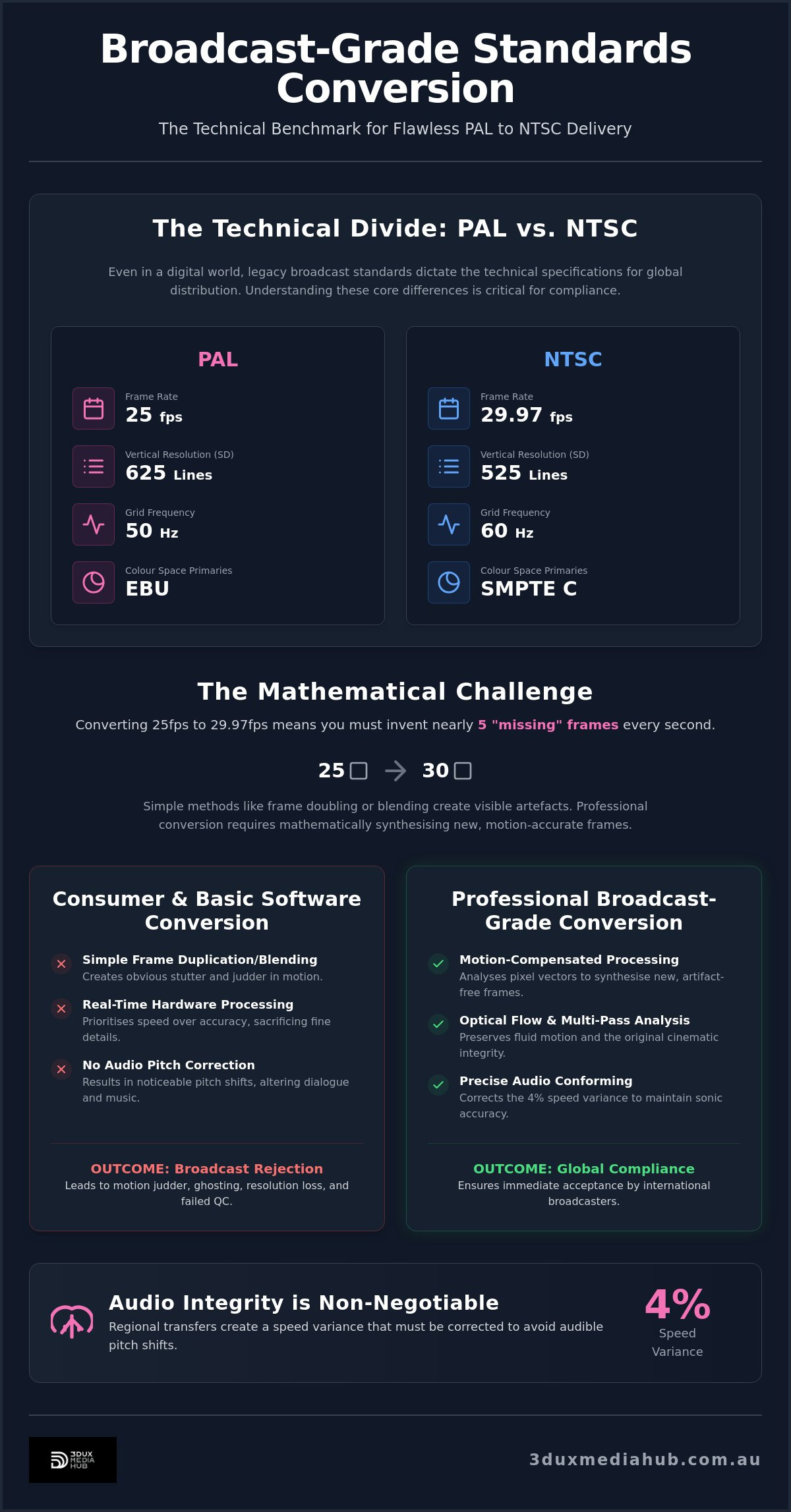
The technical divide is rooted in two specific areas: timing and resolution. In the Standard Definition (SD) domain, PAL utilises 625 scan lines at a 25 frames per second (fps) rate. Conversely, NTSC operates at 525 lines with a frame rate of 29.97 fps. When preparing content for North American broadcasters or physical media specifications, you aren’t just changing a file extension. You are fundamentally re-engineering the temporal and spatial characteristics of the media asset. Failure to account for these differences leads to immediate rejection by high-tier distribution partners.
Modern digital containers still carry these legacy constraints. A 25fps file played on a 60Hz display without proper television standards conversion will result in visible motion artefacts. Professional distribution requires a precise mathematical translation to ensure the content meets the strict ingest requirements of global platforms.
The Math of Frame Rate Conversion
Converting 25 frames into 30 (or 29.97) is a significant computational hurdle. You are essentially tasked with inventing five “missing” frames every second. Legacy methods often relied on simple frame doubling or basic linear blending. These shortcuts result in “judder” or a blurred, ghostly appearance during fast movement. Professional PAL to NTSC conversion quality requires sophisticated motion estimation. Rather than just repeating frames, high-end systems analyse pixel vectors to synthesise new, mathematically accurate frames. A standard 3:2 pull-down, while common for film-to-tape transfers, is insufficient for the 25-to-30 jump and will not satisfy broadcast-grade QC standards.
Colour Space and Gamut Shifts
The shift between PAL (EBU) and NTSC (SMPTE C) colour primaries is often overlooked. Without correct remapping, your footage may appear washed out or unnaturally saturated once converted. Colour gamut shifts in standards conversion represent the re-alignment of chromaticity coordinates to ensure that the “reds” and “greens” captured in one region remain visually identical when displayed in another. Precision is vital. Maintaining the original creative grade requires a deep understanding of these gamut differences to avoid “illegal” colours that exceed broadcast safety limits.
- PAL: 50Hz, 25fps, 625 lines.
- NTSC: 60Hz, 29.97fps, 525 lines.
- Critical Goal: Smooth motion and colour accuracy for US markets.
Why Consumer Converters Fail the Quality Test
Retail-grade “black boxes” promise plug-and-play simplicity. For professional distribution, they are a liability. These consumer devices rely on real-time hardware processing that prioritises speed over accuracy. They lack the computational power to perform the multi-pass analysis required for high-end results, resulting in a permanent loss of PAL to NTSC conversion quality. When a master asset is processed through cheap chips, fine details are often sacrificed to meet real-time throughput requirements.
The “Black Box” problem is fundamentally about how these devices interpret analogue video signal standards during the digitisation and conversion phase. Professional software workflows analyse the relationship between adjacent frames before committing to a final render. Consumer hardware simply discards data it cannot process instantly. This leads to “smearing” where pixels are crudely interpolated rather than intelligently upscaled. You aren’t just losing resolution; you are losing the professional polish required for high-tier platforms.
Distributors like Netflix or Amazon Prime maintain uncompromising technical specifications. Footage that exhibits interlacing “combing” or ghosting will trigger an immediate rejection during the Quality Control (QC) phase. These artefacts are almost impossible to fix once baked into a file. Relying on inferior conversion methods often results in expensive re-delivery fees and missed launch windows. Ensuring your assets are handled by a professional standards conversion service is the only way to guarantee a “pass” on the first attempt.
The Judder Effect Explained
Movement often looks staccato or “jerky” on consumer-converted footage. This occurs because cheap converters cannot reconcile the timing differences between regional standards without dropping or repeating frames at fixed intervals. Panning shots become unwatchable. High-action sequences lose their fluidity. At 3DUX Media Hub, we eliminate these frame-drop artefacts through precision timing and motion compensation, ensuring every movement remains smooth and natural.
Aliasing and Moiré Patterns
Poor spatial scaling in consumer hardware creates aliasing, where fine textures like clothing, brickwork, or architectural details “shimmer” incorrectly. This moiré effect is a hallmark of low-end conversion. Professional filtering techniques are required to manage these frequencies during the scaling process. By applying advanced anti-aliasing algorithms, we maintain image sharpness and clarity without introducing the distracting visual noise common in retail-grade hardware.
- Hardware limitations: Real-time chips cannot perform deep pixel analysis.
- Interlacing errors: Visible “combing” on moving objects.
- Rejection risk: High probability of failure at broadcast QC.
Motion Compensation: The Professional Quality Benchmark
Achieving superior PAL to NTSC conversion quality requires moving beyond simple frame manipulation. Professional studios rely on Motion-Compensated Standards Conversion (MCSC). This process does not merely repeat or drop frames. It uses optical flow technology to analyse the movement of every individual pixel between frames. By calculating motion vectors, the system synthesises entirely new “in-between” frames that didn’t exist in the original source. This level of mathematical precision is what separates a broadcast master from a home video conversion.
Maintaining the original “film look” is a common requirement for high-end drama and feature films. When working with 24fps content delivered in a 25fps PAL container, the conversion must account for the slight speed difference without introducing artefacts. Professional workflows preserve the cinematic cadence. High-bitrate encoding plays a vital role here. It ensures that the complex data generated during motion compensation isn’t lost to compression artefacts. Without sufficient bandwidth, the subtle nuances of synthesised frames can dissolve into macroblocking, ruining the viewer experience.
Alchemist and Teranex: Industry Standard Hardware
Studios invest heavily in dedicated processors like the Snell Alchemist or Blackmagic Teranex. These units are the backbone of global distribution. Unlike consumer gear, they use phase correlation to track objects across the screen. Linear conversion simply blends frames, causing blur. Phase correlation identifies the exact position of objects in 3D space, ensuring a “transparent” conversion. The viewer sees smooth, natural motion that feels native to the NTSC standard. This hardware remains the “safe pair of hands” for high-value assets requiring immediate turnaround.
Software-Based Motion Estimation
The landscape is shifting toward AI-driven frame rate conversion. In 2026, neural networks can predict pixel movement with incredible accuracy. However, this requires a trade-off. High-quality AI renders take significantly longer than real-time hardware. For time-sensitive broadcast delivery, hardware remains king. For archival mastering where time is less critical, AI software can offer unmatched PAL to NTSC conversion quality. Optical flow technology is superior to frame doubling because it creates new temporal data based on vector analysis rather than just duplicating existing imagery. This eliminates the “stutter” typical of lower-end methods.
- MCSC: The only way to achieve artifact-free motion.
- Phase Correlation: Superior object tracking for 100% transparency.
- High-Bitrate: Essential for preserving synthesised frame data.
- AI Integration: Pushing the boundaries of archival restoration.
Audio Conforming and Global Localisation Requirements
The 4% speed difference is the most overlooked factor in regional standards conversion. Most PAL content, particularly film-sourced drama, runs approximately 4% faster than its NTSC or native 24fps counterparts. This discrepancy occurs because the original 24fps footage was “pulled up” to 25fps for the Australian and European broadcast markets. When reversing this process for North American delivery, the audio must be slowed down to maintain perfect sync with the new frame rate. Failing to account for this shift compromises the PAL to NTSC conversion quality and results in immediate technical rejection.
Pitch correction is a non-negotiable step in this process. Simply slowing down the audio by 4% lowers the pitch, making voices sound unnaturally deep and sluggish. Professional workflows utilise sophisticated time-stretching algorithms that adjust the duration while preserving the original frequency. This ensures that the director’s creative intent remains intact. Syncing multi-channel audio, such as 5.1 surround sound or Dolby Atmos, adds further complexity. Any frame rate shift requires a sample-accurate conforming process to prevent phase issues or sync drift across the soundstage.
Localisation also extends to text-based assets. Subtitles and closed captions are tied to specific frame numbers or timecodes. Because the total duration of the programme changes during the PAL to NTSC shift, every single subtitle trigger must be recalculated. If your 90-minute feature runs several minutes longer in NTSC, your original PAL subtitle file will be completely out of sync by the second act. Precision re-timing is essential for a professional global release.
Audio Sample Rate Conversion
Maintaining the integrity of 48kHz or 96kHz audio is vital during the conforming stage. Low-end converters often introduce digital “clicks” or “pops” at frame boundaries when the audio clock is forced to match a new video rate. The 3DUX approach to audio conforming utilises high-precision resampling to ensure a seamless transition. We eliminate these artefacts, providing a sonically transparent result that meets the highest international delivery standards. Ensure your audio meets international broadcast standards with our professional standards conversion services.
Technical Compliance for Distributors
Global platforms like Netflix and Amazon Prime demand exhaustive metadata and technical compliance. A “passed” Quality Control (QC) report is often as important as the video file itself. This report verifies that the PAL to NTSC conversion quality meets specific luminance, gamut, and audio loudness requirements (such as EBU R128). Preparing these assets for 4K UHD or Blu-ray authoring requires a “safe pair of hands” to manage the complex interplay between video encoding, audio conforming, and regional localisation.
- 4% Speed Shift: Essential correction for film-sourced content.
- Pitch Preservation: Avoiding the “deep voice” effect during slowdowns.
- Subtitle Re-timing: Ensuring text assets match the new programme duration.
- QC Documentation: Providing the technical proof required by broadcasters.
Achieving Broadcast-Grade Standards Conversion with 3DUX
Securing a global distribution deal is only the first step. Delivering a master that meets every technical specification of an international broadcaster is where the real work begins. At 3DUX, we provide an end-to-end mastering workflow designed to protect your creative vision while ensuring absolute technical compliance. With over 20 years of industry experience, we act as a safe pair of hands for high-value media assets, managing everything from initial ingest to final delivery.
The 3DUX difference lies in our dual approach. We combine advanced video encoding, including specialised HEVC and 4K capabilities, with rigorous human-led quality control. This isn’t a “set and forget” process. We understand that PAL to NTSC conversion quality depends on constant monitoring for subtle artefacts that automated systems might miss. Our team manages the complex mathematics of motion compensation and spatial scaling to produce a result that is visually indistinguishable from a native regional capture. For Australian distributors weighing the overhead of maintaining specialist in-house equipment against the reliability of expert outsourcing, understanding the full calculus of in-house vs outsourced media mastering is an essential part of building a sustainable global delivery strategy.
Speed is often a critical factor for producers heading to international TV markets or film festivals. We have optimised our infrastructure to provide fast turnaround times without compromising on precision. Whether you are delivering a single feature or a multi-season series, our workflow is built for efficiency and reliability. We ensure your content is ready for the world stage on time and within specification.
Professional QC: Avoiding Costly Rejections
Every asset we process undergoes broadcast-level technical inspection. We check for gamut errors, illegal colours, and frame-sync issues that could trigger an automated rejection from platforms like Netflix or Amazon. Our mastering process includes the detailed documentation and QC reports that international distributors demand. By identifying and resolving these technical hurdles before delivery, we save you the significant costs and delays associated with re-submissions. We ensure your PAL to NTSC conversion quality is verified at every stage.
Ready for Global Distribution?
To achieve the best results, we recommend providing master files in their native frame rate and highest possible bitrate. Organising your localisation, encoding, and conversion within a single hub reduces the risk of metadata errors and ensures consistency across all regional versions. Our team is ready to assist with 4K UHD authoring, Blu-ray mastering, and complex standards conversion requirements. Contact 3DUX Media Hub for a professional standards conversion quote to ensure your content is ready for global markets.
- 20+ Years Experience: Proven expertise in international delivery.
- Broadcast QC: Included in our mastering workflow.
- 4K & HEVC: Specialised encoding for modern distribution.
- Fast Turnaround: Meeting tight festival and market deadlines.
Master Your Global Delivery Strategy
Global distribution demands technical precision that basic software exports cannot provide. Professional results require a deep understanding of motion compensation and the critical 4% audio speed shift. By prioritising these benchmarks, you protect your creative integrity and ensure your assets pass the most rigorous broadcast inspections. Achieving elite PAL to NTSC conversion quality is the difference between a successful international launch and a costly technical rejection. It’s about delivering a product that feels native to every screen it reaches.
3DUX Media Hub acts as a safe pair of hands for your high-value content. With over 20 years of technical mastering experience, we provide the broadcast-grade QC reports and expert standards conversion trusted by national and international film distributors. We manage the complex mathematics of regional transfers so you can focus on reaching new audiences. Ensure your film meets global standards with 3DUX professional conversion. Your content deserves a seamless transition to the world stage, and we have the expertise to get it there efficiently.
Frequently Asked Questions
Is PAL better quality than NTSC?
PAL provides 576 visible scan lines compared to NTSC’s 480, offering approximately 20% more vertical resolution. This historically made PAL the superior standard for image detail in the analogue era. In a modern digital context, the focus shifts to refresh rates. While PAL has better resolution, its 50Hz timing is more complex to convert to the 60Hz NTSC standard without sophisticated motion compensation to preserve the original image integrity.
Why does PAL to NTSC conversion cause motion judder?
Judder occurs because 25 frames cannot be evenly distributed into a 29.97 or 30fps timeline. Basic software often repeats every fifth frame to fill the gap, creating a rhythmic stutter during playback. High PAL to NTSC conversion quality avoids this by using vector-based analysis to synthesise new, unique frames. This ensures that the temporal flow remains smooth, particularly during complex camera pans or high-action sequences.
What is the “4% PAL speed-up” and how is it fixed?
The 4% speed-up is a legacy process where 24fps film is accelerated to 25fps for PAL markets. To fix this for NTSC distribution, the footage is slowed back down to its original speed. This requires sample-accurate audio conforming and pitch correction. Without these steps, the 4% duration shift causes the audio to sound unnaturally deep, a flaw that will trigger immediate rejection from professional global distributors.
Can I convert PAL to NTSC without losing quality?
You can achieve a visually transparent result that meets all broadcast specifications through professional mastering. While any mathematical re-interpolation involves processing, professional-grade workflows minimise degradation through multi-pass encoding and optical flow analysis. Maintaining high PAL to NTSC conversion quality ensures that the final asset retains its cinematic clarity, colour accuracy, and motion fluidity, making it indistinguishable from a native master.
Do I need standards conversion for digital 4K UHD releases?
Yes, standards conversion remains vital in the 4K UHD era if your source and target frame rates don’t match. If your 4K master is captured at 25fps but your distributor requires a 23.976fps or 59.94fps delivery, you must conform the timing and refresh rates. Digital containers still rely on these timing standards to ensure compatibility with regional display hardware and international broadcast infrastructure.
What is the difference between frame doubling and motion compensation?
Frame doubling is a crude method that simply duplicates an existing image to fill a timing gap, resulting in visible stutter. Motion compensation is a sophisticated alternative that uses pixel-tracking algorithms to synthesise entirely new frames. By predicting where an object should be between two existing frames, motion compensation creates a seamless transition. This is the mandatory industry standard for professional film and television mastering.
Why do broadcasters reject certain PAL to NTSC conversions?
Broadcasters reject conversions that exhibit technical “illegal” states or visible artefacts like ghosting and interlacing “combing”. Common triggers include gamut errors, luminance spikes, and frame-sync drift during the Quality Control (QC) phase. These issues suggest a lack of professional oversight and indicate that the asset is not fit for high-tier broadcast or streaming platforms like Netflix and Amazon Prime.
How much does professional standards conversion cost for a feature film?
Professional rates vary based on the length of the footage, the complexity of the source material, and the required turnaround time. A feature film requires a significantly higher level of analysis and multi-pass processing compared to short-form content. Factors such as audio channel count and localisation requirements also influence the final investment. To get an accurate figure for your project, it is best to provide your technical specifications for a tailored quote.