
What if your global distribution deal collapses before the first frame even plays? For many producers, the excitement of an international sale quickly dissolves into a cycle of technical rejections and spiralling localisation costs. You understand that the stakes are high. A single encoding error or a mismatched frame rate can stall a release and burn through your finishing budget. Mastering content for global distribution is the final, critical gatekeeper of your asset’s integrity; it requires a rigorous approach to 4K UHD standards, HDR metadata, and the varied requirements of global streaming giants.
This 2026 technical guide provides the exact roadmap you need to navigate these complexities. We’ll break down the essential protocols for multi-language asset preparation, standards conversion, and broadcast-grade quality control. You will learn how to produce high-fidelity masters that meet every delivery specification, ensuring a seamless, zero-rejection path to the world’s biggest screens. By focusing on technical precision early in the process, you protect your investment and guarantee your content reaches its audience exactly as intended.
Key Takeaways
- Adapt to the 2026 shift toward unified HDR standards and HEVC to ensure technical compliance across all global delivery platforms.
- Utilise high-bitrate encoding and professional 4K UHD authoring to preserve cinematic quality for both physical media and premium streaming services.
- Optimise international releases through precise audio conforming and the synchronisation of localised assets for diverse global markets.
- Mitigate the risk of expensive disc recalls and technical rejections by implementing a rigorous 5-step broadcast quality control protocol.
- Understand the technical advantages of partnering with a specialised media hub when mastering content for global distribution to guarantee asset integrity.
The Technical Landscape of Global Content Distribution in 2026
Mastering content for global distribution is the final bridge between post-production and the consumer. It involves more than a simple file export; it’s the rigorous engineering of a definitive “gold” master. This asset serves as the single source of truth for every required delivery platform, from high-end streaming services to physical 4K UHD discs. In 2026, the industry has shifted toward a more unified technical framework, prioritising high-fidelity visuals and efficient data management to meet rising audience expectations.
Central to this evolution is the High Efficiency Video Coding (HEVC) standard. This compression technology allows for superior image quality at lower bitrates, which is essential for managing global bandwidth constraints. Distributors now manage a hybrid landscape. While digital-only delivery is prevalent, a hybrid strategy that includes high-end physical distribution remains the gold standard for boutique labels and major studios seeking to preserve cinematic integrity without the variable quality of internet streaming.
Why Technical Compliance is Non-Negotiable
Compliance isn’t a suggestion. It’s a gatekeeper. Even minor metadata errors or incorrect colour space tagging can trigger a global delivery failure. When an asset is rejected by a major aggregator, the financial impact is immediate. You face missed release windows, additional laboratory fees, and potential damage to your reputation with distributors. A professional mastering house acts as a protective shield, ensuring your creative vision survives the technical conversion process. They verify that every frame and audio channel meets the exact specifications of the target market, preventing the high costs of post-delivery fixes.
The Evolution of Delivery Specifications
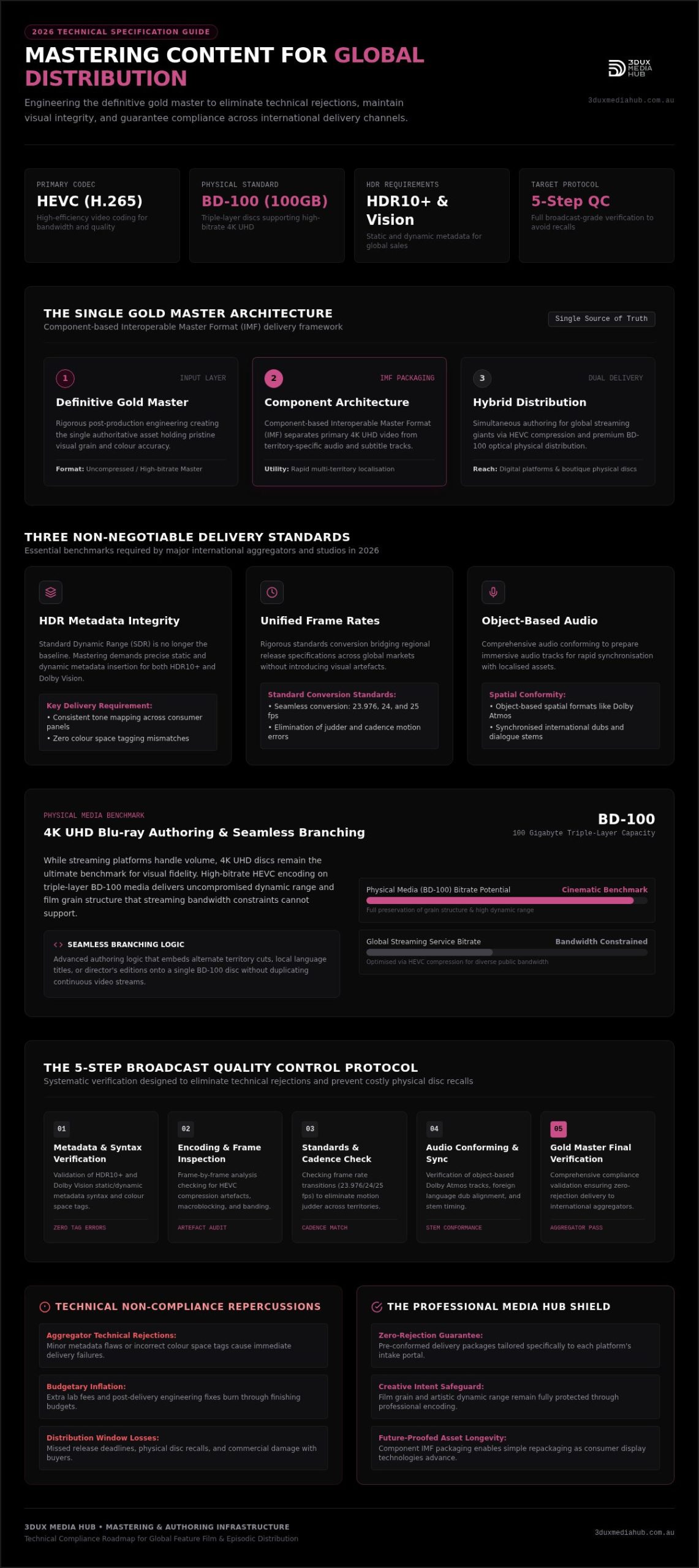
Standard Dynamic Range (SDR) is no longer the baseline for premium global content. In 2026, HDR10+ and Dolby Vision have become standard requirements for international sales. This shift demands a higher level of technical rigour during the mastering stage. We also see an increasing demand for 4K UHD masters across all genres, including smaller independent releases. Future-proofing your assets is critical. By mastering to the highest current standards, you ensure your content remains viable and monetisable as display technology continues to advance. Key requirements for modern delivery include:
- HDR Metadata Integrity: Accurate static and dynamic metadata for consistent playback across diverse consumer devices.
- Unified Frame Rates: Precise standards conversion to handle the transition between 23.976, 24, and 25fps markets without motion artefacts.
- Object-Based Audio: Preparing immersive audio tracks like Dolby Atmos for seamless global localisation.
Mastering for 4K UHD and High-Efficiency Encoding
Mastering content for global distribution requires technical precision that exceeds standard post-production workflows. While streaming platforms manage the highest volume of viewers, the 4K UHD Blu-ray format remains the definitive benchmark for visual and auditory excellence. Delivering this quality necessitates 4K UHD authoring services that handle high-bitrate HEVC encoding without compromising grain structure or colour accuracy. It’s about protecting the master asset through every stage of the delivery pipeline.
High-bitrate encoding is vital for maintaining cinematic quality. For global streaming, HEVC (H.265) balances file size with fidelity, but physical media allows for bitrates that streaming simply cannot reach. This creates a superior consumer experience for high-value assets. To streamline these complex deliveries, the Library of Congress Interoperable Master Format overview provides a technical foundation for how component-based master packages simplify the pairing of primary video with multi-language assets. Professional encoding ensures your content remains compliant across every territory.
The Mechanics of 4K UHD Authoring
Feature films in 2026 often require the triple-layer BD-100 disc structure. This 100GB capacity is essential for 4K UHD content featuring high dynamic range and immersive audio. Authoring at this level involves complex logic, such as seamless branching. This allows distributors to include different territory versions or director’s cuts on a single disc without duplicating massive video files. A critical component of this process is interactive Blu-ray menu design. These menus must be intuitive and technically compliant across all global playback hardware to prevent consumer frustration and costly disc returns.
Advanced Video and Audio Encoding
The choice between hardware and software encoding often dictates the final output’s stability. For broadcast-grade results, professional video encoding services utilise dedicated hardware pipelines for maximum precision. Audio requirements have also intensified. Immersive formats like Dolby Atmos and DTS:X are now standard for international distribution. These formats require specific metadata handling to ensure object-based audio translates correctly across various consumer speaker configurations. If you’re looking to secure your film’s technical integrity, engaging with a specialised authoring team ensures your assets are ready for any screen in the world.
Content Localisation: Preparing Assets for International Markets
Localisation is more than a translation exercise; it’s a technical synchronisation of assets. When mastering content for global distribution, you must ensure every localised element aligns perfectly with the primary video essence. This involves managing textless masters, which are clean versions of the film without on-screen titles or graphics. Providing these masters allows international distributors to overlay territory-specific text without degrading the underlying image quality. It’s a critical step in maintaining a premium look across every market, ensuring that titles in French, Japanese, or Arabic look as professional as the original English version.
Audio Conforming and Dubbing Integration
Managing multiple language tracks within a single master file requires extreme precision. A single feature film might carry twenty or more audio streams, including stereo, 5.1, and immersive mixes for each language. Maintaining high-quality Music and Effects (M&E) tracks is non-negotiable. These tracks allow for seamless dubbing in foreign territories while preserving the original cinematic soundscape. The technical process of audio conforming for international film release involves re-syncing these tracks to account for different territory frame rates, such as moving from 24fps to 25fps. Compliance with the EBU R 128 loudness normalization standard ensures your audio meets the rigorous technical ceilings required by European broadcasters, preventing rejection due to loudness spikes. This level of technical oversight is what separates a professional delivery from a costly failure.
Subtitle and Closed Caption Compliance
Subtitle integration presents unique challenges, particularly when assets move across different frame rates. A subtitle file timed for a 24fps master will drift out of sync if applied to a 25fps broadcast master without professional adjustment. You must also navigate the requirements of different global platforms, which may demand specific formats like SRT, WebVTT, or SCC. Standards vary significantly by region and platform:
- Soft Subtitles: Preferred by streaming platforms to allow user selection and searchability across different devices.
- Burn-in Subtitles: Often required for specific creative titles or when a distributor wants to lock the visual experience for a specific territory.
- Closed Captioning: Essential for legal compliance in markets like the US (FCC requirements) and Australia (ACMA standards), ensuring accessibility for the hearing impaired.
Professional mastering ensures these files are technically robust and timed to the millisecond. This protects your brand from compliance penalties and ensures a high-quality experience for every viewer, regardless of their location or language.
Broadcast Quality Control and Technical Compliance Testing
Mastering content for global distribution requires a “zero-failure” mindset. Technical rejections at the delivery stage are expensive and can damage your reputation with international aggregators. We employ a rigorous 5-step professional QC process: Automated, Manual, Technical, Creative, and Compliance. This multi-layered approach identifies everything from metadata mismatches to subtle creative inconsistencies that could derail an international launch. It’s about ensuring your content is technically flawless before it leaves the facility.
While AI-driven validation tools have advanced, the “Eyes-on-Glass” approach remains the industry’s gold standard. A seasoned technical operator performs a full linear play-through to spot compression artefacts, dead pixels, or single-frame flash frames that automated systems often miss. This level of scrutiny is particularly vital for physical media, where Blu-ray quality control services act as the final insurance policy against devastating disc recalls and the subsequent logistical nightmare of re-authoring and replacement.
The QC Checklist for Global Delivery
Our technical audit follows a modular checklist to ensure no detail is overlooked. This process is tailored to the specific requirements of the world’s largest streaming and broadcast platforms. The core steps include:
- Step 1: Automated File Validation. We test the master file against rigid delivery specifications for platforms like Netflix and Apple TV, verifying container integrity and codec compliance.
- Step 2: Full Linear Play-through. A technical operator monitors the entire programme in a controlled environment to catch intermittent glitches, dropouts, or sync issues.
- Step 3: Audio Compliance. We verify phase alignment and loudness levels against international standards like EBU R128 to ensure the mix is broadcast-ready for any territory.
Standards Conversion and Frame Rate Management
Moving assets between PAL, NTSC, and SECAM territories requires specialised broadcast standards conversion services. It’s important to understand that professional conversion is not simple resizing; it involves complex temporal processing to maintain visual integrity. Converting 24fps film to 25fps or 29.97fps for global broadcast markets presents significant challenges. Without high-quality motion-compensated conversion, viewers experience “judder” or ghosting during camera pans. We utilise advanced algorithms to ensure motion remains fluid and natural, regardless of the target territory’s technical requirements. If you need to ensure your masters are technically flawless, our broadcast-grade QC team provides the precision required for global success.
Partnering with a Professional Media Hub for Global Success
The transition from a creative edit to a technical master is where many distribution deals succeed or fail. While generalist post-production houses excel at creative storytelling, they often lack the specialised infrastructure required for final delivery compliance. Mastering content for global distribution is a distinct engineering discipline. It requires an authoritative understanding of the evolving standards set by international broadcasters and streaming platforms. Engaging a specialised media hub ensures that your creative vision isn’t just finished, but is technically robust enough for any territory.
For boutique and major labels, professional disc authoring remains a cornerstone of high-value asset protection. It’s not just about putting data on a disc; it’s about creating a premium consumer experience that works flawlessly on every player. We operate as a “safe pair of hands” for your intellectual property. By involving a mastering partner early in the post-production phase, you can identify potential technical roadblocks before they become expensive delivery delays. Proactive planning is the most effective way to protect your finishing budget.
The 3DUX Advantage: Expertise and Efficiency
Success in the entertainment industry is often measured by speed and precision. With 20+ years of industry experience, our team understands the high stakes of international release windows. We’ve built our reputation on handling complex technical deliveries that generalist vendors find daunting. Our advantage lies in a combination of seasoned expertise and a high-tech facility designed for one purpose: global delivery. We provide:
- Fast Turnaround: Optimised workflows that meet aggressive global release dates without compromising technical integrity.
- Technical Precision: Deep expertise in 4K UHD and HDR mastering that ensures your assets meet the strictest delivery specs.
- Personalised Service: A dedicated partner who understands the specific territory requirements of your distribution deal.
Streamlining Your Distribution Workflow
A centralised media hub reduces the complexity of your distribution chain. When you manage authoring, encoding, and broadcast-grade QC under one roof, you eliminate the communication gaps that lead to errors. This modular approach ensures consistency across all versions of your film, from the 4K UHD master to the localised streaming assets. You don’t need a dozen vendors; you need one reliable partner who can handle the technical heavy lifting. Ensure your content is ready for the world with professional mastering that guarantees asset integrity and consumer connection.
Securing Your Global Release Strategy
Mastering content for global distribution is no longer just a technical tick-box; it’s a strategic safeguard for your intellectual property. As 2026 brings unified HDR standards and high-efficiency encoding to the forefront, the margin for error has vanished. Success depends on rigorous technical compliance and the seamless integration of localised assets. By prioritising broadcast-grade quality control and precise standards conversion early in your workflow, you eliminate the risk of technical rejections and protect your finishing budget from expensive post-delivery fixes.
With 20+ years of technical mastering expertise, we understand the high stakes of international delivery. Our team specialises in 4K UHD, Blu-ray, and broadcast delivery, providing the fast turnaround required by national and international distributors. We operate as your safe pair of hands in an increasingly complex technical landscape. Contact 3DUX Media Hub for a technical consultation on your next global release. Your vision deserves a flawless global debut. Let’s ensure your master is ready for every screen.
Frequently Asked Questions
What is the difference between mastering and encoding for global distribution?
Mastering is the holistic process of preparing the final “gold” version of your film. It includes quality control, menu design, and asset synchronisation. Encoding is a specific technical sub-set involving the compression of video and audio into formats like HEVC or H.264. While mastering content for global distribution requires encoding, the former ensures the entire package meets the rigid compliance standards of international distributors and physical media platforms.
Why do I need a professional QC report for my film delivery?
A professional QC report serves as the final technical validation of your asset’s integrity. It provides a detailed audit of video and audio compliance, identifying dead pixels, compression artefacts, or loudness spikes. Major streaming platforms and distributors require these reports to mitigate the risk of technical rejections. Without a certified report, you risk the high cost of disc recalls or missed release windows due to unforeseen technical failures.
How does standards conversion affect the visual quality of my content?
Standards conversion changes the frame rate or resolution of your content to suit regional requirements, such as converting 24fps film to 25fps for European broadcast. If performed incorrectly, it causes motion judder and ghosting. High-quality motion-compensated conversion preserves the visual flow of your content. This ensures that camera pans and fast-moving sequences remain fluid, regardless of technical differences between the source material and the target territory’s standards.
What are the current 4K UHD delivery requirements for major streaming platforms in 2026?
In 2026, major streaming platforms demand 4K UHD assets delivered with HDR10+ or Dolby Vision metadata. Video must utilise high-efficiency HEVC encoding with bitrates typically ranging from 15 to 30 Mbps. Audio requirements have shifted toward immersive formats like Dolby Atmos, which must adhere to strict EBU R128 loudness standards. Most distributors now require delivery via Interoperable Master Format (IMF) packages to streamline the management of multi-language assets.
Can I use the same master for both Blu-ray and digital distribution?
No, you cannot use an identical master for both formats. While they share the same source material, the technical specifications for physical and digital delivery are vastly different. Blu-ray requires specialised authoring, interactive menu logic, and bitrates reaching 100 Mbps for 4K UHD. Digital distribution assets are encoded with specific platform profiles and metadata. Each delivery path requires its own unique technical preparation to ensure it functions correctly on the end-user’s device.
What is audio conforming, and why is it necessary for international release?
Audio conforming is the technical process of re-aligning audio tracks to a video master that has undergone a frame rate or edit change. It is essential when preparing content for international release, as video often needs to be sped up or slowed down for different broadcast markets. Conforming ensures that dialogue, Music and Effects (M&E), and foreign language dubs remain in perfect synchronisation with the on-screen action, preventing distracting sync errors.
How long does the professional mastering process typically take?
The timeline for professional mastering depends on project complexity and the number of delivery versions required. A standard feature film mastering, encompassing encoding and a comprehensive 5-step quality control process, generally takes between 5 and 10 business days. More complex 4K UHD authoring projects with interactive menus or extensive localisation requirements may take longer. We prioritise efficiency to help distributors meet aggressive global release dates without sacrificing technical precision.
What technical assets do I need to provide for content localisation?
To facilitate content localisation, you must provide a clean, textless master and high-quality Music and Effects (M&E) audio stems. These stems allow for territory-specific dubbing while preserving the original soundscape. Additionally, you should supply time-coded dialogue scripts and any existing subtitle files in formats like SRT or VTT. Providing these assets ensures the mastering team can integrate localised elements seamlessly, maintaining the creative integrity of your film across all global markets.