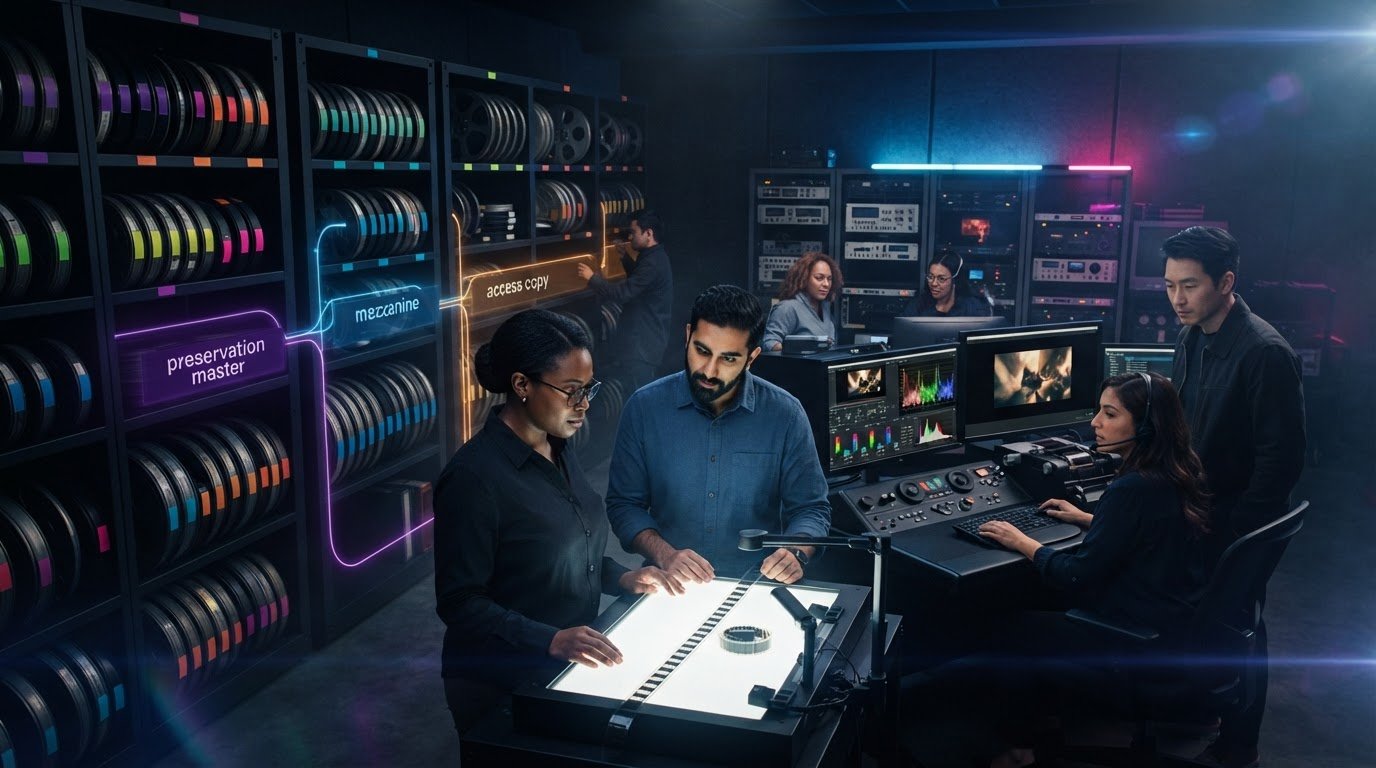
Storage can preserve a file, but it can’t make an uncertain master usable. That distinction is central to archival mastering for film libraries, where legacy materials may arrive in inconsistent formats, versions or technical condition. A file can be safely stored while teams remain unsure which version it contains or whether it is ready for localisation.
A film master may need to support several uses. A preservation master, a distribution master and an access copy serve different purposes, so treating them as interchangeable can create problems later. A controlled, documented workflow clarifies what each asset is for and how it should be checked.
This guide explains how preservation, mastering and storage fit together, and what to document when preparing film-library assets. It covers source assessment, video and audio encoding, broadcast-quality QC and standards conversion, as well as how authoring and localisation prepare versions for downstream distribution. The goal is a clear process, with technical checks and outputs aligned to the library’s intended use.
Key Takeaways
- Use archival mastering for film libraries to prepare controlled, documented assets, while treating preservation policy and long-term storage as separate responsibilities.
- Shape each workflow around the available source materials, as legacy titles may differ in condition, versions and accompanying elements.
- Choose preservation, mezzanine and access roles according to intended use rather than assuming one file format suits every purpose.
- Record version, language, subtitle and audio requirements alongside technical specifications so deliverables are easier to identify and use.
- Align encoding, QC and downstream authoring or localisation with the library’s distribution needs.
What archival mastering for film libraries does, and what it does not
Archival mastering for film libraries is the technical preparation of source material into controlled, documented master assets. It can include assessing the available picture and sound elements, preparing files to defined requirements, checking the outputs and recording what each deliverable represents.
Archival mastering prepares and validates files; it is not simply copying or storing them. A copy may reproduce existing content without clarifying its version, intended use or technical condition. Mastering adds control and documentation, but a completed master does not, by itself, guarantee long-term preservation. Preservation policy, ongoing management and storage are separate responsibilities.
The distinction matters because the same title may need different versions for preservation, access and distribution. A library might retain a high-quality master for future use, prepare a more practical file for researchers and create separate delivery assets for a particular release. The right set depends on the title, source elements and intended use, not a universal template. The broader context of film preservation includes both photochemical and digital approaches; mastering is one part of a wider preservation effort.
How is archival mastering different from film archiving?
Film archiving can encompass cataloguing, preservation policy, rights information, storage and access planning. Mastering focuses on the technical preparation and validation of defined assets. First establish what the assets need to do, then set suitable deliverables and technical requirements. Storing a file protects its place in a system; it does not establish that it is the correct version or ready for a planned use.
Who benefits from a controlled master set?
Film libraries, distributors and rights-holders can use documented master sets to manage catalogue titles with greater clarity. Version notes help teams distinguish source material from prepared deliverables and identify which assets may support access, localisation or later distribution. For example, recording the picture version and included audio or subtitle elements can help prevent teams from treating two different files as interchangeable.
Not every title needs the same number or type of masters. One project may require a single defined asset; another may call for several deliverables for distinct purposes. Start by stating the intended use and documenting the relationship between each output and its source. This gives technical teams a clear basis for preparation and QC, while keeping preservation planning and storage decisions distinct.
How an archival mastering workflow moves from source assets to verified masters
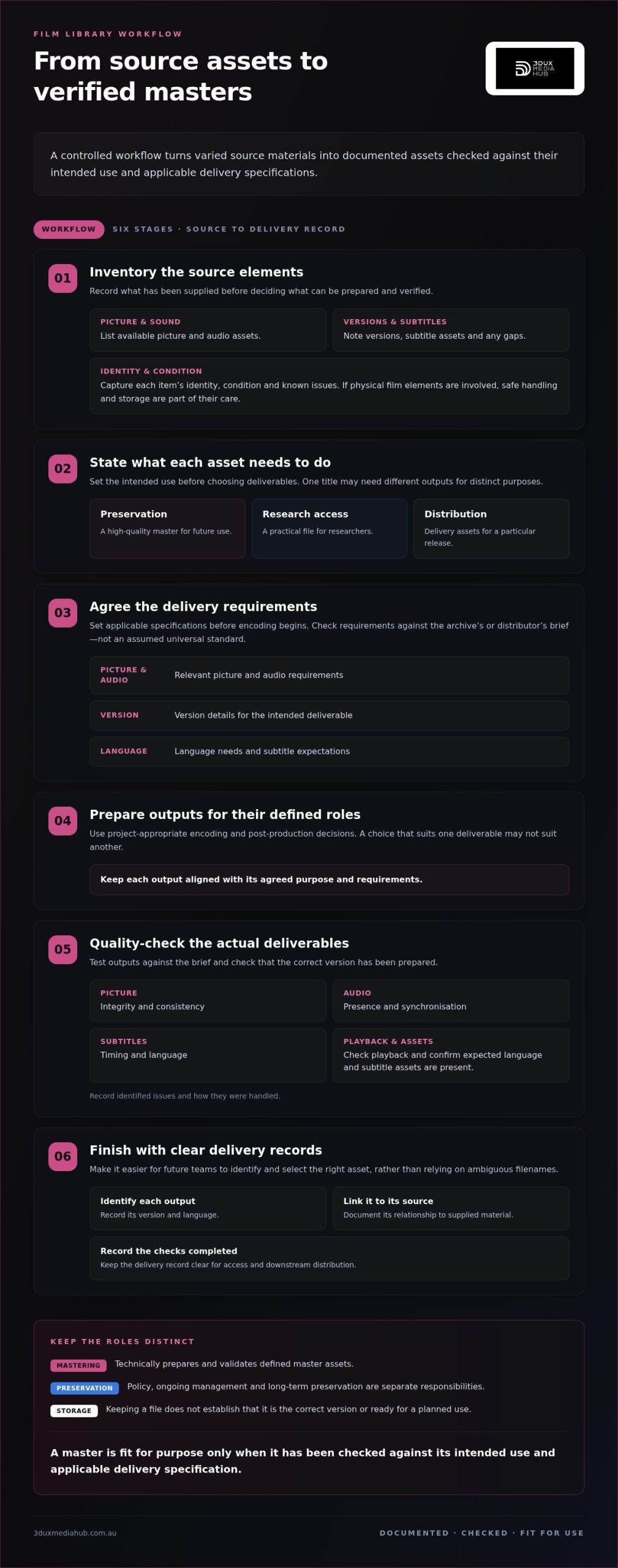
A reliable workflow follows a clear sequence, but the work depends on the materials available. One title may have a finished digital source with separate audio and subtitle files; another may have incomplete elements or known technical issues. Record what has been supplied before deciding what can be prepared and verified.
Assess source elements and establish project requirements
Start with an inventory of picture, audio, subtitle and version assets. Note each item’s identity, condition, known issues and any gaps. If physical film elements are involved, safe handling and storage are part of their care; the Library of Congress guide to Care, Handling, and Storage of Motion Picture Film provides relevant guidance.
Next, define the intended use. Preservation, research access and distribution can require different outputs. Set the applicable delivery specifications before encoding begins, including relevant picture and audio requirements, version details, language needs and subtitle expectations. Check standards against the archive’s or distributor’s brief rather than assuming one set applies to every title.
Prepare, quality-check and document the master outputs
Once requirements are agreed, prepare the files using project-appropriate encoding and post-production decisions. A choice that suits one deliverable may not suit another, so outputs should follow their defined roles. For more on encoding decisions, see this guide to professional video encoding services.
Quality control should test the actual deliverables against the brief. Checks may cover picture integrity and consistency, audio presence and synchronisation, subtitle timing and language, and whether the correct version has been prepared. Depending on the project and source elements, reviewers can compare the output with the brief and source records, check picture and audio playback, and confirm that the expected subtitle and language assets are present. Record identified issues and how they were handled.
A master is only fit for purpose when it has been checked against its intended use and the applicable delivery specification.
Finish with clear delivery records. Identify each output, its version and language, its relationship to the supplied source and the checks completed. This metadata helps future teams select the right asset for access or downstream distribution, instead of relying on ambiguous filenames. For defined encoding and QC requirements, video and audio encoding support can help prepare consistent project deliverables.
Preservation master, mezzanine file or access copy: choosing the right role
These terms describe what an asset is for, not a universal set of formats or technical specifications. In archival mastering for film libraries, define each file’s role against the archive’s policy and the relevant delivery brief. One source title may need separate preservation and access deliverables, each with its own specifications, checks and documented relationship to the source.
| Asset role | Purpose | Typical users | Relationship to source and downstream use |
|---|---|---|---|
| Preservation master | Retain a controlled, high-quality representation of source material for ongoing preservation planning. | Archive and technical teams | Prepared from identified source elements and documented for future management. It may inform later access or distribution work, but does not replace preservation policy or storage planning. |
| Mezzanine master | Provide an intermediary asset for production or distribution workflows. | Post-production and distribution teams | Can support reuse across downstream outputs, depending on its specifications and the workflow. It may be used to prepare a specific delivery encode. |
| Access copy | Make a title practical to view or meet a defined distribution use. | Researchers, audiences or delivery partners | Derived from source or another approved master. It is prepared for a particular access or delivery context, rather than serving automatically as a preservation asset. |
What is the difference between a preservation master and an access copy?
A preservation master is intended to retain a controlled, high-quality representation of the identified source material. An access copy is prepared for practical viewing or a specified distribution purpose, which may call for different technical and language requirements. An access encode isn’t a substitute for preservation planning: suitability for one use doesn’t establish that it meets the archive’s preservation needs.
When does a mezzanine master help a library?
A mezzanine master can act as an intermediary when a library expects to create more than one downstream version. Its value lies in potential reuse, but that depends on the asset’s characteristics and the project workflow. A final delivery encode, by contrast, is prepared against a specific platform, distributor or format brief. Neither label guarantees a particular codec or specification, so follow the archive’s policy and the applicable delivery requirements.
If a library needs a disc deliverable, the mezzanine or another approved source may feed a separate authoring workflow. 4K UHD authoring services can support that downstream step. Keep each output’s role, version and source relationship clear in the records. This helps teams select the right asset without mistaking an access or delivery file for a preservation master.
A practical archival mastering checklist for film-library projects
A clear project brief reduces ambiguity before technical work starts. Use this checklist to separate verified requirements from assumptions, inherited catalogue notes and details that still need resolving. For archival mastering for film libraries, the record should connect each source element to its intended output and use.
What should a library document before mastering begins?
- Supplied elements: List picture, audio, subtitle and other relevant materials. Record source provenance, known versions, condition, identified technical issues and any missing elements.
- Purpose and audience: State the intended use for each output, such as preservation, research access or distribution. Note the audience and territory where relevant.
- Rights and permitted use: Record the rights information and any usage or territory limits that affect planned outputs. Keep these details distinct from technical specifications.
- Delivery requirements: Capture the receiving organisation’s specifications, file expectations and naming conventions. Note their source, such as a current delivery brief, rather than relying on memory or an old project record.
- Required deliverables: List the outputs needed and the relationship each should have to the source. Include relevant language, subtitle, audio and version requirements.
Mark each detail as confirmed, provisional or unknown. An inherited metadata field can be useful, but it isn’t automatically a verified technical requirement. If a catalogue note says “original version”, for example, record the label and flag it for review rather than treating it as proof of which picture edit or audio track is present.
How should a library handle versions and localisation assets?
Track each picture edit, audio version, subtitle file and language-specific asset as a distinct element. Give related assets consistent identifiers that show the title, version and language without implying that different files are interchangeable. This helps technical teams match the right audio and subtitle materials to the intended picture version, and lets reviewers identify exactly what was checked.
Where localisation is in scope, include language and version details in the project record and delivery naming. Audio conforming for international film release can support workflows where language-specific audio needs to align with a particular version. For broader delivery checks, see broadcast quality control for film distribution.
Bring the inventory, confirmed specifications and version records together in one accessible brief before work begins. For project-specific encoding and QC requirements, film-library mastering support can help define the deliverables.
How professional mastering services support usable film-library masters
A defined workflow turns a library’s delivery brief into technical outputs that can be checked and used for their intended purpose. For archival mastering for film libraries, service work can support asset control and consistency through agreed specifications, clear version identification and documented QC. It doesn’t replace the library’s preservation policy or long-term storage arrangements.
Which technical services can support an archival master workflow?
Video and audio encoding prepares files to project-approved requirements, from SD to 4K where specified. Broadcast-quality QC checks deliverables against the relevant brief, helping identify picture, audio or version issues before handover. Checks should reflect the output’s purpose and the receiving organisation’s specifications, rather than assume one standard fits every title.
Related services apply when downstream use calls for them. Standards conversion can prepare content for a specified distribution requirement. Content localisation can support language-specific versions. 4K UHD, Blu-ray and DVD authoring can prepare titles for those formats, with menus designed to suit the project. These are distinct delivery steps, not substitutes for a preservation master or an archive’s storage plan.
3DUX Media Hub provides mastering-related technical services, including encoding, QC, standards conversion, localisation and authoring. Keeping these technical services distinct from preservation policy and storage planning helps libraries define outputs without confusing file preparation with preservation infrastructure.
What should the next step be for a film library?
Bring together the source inventory, intended uses and applicable delivery specifications. Include relevant picture and audio versions, subtitle and language requirements, known technical issues and any naming conventions supplied by the receiving organisation. This gives the project a practical basis for defining deliverables and allocating checks.
From there, encoding, QC and related outputs can be tailored to the title’s source materials and agreed distribution needs. Clear requirements help maintain consistency across versions while keeping each deliverable’s role identifiable. That’s especially useful when a catalogue title needs more than one version for different audiences or delivery contexts.
For a considered discussion about encoding, QC and related deliverables for your library, film-library mastering services can support the project workflow.
Make each master ready for its intended use
Archival mastering for film libraries is most effective when every deliverable has a defined role, a documented relationship to its source and checks aligned with its intended use. A preservation master, mezzanine file and access copy aren’t interchangeable, and storing a file alone doesn’t ensure it is ready for future access or distribution.
Start with a clear inventory and project brief. Record available versions, audio and subtitle elements, intended uses and delivery requirements. Then prepare and quality-check the outputs against those requirements. This creates a more controlled foundation for future access, localisation and distribution, while keeping mastering distinct from preservation policy and long-term storage.
3DUX Media Hub supports film-library deliverables with video and audio encoding, broadcast-quality QC, standards conversion, localisation and authoring. These services can support consistent assets and global distribution needs, tailored to the project’s requirements.
Ready to plan the next step for your catalogue? Discuss your film-library mastering requirements and move forward with a clear, fit-for-purpose workflow.
Frequently Asked Questions
What is archival mastering for film libraries?
Archival mastering for film libraries is the technical preparation of source material into controlled, documented master assets. It establishes what each file represents, what it’s intended for and whether it meets agreed technical requirements. A library may prepare different assets for preservation, research access or distribution. Mastering prepares and checks files; it doesn’t provide the preservation policy, ongoing management or storage needed to maintain them over time.
How is a preservation master different from an access copy?
A preservation master is prepared to retain a controlled, high-quality representation of identified source material. An access copy is designed for practical viewing or a defined distribution use, so its technical settings and included language elements may differ. One title can require both. The right specifications depend on the archive’s policy and the receiving organisation’s requirements, so an access copy shouldn’t automatically be treated as a preservation master.
Does archival mastering preserve a film indefinitely?
No. Archival mastering prepares and validates files, but it can’t guarantee that a film will remain accessible indefinitely. Long-term preservation also depends on the library’s preservation policy, storage arrangements, asset management and plans for maintaining access as technology changes. A technically checked master is a valuable managed asset, not a complete preservation system. Keep its documentation and storage responsibilities clear, and review them as part of the archive’s ongoing preservation approach.
Which file format is best for an archival film master?
There isn’t one file format that suits every archive or project. The appropriate choice depends on the archive’s preservation policy, available source material and intended use. A distribution specification may call for different characteristics from an access or preservation deliverable. Define the required format and technical parameters in the project brief, then verify them against the archive’s or receiving organisation’s current requirements before preparing the master.
Can an existing digital film file be remastered for library use?
Yes, an existing digital file can be assessed as a source for library deliverables. The workflow depends on its technical condition, provenance, picture and audio characteristics, available supporting elements and intended use. First identify the file and any known limitations, then define the required outputs and specifications. A new encode or other preparation may support a particular use, but it doesn’t restore information missing from the available source.
What happens if a film library has incomplete or inconsistent source materials?
The materials are assessed and documented before deliverables are defined. This includes recording which picture, audio, subtitle and version elements are available, along with known issues and gaps. The project brief can then distinguish confirmed facts from inherited metadata or assumptions. Decisions are based on the source material and intended use, so the workflow can be tailored to the title rather than forcing every film through an identical process.
How much does archival mastering for a film library cost?
The cost depends on the project scope, source condition and required deliverables. A project involving several versions, language assets, encoding requirements or QC checks may have different needs from one with a single defined output. A clear inventory and delivery brief help establish the work involved, including any relevant authoring, localisation or standards conversion. Pricing is project-based, so there isn’t one figure that applies to every film-library title.