
What if the language assets are approved, but the delivery master contains the wrong subtitle version? That mismatch can hold up an international release. Film content localisation takes more than adapting dialogue: assets, approvals and technical preparation need to stay aligned from the outset.
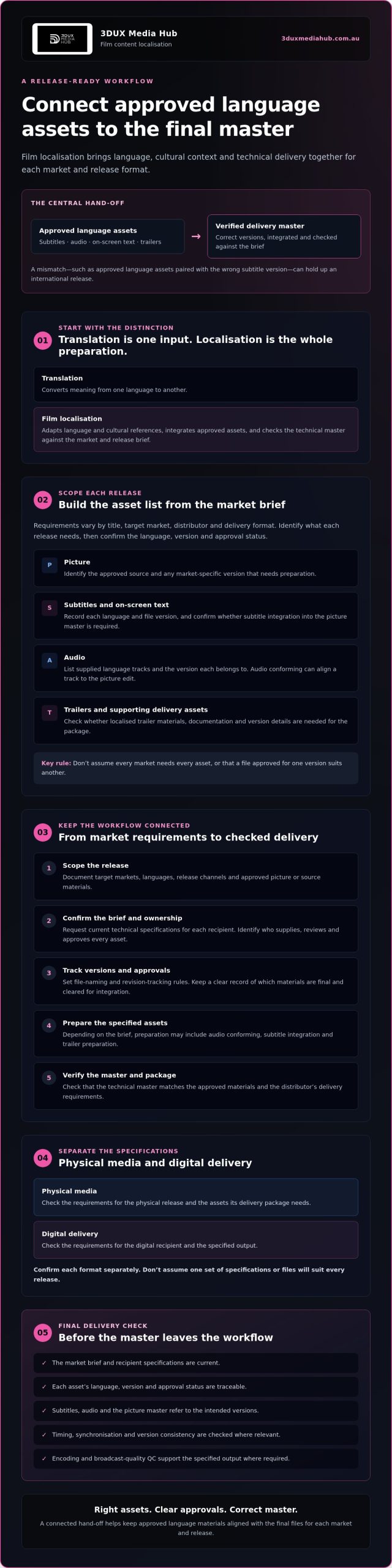
It’s easy to focus on what audiences will hear or read and overlook how each version must fit the release requirements. The right combination of subtitles, audio assets, on-screen text and trailer materials depends on the target market and delivery format. Clear hand-offs between creative, localisation and mastering teams help keep approved language assets connected to the final files.
This guide explains the localisation workflow, the assets to plan and the checks to complete before delivery. Learn how to scope requirements by market, sequence reviews and approvals, and verify that technical masters match approved materials. We’ll also cover how asset preparation, encoding and broadcast-quality QC can support a connected distribution workflow and help prevent avoidable errors.
Key Takeaways
- Film content localisation brings language, cultural context and technical delivery together for an international release.
- Use the market brief to identify the picture, subtitle, audio, trailer and documentation assets each release needs.
- Keep asset versions and approval status visible so teams can trace which materials are cleared for each master.
- Check physical media and digital delivery requirements separately rather than assuming they use the same specifications.
- Audio conforming, subtitle integration and trailer preparation can help ready supplied assets for specified outputs.
What Does Film Content Localisation Include for Global Releases?
Film content localisation prepares a title for audiences and delivery requirements in a particular market. It can involve adapting language and cultural references, integrating approved assets, and checking that the completed version meets the distributor’s technical brief. Translation may provide dialogue or on-screen text in another language, but it is only one possible input to the release workflow.
Translation converts meaning from one language to another; localisation adapts and prepares a film’s language assets and technical master for a specific market and release. The scope depends on the destination market, distributor brief and release format. A version for physical media may need different asset preparation from a digital delivery, so confirm requirements rather than assuming one set of files suits every release.
How Is Film Localisation Different from Translation?
Translation addresses words. Localisation considers how approved language assets work in the finished film and its delivery package. This can include adapting dialogue or on-screen text for cultural context, integrating supplied subtitles or audio, and checking timing, synchronisation and version consistency. Dubbing is one approach to presenting dialogue in another language, as outlined in this overview of film dubbing and localisation. Scope translation and dubbing separately from technical preparation.
For distributors, the key hand-off is between approved creative assets and the master prepared for release. Record which files are final, which version each belongs to and what checks apply before integration. Without that control, a correct translation can still be paired with the wrong subtitle file or audio version.
Which Release Elements May Need Localisation?
The required elements vary by title, target market and distributor specification. Identify the assets needed for each release, then confirm their language, version and approval status. Depending on the brief, the list may include:
- Subtitles: approved subtitle files and their integration into the required version.
- Audio: supplied language tracks that may need conforming to the picture edit.
- Trailers: localised versions or materials prepared for the relevant release.
- Supporting delivery assets: documentation and version details needed to identify and check the package.
Don’t assume every market needs every asset, or that a file approved for one version is suitable for another. For a closer look at matching audio to picture, read the film audio conforming guide. Clear asset requirements help teams prepare the right materials and keep track of the master they’re intended for.
Which Language and Technical Assets Should a Film Localisation Plan Cover?
A useful asset plan connects each market and release to the files needed to build and verify its delivery package. List assets by purpose, then record the required language, version, source and approval status. This makes hand-offs clearer, especially when rights holders supply some materials and separate localisation work must be commissioned for others.
The distributor’s delivery specification governs the final asset checklist. Request the current brief for each intended recipient rather than carrying assumptions over from another release. Specifications can differ by market and format, and approved source materials must match the version being prepared.
What Should a Distributor Confirm Before Work Begins?
Before commissioning work, document the target markets, languages, release channels and approved picture or source materials. Confirm each recipient’s current technical specifications and identify who owns, supplies, reviews and approves every asset. Set version-control rules too, including file naming, revision tracking and a clear record of which materials are approved for integration. These decisions help prevent a superseded asset from being mistaken for the final version.
Build the Asset List by Purpose
- Picture: identify the approved source and any market-specific version that needs preparation.
- Subtitles: record each required language, the supplied or commissioned file, and whether integration into the picture master is required.
- Audio: list the supplied tracks and the version each belongs to. Audio conforming aligns an audio track with the relevant picture edit; it is separate from creating or translating dialogue.
- Trailers: include localised promotional assets only where the release brief calls for them.
- Delivery documentation: capture file identifiers, language and version details, approvals, and the recipient’s technical requirements.
Keep asset creation distinct from technical preparation. A rights holder may provide approved language files, while other language assets need to be commissioned. Make responsibility explicit in the project brief. Subtitle integration and audio conforming are separate tasks, and each should be checked against its intended picture version.
Encoded delivery files also need to be prepared against the applicable recipient specification. For more on that stage, see the professional video encoding guide. Distributors can also review 3DUX Media Hub’s content localisation services when planning project-specific asset preparation against a delivery brief.
How Does Film Localisation Move from Approved Assets to Delivery Masters?
A reliable workflow gives each asset a clear route from the project brief to the finished master. In film content localisation, the technical hand-off is only as dependable as the source package. Teams need complete, approved materials and the current delivery specification before integration begins.
What Are the Main Localisation Workflow Stages?
- Confirm scope. Record the target market, release format, recipient requirements, required languages and approval owners. Obtain the recipient’s current technical specification.
- Collect and check assets. The rights holder supplies approved picture and any existing language materials. Log what has arrived, its version and approval status. Flag missing or unclear items before work proceeds.
- Prepare the materials. Language vendors or other appointed suppliers provide commissioned assets where required. The technical team checks that supplied files correspond to the intended picture version and are ready for integration.
- Integrate and review. Integrate approved subtitles and audio as specified. Review the assembled version against the source and delivery brief, then resolve discrepancies with the relevant owner.
- Approve and master. Obtain sign-off on the integrated version before final encoding or authoring begins. Complete the specified technical checks, record the delivered version and hand over the master with its required documentation.
These are practical approval gates, not administrative extras. They clarify when responsibility passes from the rights holder to language suppliers and then to the technical team. If an asset changes after approval, update its version record and confirm whether the integrated master needs to be rebuilt or rechecked.
Where Can Localised Film Deliveries Go Wrong?
Common preventable risks include a subtitle file matched to an earlier picture edit, an audio track that no longer aligns with the approved version, missing delivery materials, or a specification that has changed since the project was scoped. A checklist linked to asset names and approval status helps expose these gaps before they reach the master.
QC should check both technical integrity and asset correspondence. Confirm that delivered files meet the recipient’s current requirements, then verify that the correct approved picture, subtitles and audio are present and aligned. Don’t rely on assumed universal settings; requirements vary by recipient and release format.
For physical disc projects, the Blu-ray quality control guide covers disc-specific QC considerations. Encoding, broadcast-quality QC and authoring can form part of a connected preparation workflow, with each output checked against its applicable brief.
How Should Distributors Scope Localisation Across Markets and Release Formats?
Localisation can feel complex when several markets, recipients and release formats are involved. The work becomes manageable when each deliverable has a defined purpose, owner and approval path. Scope each market and format separately, then compare requirements to identify shared assets and genuine differences.
How Can a Deliverables Matrix Clarify Scope?
Use one row for each market and release combination. A practical matrix might look like this:
- Market: [confirm destination]
- Release format and version: [confirm physical media or digital delivery, and the picture version]
- Language asset: [list required supplied or commissioned asset]
- Specification: [record recipient requirements or mark “to confirm”]
- Owner and sign-off: [name the responsible party and approval status]
Keep unknowns visible. Don’t fill gaps with assumed language, accessibility or technical requirements; verify them with the relevant distributor or recipient. Reviewing rows side by side can reveal duplicate requests, missing assets or conflicting specifications before they affect schedules and hand-offs.
A clear owner matters as much as a clear file list. The rights holder may supply the approved picture, a language supplier may provide a commissioned asset, and a technical team may prepare the specified output. Record who approves each hand-off and which version that approval covers.
What Changes Between Physical and Digital Deliveries?
The planning questions differ because the outputs differ. For physical media, confirm whether the brief includes disc authoring, menus and any associated package materials, then check the applicable requirements with the recipient. For digital delivery, confirm the required encoded files and delivery specification. Don’t assume that a picture or language asset prepared for one format will automatically suit another.
These are planning distinctions, not universal rules. A distributor’s brief determines which assets and technical outputs apply to a particular title, market and destination. For physical-media considerations, see the professional disc authoring guide.
Once approved, the matrix gives creative, language and mastering teams a shared reference for responsibilities, open questions and sign-off. The 3DUX Media Hub website outlines services that may be relevant to project-specific localisation and technical deliverables.
How Can a Technical Partner Prepare Localised Film Content for Release?
Approved language assets still need to be prepared for their intended release output. A technical partner works from the supplied materials and distributor’s specification, helping connect those assets to the picture, master and delivery checks. This is the practical role of technical support in film content localisation: prepare and verify the release package while keeping responsibility for creating or approving each asset clear.
What Can 3DUX Media Hub Support?
3DUX Media Hub supports film and TV asset preparation through audio conforming, subtitle integration and trailer preparation. These tasks help align supplied, approved materials with the relevant picture version and project brief. Related services may include video and audio encoding, standards conversion, authoring for physical media and broadcast-quality QC, where specified for the project.
The scope depends on the assets received and the requested outputs. Confirm that source files are complete, identify which versions have approval, and provide the applicable delivery specifications. This gives the technical team a clear basis for preparation and QC. Translation, dubbing, film production and streaming platform operation are separate from these technical services.
What Should You Include in a Localisation Enquiry?
A concise brief helps clarify the work to be scoped. Include:
- Target markets and release formats: identify the intended destinations and whether physical media, digital delivery or both are in scope.
- Delivery specifications: provide the current requirements from each recipient, or flag any that are still to be confirmed.
- Asset inventory: list the picture version, supplied subtitle and audio assets, trailers and supporting documentation, noting approval status.
- Approvals and timing: name the people responsible for sign-off, outline approval stages and share relevant deadlines without assuming a turnaround.
- Open technical questions: highlight missing materials, version differences or uncertainties that could affect preparation.
These details help establish where technical preparation begins, which assets are ready to integrate and what needs clarification before work proceeds. They also give the parties a shared reference for deliverables and hand-offs. For service details, visit 3DUX Media Hub’s film localisation page.
Prepare Your Film for Its Next Market
Successful film content localisation depends on more than approved language assets. Scope each market and release format against the recipient’s current specifications, then track ownership, version control and sign-off from asset intake through to the delivery master. These steps help keep approved materials and final outputs aligned.
A clear asset plan also makes technical hand-offs easier. 3DUX Media Hub supports localisation asset preparation, including audio conforming, subtitle integration and trailer preparation. Depending on the project brief, related capabilities include encoding, authoring and broadcast-quality QC. The principals report more than 20 years of industry experience.
Before seeking a project discussion, gather your target markets, release formats, delivery specifications and asset inventory. Include open questions and approval stages, then discuss your film localisation brief with 3DUX Media Hub.
Frequently Asked Questions
What does film content localisation include?
Film content localisation prepares a film’s language and supporting assets for a particular market and release. Depending on the brief, it may include subtitle integration, audio conforming, trailer preparation, adaptation of on-screen text and technical checks on delivery files. Translation may be one input, but it doesn’t cover the complete preparation workflow. The distributor’s specification and the assets already available determine what’s required for each version.
When should localisation begin in a film distribution workflow?
Begin localisation planning as soon as target markets, release formats and intended recipients are known. Early scoping gives the distributor time to confirm required assets, obtain current specifications and identify who will supply and approve each file. Technical integration can start once the relevant source materials are complete and approved. If market or delivery requirements change, update the asset plan before affected masters are prepared.
Can localised subtitles be integrated into a film delivery master?
Yes, supplied and approved subtitles can be integrated into a film master when the intended output and recipient specification call for it. Confirm the subtitle language, file version and matching picture edit before integration. Afterward, check that the subtitles appear correctly and correspond to the approved asset. Requirements vary by release, so confirm whether the recipient needs integrated subtitles, separate files or another specified arrangement before mastering.
What assets should a distributor provide for film localisation?
Provide the approved picture source, a list of target markets and release formats, and the recipient’s current delivery specifications. Include any available subtitle files, audio tracks, trailer materials and supporting documentation, with each asset’s language, version and approval status identified. Note what’s missing or still needs commissioning, and name the people responsible for sign-off. A clear inventory helps the technical team assess what can be prepared and what needs clarification.
How is localised film content checked before delivery?
Check both technical integrity and whether the master contains the correct approved assets. Review the output against the recipient’s current specification, then verify that picture, subtitles and audio match the intended version and are correctly integrated. Check required files and documentation against the delivery brief as well. The exact QC process depends on the output, so confirm relevant checks for each destination rather than relying on assumed settings.
Does every international market need a separate film master?
No, not necessarily. Whether a separate master is needed depends on the recipient’s requirements, release format and localised assets. Some deliveries may use a shared picture master with separate language files, while others may call for different versions or prepared outputs. Don’t assume either approach applies universally. Map each destination’s requirements against the available assets, then confirm the required masters and files with the distributor before preparation begins.