A technical rejection from a global distributor isn’t just a minor setback; for an independent filmmaker, it’s a financial catastrophe that can stall a project’s momentum indefinitely. You’ve spent months perfecting the colour grade and sound mix, yet the final technical hurdle of 4K UHD mastering for independent films often remains the most daunting part of the process. It’s a high-stakes environment where a single metadata error or an incorrect HDR10 peak brightness setting can result in immediate disqualification from major platforms.
We understand that the complexity of modern delivery specs is enough to overwhelm even the most seasoned production team. This 2026 technical guide provides the exact roadmap you need to manage the nuances of UHD distribution, ensuring your high-fidelity visual presentation meets every international standard without the risk of a costly rejection. We’ll examine the critical distinctions between HDR10 and Dolby Vision, outline the precision required for high-efficiency encoding, and detail the rigorous QC protocols that turn a raw export into a professional, globally distributable asset.
Key Takeaways
- Understand why 4K delivery is now mandatory for premium global placement and how it protects your film’s long-term commercial value.
- Master the technical specifications of 4K UHD mastering for independent films, focusing on HEVC encoding and bitrate management to eliminate compression artefacts.
- Explore the specific authoring requirements for 4K UHD Blu-ray to capitalise on the resurgence of the boutique physical media market.
- Learn why combining automated tools with human-eye technical QC is the only way to guarantee your master passes rigorous distributor compliance checks.
- Recognise how partnering with a specialist Australian hub ensures broadcast-quality results and fast turnaround for tight distribution deadlines.
Beyond the Resolution: Why 4K UHD Mastering is Vital for Independent Films in 2026
In 2026, delivering an indie project in 1080p is a fast track to the bargain bin. High-tier distributors now treat Ultra High Definition as the baseline for acquisition. There is a massive gap between a basic 4K export from a timeline and professional 4K UHD mastering for independent films. One is just a file; the other is a compliant, high-value asset ready for global commerce. Think of the master as the gold standard of your project. While resolution refers to the pixel count, a master includes the metadata, colour space, and encoding parameters that define the viewing experience.
Mastering in 4K future-proofs your work. It ensures that as display technology evolves, your film remains commercially viable. It’s about protecting the longevity of your intellectual property. A high-quality master ensures your catalogue retains its value for decades, allowing for re-releases and new platform placements as the market shifts. Without professional intervention, an indie film risks looking thin or digital on high-end 4K displays. Professional mastering adds the weight and polish required for premium placement.
Distributor Requirements and Global Delivery Standards
Platforms like Netflix and Stan don’t just ask for pixels. They demand technical compliance with strict delivery specifications, often requiring specific IMF or ProRes packages. Secure international sales often hinge on these technicalities. If you can’t provide a compliant master, the deal often stalls or fails entirely. Preparing for the final mile of distribution requires a professional approach to asset preparation. It’s the difference between a successful release and a technical rejection that costs thousands in remedial work. 3DUX Media Hub acts as a safe pair of hands here, ensuring every file meets these rigorous global standards.
The Aesthetic Advantage for Independent Cinema
Indie films often rely on texture and atmosphere to stand out. 4K UHD allows for the preservation of fine film grain and subtle shadow detail that standard HD compression usually destroys. It’s about the cinematic experience. A professional master ensures that the director’s vision translates perfectly to the domestic screen without compromise. High-bitrate encoding prevents the banding and blockiness that often plague lower-resolution exports. When you invest in 4K UHD mastering for independent films, you aren’t just ticking a box for a distributor. You’re ensuring the audience sees exactly what you intended, with the colour depth and clarity the story deserves. This precision is what separates a professional production from a hobbyist project.
The Technical Core: HEVC Encoding and HDR Compliance
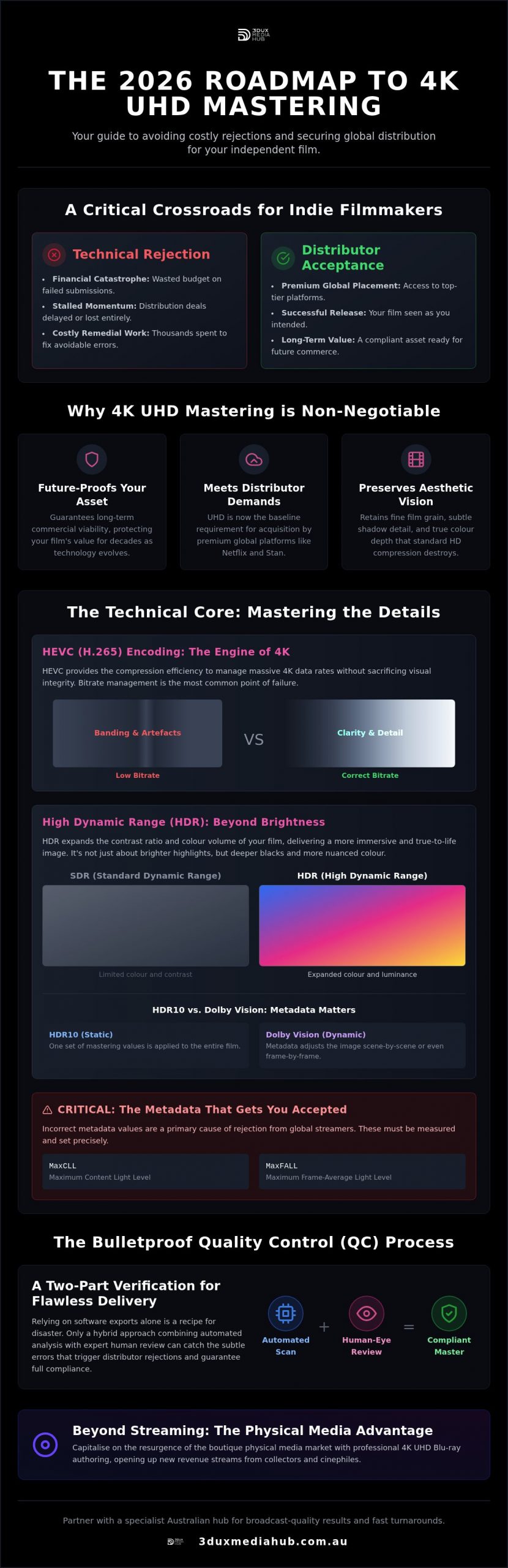
HEVC (H.265) is the engine behind 4K UHD delivery. It provides the compression efficiency needed to manage massive data rates without sacrificing visual integrity. For indie filmmakers, bitrate management is the most common point of failure. Low bitrates cause visible banding in gradients and blocky compression artefacts in high-detail areas. High-quality 4K UHD mastering for independent films requires a delicate balance. You need enough data to support the Rec. 2020 colour space while keeping the final asset manageable for distribution. Professional mastering ensures that the transition from the P3 colour space of the grade to the Rec. 2020 container of the master is handled without clipping or hue shifts.
Mastering for High Dynamic Range (HDR)
HDR is not just about making the screen brighter. It’s about expanding the contrast ratio and colour volume of your film. The technical workflow for 4K UHD HDR mastering involves precise luminance mapping and metadata management. While HDR10 is the industry baseline, Dolby Vision offers dynamic metadata that adjusts the image shot-by-shot. This ensures your creative vision remains consistent across different consumer displays. A common pitfall for independent houses is failing to manage the “MaxCLL” (Maximum Content Light Level) and “MaxFALL” (Maximum Frame-Average Light Level) values correctly. These metadata points are vital for preventing technical rejection from global streamers who demand strict adherence to luminance limits.
Professional Video Encoding Services
Relying on a standard NLE export for your final master is a significant risk. Professional tools allow for multi-pass encoding and granular control over the GOP (Group of Pictures) structure. Our professional video encoding services provide a level of precision that standard software simply cannot match. This process maintains high visual fidelity while optimising file sizes for both digital platforms and physical media. Physical media requires significantly higher bitrates (often up to 100 Mbps) compared to streaming encodes. This ensures that complex elements like film grain, water, and smoke don’t dissolve into digital noise. If you’re preparing a high-value asset, choosing a reliable technical authoring partner can prevent the high cost of post-delivery errors. We handle the complex encoding parameters so your project meets every global delivery standard on the first attempt.
Authoring for Physical Media: The 4K UHD Blu-ray Advantage
Streaming might dominate volume, but boutique physical media is where independent and cult cinema find their most dedicated, high-margin audiences. Collectors today demand the uncompromising quality of a physical disc, which offers bitrates far exceeding even the best 4K streaming services. For a filmmaker, a physical release is a prestige asset and a significant revenue stream. However, 4K UHD mastering for independent films intended for disc requires a specialised technical approach. You aren’t just delivering a file; you’re building a complex, layered software environment that must function perfectly on hardware players from various manufacturers.
The technical requirements for 4K UHD Blu-ray authoring involve more than just high-quality video. You must manage specific disc structures:
- Disc Capacity: Choosing between BD-66 (dual-layer) and BD-100 (triple-layer) based on feature length and bonus content.
- Transfer Rates: Ensuring the total bitrate, including audio and subtitles, stays within the 100 Mbps or 128 Mbps limits to prevent playback stutter.
- Security: Implementing AACS2 encryption to protect your intellectual property from unauthorised copying.
- Region Coding: While 4K UHD discs are technically region-free, your master must still be configured to meet global distribution agreements.
Interactive Menu Design and Motion Graphics
A premium disc release requires a sophisticated user interface. High-end interactive Blu-ray menu design for 4K ensures the viewer’s first impression matches the quality of the film. We use BD-J (Blu-ray Disc Java) to create seamless, responsive navigation that doesn’t feel sluggish. Integrating motion graphics into the menu adds a layer of professionalism that static images can’t provide. Technical stability is the priority here; a menu that crashes a consumer’s player can lead to costly product recalls and brand damage.
Audio Encoding for 4K UHD Discs
Sound is half the experience in independent cinema. 4K UHD discs provide the bandwidth for lossless, immersive audio formats like Dolby Atmos and DTS:X. This requires a precise technical process of audio conforming for international film release, ensuring that every channel is correctly mapped and synced. Managing multiple audio tracks is essential for global sales. You’ll often need to organise various localisation assets, including dubbed tracks and descriptive audio for the visually impaired, all while maintaining strict sync with the 4K video stream. Professional authoring ensures these assets are organised logically, allowing the viewer to switch languages or formats instantly without interrupting the cinematic flow.
Quality Control and Technical Compliance: Avoiding Distributor Rejections
Quality control (QC) is the final technical gatekeeper between your production and a successful global release. In the context of 4K UHD mastering for independent films, the margin for error is non-existent. Global distributors and streaming platforms use automated ingest systems that flag even the smallest deviation from their delivery specifications. A professional QC report is your insurance policy. It identifies technical flaws before they reach the distributor, saving you from the astronomical costs and reputational damage of a project rejection.
Effective QC requires a dual-layered approach. Automated tools are excellent for checking file syntax, illegal colours, and metadata consistency. However, they cannot replace the human eye. A technical expert must watch the master from start to finish to identify dead pixels, subtle compression artefacts, or a subtitle track that drifts by a single frame. Gamut errors are particularly common in HDR projects. If your grade pushes a colour beyond the Rec. 2020 limit, the file will fail ingest immediately. We ensure your master is technically perfect, allowing you to focus on your next production instead of managing technical disputes.
The 4K UHD QC Checklist
Every master leaving our hub undergoes a rigorous inspection process. You can find our detailed breakdown of 2026 Blu-ray quality control protocols, which we apply to both physical and digital deliveries. We verify that HDR metadata, specifically MaxCLL and MaxFALL values, aligns perfectly with the visual content. Checking subtitle timing and localisation accuracy is also vital. A technical error in a foreign language track can be just as damaging as a video glitch. We cross-reference every asset against the distributor’s delivery sheet to ensure absolute compliance.
Broadcast Standards and Global Compliance
Securing an international TV deal requires more than just a 4K file. You’ll often need to navigate complex broadcast standards conversion services to meet the requirements of different territories. Converting a 24fps cinematic master to a 25fps European broadcast standard involves precise frame interpolation and audio pitch correction. Without professional handling, these conversions can introduce stuttering or audio sync issues. Whether you are delivering to a boutique cinema chain or a major global streamer, your 4K master must meet strict technical specifications. Our specialists manage these complexities, providing the asset preparation needed for a seamless global launch. If you want to ensure your film passes every technical hurdle, book a professional QC session with 3DUX Media Hub today.
Partnering with 3DUX Media Hub for Professional 4K UHD Mastering
3DUX Media Hub specialises in the technical complexities that often stall independent releases. With over 20 years of industry experience, we’ve built a reputation as the safe pair of hands for high-value film assets. We understand that for an indie filmmaker, every dollar and every day counts. Our Australian-based hub is designed for efficiency and technical precision. We don’t just process files; we ensure your project survives the rigorous scrutiny of global distribution. Fast turnaround times are a core part of our service. We know that distribution windows are tight and missing a delivery date isn’t an option.
Professional 4K UHD mastering for independent films requires more than just standard software. It requires a deep understanding of evolving media standards. We provide a comprehensive suite of services including broadcast-quality QC, high-efficiency encoding, and content localisation. Our team handles the technical heavy lifting of asset preparation. We provide the technical infrastructure that turns a finished edit into a globally distributable product. This precision protects your investment and ensures your film looks exactly as intended on every screen.
Our Approach to Independent Film Mastering
Our approach is modular and transparent. We provide customised authoring solutions that respect indie budgets without compromising on technical quality. You’ll work directly with technical experts who understand the nuances of 4K UHD, from bitrate management to HDR metadata compliance. We don’t hide behind account managers; you get direct answers to technical questions. We support the full spectrum of delivery needs:
- 4K UHD Blu-ray authoring with interactive motion menus.
- High-bitrate encoding for major streaming platforms like Stan and Netflix.
- Standards conversion for international broadcast markets.
- Audio conforming and comprehensive subtitle localisation.
Get Your Film Ready for Global Release
Contact 3DUX Media Hub to discuss your 4K UHD mastering requirements today.
Secure Your Project’s Global Distribution Potential
The transition from a finished grade to a globally compliant master is the most critical phase of your film’s journey. Professional 4K UHD mastering for independent films is no longer just about resolution; it’s about technical compliance and protecting your intellectual property for the long term. By prioritising HEVC encoding precision and rigorous QC protocols, you eliminate the risk of technical rejection from major streaming platforms and boutique physical media distributors. Every technical detail, from HDR metadata to audio conforming, must be flawless to ensure your work reaches its audience without delay.
3DUX Media Hub provides the technical infrastructure and over 20 years of experience needed to navigate these complexities. As a specialist Australian-based authoring and encoding hub, we offer the fast turnaround times essential for meeting tight distribution deadlines. Don’t let a metadata error or a gamut violation stall your project’s success. Secure your film’s technical future with professional 4K UHD authoring at 3DUX Media Hub. Your creative vision deserves a technical presentation that matches its ambition.
Frequently Asked Questions
What is the difference between 4K resolution and 4K UHD mastering?
Resolution refers specifically to the pixel count, which is 3840 x 2160 for Ultra High Definition. Mastering is the comprehensive technical process of preparing that high-resolution file for commercial distribution. It involves colour space conversion to Rec. 2020, high-efficiency encoding, and the injection of essential HDR metadata. While any camera can shoot 4K, only professional mastering ensures the file meets the rigorous standards required by global distributors.
Do I really need an authoring house for my independent film release?
Professional authoring is essential if you intend to secure premium placement on platforms like Netflix or Stan. Authoring houses provide broadcast-grade encoding and technical validation that consumer-level NLE software simply cannot replicate. Investing in 4K UHD mastering for independent films through a specialised hub ensures your project passes distributor QC on the first attempt, preventing the high cost of technical rejections and delivery delays.
How long does the 4K UHD authoring process typically take?
Timelines depend on the complexity of the project and the volume of localised assets. A standard feature film master usually requires five to ten business days to complete. This window allows for high-precision encoding, menu design, and a full human-eye technical QC. We focus on providing a fast turnaround to help filmmakers meet strict global distribution deadlines while maintaining absolute technical accuracy throughout the process.
What technical assets do I need to provide for 4K UHD mastering?
You must provide a high-quality mezzanine file, typically a ProRes 4444 or 4444 XQ export with a wide colour gamut. We also require separate audio stems for 5.1 or Dolby Atmos mixes and timed subtitle files in a compatible format. If your project includes a physical release, you’ll need to provide high-resolution assets for menu design and any localised audio tracks for international territories.
Can 3DUX Media Hub handle both physical disc and digital platform masters?
Yes, our facility is equipped to handle both 4K UHD Blu-ray authoring and digital platform delivery. We create a master asset that can be formatted for physical media or optimised for high-efficiency digital streaming. This dual capability ensures your film remains consistent across all viewing environments, whether it’s being played from a boutique collector’s disc or streamed via a major global VOD service.
Is HDR10 or Dolby Vision better for an independent film master?
HDR10 is the mandatory industry baseline for all High Dynamic Range content and offers excellent compatibility. Dolby Vision provides a more refined experience through dynamic metadata that adjusts the image shot-by-shot, but it involves a more complex mastering workflow. Most independent productions prioritise HDR10 for its cost-effectiveness and universal support, though we can implement Dolby Vision for projects requiring the highest level of visual precision.
What happens if my 4K master fails a distributor’s technical QC?
A technical failure results in an immediate rejection, which can stall your release and trigger additional fees. This is why we perform rigorous internal QC before any file is delivered. If a distributor flags an issue, we analyse the specific error code, rectify the technical fault, and re-author the master. Our goal is to prevent this scenario entirely by ensuring every asset is compliant before it leaves our hub.
Why is bitrate management so important for 4K UHD encoding?
Bitrate management is the key to maintaining visual fidelity without creating unmanageable file sizes. If the bitrate is too low, complex scenes will suffer from visible banding and digital noise. Professional 4K UHD mastering for independent films uses sophisticated multi-pass encoding to allocate more data to high-detail frames. This ensures that film grain, smoke, and fine textures are preserved perfectly, providing a truly cinematic experience for the viewer.