What if the “control” of an in-house team is actually a $200,000 anchor dragging down your 2026 margins? It’s a question many Australian distributors are asking as hardware cycles shorten and licensing fees for HEVC and AV1 climb. We understand the pressure. Maintaining a suite of 4K UHD authoring tools and keeping specialised staff on the payroll is a massive overhead. You need masters that pass global QC every single time, without the constant headache of software renewals. Deciding between in-house vs outsourced media mastering is no longer just about convenience; it’s a high-stakes calculation of technical debt versus global compliance.
You want your content to hit international markets without the fear of a rejection letter from a major streamer or physical media distributor. This guide compares the technical risks and logistical rewards of in-house versus outsourced media mastering to ensure your film or TV content is ready for global delivery. We’ll explore how to secure technically flawless masters for 4K UHD, Blu-ray, and digital platforms while slashing your overheads. You’ll learn how to guarantee compliance with international broadcast standards and protect your high-value assets with a more agile, project-based approach.
Key Takeaways
- Evaluate the strategic balance of in-house vs outsourced media mastering to navigate the rising costs of technical debt and hardware cycles in 2026.
- Identify the hidden financial burdens of internal infrastructure, from high-end reference monitors to ongoing licensing for specialised authoring tools.
- Gain a technical edge with professional HEVC encoding and 4K UHD authoring that ensures your content meets the highest cinematic standards for global delivery.
- Mitigate distribution risks by implementing broadcast-grade Quality Control (QC) that goes beyond automated tools to catch gamut errors and audio phase issues.
- Optimise your production budget by shifting from fixed internal overheads to an efficient, project-based model for your high-value assets.
The Mastering Dilemma: In-House Control vs. Outsourced Expertise
Technical mastering isn’t just a final export. It’s the critical bridge between the creative edit suite and the end consumer’s screen. Many producers feel the “DIY” temptation. They assume that because they can render a high-quality file from their NLE, they’ve mastered the content. This misconception often leads to expensive QC rejections. When debating What is Media Mastering?, it’s vital to separate creative post-production from technical mastering for distribution. Creative post is about the narrative and aesthetic. Technical mastering is about bitrates, HEVC encoding standards, and ensuring compliance with global streaming platforms or physical media specifications.
As we move through 2026, the landscape is increasingly hybrid. You aren’t just delivering to one platform. You’re likely managing a 4K UHD disc release alongside a global SVOD rollout. The strategic choice between in-house vs outsourced media mastering often comes down to where you want your team to spend their energy. Do you want your best editors troubleshooting audio phase issues or gamut errors? Probably not. Outsourcing ensures that your high-value assets are handled by a safe pair of hands while your internal team focuses on the next production.
The Scope of Modern Mastering
Modern distribution requires preparing assets for 4K UHD, Blu-ray, and digital platforms simultaneously. A standard “one size fits all” export from an NLE rarely cuts it. Professional mastering hubs manage the heavy lifting of specialised HEVC encoding for 4K UHD HDR content and complex motion menu design for physical media. They also take charge of organising global delivery manifests for multiple territories. This level of technical oversight ensures that every file meets the specific requirements of the destination platform, whether it’s a boutique Blu-ray label or a major global streamer.
Evaluating Your Internal Capabilities
Distributors must be honest about their internal bandwidth. Rigorous technical QC is a full-time job. It requires calibrated reference monitors, specialised software licenses, and a deep understanding of international standards. Consider the following factors when assessing your team:
- Technical Bandwidth: Does your team have the capacity to perform frame-by-frame QC for dead pixels or audio sync drift?
- Expertise Depth: Do you have staff who stay updated on the latest changes to Dolby Vision or DTS-HD licensing?
- Resource Allocation: Are your creative staff losing hours to technical encoding tasks instead of working on revenue-generating projects?
The risk of keeping everything in-house is technical debt. Outsourcing allows you to leverage decades of experience without the burden of maintaining expensive, rapidly aging infrastructure. It shifts the responsibility of compliance to experts who live and breathe technical specifications, ensuring your content is ready for the world stage without the overhead.
The Hidden Costs of In-House Mastering Infrastructure
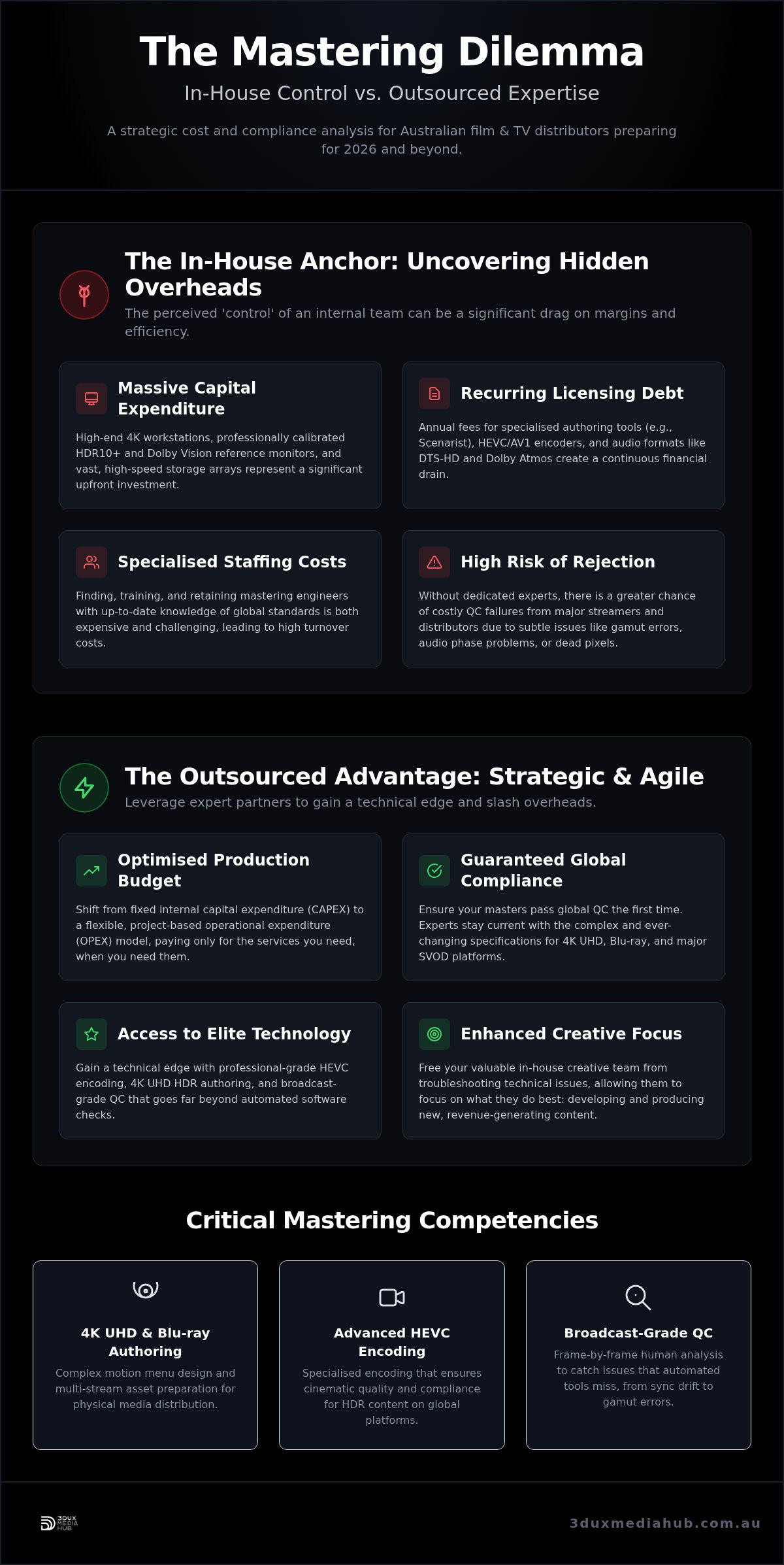
While The Trend of In-House Studios has gained momentum across various sectors, the specific technical requirements for film and TV mastering present a unique financial challenge. Building an internal mastering suite requires more than just a fast computer and a copy of Resolve. It demands significant capital expenditure (CAPEX) on high-end workstations capable of sustained 4K UHD processing and reference monitors that meet strict HDR10+ or Dolby Vision standards. These aren’t standard office displays. They’re precision instruments that require regular calibration and maintenance.
Storage is another silent budget killer. Mastering high-bitrate HEVC or ProRes files requires massive, high-throughput storage arrays. Beyond the hardware, software licensing debt accumulates rapidly. Professional authoring tools like Scenarist, alongside encoder licenses for DTS-HD and Dolby Atmos, carry heavy annual fees. When you calculate the in-house vs outsourced media mastering equation, these recurring costs often outweigh the perceived control of internal production.
Staffing adds another layer of complexity. Finding and retaining a specialised mastering engineer is difficult. These professionals need a deep understanding of technical specifications, from audio phase alignment to bit-budgeting for physical discs. If your engineer leaves, you’re left with expensive hardware and no one to run it. You also face the ‘Idle Time’ factor. You pay for the staff and the licenses even during production gaps when your suite sits empty. It’s a fixed overhead that doesn’t scale with your release schedule.
Maintenance and Technical Updates
Staying current with evolving standards is a constant race. In 2026, HEVC encoding requirements and HDR metadata standards continue to shift. Staying compliant means regular software updates and hardware refreshes. If you fall behind, you risk technical debt. Outdated masters lead to rejections from global distributors, causing delays that can derail a release window. Managing hardware failures and software bugs internally is a distraction your team doesn’t need during a high-pressure delivery cycle.
Project-Based Fees vs. Fixed Overheads
Outsourcing transforms these unpredictable fixed costs into manageable project-based fees. This model provides predictable budgeting for independent producers and major studios alike. You only pay for the services you use, when you use them. This flexibility allows you to scale up for a multi-title slate without the need to hire additional staff or purchase more equipment. For a reliable partner to manage these complexities, consider how the expertise at 3DUX Media Hub can streamline your distribution workflow. Shifting from a CAPEX-heavy internal model to an agile, outsourced partnership reduces your technical risk and protects your bottom line.
Technical Advantages of Outsourced Authoring and Encoding
Technical precision is the primary differentiator when comparing in-house vs outsourced media mastering. While internal teams often rely on standard NLE presets for H.264 or HEVC exports, these automated tools rarely meet the rigorous demands of 4K UHD distribution. High-end mastering hubs utilise multi-pass HEVC encoding to ensure every frame maintains its cinematic integrity. This process is essential for preserving grain structure and shadow detail in HDR10+ or Dolby Vision masters. By leveraging Business process outsourcing for these specialised tasks, distributors gain access to high-bitrate encoding pipelines that an in-house suite simply cannot replicate without massive investment.
Managing the complexity of 4K UHD is an art form. It requires meticulous bit-budgeting to balance image quality with the physical constraints of the medium. For many Australian distributors, our Professional 4K UHD authoring services provide a solution for integrating interactive motion menus and high-bandwidth audio streams without compromising the video bitrate. This technical oversight is even more critical when managing global localisation. A single master must often accommodate multiple audio tracks and frame-accurate subtitle streams for dozens of territories. Entrusting this to a dedicated hub removes the risk of synchronisation drift or metadata errors that can lead to costly recalls.
Standards Conversion and Global Localisation
Navigating the technical divide between PAL and NTSC broadcast regions remains a hurdle in 2026. Despite the move toward digital delivery, frame rate discrepancies and colour space conversions still cause significant delivery issues. Achieving high PAL to NTSC conversion quality requires advanced motion-compensated processing. A specialised mastering partner ensures that your content remains frame-accurate across all localised versions. This level of detail is vital for maintaining the creative intent of the original production while meeting the technical requirements of international broadcasters.
Optimising for Physical Media
Physical media mastering demands a level of expertise that goes beyond digital file delivery. Designing interactive menus that function flawlessly on all consumer players requires rigorous testing across multiple hardware generations. Technical nuances, such as the placement of DVD and Blu-ray layer breaks, are critical for a seamless viewing experience. A professional hub manages the entire disc structure, ensuring the highest possible image quality is achieved within the storage constraints of the disc. This no-nonsense approach to technical specifications ensures your physical release is as robust and reliable as your digital assets.
Mitigating Risk: Quality Control and Global Compliance
Quality Control (QC) is the final gatekeeper in the distribution pipeline. It’s a rigorous technical audit that protects your investment from costly delivery failures. A professional QC report isn’t just a checklist. It’s a deep dive into signal legality. We look for gamut errors where colours exceed broadcast limits, audio phase issues that cause cancellation in mono environments, and dead pixels that can ruin a 4K presentation. While automated QC tools have improved, they remain a partial solution. They lack the context to identify a subtle compression artefact or a frame-rate stutter that a human eye catches instantly. In 2026, the “human-eye” factor remains the gold standard for high-value assets.
The choice between in-house vs outsourced media mastering often boils down to who carries the liability for a technical failure. If an internal team misses a metadata error, the distributor bears the cost of the delay and the fix. Outsourcing to a specialised hub provides a crucial safety net. You receive a technically flawless master that complies with platform-specific delivery specs for Netflix, Amazon, and Disney+. This passed report offers financial protection before you commit to expensive physical replication or global digital rollouts. It’s about ensuring your content is “safe for air” before it leaves the building.
Avoiding Distributor Rejections
Technical pitfalls often lead to rejections that derail release windows. Common issues include incorrect HDR metadata, mismatched audio channel mapping, or non-compliant subtitle positioning. Standardising your assets for global broadcast delivery specifications requires more than just a passing knowledge of the rules. It requires an authoritative understanding of how different territories interpret those rules. An independent technical review acts as a buffer. It catches errors before they reach the distributor’s desk, preserving your reputation as a reliable content provider.
The Fast Turnaround Advantage
Urgent delivery windows for film festivals and global premieres leave zero room for error. A dedicated mastering hub operates with parallel processing capabilities that an in-house team simply can’t match during peak periods. This efficiency reduces the “stress-test” on your internal creative staff. Instead of being bogged down in encoding queues and technical troubleshooting, your team stays focused on their core strengths. Shifting the technical burden to a partner with over 20 years of experience ensures speed without sacrificing precision. Ensure your content passes every time with our broadcast quality QC services.
Partnering with 3DUX Media Hub for Strategic Mastering
Choosing a mastering partner is a decision that impacts your entire distribution chain. In the final evaluation of in-house vs outsourced media mastering, the strategic advantage lies with the studio that minimises technical debt while maximising asset quality. 3DUX Media Hub has provided this advantage for over 20 years. We operate as a safe pair of hands for high-value Australian film and TV content. Our approach is direct. We focus on the technical precision required for 4K UHD HDR mastering and broadcast-grade QC, ensuring your content is ready for any screen, anywhere in the world.
Efficiency is the core of our service model. By shifting from fixed internal overheads to our project-based expertise, you gain access to a high-tech infrastructure without the capital burden. We handle the complexities of HEVC encoding and 4K UHD HDR mastering using the latest 2026 standards. This proactive partnership ensures that your assets are not just compliant, but superior in quality. We understand the high stakes of the entertainment industry and provide the reliability needed to meet aggressive delivery windows for global streaming and physical media.
The Professional Choice for Australian Distributors
National distributors trust 3DUX because we provide more than just technical services. We offer a deep understanding of the local and international distribution landscape. Our customised mastering solutions are tailored to your specific release strategy, whether that involves complex motion menu design or multi-language localisation. For distributors looking to navigate the current market, our Professional disc authoring Australia guide offers a comprehensive look at the requirements for Blu-ray and 4K UHD in 2026. We ensure your physical and digital assets are handled with the same level of expert care.
Get Your Assets Ready for the World
Technical consultation is the first step toward a flawless delivery. We identify potential bottlenecks in your assets before they lead to distributor rejections. Our team manages everything from standards conversion to frame-accurate subtitle integration, providing a streamlined path to global success. Don’t let technical debt or staffing gaps hold back your distribution slate. Secure your content’s future with a partner that values precision and speed. Enquire about our global mastering services today to receive a detailed quote for encoding, authoring, or localisation for your next project.
Future-Proof Your Global Distribution Strategy
Winning in the 2026 media landscape requires a strategic shift from maintaining hardware to mastering assets. By moving away from the financial burden of internal infrastructure, you eliminate technical debt and focus on what matters: high-quality delivery. The comparison of in-house vs outsourced media mastering reveals that agility is your most powerful tool. Dedicated hubs provide the precision needed for 4K UHD and specialised HEVC encoding that standard internal suites often struggle to replicate. You gain the absolute security of comprehensive broadcast-grade QC reports, ensuring every master is technically flawless for international release.
3DUX Media Hub brings over 20 years of technical expertise to your production slate. We are specialists in 4K UHD HDR mastering and rigorous quality control, acting as a reliable safe pair of hands for your high-value content. Don’t let technical bottlenecks or licensing fees delay your global premiere. It’s time to streamline your workflow and protect your margins with a partner who understands the high stakes of the industry. Master your content for global release with 3DUX Media Hub and ensure your vision reaches every consumer without compromise. Your content deserves a perfect delivery.
Frequently Asked Questions
What is the primary difference between in-house mastering and outsourcing?
The primary difference is the shift from heavy capital expenditure to an agile, project-based operational model. In-house mastering requires you to maintain expensive hardware, specialised staff, and recurring software licenses regardless of your production volume. Outsourcing provides immediate access to elite technical standards and global compliance without the burden of technical debt or idle infrastructure costs.
Is it more cost-effective to outsource mastering for a single independent film?
Outsourcing is significantly more cost-effective for independent releases. Industry data suggests the “fully loaded” cost of an in-house employee is often 1.75 to 1.85 times their base salary when accounting for benefits and overheads. For a single project, paying for a specialised hub avoids the massive upfront investment in 4K UHD authoring tools and calibrated reference monitors.
What are the most common reasons for a distributor to reject a master?
Rejections typically stem from technical non-compliance with platform-specific delivery manifests. Common culprits include gamut errors that exceed broadcast limits, audio phase cancellation in mono environments, and incorrect HDR metadata. In the context of in-house vs outsourced media mastering, a specialised hub provides a crucial safety net by catching these errors before they reach the distributor’s desk.
Does 3DUX Media Hub handle both digital and physical media mastering?
3DUX Media Hub provides comprehensive support for both digital streaming and physical media formats. Our services include professional encoding for SVOD platforms alongside expert 4K UHD, Blu-ray, and DVD authoring. We manage the entire technical pipeline, from motion menu design to broadcast-grade QC, ensuring your content is ready for global hybrid release strategies.
How does professional encoding differ from standard NLE exports?
Professional encoding utilises multi-pass HEVC processing and meticulous bit-budgeting to preserve cinematic grain and shadow detail. Standard NLE presets are often too generic for high-end distribution, frequently resulting in banding or macroblocking in complex scenes. We use specialised tools to ensure maximum image quality is maintained within the specific bitrate constraints of the target platform.
What technical standards are required for 4K UHD global distribution?
Global 4K UHD distribution requires compliance with HEVC (H.265) standards, BT.2020 colour space, and high-dynamic-range metadata like HDR10 or Dolby Vision. While the AV1 codec is seeing a projected growth to 57% adoption by the end of 2026, HEVC remains the standard for high-end delivery. Professional mastering ensures your files meet these exact specifications for both physical discs and digital platforms.
Can an outsourced mastering hub help with content localisation?
A specialised mastering hub is essential for managing the complexities of content localisation. This includes integrating multiple audio tracks, frame-accurate subtitle streams, and performing standards conversion between PAL and NTSC regions. We ensure that all localised versions of your content maintain synchronisation and comply with the technical requirements of international broadcast territories.
How long does the professional mastering process typically take?
Turnaround times depend on the project’s technical complexity and the depth of the required Quality Control. A standard encoding and QC task can often be completed within 48 to 72 hours. More complex 4K UHD authoring projects that involve interactive motion menus and multi-language support typically require one to two weeks to ensure a technically flawless final delivery.