A single technical rejection doesn’t just stall your release; it incinerates your marketing budget and derails global distribution timelines. In an era where Amazon Prime now mandates 4K resolution and Ofcom is enforcing strict new accessibility codes, the margin for error has effectively vanished. Rigorous quality control for VOD platforms is no longer a luxury, it’s a strategic necessity to avoid the compounding costs of re-delivery fees and missed premiere windows.
You’ve likely found that keeping pace with shifting technical specifications feels like chasing a moving target. We understand the pressure of ensuring every asset is compliant before it hits the ingest server. This guide provides the technical rigour you need to master 2026 compliance, from EBU R128 loudness standards to the nuances of localising content for international markets. We’ll examine the critical balance between automated software checks and manual expert review, giving you the confidence that your assets are truly broadcast-ready for any territory.
Key Takeaways
- Understand why rigorous quality control for VOD platforms is the only way to avoid escalating re-delivery fees and global distribution delays.
- Master the 2026 technical landscape, including 4K UHD resolution, Rec.2020 colour spaces, and EBU R128 audio loudness compliance.
- Discover why a hybrid QC model—pairing automated speed with manual precision—is the only way to catch subtle audio clicks and subtitle sync drift.
- Follow a proven five-step workflow to navigate complex platform spec sheets and ensure your content passes ingest on the first attempt.
- Leverage over 20 years of technical expertise to streamline your encoding and localisation for seamless global releases.
What is Quality Control for VOD Platforms?
Quality control for VOD platforms is the systematic technical verification of media files against the rigid delivery mandates set by global streaming services. It is the final, non-negotiable checkpoint. While traditional broadcast QC once focused on signal legality for terrestrial transmission, modern VOD standards demand a deeper level of forensic analysis. We’re now dealing with high-bitrate encoding, complex metadata, and multi-language localisation packages that must function perfectly across thousands of different consumer devices. Precision is everything. If your black levels drift or your metadata is malformed, your asset fails ingest. It is that simple.
The primary objective is preserving creative intent. If a colourist spends weeks perfecting a moody, low-light scene, a poor encode or an incorrect colour space conversion will destroy that work. Technical QC focuses on the “bits and bytes”, ensuring file wrappers, codecs, and bitrates match the spec sheet exactly. Content QC, conversely, looks at the subjective experience, such as subtitle timing and audio sync. Both are essential to meet global video quality standards and ensure the viewer’s experience isn’t marred by technical glitches. In 2026, the complexity of these checks has increased as platforms move toward more sophisticated delivery containers.
The Evolution of VOD Quality Standards
The industry has moved rapidly beyond simple SD and HD deliveries. In 2026, 4K UHD and Dolby Vision are the baseline for premium content. Most major platforms now prioritise HEVC (High Efficiency Video Coding) to balance high visual fidelity with bandwidth efficiency. This shift requires specialised hardware and software capable of detecting micro-errors in high-dynamic-range (HDR) signals. Additionally, the rise of “binge-watching” culture has forced a focus on audio consistency. Discrepancies in loudness between episodes are no longer tolerated. Adhering to EBU R128 standards is now a standard requirement for episodic content to ensure a seamless listener experience across a full season.
Why Distributors Cannot Afford to Skip Professional QC
Skipping a professional review is a gamble with your bottom line. Platform rejection fees are substantial, but the hidden costs are often higher. A rejected file can push a release date back by weeks. This creates a cascade of failures in your marketing and PR strategy. Professional QC acts as a “safe pair of hands” for your production. It protects your reputation with streamers like Netflix or Amazon. Proper media asset preparation for distribution ensures that your film or series enters the global market without the friction of technical failure. We provide the technical rigour that larger, bloated agencies often overlook, focusing on speed and absolute precision.
Core Technical Specifications for Broadcast Delivery
Meeting the delivery mandates for global streamers requires more than just exporting a high-resolution file. It demands a forensic approach to technical specifications. Implementing rigorous quality control for VOD platforms ensures that resolution, frame rate, and colour space conversions are flawless. In 2026, the industry has moved decisively toward 4K UHD as the primary acquisition and delivery standard. This shift brings a transition from legacy Rec.709 colour spaces to the wider gamut of Rec.2020. Getting this conversion wrong results in muddy blacks or oversaturated highlights, triggering an immediate rejection. Continuous timecode and a stable Group of Pictures (GOP) structure are equally vital for ingest. For Australian distributors, Photosensitive Epilepsy (PSE) testing remains a critical hurdle; failing a Harding Test for luminance flashes can halt a national broadcast release before it starts.
Video Encoding and Bitrate Integrity
Precision in bitrate management separates professional deliverables from amateur encodes. While high bitrates preserve detail, they must remain within platform-specific ceilings to ensure smooth playback across varied network conditions. Our 4K UHD authoring services focus on maintaining this visual fidelity, eliminating common artifacts like macroblocking in high-motion scenes or banding in subtle gradients. We ensure that interlacing issues are non-existent, providing a progressive master that meets the world’s strictest standards for clarity and depth.
Audio Compliance and Global Standardisation
Audio compliance is governed by strict loudness standards, typically normalised to -23 LUFS for EBU R128 or -24 LKFS for ATSC A/85. It isn’t just about hitting a numerical target. It’s about dialogue intelligibility. Whether the viewer is using a high-end 5.1 surround system or basic mobile speakers, the mix must hold up. Managing multi-language audio tracks for international releases adds another layer of complexity, requiring perfect sync across every localised stream. If you’re unsure about your asset’s compliance, our team can provide a comprehensive technical audit to ensure everything is broadcast-ready.
Metadata plays a silent but pivotal role in the modern delivery package. HDR10 or Dolby Vision sidecar files must be frame-accurate to avoid visual glitches. These files contain the dynamic instructions that tell the consumer’s display how to map brightness and colour. If the metadata is misaligned by even a single frame, the visual experience is compromised. This level of granular detail is why professional quality control for VOD platforms is indispensable for high-stakes media assets.
Automated vs. Manual QC: The Hybrid Advantage
Relying solely on software is a dangerous shortcut. While automated tools provide essential speed, they lack the cognitive discernment required to catch creative or contextual errors. Achieving true quality control for VOD platforms in 2026 requires a hybrid model. This approach combines the exhaustive data-crunching of algorithms with the forensic watch-through of a technical expert. At 3DUX Media Hub, we’ve refined this process over 20 years, ensuring that every asset isn’t just technically legal, but creatively sound. We use the hybrid model to guarantee that your assets meet the world’s strictest delivery specifications without the risk of expensive re-delivery fees.
What Automated QC Tools Do Best
Automation is the first line of defence. It excels at detecting technical “red flags” that the human eye might miss during a single pass. Software is indispensable for:
- Verifying File Integrity: Ensuring the container (MXF, IMF, or ProRes) and metadata are perfectly formed.
- Detecting Illegal Colours: Flagging luminance or chrominance levels that exceed broadcast safety limits.
- Dropped Frame Detection: Identifying missing data packets or encoding glitches across high-volume episodic content.
- Rapid Scanning: Performing initial technical audits at speeds human operators cannot match.
The Critical Role of the Human Eye
Software is blind to intent. A technical expert performing a 100% watch-through—known as a Full Manual QC—is the only way to catch subjective failures. For example, an automated tool might flag film grain as encoding noise, or it might completely miss a dead pixel that is only visible against a specific background. Humans are also essential for checking localisation. We ensure that subtitles correctly reflect the Australian English context and that audio sync hasn’t drifted during the encoding process. Spotting these “unfixable” errors before they reach the platform’s ingest stage is what separates a successful delivery from a costly rejection.
Mastering the QC Report
The output of this hybrid process is the QC Report. Understanding how to read this document is vital for your post-production workflow. Errors are typically categorised to help editors prioritise fixes:
- Critical: A definitive fail. These issues, such as a Harding Test failure or out-of-spec audio loudness, will trigger an immediate platform rejection.
- Warning: Issues that are technically out of spec but may be acceptable depending on the platform’s discretion or the creative intent.
- Informational: Technical notes that don’t require action but provide context on the file’s properties.
We provide timestamped error logs that allow your editors to jump directly to the problem area. This precision streamlines the re-mastering process, ensuring that the second version of your asset is the final version. It’s a methodical approach that turns quality control for VOD platforms from a point of anxiety into a reliable safeguard for your global release.
Navigating Compliance and Avoiding Platform Rejections
Passing a platform’s technical audit requires a methodical approach that starts long before the final render. Global streamers are increasingly uncompromising; a single metadata mismatch or a peak audio violation will trigger an automated rejection. To maintain your release schedule and avoid punitive re-delivery fees, you need a robust internal workflow. This process ensures that your assets aren’t just high-quality, but are technically compliant with the specific ingestion engines of platforms like Netflix, Amazon Prime, or Stan. Implementing professional quality control for VOD platforms at the correct stage of post-production is the difference between a seamless launch and a costly technical bottleneck.
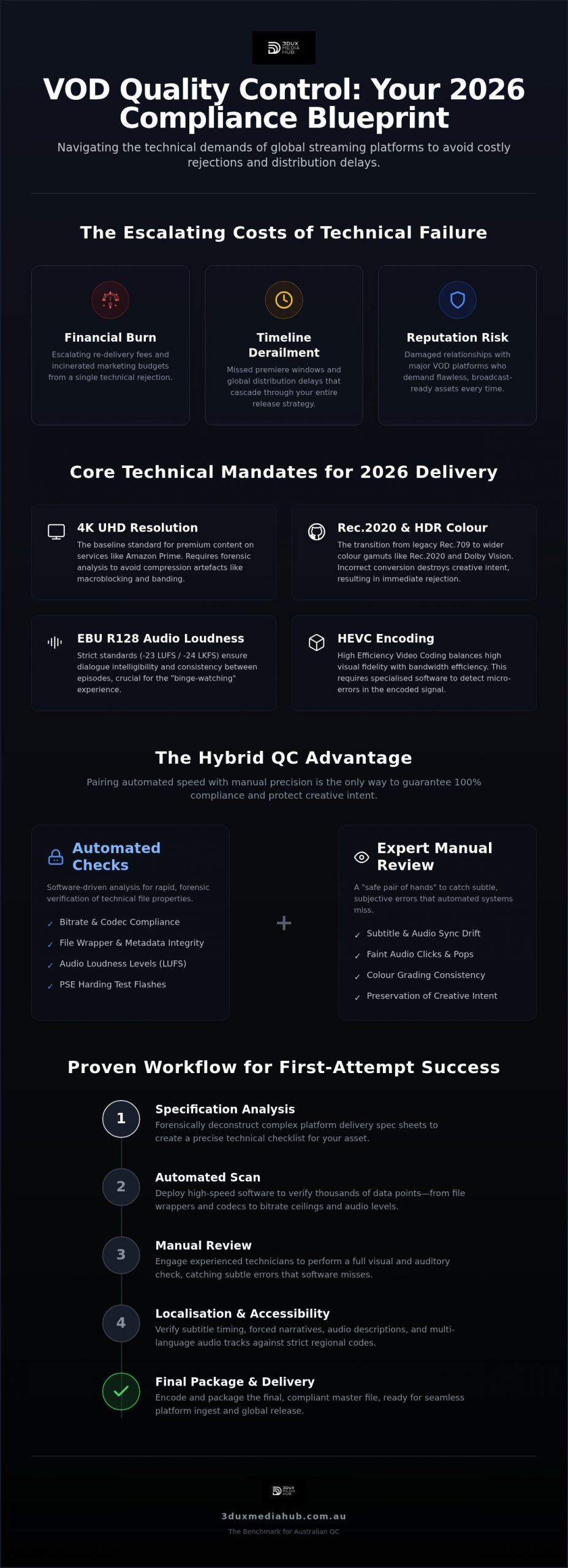
We recommend a strict five-step workflow for every delivery package:
- Step 1: Obtain the Spec Sheet. Never assume a “standard” delivery. Obtain the latest platform-specific specification document. These are updated frequently; for instance, Amazon Prime recently mandated 4K resolution as the baseline for new series.
- Step 2: Internal Technical Audit. Perform a preliminary check during the final export. Verify that your sequence settings match the required frame rate and colour space, specifically checking for Rec.2020 compliance if delivering in HDR.
- Step 3: Independent Professional QC. Submit your master file to a dedicated facility. Independent verification is essential to catch errors that an in-house editor, who has seen the footage hundreds of times, might naturally overlook.
- Step 4: Address Critical Failures. Review the QC report immediately. Focus on “Critical” failures first. Use segment re-encoding to fix only the affected sections, preserving the integrity of the rest of the file and saving valuable time.
- Step 5: Final Wrap and Certification. Once the “Clean Master” is produced, package it with the QC certificate. This document serves as the technical passport for your asset, proving it has passed rigorous quality control for VOD platforms.
Managing Localisation and Asset Preparation
International distribution adds layers of technical complexity. You must prepare “Textless Masters”—versions of your content without burnt-in titles or credits—to allow for international versioning. Furthermore, 2026 accessibility regulations in the UK and US now require specific quotas for subtitles and audio descriptions. Ensuring your SDH (Subtitles for the Deaf and Hard of Hearing) and forced narratives are frame-accurate is vital. These elements must meet the legibility and placement standards of each target region to avoid rejection on accessibility grounds.
The “Golden Master” Strategy
Efficiency in 2026 relies on the “Golden Master” strategy. Instead of creating different versions for every platform, create a single, high-quality mezzanine file. ProRes 4444 XQ or IMF (Interoperable Master Format) packages are the preferred industry standards. These formats allow you to derive all necessary delivery versions without losing generational quality. Storing these QC-passed masters in a secure, checksum-verified archive ensures your content is future-proofed for secondary licensing deals or library migrations.
Don’t risk your distribution window on a technicality. Ensure your next release is faultless by partnering with our broadcast quality QC specialists today.
Why 3DUX Media Hub is the Benchmark for Australian QC
Success in the global entertainment market is built on technical precision. With over 20 years of industry experience, 3DUX Media Hub has established itself as the authoritative partner for Australian distributors. We provide a level of technical rigour that larger, bloated agencies simply cannot match. Our approach to quality control for VOD platforms is rooted in a deep understanding of both legacy broadcast standards and the cutting-edge requirements of 2026 streaming services. We don’t offer fluff or buzzwords. We offer a “safe pair of hands” for your high-value assets, ensuring they meet every delivery mandate on the first attempt.
We are uniquely positioned in the Australian market. We handle 4K UHD authoring, Blu-ray, and DVD projects alongside high-bitrate digital VOD deliveries in a single, centralised facility. This dual expertise in physical and digital media gives us a forensic understanding of encoding and bitrate management that pure-play digital agencies lack. Whether you’re targeting a domestic release on Stan or a global premiere on Netflix, we ensure your assets are technically impeccable before they leave our centre.
Comprehensive Post-Production Support
Our capabilities extend far beyond basic verification. We provide a full suite of technical services, including standards conversion, high-end video and audio encoding, and motion graphics for static or dynamic menus. Based in Sydney, we offer national service coverage, supporting distributors and production houses from Perth to Brisbane. We understand the “fast turnaround” nature of the industry. Our workflow is designed for speed without compromising our “Broadcast Quality” promise. We treat every frame with the same level of care you put into the production itself.
A Safe Pair of Hands for Global Distribution
Managing the complexities of international delivery requires more than just a spec sheet. It requires a partner who has successfully delivered thousands of assets to major global platforms. We’re specialists in HEVC encoding and 4K UHD mastering, ensuring your content looks exactly as the director intended, regardless of the consumer’s device. Our service is personalised. You won’t be shuffled between account managers; you speak directly to the technical experts handling your content. This direct access ensures that technical queries are resolved immediately, keeping your distribution timeline on track. Partner with experts who treat your content as their own and contact 3DUX Media Hub today.
Secure Your Global Release with Technical Precision
The landscape of digital delivery is more demanding than ever. Mastering 4K UHD resolution, Rec.2020 colour spaces, and strict audio loudness standards is no longer optional for distributors. A hybrid approach to quality control for VOD platforms is the only way to catch the forensic errors that trigger costly rejections. By combining automated verification with a 100% manual watch-through, you protect both your budget and your creative vision.
Don’t let a technicality derail your distribution timeline. We bring over 20 years of technical mastering experience to every project. Our specialists focus on 4K UHD and global VOD compliance; we provide comprehensive QC reports with timestamped error logs so your team can work with absolute clarity. We act as your safe pair of hands in a high-stakes industry, ensuring your content is technically impeccable for any territory.
Ensure your assets are broadcast-ready with 3DUX Media Hub and take the risk out of your next global launch. Your content deserves a flawless premiere.
Frequently Asked Questions
What is the difference between Broadcast QC and VOD QC?
VOD QC is a forensic verification of file wrappers, high-bitrate encoding, and complex metadata. While broadcast QC prioritises signal legality for terrestrial transmission, VOD QC ensures your content functions across thousands of different consumer devices. It requires a deeper analysis of file containers and device-specific playback requirements to avoid the high cost of global distribution rejections.
Why did my file fail QC even though it looks fine on my monitor?
Standard consumer monitors cannot detect gamut violations, metadata errors, or EBU R128 loudness non-compliance. A file might look perfect in your edit suite but still contain technical “red flags” that trigger automated ingest rejections. We use professional scopes and forensic software to identify these hidden failures that standard hardware simply cannot display during a typical watch-through.
How long does a professional manual QC take for a feature film?
A professional manual QC for a feature film generally takes 1.5 to 2 times the content’s total runtime. This timeframe allows our technical experts to perform a 100% watch-through, log timestamped errors, and verify audio sync across every track. It’s a methodical process that ensures nothing is missed, from a single dead pixel to subtle audio clicks or subtitle drift.
Do I need a separate QC report for every VOD platform?
Not necessarily, provided your “Golden Master” passes quality control for VOD platforms against the world’s strictest technical specifications. However, some major streamers mandate their own specific QC certificates before ingest. We recommend a comprehensive technical audit that meets the highest common denominator of global platform requirements to streamline your multi-territory release and avoid re-delivery fees.
What is an IMF package and why are platforms asking for it?
An IMF (Interoperable Master Format) package is a component-based master that separates video, audio, and subtitle tracks into a single container. Platforms prefer this format because it allows for efficient localisation and versioning without re-encoding the entire file. It is the preferred industry standard for 2026 because it simplifies the management of complex, multi-language delivery packages across various regions.
Can 3DUX Media Hub help fix the errors found in a QC fail?
Yes, we provide the technical expertise to remediate failures identified in any QC report. Our services include video and audio encoding, standards conversion, and content localisation. We act as a proactive partner, fixing technical errors and ensuring your assets are “broadcast-ready” for a successful second submission, preventing further delays to your global distribution schedule.
Does professional QC include checking for photosensitive epilepsy (PSE)?
Yes, professional QC includes Photosensitive Epilepsy (PSE) testing, commonly known as a Harding Test. This is a critical requirement for national broadcast compliance in Australia and the UK. We use specialised software to scan for luminance flashes or spatial patterns that could trigger seizures, ensuring your content is safe for all viewers and meets legal safety standards.
What is the most common reason for VOD platform rejection in 2026?
Metadata mismatches and EBU R128 audio loudness violations are the most frequent causes of rejection. Modern ingest engines are uncompromising; they will reject a file if the metadata doesn’t perfectly match the technical properties of the asset. Ensuring your HDR10 sidecar files and audio peaks are within spec is essential for passing quality control for VOD platforms on the first attempt.