The global film distribution market is projected to hit $103.3 billion in 2026, yet technical rejection remains a primary risk for every international release. Implementing a precise localisation workflow for film distributors is the only way to avoid high rejection rates and the audio sync issues that often plague dubbed versions. You know the high stakes of a global launch. There is no room for inconsistent subtitle formatting or metadata errors when delivering to major digital platforms.
This guide will help you master the technical complexities of 4K UHD, Blu-ray, and digital delivery with a focus on reliability and speed. We’ll explore how to build a robust workflow that meets the latest DCI 1.5.0 specifications while maintaining broadcast-grade quality control. You’ll learn how to reduce turnaround times for international masters and ensure your content is ready for seamless global delivery across every region. It’s about turning technical hurdles into a streamlined path to market.
Key Takeaways
- Transition from reactive methods to a proactive localisation workflow for film distributors to meet the rigorous technical demands of the 2026 global market.
- Master the essential technical pillars of audio conforming and multi-format subtitle integration, ensuring compliance across SRT, VTT, and XML standards.
- Distinguish between the unique localisation requirements for physical 4K UHD media and digital VOD platforms, including complex menu and motion graphic translation.
- Prevent costly platform rejections by identifying and rectifying common errors such as sync drift, font corruption, and illegal colours through broadcast-grade QC.
- Leverage industry-leading expertise to scale your international mastering, ensuring fast turnaround and high-standard delivery for every global territory.
Optimising the Localisation Workflow for Global Film Distribution
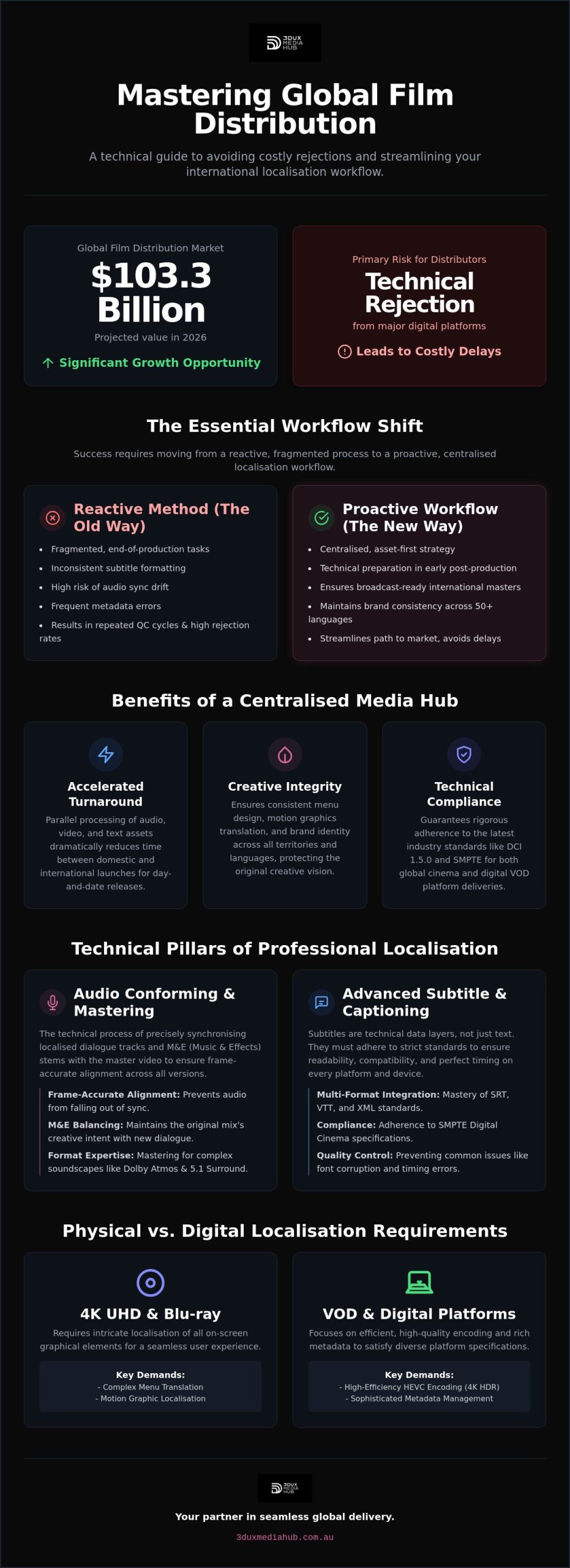
A modern localisation workflow for film distributors is no longer a simple translation task tucked onto the end of production. It’s a high-stakes technical asset-management strategy. With the global film distribution market projected to reach $103.3 billion in 2026, the cost of technical failure has never been higher. Success in this environment requires a shift from reactive fixes to a proactive, asset-first model. This means prioritising technical preparation during early post-production. A fragmented workflow often results in sync drift, illegal colours, and inconsistent metadata. Centralising these processes within a professional media hub eliminates these redundancies and ensures your international masters are broadcast-ready from the first delivery.
The Evolution of Media Localisation
The rise of 4K UHD and High Dynamic Range (HDR) has fundamentally increased the burden on international masters. Delivering a film globally now requires precise HEVC encoding and sophisticated metadata management to satisfy the rigorous standards of major streaming platforms. We’ve moved well beyond the era of ‘burnt-in’ subtitles. Modern delivery demands flexible, multi-asset packages where text and audio components remain separate yet perfectly conformed to the video master. This technical precision is vital for supporting the film dubbing process across dozens of territories simultaneously. High-efficiency encoding ensures visual quality remains uncompromised while meeting strict bitrate requirements for different regions.
Strategic Benefits of a Centralised Workflow
Speed is the primary currency for distributors in 2026. Implementing a centralised localisation workflow for film distributors allows for aggressive day-and-date international releases without the constant fear of platform rejections. By managing every asset in a single technical centre, you maintain creative and brand consistency across 50+ languages. This methodical approach mitigates the risk of font corruption or audio sync issues that frequently cause costly release delays. When evaluating your options, understanding the landscape of leading content localisation firms for global film and TV release can help you identify the right technical partner for your international rollout.
- Accelerated Turnaround: Parallel processing of audio, text, and video assets reduces the time between domestic and international launches.
- Creative Integrity: Consistent menu design and motion graphics translation across all locales.
- Technical Compliance: Rigorous adherence to DCI 1.5.0 and SMPTE standards for both global cinema and digital VOD platforms.
Fragmented workflows create hidden costs through repeated QC cycles and manual file handling errors. A centralised hub acts as a safe pair of hands, providing a streamlined path to market that protects the value of your media assets. It’s the difference between a smooth global rollout and a series of expensive technical hurdles.
Technical Pillars of Professional Film Localisation
Technical localisation is an engineering discipline. It’s not merely about changing the language; it’s about re-engineering the asset for a new environment. A failed delivery often stems from a lack of technical rigour during the preparation phase. A robust localisation workflow for film distributors treats audio, text, and metadata as critical components that must be conformed to the master video with surgical precision. This ensures that every delivery, whether it’s a 4K UHD master or a digital storefront asset, meets the highest industry benchmarks. Skipping these steps leads to sync drift and platform rejections that can derail a global launch.
Audio Conforming and Multi-Language Mastering
Audio conforming for film distributors is the technical process of precisely synchronising localised dialogue tracks and M&E stems with the master video to ensure frame-accurate alignment across all global versions. This process is vital for maintaining the creative intent of the original mix. When managing complex soundscapes like Dolby Atmos or 5.1 surround sound, the technical team must ensure that the M&E (Music and Effects) tracks are perfectly balanced with the new dubbed dialogue. This prevents audio from slowly falling out of time with the picture over the duration of the film. Professional content localisation services provide the specialised suites needed to master these multi-language audio files without losing dynamic range or spatial accuracy.
Advanced Subtitle and Captioning Workflows
Subtitles are more than just text on a screen. They are technical data layers that must adhere to specific SMPTE Digital Cinema standards to ensure readability and compatibility. Distributors must manage three primary types of text assets:
- Standard Subtitles: Translated dialogue for foreign language audiences.
- SDH (Subtitles for the Deaf and Hard of Hearing): Includes dialogue and descriptive audio cues.
- Closed Captions: Often delivered as separate sidecar files like VTT or SCC for digital platforms.
Theatrical delivery often requires high-quality XML or Interop formats, while home entertainment assets for 4K UHD discs need to be optimised for high-bitrate playback. Font corruption and illegal character errors are common in poorly managed workflows. Ensuring your subtitle assets are correctly formatted for both physical media and VOD storefronts is a non-negotiable step in the mastering process.
Asset Preparation and Standards Conversion
Finalising a global release also involves localising trailers and digital metadata. This includes translating title treatments and motion graphics to match the regional marketing strategy. Standards conversion is equally critical. Converting 24p cinematic masters to 25p or 29.97p for international broadcast requires high-end hardware to avoid motion artefacts or pitch shifts in the audio. Getting these technical pillars right from the start saves weeks of troubleshooting during the delivery window. It creates a clean, compliant master ready for any territory.
Managing Assets for Physical vs Digital Localisation
Localisation isn’t a one-size-fits-all process. A robust localisation workflow for film distributors must account for the distinct technical architectures of physical discs and digital streaming platforms. Physical media is immutable once pressed; there’s no room for a “patch” if a subtitle file is corrupted. Digital assets offer more flexibility for updates, but they face a gauntlet of automated ingest checks from global VOD giants. Precision is paramount in both, yet the technical execution differs significantly.
Authoring for International Physical Media
Physical media authoring requires a deep understanding of hardware limitations and regional standards. When preparing a 4K UHD or Blu-ray release for international markets, you’re re-engineering the disc’s logic. This includes localising motion and static menus so interactive elements feel native to the viewer. For 4K UHD, this involves complex HEVC encoding and the integration of Dolby Vision metadata. These elements must remain consistent across all localised versions to maintain the high-fidelity experience consumers expect from premium physical formats.
Seamless branching is a critical tool for global distributors. It allows a single disc to contain multiple versions of a film, such as a theatrical cut for one territory and a slightly different version for another, without duplicating the entire video file. This requires expert-level authoring to ensure transitions are invisible to the viewer. Compliance with regional coding and legal requirements remains a non-negotiable step for any international disc rollout. Bitrate management is also more demanding here. Physical media allows for much higher bitrates than streaming, often peaking at 128 Mbps, which necessitates a higher level of technical precision during the encoding phase.
Digital Delivery and Global VOD Standards
Digital localisation is increasingly driven by the Interoperable Master Format (IMF). This standard has revolutionised the localisation workflow for film distributors by allowing for a single “source of truth” file from which all regional versions are derived. Rather than delivering 50 different full-length masters, distributors deliver supplemental packages containing only the localised audio and subtitle components. This modular approach reduces storage costs and speeds up delivery to global platforms.
Meeting the strict compliance standards of platforms like Apple TV, Netflix, and Amazon Prime requires more than just technical accuracy. It requires meticulous metadata localisation. This includes everything from the film’s synopsis and genre tags to the localised key art and trailer assets. Every piece of content must be formatted exactly to the platform’s specifications to avoid automated rejections. With the global film distribution market projected to reach $103.3 billion in 2026, ensuring your digital assets are compliant with the latest DCI 1.5.0 specifications is vital for a successful global launch. It’s about providing a safe pair of hands for your high-value media assets.
Navigating Technical Compliance and Quality Control
Technical compliance is the final gatekeeper in the global distribution chain. A single technical oversight can lead to an immediate platform rejection, resulting in missed release windows and significant financial penalties. A professional localisation workflow for film distributors must integrate broadcast-grade quality control (QC) at every stage of the process. This isn’t just about catching typos in subtitles. It’s about ensuring every technical parameter of the master file meets the rigid specifications of international broadcasters and digital storefronts. From gamut errors to metadata mismatches, the margin for error is non-existent.
The QC Checklist for Film Distributors
Verifying audio channel mapping is a critical first step. Multi-language masters often contain complex track layouts, including 5.1 surround, stereo fold-downs, and descriptive audio. Each must be correctly tagged and positioned to avoid playback issues. Subtitle readability is equally vital. Technicians must check safe zones to ensure text isn’t obscured by platform UI elements or cut off on certain screen aspect ratios. Manual QC remains indispensable for 4K HDR content because automated tools cannot yet accurately judge the artistic nuance of high dynamic range highlights or subtle sync issues in dubbed dialogue.
Avoiding Costly Rejections and Redeliveries
Every major global distributor provides a detailed ‘spec sheet’ that defines their technical requirements. Failure to adhere to these can be catastrophic. Common localisation errors often include:
- Sync Drift: Audio or subtitles slowly falling out of time over a 90-minute programme.
- Font Corruption: Illegal characters appearing in foreign language scripts due to encoding mismatches.
- Illegal Colours: Video levels exceeding broadcast gamut limits, particularly in high-contrast HDR masters.
Standards conversion is another frequent failure point. Incorrectly converting a 24p cinematic master to PAL or NTSC formats can introduce motion judder or pitch-shifted audio. These errors are often only detected during the final ingest phase at the platform level. A robust localisation workflow for film distributors includes the generation of comprehensive technical reports. These documents act as a certificate of health for your assets, providing the technical proof needed to move through the distribution chain without friction. If you want to ensure your masters are broadcast-ready without the stress of redeliveries, consider partnering with a hub that provides broadcast quality QC services with over 20 years of technical experience.
Automated QC tools are excellent for identifying data-level issues like dropped frames or bitstream errors. However, they lack the human eye’s ability to spot context-specific mistakes. A hybrid approach, combining high-end hardware probes with seasoned technical operators, provides the ultimate safety net for high-value media assets. This methodical rigour is what separates a successful global release from a technical nightmare. Choosing among the top-tier content localisation firms specialising in broadcast-grade QC and 4K UHD mastering is a critical decision that directly impacts your platform acceptance rates.
Scaling Distribution with a Professional Media Hub
Scaling a release across international borders demands a localisation workflow for film distributors that is both elastic and technically rigorous. As the global film translation market continues its steady climb toward a projected $5.06 billion by 2033, manual or fragmented processes will inevitably fail. 3DUX Media Hub acts as a centralised technical engine. We provide the infrastructure needed to manage high-value media assets with absolute precision. This ensures your content is ready for 4K UHD, Blu-ray, and global digital storefronts without the overhead of coordinating multiple vendors. We turn technical complexity into a streamlined path to market.
The 3DUX Advantage: Technical Expertise and Speed
We bring over 20 years of industry experience to every project. Our team specialise in high-efficiency HEVC encoding and complex 4K UHD authoring. We don’t just process files; we engineer them for global compliance. This technical depth allows us to maintain fast turnaround times while adhering to the most stringent quality control standards. We understand the high stakes of the entertainment industry. Our approach focuses on reliability and precision, ensuring your masters are broadcast-ready the first time.
- Advanced Encoding: Specialists in 4K UHD and HEVC encoding for superior visual quality.
- Global Authoring: Expert authoring for multi-region Blu-ray and DVD releases.
- Local Expertise: Personalised service from a seasoned Australian technical team that understands global delivery specs.
Getting Started with Your Localisation Strategy
Efficiency begins in the preparation phase. Consolidating your master assets, M&E tracks, and metadata early in the post-production cycle ensures a seamless transition into the localisation workflow for film distributors. We consult directly with your team on global delivery specifications to prevent technical bottlenecks. This proactive approach identifies potential issues, such as sync drift or gamut errors, before they become costly platform rejections. It’s about building a robust foundation for your international release from day one.
Future-proofing your library is essential in a rapidly evolving market. We ensure your assets are mastered to current DCI 1.5.0 standards while remaining adaptable for future hardware iterations. Whether you’re launching a wide theatrical campaign or a premium physical media release, we provide the technical certainty required for global success. We act as a safe pair of hands for your high-value media assets, moving you rapidly from one service phase to the next without unnecessary filler.
Contact 3DUX Media Hub to organise your next global release and leverage decades of practical mastering experience for your film library.
Mastering Your Global Release Strategy
The global film distribution landscape in 2026 demands a shift from reactive fixes to proactive technical mastering. We’ve explored how a robust localisation workflow for film distributors ensures broadcast-grade compliance across physical and digital platforms. By prioritising audio conforming, precise subtitle integration, and rigorous QC, you protect your high-value media assets from costly rejections. Centralising these tasks within a professional media hub provides the speed and reliability needed for aggressive international rollouts.
3DUX Media Hub offers over 20 years of technical post-production experience. We are specialists in 4K UHD and HEVC encoding, providing an Australian-based technical hub with proven global delivery expertise. Don’t leave your international masters to chance. Partner with a team that understands the high stakes of the entertainment industry and delivers results with surgical precision. Our methodical approach ensures your content meets every regional requirement without the stress of redeliveries.
Streamline your localisation workflow with 3DUX Media Hub today. Your content is ready for the world stage; ensure it arrives in perfect condition.
Frequently Asked Questions
What is the difference between translation and localisation in film?
Translation is the linguistic act of converting dialogue from one language to another. Localisation is a comprehensive technical process that adapts the entire media asset for a specific territory. This includes audio conforming, subtitle integration, and ensuring the final file meets regional broadcast standards. It’s about technical compliance as much as it is about language.
How long does the localisation workflow typically take for a feature film?
A professional localisation workflow for film distributors typically spans several weeks depending on the number of languages and delivery formats required. A standard feature film might take two to four weeks for a full suite of international masters. This timeframe includes rigorous quality control and standards conversion to ensure every territory receives a compliant file.
What technical assets are required for a professional localisation project?
You need a high-resolution master video clean of text, separate Music and Effects (M&E) stems, and the original dialogue scripts. Additionally, providing specific font files and localised metadata ensures consistency across digital storefronts. These assets allow the technical team to build a compliant international master without compromising the original creative intent.
Can you localise 4K UHD content for both digital and physical release simultaneously?
Yes, you can localise for both formats at the same time by using a centralised media hub. This approach ensures that the HEVC encoding for digital platforms matches the technical precision required for 4K UHD Blu-ray authoring. It reduces redundancy and guarantees that your high-dynamic-range (HDR) metadata remains consistent across all release channels.
What is audio conforming and why is it necessary for dubbed content?
Audio conforming is the technical process of synchronising foreign language dialogue tracks with the master video frames. It’s necessary because dubbed audio can often drift out of time during the recording or editing process. Conforming ensures that every syllable aligns perfectly with the on-screen action, preventing the sync issues that lead to platform rejections.
How do you ensure subtitles are compliant with international broadcast standards?
Compliance is achieved by adhering to specific technical spec sheets provided by global distributors. This involves checking subtitle safe zones to avoid text being cut off by UI elements and ensuring frame-accurate timing. Professional workflows use standardised formats like SMPTE-compliant XML to maintain consistency across theatrical and home entertainment platforms.
What is a CCSL and do I need one for my film distribution?
A Combined Continuity and Subtitle List (CCSL) is a highly detailed document that captures every line of dialogue, camera movement, and on-screen text. You need one because it serves as the definitive blueprint for translators and legal teams. It ensures that the localisation workflow for film distributors remains accurate and legally compliant across all international territories.
Why is professional QC more important than automated software checks?
Automated software is excellent for detecting bitstream errors or dropped frames, but it cannot judge human nuance. Professional QC involves a technical operator who checks for sync drift, font corruption, and the artistic accuracy of HDR highlights. Manual checks provide the final layer of security needed to protect high-value media assets from catastrophic delivery failures.