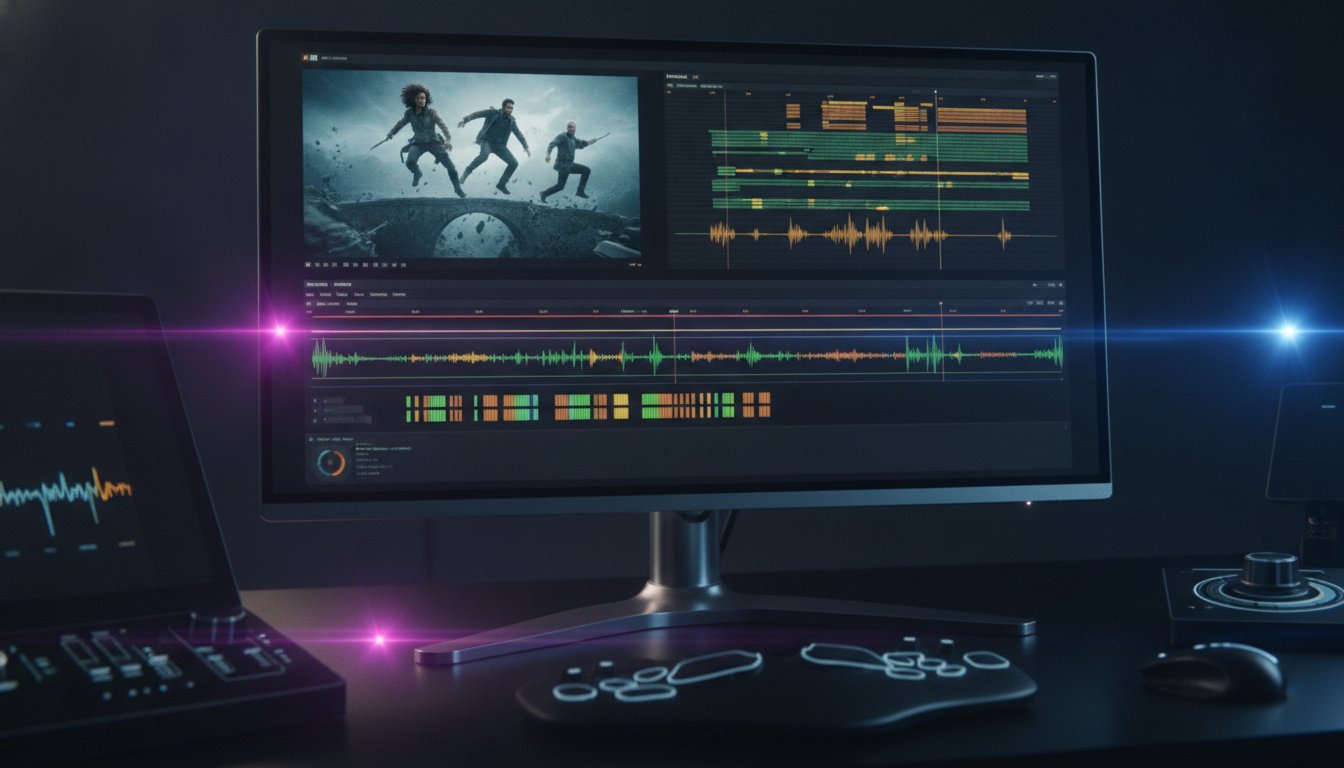
Your global release isn’t a translation project; it’s a high-stakes technical mastering operation. Achieving seamless multi-language content localisation requires more than just linguistic accuracy. It demands a rigorous approach to technical specifications to avoid the gut-wrenching prospect of a technical rejection from a major streamer. You’ve spent months perfecting your cinematic vision. Now, the challenge is maintaining that quality across different frame rates and standards without losing synchronisation or clarity.
We understand that managing multiple audio tracks and subtitle files is a complex logistical hurdle. This guide provides a clear technical checklist to ensure your assets are broadcast-ready for 2026. We’ll explore efficient workflows for versioning and the latest compliance requirements. You’ll learn how to handle SMPTE ST 2131 audio metadata mapping and meet EBU R128 loudness standards with confidence. Whether you’re delivering 4K UHD masters or preparing for international broadcast, these best practices will secure your path to a flawless global release.
Key Takeaways
- Distinguish between simple translation and comprehensive technical localisation to ensure all assets—from audio tracks to metadata—are world-ready.
- Master the complexities of audio conforming and M&E track preparation to maintain cinematic quality across varying global frame rates and standards.
- Implement precise technical standards for subtitle integration and forced narratives to guarantee legibility and compliance with international delivery specifications.
- Utilise rigorous technical QC and standards conversion to navigate the strict requirements of global streamers and avoid costly distribution rejections in your multi-language content localisation strategy.
- Streamline your global delivery by integrating localisation directly into your 4K UHD authoring workflow for faster turnarounds and broadcast-grade results.
Defining Multi-Language Content Localisation for Global Media
Effective Language localisation involves a comprehensive technical overhaul of your master assets, moving far beyond simple subtitle translation. In the high-stakes world of global streaming, multi-language content localisation is a precision-driven process. It encompasses audio conforming, menu redesign, and metadata alignment to meet the rigorous standards of international distributors. If your technical specs don’t align with local delivery requirements, you risk losing distribution rights or facing expensive re-mastering fees. Technical precision is the only way to protect your investment.
Cinematic intent must survive the localisation process without compromise. We utilise high-bitrate encoding, specifically HEVC for 4K UHD assets, to ensure that visual fidelity remains consistent across every language version. This technical rigour is vital for maintaining the director’s vision while accommodating the unique data requirements of different territories. Whether it’s a theatrical release or a streaming debut, the encoding must be robust enough to handle complex grain structures and high-contrast HDR highlights in every localised version.
Localisation vs. Transcreation: What Distinguishes Them?
The Core Assets of a Localised Media Bundle
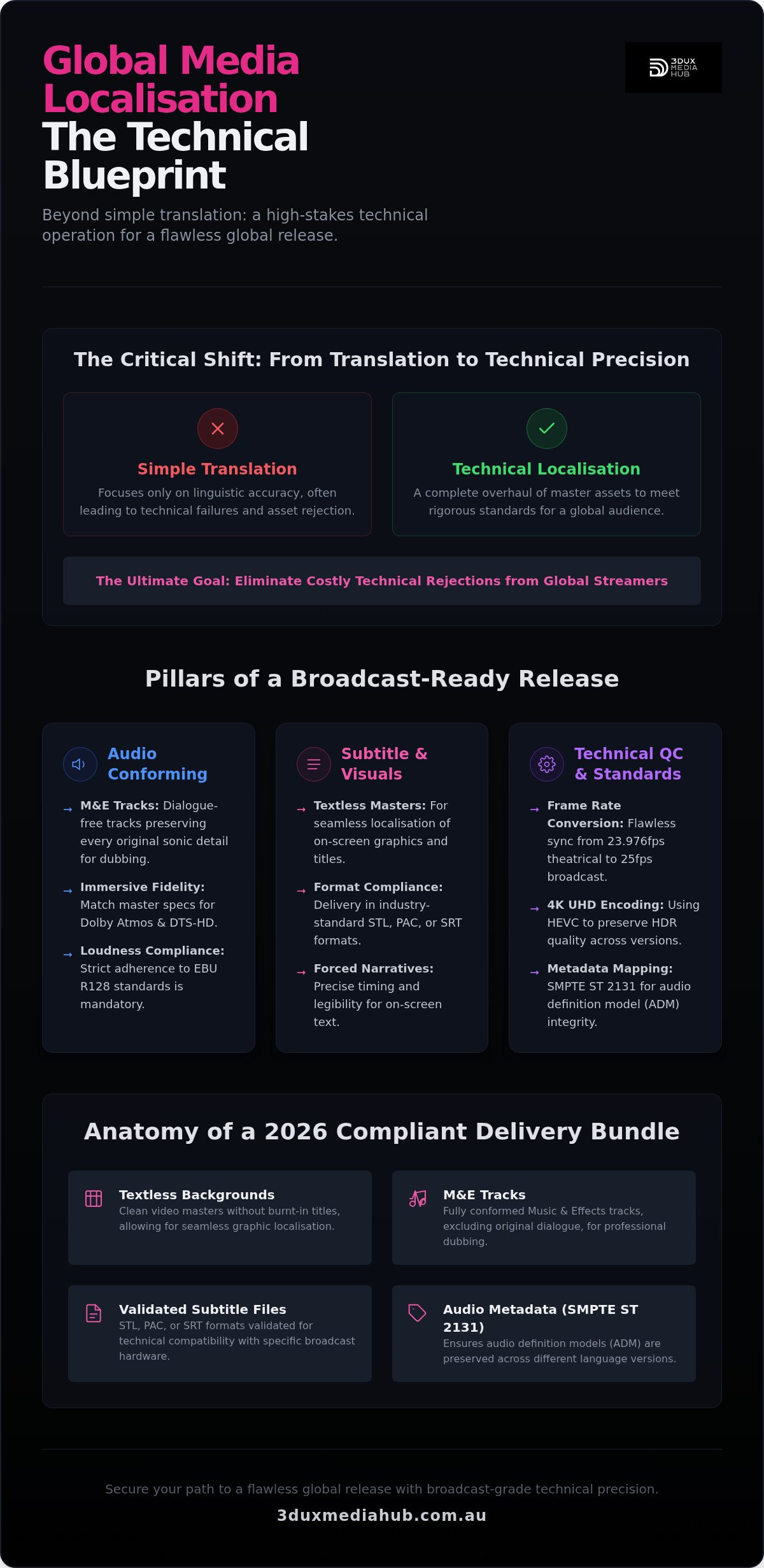
A professional localisation package is a complex bundle of high-value assets. It’s not just a video file and a few SRTs. A compliant delivery bundle for 2026 must include specific components:
- Textless Backgrounds: Clean video masters without burnt-in titles, allowing for seamless graphic localisation.
- M&E Tracks: Music and Effects tracks must be fully conformed. These exclude original dialogue while retaining every other sonic detail for professional dubbing.
- Subtitle Files: Industry-standard formats like STL, PAC, or SRT, validated for technical compatibility with specific broadcast hardware and 2026 SMPTE standards.
- Audio Metadata: Integration of SMPTE ST 2131 standards to ensure audio definition models (ADM) are preserved across different language versions.
Managing these assets requires a “safe pair of hands” with decades of technical experience. Every file must be broadcast-compliant to ensure your project clears quality control on the first pass. This methodical approach eliminates the risk of technical rejections and keeps your global release on schedule.
Technical Frameworks for Audio Conforming and Dubbing
While linguistic translation is the visible part of the process, the technical success of your project rests on rigorous audio engineering. Preparing Music and Effects (M&E) tracks is a critical first step. These tracks must be entirely free of the original language while preserving every atmospheric detail, foley sound, and musical cue. Professional audio conforming for international film release ensures your localised dialogue sits naturally within the soundscape. This maintains the original cinematic impact without the risk of technical artifacts.
Fidelity is non-negotiable. Whether delivering in DTS-HD or the immersive environments of Dolby Atmos, the localised mix must match the master’s specifications. This involves more than just swapping dialogue channels. It requires a meticulous re-balance to ensure localised voices don’t overpower the score or get lost in the surround channels. This level of precision is what prevents technical rejections from global broadcasters. It’s a job for a professional encoding partner who understands the intricacies of multi-track versioning.
Managing Frame Rate Discrepancies in Global Audio
Synchronising audio across different regional standards is a major technical hurdle. Converting a 23.976fps theatrical master to a 25fps broadcast standard requires sophisticated time-stretching. Without expert pitch correction, your localised audio will sound unnaturally high or low. We utilise advanced phase-locked processing to ensure that lip-sync remains spot on, regardless of the target frame rate. This prevents the drifting effect that often plagues poorly managed multi-language content localisation projects.
Surround Sound Localisation Requirements
Global delivery often requires multiple audio configurations. While premium streamers demand Atmos or 7.1 mixes, many territories still require legacy 5.1 or even stereo-only downmixes. Each version must comply with regional loudness standards to avoid automatic broadcast attenuation. In 2026, compliance with EBU R128 (-23 LUFS) for Europe and ATSC A/85 (-24 LKFS) for North America is mandatory for broadcast acceptance. Streaming platforms generally require targets between -24 and -18 LUFS with true-peak limits of -2 to -1 dBTP.
- Loudness Compliance: Adhering to specific LUFS/LKFS targets to ensure consistent playback volume across all platforms.
- Dialogue Balancing: Meticulously mixing localised dialogue so it remains intelligible against complex background effects and scores.
- Downmixing Integrity: Verifying phase coherence when collapsing surround tracks to stereo for mobile devices or legacy broadcast systems.
Precision in these areas ensures your final master is compliant with the world’s most stringent delivery specifications. This methodical approach guarantees your high-value assets are ready for any market, anywhere.
Subtitle Integration and Visual Asset Customisation
Visual assets require the same level of technical rigour as audio tracks. In a comprehensive multi-language content localisation workflow, subtitles are more than just text on screen; they’re a complex overlay layer that must meet strict readability standards. We manage ‘forced narratives’—those essential subtitles for foreign-language dialogue or on-screen signs—with surgical precision. These must be correctly flagged in the stream to ensure they appear automatically, even when the viewer hasn’t enabled full subtitling. Failing to flag these correctly is a common cause for technical QC rejection.
Legibility is governed by strict character-per-second (CPS) limits. For adult audiences, we typically target 15 to 20 CPS to ensure comfortable reading without distracting from the cinematography. Placement is equally vital. All text must sit within the 2026 Title Safe zones to avoid being cropped on diverse displays, from mobile screens to ultra-wide home theatre setups. For broadcast-grade accessibility, we utilise specific colour coding and high-contrast fonts that comply with the latest WCAG 2.1 Level AA standards. This ensures your content is inclusive and compliant with regional accessibility laws.
Localising On-Screen Graphics and Menus
Physical media and high-end digital releases demand sophisticated interactive Blu-ray menu design that supports seamless multi-language navigation. This isn’t just about translating button text. It involves re-authoring the Interactive Graphic Stream (IGS) to accommodate varying word lengths in different languages. German or French translations often require more horizontal space than English, necessitating a flexible UI layout that doesn’t break the menu’s aesthetic or functionality.
Motion graphics also require a modular approach. We organise your original project files to allow for efficient text replacement of lower thirds, location markers, and title cards. This process relies on having a clean ‘textless’ master, as discussed in our previous asset overview. Beyond the visuals, we manage the technical metadata and alt-text for global digital platforms. This ensures your project is searchable and accessible across every territory, maintaining a professional standard from the first menu click to the final credits.
Navigating International Broadcast Standards and Technical QC
The final technical gatekeeper for any global release is Quality Control (QC). Even the most polished multi-language content localisation project can fail at this stage if it doesn’t adhere to the exact delivery specifications of major streamers like Netflix, Amazon, or Disney+. Technical rejections are more than just an inconvenience; they’re a significant financial risk that can delay international premieres and blow out budgets. This is where broadcast standards conversion services become indispensable. Ensuring your master is correctly formatted for specific regional requirements is the only way to guarantee a smooth delivery.
While automated QC tools are effective for catching dead pixels or black frames, they lack the nuance required for high-end film assets. A ‘safe pair of hands’, specifically an experienced technical operator, is essential to catch subtle synchronisation drifts or subtitle legibility issues that AI might overlook. Common reasons for localised asset rejection include:
- Synchronisation Drift: Localised audio tracks slipping out of sync due to incorrect frame rate conversion.
- Illegal Colours: Video levels exceeding broadcast limits, particularly in HDR masters delivered to SDR territories.
- Character Encoding Errors: Subtitles failing to display regional characters correctly, such as diacritics or non-Latin scripts.
- Loudness Violations: Failing to meet the EBU R128 or ATSC A/85 standards required for broadcast acceptance.
The Step-by-Step Technical QC Process
Our rigorous QC process involves a full-duration linear check of the master asset. We verify that every localised audio track remains perfectly aligned with the visual cues across the entire programme. Subtitle files are tested for encoding integrity, ensuring that special characters render correctly across all target devices. Only after these exhaustive checks do we provide the final technical sign-off for global delivery specifications.
Standards Conversion: PAL, NTSC, and Beyond
Converting between 23.976fps, 25fps, and 29.97fps requires sophisticated motion-compensated interpolation to maintain image sharpness. This is particularly challenging when performing HDR to SDR tone mapping for localised masters. Every territory has its own technical quirks. For physical media releases, utilising professional Blu-ray quality control services before replication is the only way to prevent a costly recall. We ensure your content is compliant with 2026 SMPTE standards, including the latest ST 2131 audio metadata mapping.
Ensure your high-value assets meet every global standard by partnering with our broadcast-grade technical team today.
Streamlining Your Localisation Workflow with 3DUX Media Hub
Localisation shouldn’t be a siloed afterthought in your production timeline. Integrating multi-language content localisation directly into our 4K UHD authoring services creates a unified mastering environment. This consolidated approach eliminates the friction between creative versioning and technical delivery. We handle the heavy lifting of audio conforming, subtitle integration, and metadata alignment within a single, secure workflow. By centralising these processes, we ensure that every localised asset inherits the same high-bitrate quality and technical rigour as your primary 4K master.
Our principals bring over 20 years of industry experience to the table. We act as a seasoned “safe pair of hands” for high-value media assets, prioritising technical precision above all else. The 2026 media landscape demands rapid turnaround times for simultaneous global theatrical and digital releases. Our facility is engineered for speed without compromising on broadcast-grade quality control. We specialise in 4K UHD and HEVC encoding, ensuring your content meets the latest SMPTE standards, including ST 2131 for immersive audio metadata.
Expert Support for Global Distribution
Whether you’re an independent filmmaker or a major distributor, we provide tailored solutions that scale with your project’s complexity. We understand the high stakes of international release windows. Our team takes a no-nonsense approach to technical hurdles, ensuring your content is ready for every screen, anywhere in the world. We don’t just provide services; we act as a proactive partner. We identify potential compliance issues before they result in a technical rejection, saving you time and protecting your distribution revenue.
Ready to Organise Your Global Release?
Success in multi-language content localisation begins with early preparation. We recommend consulting with our technical experts before you finalise your post-production phase. This allows us to advise on the best practices for textless masters and M&E track organisation, ensuring a seamless onboarding process. Leveraging our professional video encoding services ensures your project is optimised for multi-platform delivery, from premium cinema projectors to mobile streaming apps.
Don’t leave your global delivery to chance. Contact 3DUX Media Hub today for a comprehensive technical asset assessment. We’ll help you navigate the complexities of international standards and ensure your final master is fully broadcast-compliant for 2026 and beyond.
Securing Your Global Distribution Strategy
Mastering multi-language content localisation is the final, critical step in protecting your cinematic investment. Success hinges on precise technical execution, from conforming high-fidelity M&E tracks to ensuring subtitle assets meet strict Title Safe requirements for 2026. By prioritising broadcast-grade quality control and adhering to international standards like SMPTE ST 2131, you eliminate the risk of costly distribution rejections and ensure your vision reaches global audiences without compromise.
With over 20 years of technical expertise, 3DUX Media Hub acts as a reliable partner for high-stakes releases. We specialise in 4K UHD, Blu-ray authoring, and complex global delivery standards, providing the fast turnaround times required in today’s competitive landscape. Our integrated approach ensures your assets are compliant, polished, and ready for every screen, regardless of the territory. Streamline your global media distribution with 3DUX Media Hub today. We’re here to help you navigate the technical complexities of the international market with absolute confidence.
Frequently Asked Questions
What is the difference between dubbing and subtitling in content localisation?
Dubbing replaces the original dialogue with a translated voice performance while retaining the original music and effects. Subtitling involves placing translated text overlays on the screen, allowing viewers to hear the original vocal performances. Both are essential components of multi-language content localisation. Subtitling is often faster and more cost-effective, whereas dubbing offers a more immersive experience for territories where native-language audio is the primary consumer preference.
Why is audio conforming necessary for international film releases?
Audio conforming ensures that localised dialogue tracks align perfectly with the master video timing and frame rate. When a film is converted between theatrical (24fps) and broadcast (25fps) standards, the audio must be re-synchronised to prevent lip-sync drift. This process also involves balancing the new dialogue against the Music and Effects (M&E) tracks to maintain the original mix’s cinematic integrity and meet international loudness compliance standards.
What are the standard frame rates for global broadcast delivery?
The primary standards for global delivery in 2026 remain 23.976fps for theatrical and high-end streaming masters. European and Australian broadcast typically requires 25fps, while North American markets often utilise 29.97fps or 30fps. Our standards conversion services utilise motion-compensated interpolation to ensure smooth transitions between these rates. This preserves image sharpness and motion cadence for every international territory you target, ensuring your content is compliant with local hardware requirements.
How do I ensure my subtitles are compliant with international standards?
Compliance requires adhering to character-per-second (CPS) limits and character-per-line constraints, usually 15 to 20 CPS for adult demographics. You must also ensure all text sits within the 2026 Title Safe zones to prevent cropping on diverse displays. Technical validation involves checking for special character support in non-Latin scripts and ensuring the file format, such as STL or PAC, is compatible with the target broadcaster’s specific hardware and delivery specs.
What technical assets do I need to provide for multi-language localisation?
To begin the process, you must provide a clean ‘textless’ video master, which removes all original titles and on-screen text. You also need a fully conformed Music and Effects (M&E) track, the original dialogue script with timecodes, and any existing subtitle files. Providing these assets in high-bitrate formats ensures we maintain cinematic quality throughout the multi-language content localisation and mastering stages for your high-stakes global release.
Can 3DUX Media Hub handle both physical media and digital localisation?
Yes, 3DUX Media Hub specialises in both physical media authoring and digital delivery. We provide comprehensive 4K UHD, Blu-ray, and DVD authoring, alongside high-efficiency video encoding for streaming platforms. Our workflow integrates localisation into the mastering process, allowing us to create broadcast-compliant assets for global theatrical releases and digital storefronts simultaneously. This dual capability ensures your high-value assets are ready for any distribution channel, from cinema to mobile.
What is an M&E track and why is it vital for dubbing?
An M&E track contains all the music and sound effects from a production but excludes the original dialogue. It is vital for dubbing because it allows a localised voice cast to be layered over the original soundscape without losing the film’s atmospheric detail. Without a clean M&E track, any attempt at dubbing would result in the loss of background Foley and the musical score, severely compromising the final production value.
How long does the technical QC process take for a feature film?
A thorough technical QC for a feature film typically requires one to two business days. This timeframe allows our operators to conduct a full-duration linear check of the master asset to verify audio sync, subtitle rendering, and encoding integrity. While automated tools provide a baseline, our manual review ensures that subtle artistic nuances and complex metadata, such as SMPTE ST 2131, are fully compliant before final delivery to global streamers.