A single pixel error or a misaligned metadata flag can trigger an immediate rejection from global streamers, costing your production weeks in delays and thousands in re-delivery fees. It’s the nightmare scenario every producer dreads as they approach the finish line. You’ve spent months perfecting the grade and the mix, but without rigorous technical QC for video mastering, your content remains a liability rather than a global asset.
We understand that the shifting landscape of HDR10+, Dolby Vision, and immersive audio specs feels like a moving target. It’s frustrating when technical jargon from authoring houses stands between your film and its audience. This guide provides the definitive roadmap to mastering these complexities. You’ll learn how to ensure your master files pass 100% of delivery specifications with total confidence. We’ll break down the 2026 standards, demystify the latest industry requirements, and explain why expert human review is still your best defence against costly automated errors.
Key Takeaways
- Distinguish between creative editorial and technical signal integrity to prevent compliance failures at the final hurdle.
- Master the core pillars of video, audio, and metadata integrity required to meet 2026 global delivery standards.
- Understand why a hybrid approach of automated software and expert human review is the gold standard for technical QC for video mastering.
- Utilise a proactive pre-mastering checklist to eliminate common errors and avoid expensive re-delivery fees.
- Ensure your assets are distribution-ready by mastering complex HDR10+ and Dolby Vision metadata requirements.
What is Technical QC for Video Mastering?
Technical QC for video mastering is the rigorous, frame-by-frame evaluation of media assets to ensure they meet precise industry specifications. It isn’t an editorial review. We aren’t checking if the acting is good or if the story flows. Instead, we focus on signal integrity, bitstream syntax, and standards compliance. It’s the final gatekeeper in the mastering chain. While creative QC identifies boom mics or misspelt names in credits, technical QC looks for “illegal” colours that exceed broadcast limits or audio phase issues that could ruin the experience for the end user.
A single “digital hit” or a metadata mismatch can trigger a catastrophic failure. Imagine one corrupt frame surviving the process and making it onto a retail disc. That error can force a global recall of physical media, costing distributors hundreds of thousands of dollars. Technical QC exists to catch these invisible killers before the “render” button becomes permanent. It’s about transforming a finished creative project into a robust, compliant global asset.
The Distinction Between QC and Quality Assurance (QA)
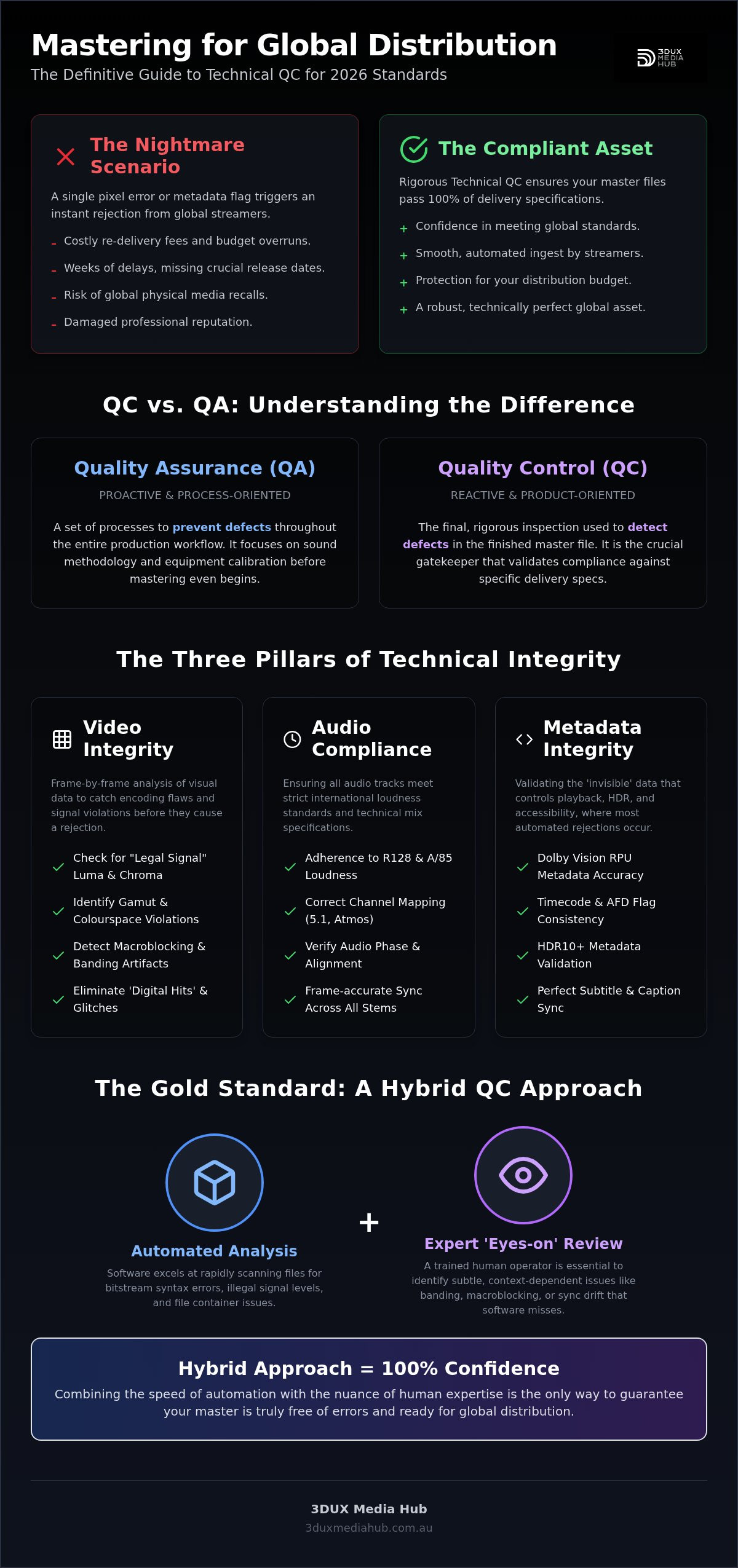
Industry professionals often conflate QC and QA, but they serve distinct functions. Quality Assurance (QA) is the set of proactive processes used to prevent defects throughout production. Quality Control (QC) is the reactive process of detecting defects in the final output. For high-end 4K UHD authoring services, both are non-negotiable. QA ensures the workflow is sound, focusing on the equipment and methodology. QC is the final inspection of the specific file to confirm it meets the target delivery spec.
Why Technical QC is Vital for Global Distribution
Global streamers and retailers operate on strict automated ingest systems. If your file doesn’t meet their exact Luma or Chroma requirements, the system rejects it instantly. This leads to missed release dates and damaged reputations. Professional technical QC for video mastering protects the filmmaker’s vision and the distributor’s bottom line. It guarantees that 2026 Blu-ray quality control for film distribution standards are met, giving you a master that passes 100% of delivery specs every time. Without this safeguard, you’re essentially gambling with your distribution budget.
The Technical Pillars: Video, Audio, and Metadata Integrity
The foundation of effective technical QC for video mastering rests on three non-negotiable pillars: visual, auditory, and structural integrity. Modern 2026 masters are significantly more complex than the SDR deliverables of previous years. With the widespread adoption of HDR10 and Dolby Vision, the margin for technical error has narrowed. While professional video encoding services ensure the base signal is robust, the QC process must validate that Luma and Chroma levels remain within “Legal Signal” parameters for global broadcast compliance.
Visual Artifacts and Signal Anomalies
We look for specific encoding flaws that automated tools often miss. This includes macroblocking in high-motion scenes, banding in shadows, and interlacing artifacts. “Digital Hits” are particularly problematic; these brief, jarring glitches often occur during standards conversion or high-pressure encoding cycles. Gamut Violations are signal levels that exceed the display capabilities of standard monitors. Identifying these early prevents rejections from platforms with strict gamut clamping policies.
Audio Compliance: Loudness and Phase
Technical compliance is as much about the ear as it is the eye. We strictly adhere to R128 and A/85 loudness standards to ensure your content meets Australian and international broadcast regulations. Misaligned phase or incorrect channel mapping in 5.1 and Dolby Atmos mixes leads to immediate failure at the ingest stage. Because audio conforming for international film release involves complex multi-language track stacking, every stem must be verified for frame-accurate sync and signal integrity. Our process ensures your audio remains immersive without violating technical thresholds.
Metadata and Structural Validation
The “invisible” components of the master are where the most rejections occur. For Dolby Vision assets, we verify the Reference Processing Unit (RPU) metadata to ensure the dynamic mapping is frame-accurate. We also check for Timecode consistency and Active Format Description (AFD) flags to guarantee the correct aspect ratio is triggered on the viewer’s screen. Finally, we ensure subtitle and closed caption synchronisation remains perfect across the entire feature. If you need a safe pair of hands to manage these complex technical variables, our expert review provides the necessary insurance for your assets.
Automated vs. Eyes-on QC: Striking the Right Balance
Automated QC is the speed engine of modern distribution. It excels at the heavy lifting of bitstream syntax checking, frame-accurate loudness measurement, and container validation. For technical QC for video mastering, these tools are indispensable for catching what the human eye cannot perceive, such as corrupted packets or illegal metadata flags buried in the header. However, relying solely on software is a high-risk strategy that often leads to “false positives” or, worse, overlooked subjective errors.
Software struggles significantly when faced with complex interactive Blu-ray menu design and navigation logic. A machine can confirm a file exists, but it can’t tell if the “Play Movie” button accidentally triggers the wrong audio stream or if a navigation loop is broken. Validating the user experience requires a human brain to ensure the logic paths match the technical documentation. We treat automated tools as the first line of defence, not the final word.
What Software Misses: The Human Element
Software is binary; it sees a “problem” or it doesn’t. It frequently flags intentional creative choices, such as heavy film grain or stylistic lens flares, as “noise” or “compression artifacts.” Conversely, automated tools often miss subtle but devastating issues like ghosting, matte shifts in composites, or “dead pixels” that only appear in certain colour gamuts. During content localisation, an expert operator is the only reliable way to catch lip-sync drift or cultural nuances in subtitle placement. Our operators understand the creative “intent” of the image, ensuring that technical compliance never comes at the expense of the filmmaker’s vision.
The 3DUX QC Hybrid Workflow
We don’t force a choice between speed and precision. Our workflow integrates both into a dual-layer safeguard. Every project begins with a comprehensive automated pass to secure the technical foundation and bit-level integrity. This is immediately followed by a 100% linear human review, where a seasoned technician watches the content from start to finish. This rigorous hybrid approach is the gold standard for broadcast standards conversion services. By combining machine speed with veteran intuition, we produce a comprehensive technical report that minimises the risk of costly re-submissions. It’s the only way to turn a “passable” file into a bulletproof master asset.
Avoiding Rejections: A Pre-Mastering Technical Checklist
Master rejections are expensive, frustrating, and usually avoidable. Implementing a rigorous pre-check protocol before you hand over assets ensures your technical QC for video mastering isn’t derailed by basic errors. Proactive distributors save time by aligning with their authoring house early. Clear communication regarding delivery specs prevents the “ping-pong” effect of multiple re-submissions. Providing comprehensive Mastering Metadata alongside your video files is the first step toward a 100% pass rate.
Step 1: Verify Source Asset Integrity
Never assume a file is perfect just because the render finished. Check for file corruption using MD5 checksums to guarantee bit-for-bit integrity during transfer. Your master must be in a professional mezzanine codec, such as ProRes 4444 XQ or DNxHR, to maintain the necessary bit depth for HDR grading. Confirm that the frame rate and resolution match the intended distribution market exactly. A mismatch here often requires a full re-export, stalling the entire mastering chain.
Step 2: Audio Layout and Loudness Pre-Check
Label your audio stems with absolute precision. A standard map, such as Ch 1-2 for the Full Mix and Ch 3-4 for the M&E, prevents mapping errors during the encoding stage. Perform a quick loudness scan to ensure the mix isn’t peaking above -1dBTP, as this is a common trigger for automated rejection. You should also verify that your M&E (Music and Effects) tracks are fully populated and ready for localisation. Missing foley or sync-drift in the M&E stems will cause significant delays during international versioning.
Step 3: Visual Inspection for Common Artifacts
Perform a manual “spot check” at high-contrast scenes and fast-motion sequences where encoding artifacts like macroblocking are most likely to appear. Look for “dead pixels” or “hot pixels” that may have been missed during the DI (Digital Intermediate) stage. These tiny sensor errors are often invisible on small monitors but become glaringly obvious on 4K UHD displays. Finally, ensure that all titles, subtitles, and legal text sit strictly within the Title Safe area. If you want to avoid the high cost of master rejections, contact 3DUX Media Hub to discuss your technical delivery requirements before you start your final export.
Expert QC and Mastering Services at 3DUX Media Hub
3DUX Media Hub is the safe pair of hands for your high-value media assets. We operate as a specialised technical partner for distributors across the country, providing a level of precision that only comes from decades of frontline experience. With over 20 years of practical expertise, we’ve refined our workflows to meet the most demanding global delivery specifications. We are one of the premier Blu-ray authoring companies Australia relies on for technical integrity. Our team manages the entire mastering chain, from initial video and audio encoding to complex content localisation and final technical QC for video mastering.
The stakes in the entertainment industry are incredibly high. A single metadata error can stall a global launch. We mitigate this risk through a combination of high-tech infrastructure and veteran intuition. Our services are designed for speed without sacrificing the “no-nonsense” rigor required by major streamers and retailers. We don’t just tick boxes. We ensure your content is robust, compliant, and ready for the global stage.
Our Technology and Facility
We function as a “one-stop-shop” for the final stages of the post-production chain. This integrated approach eliminates the friction often found when moving files between separate vendors. We manage everything under one roof:
- High-bitrate HEVC and AVC encoding for 4K and HD.
- Subtitle track management and forced narrative checks for localisation.
- Immersive audio validation for Dolby Atmos and 5.1 surrounds.
- Interactive menu design and navigation logic testing.
Whether you’re an independent filmmaker preparing for a festival run or a major distributor managing a global retail launch, our team scales to meet your requirements. We understand the pressure of release deadlines. Our commitment to fast turnaround ensures your assets are delivered on time and on spec. Contact our team today to discuss your project’s technical specifications and secure your distribution-ready master.
Securing Your Global Distribution Future
Achieving a flawless master in 2026 requires more than just high-end software; it demands a rigorous, dual-layer approach that combines automated precision with veteran human intuition. By implementing a strict pre-mastering checklist and mastering the complexities of HDR metadata, you transform your creative work into a bulletproof global asset. Rigorous technical QC for video mastering is your final safeguard against the high costs of re-delivery and the risk of retail recalls. It’s the difference between a project that sits in a loop of rejections and one that reaches its audience on schedule.
With over 20 years of technical mastering experience, we provide the expertise needed to navigate shifting global standards. Our full 4K UHD and Blu-ray authoring suite ensures your content meets every rigorous delivery spec for film and TV. We act as your proactive partner, managing the technical heavy lifting so you can focus on your next creative endeavour. Our global distribution support is designed to get your content across the finish line with total confidence.
Ensure your master is distribution-ready with 3DUX Media Hub. Your content deserves a safe pair of hands to reach its audience without compromise. We’re ready to help you organise your next successful launch.
Frequently Asked Questions
What is a “Digital Hit” in a video master?
A digital hit is a momentary visual corruption appearing as blocky artifacts or jarring pixelated flashes. These glitches usually occur during the encoding process or due to storage media failures during file transfer. In a professional technical QC for video mastering, we identify these hits frame by frame to prevent them from reaching the final retail product. Even a single frame of corruption can trigger an immediate rejection from global streaming platforms.
How long does a professional technical QC take for a feature film?
A comprehensive technical review typically requires 1.5 to 2 times the total runtime of the content. This duration allows for the initial automated bitstream analysis followed by a full linear human review. For a standard 90 minute feature, the process involves several hours of meticulous observation and data logging. Factors like the number of audio tracks and the complexity of HDR metadata can influence the total time required for a definitive pass.
Why was my master rejected for “Gamut Violations”?
Rejection for gamut violations occurs when the colour or luminance levels in your master exceed the legal limits of the target display standard. If your grade pushes colours beyond the Rec.709 or Rec.2020 boundaries, the signal can’t be accurately reproduced on consumer hardware. This results in “clipping,” where fine detail in highlights or saturated areas is lost. We use specialised scopes to ensure every pixel remains within compliant, broadcast legal thresholds.
Can automated QC software replace a human operator?
Automated software cannot replace the intuition of a seasoned technician. While software is excellent for measuring loudness and checking file syntax, it lacks the ability to identify subjective issues like lip sync drift or “ghosting” artifacts. A human operator understands the creative intent and can distinguish between stylistic film grain and unwanted compression noise. Our hybrid approach ensures that technical compliance never overrides the visual integrity of the filmmaker’s original vision.
What are the most common technical errors in 4K UHD masters?
The most frequent failures in 4K UHD masters involve mismanaged HDR metadata and bitrate spikes that exceed the hardware buffer limits of playback devices. We also frequently encounter incorrect colour space tagging and misaligned Dolby Vision RPU data. These structural errors often remain invisible on a standard editing timeline. They only manifest when the file is ingested into a professional authoring system or played back on a calibrated 4K display environment.
Do I need a separate QC for digital delivery and Blu-ray?
Yes, because the delivery specifications for physical media and digital streaming are fundamentally different. A master optimised for a 100GB 4K UHD disc uses significantly higher bitrates and different container structures than a file destined for a streaming platform. Blu-ray also requires rigorous testing of interactive menu logic and navigation paths. Performing a dedicated technical QC for video mastering on each specific deliverable is the only way to ensure 100% compliance.
What is the difference between SDR and HDR QC?
HDR QC is significantly more complex than SDR because it requires the validation of dynamic metadata, such as MaxCLL and MaxFALL values. While SDR QC focuses on the Rec.709 colour space and standard luminance levels, HDR must account for the much wider Rec.2020 gamut and peak brightness levels up to 1000 nits or more. We verify that the HDR metadata correctly maps the image to the consumer’s display without causing “crushed” blacks or blown out highlights.
How much does professional technical QC cost in Australia?
The investment for professional review depends on several technical variables rather than a flat rate. Factors including the total runtime, the complexity of the audio configuration, and whether the project requires HDR10+ or Dolby Vision validation all influence the final scope. Complex projects with multiple localised audio stems or interactive menus require more intensive labour than simple digital file deliveries. We recommend discussing your specific delivery specs to receive an accurate project assessment.