A single frame of out-of-gamut colour or a fraction of a decibel in audio loudness can kill a global distribution deal before it even starts. In the high-stakes world of 2026 media delivery, technical perfection isn’t just a goal. It’s the only insurance policy you have against a costly rejection from major streamers or broadcasters. Relying on specialised film distribution technical services is no longer optional for filmmakers who want their content to reach international audiences without a hitch. You’ve likely spent years on your project. The last thing you need is a QC failure at the finish line.
We know the pressure of managing multi-language localisation assets and the confusion surrounding 4K UHD versus Blu-ray mastering requirements. This guide promises to demystify the technical landscape, ensuring your content meets every stringent broadcast quality control standard. We’ll examine the latest 2026 specifications for 4K UHD authoring, explain the updated ATSC A/85 audio guidelines, and show you how to organise your delivery pipeline for global success. It’s time to turn your technical assets into a seamless gateway to the global market.
Key Takeaways
- Understand how modern film distribution technical services ensure your assets meet the complex requirements of global streamers and broadcasters without risk of rejection.
- Master the technical nuances of 4K UHD authoring, including HEVC encoding and HDR integration, to maintain the highest cinematic standards across all formats.
- Streamline your content localisation by managing multi-language assets and audio conforming with precision for international delivery.
- Implement a rigorous “Three-Pass” broadcast quality control process to catch technical and creative issues before they impact your release timeline.
- Consolidate your encoding, authoring, and QC into a single, high-efficiency workflow backed by over 20 years of industry expertise.
Navigating the Technical Landscape of Modern Film Distribution
The Difference Between Post-Production and Distribution Mastering
Many producers mistake their final edit for a delivery master. Post-production is about creative intent; distribution mastering is about technical compliance. A professional hub ensures your assets are formatted for digital aggregation, where technical metadata plays a critical role. Without the correct metadata, platforms can’t categorise or stream your content accurately. Assets must be prepared for everything from high-bitrate physical media to adaptive bitrate streaming. This involves precise standards conversion and audio conforming to ensure the viewer experience remains consistent regardless of the device.
The High Cost of Technical Errors
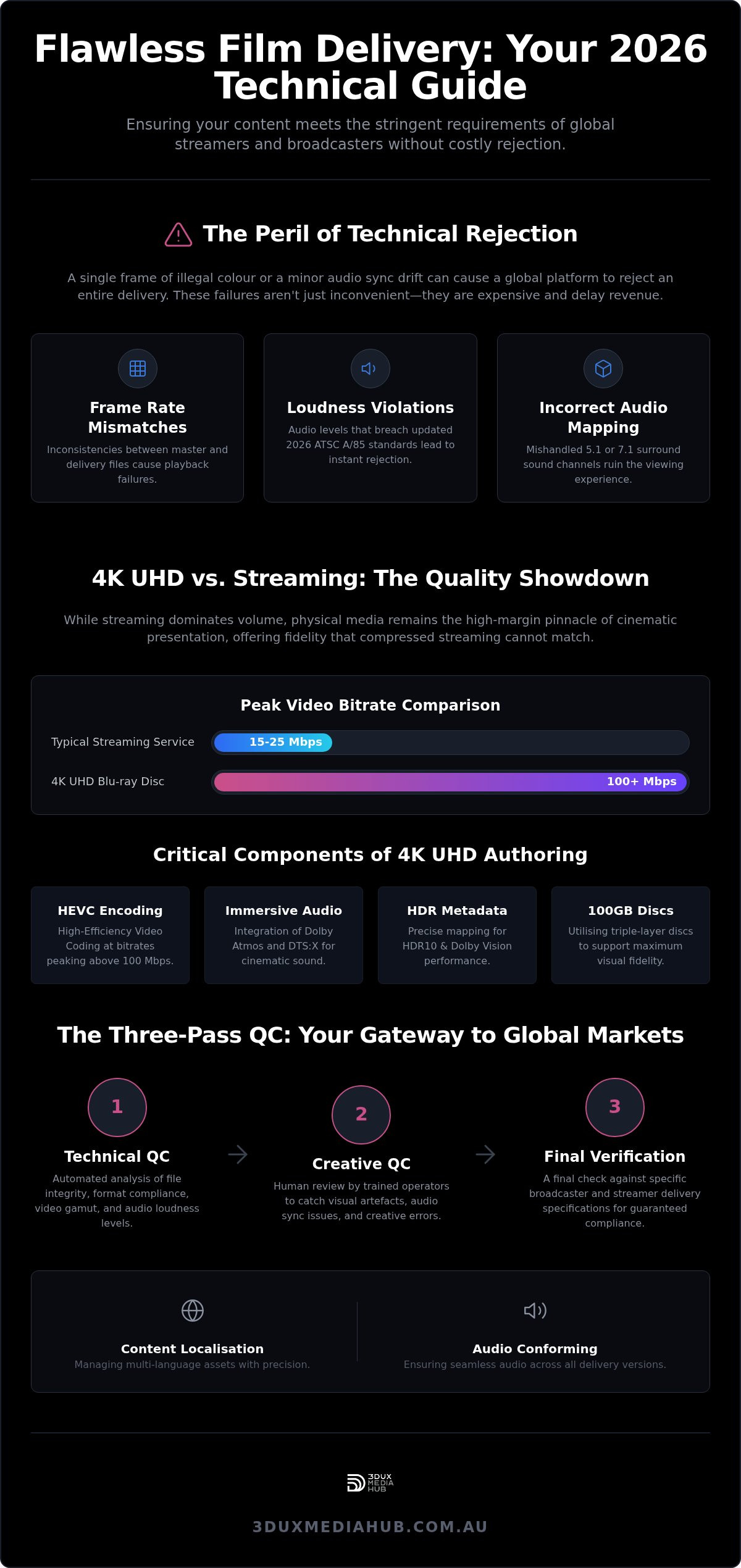
Technical rejections are the leading cause of delayed revenue for independent filmmakers. A single frame of illegal colour or a minor audio sync drift can cause a global platform to reject an entire delivery. These failures aren’t just inconvenient. They are expensive. Industry data suggests that creating a 4K DCP in 2026 can cost up to $18 per minute. If a 90-minute feature fails QC, the financial blow to an indie budget is significant. Common reasons for rejection include:
- Frame rate mismatches between master and delivery files.
- Loudness levels that violate the updated 2026 ATSC A/85 standards.
- Incorrectly mapped audio channels for 5.1 or 7.1 surround sound.
Mastering for 4K UHD and Blu-ray: The Gold Standard of Quality
While digital platforms dominate volume, physical media remains the high-margin pinnacle of cinematic presentation. High-bitrate playback offers a level of visual and auditory fidelity that compressed streaming simply cannot match. For filmmakers, mastering for 4K UHD and Blu-ray is about preserving the artistic integrity of the work while tapping into the lucrative collectors’ market. Expert Professional 4K UHD authoring services ensure your film is presented exactly as intended on premium home cinema systems. Streaming services often throttle bitrates to 15 or 25 Mbps, leading to visible compression artefacts. In contrast, a 4K UHD disc can deliver peaks of 100 Mbps or more, making it a vital component of high-end film distribution technical services.
4K UHD Authoring Requirements
4K UHD authoring is the process of encoding and structuring video, audio, and metadata for high-bitrate disc playback. This technical phase requires deep expertise in HEVC encoding and the integration of HDR10 or Dolby Vision metadata. To achieve maximum visual fidelity, we utilise triple-layer 100GB discs. This allows for massive file sizes that standard broadband connections can’t handle. We focus on several critical technical components during this stage:
- High-efficiency Video Coding (HEVC) at bitrates peaking above 100 Mbps.
- Integration of immersive audio formats like Dolby Atmos and DTS:X.
- Precise metadata mapping for consistent HDR performance across different displays.
Every bit of data must be perfectly structured to ensure compatibility with global hardware standards. This level of precision is a core part of professional film distribution technical services.
Blu-ray and DVD: Still Vital for Global Revenue
Physical media remains a critical component of global distribution, particularly in territories where high-speed internet is inconsistent. It’s also a vital revenue stream for independent cinema. Fans want to own a piece of the film. This is where interactive menu design comes into play. Motion and static menus aren’t just functional; they’re an extension of your film’s branding. A well-designed menu enhances the consumer experience and adds perceived value to the physical product. Even DVD remains relevant in specific international markets, requiring expert standards conversion to maintain quality on older formats. They offer a stable, high-quality viewing experience that isn’t dependent on bandwidth. If you want to maximise your project’s reach, securing a technical partner with experience in both digital and physical mastering is essential.
Content Localisation and Asset Preparation for Global Markets
Localisation is often the most misunderstood part of the delivery process. It goes far beyond mere translation. For an Australian production to succeed in non-English speaking markets, the technical asset preparation must be flawless. This involves creating “textless” masters. These are clean versions of the film without any burnt-in titles or captions. They allow international broadcasters to overlay their own localised graphics without interfering with the original vision. Managing these assets is a core function of professional film distribution technical services.
Audio Conforming and Multi-Channel Mastering
Audio is where many global deliveries fail. Audio conforming for international film release requires aligning dubbed tracks perfectly with the master video. This isn’t just about timing. It’s about maintaining the integrity of 5.1 and 7.1 surround sound stems. Different regions have strict technical standards for audio loudness. In Europe, the EBU R128 standard is the benchmark. In the US, the updated July 15, 2026, ATSC A/85 guidelines are now the mandatory standard for both broadcast and streaming. We ensure your audio stems are conformed to these specific regional requirements, preventing costly rejections from international networks.
Subtitle and Closed Captioning Technicals
Subtitles are no longer just text files. They are complex technical assets. In 2026, compliance with accessibility standards is a legal requirement in many markets. We manage the integration of multi-language SRT and VTT formats, ensuring they function correctly across diverse digital platforms. You must choose between hard-coded and selectable subtitles based on the distribution channel. Hard-coded subtitles are burnt into the video file. They are frequently used for theatrical screenings or specific “forced” narrative translations. Selectable subtitles allow the viewer to toggle between languages. These require precise metadata management within the container file. Digital releases often involve dozens of subtitle tracks. Each must be synchronised to the frame. Our role is to ensure these localisation assets are perfectly organised. This allows for a smooth global rollout across SVOD and physical media. Asset preparation is the difference between a project that gets stuck in technical limbo and one that reaches its audience on time.
Ensuring Compliance: The Vital Role of Broadcast Quality Control
Broadcast Quality Control (QC) is the final gatekeeper of your project’s commercial life. It is the non-negotiable step that sits between your master file and a successful global release. Without a rigorous QC pass, your delivery is essentially a gamble. Global platforms and international broadcasters have zero tolerance for technical flaws. A single frame of illegal colour or a momentary audio dropout will trigger a systematic rejection. Professional film distribution technical services provide the technical assurance that your assets are compliant with every delivery specification in your contract. We act as your final line of defence against costly delays.
Standards Conversion and Frame Rate Integrity
The transition from theatrical 24fps to broadcast-ready 25fps or 29.97fps is a technical minefield. Simple pull-down methods often lead to judder or ghosting, which will fail most stringent broadcast QC passes. We utilise high-quality motion-compensated conversion to maintain visual fluidity across formats. This ensures that your film looks as good on a television screen in London as it did in a cinema in Melbourne. Managing these frame rate shifts while maintaining audio pitch and sync is critical for international compliance. Our Broadcast standards conversion services are designed to handle these complex transitions with surgical precision.
The QC Checklist for Film Delivery
Our Three-Pass QC process is designed to catch what others miss. We don’t just rely on software. We combine automated precision with human expertise to ensure total compliance. This methodical approach is the industry benchmark for reliability.
- Step 1: Automated File Validation. We test the file against the exact delivery specs for the target platform. This validates bitrates, codecs, and metadata structure.
- Step 2: Human-led Technical Review. A technician watches the entire project on calibrated monitors. They look for visual artefacts, dead pixels, and audio glitches that software might overlook.
- Step 3: Comprehensive Reporting. We generate a detailed QC report. This document is your technical proof of compliance for the distributor.
This process is especially vital for physical media releases, where technical errors are permanent and expensive to rectify. You can learn more about our 2026 Blu-ray quality control for film distribution to see how we protect high-value assets. If you need to ensure your delivery is bulletproof, contact our technical team for a comprehensive broadcast QC review before you hit the send button.
Partnering with 3DUX Media Hub for Technical Excellence
Choosing the right partner for film distribution technical services is a strategic decision that affects your project’s bottom line. With over 20 years of industry experience, 3DUX Media Hub acts as a safe pair of hands for high-value media assets. The technical landscape in 2026 is unforgiving. One minor error in metadata or a slight deviation in encoding parameters can halt a global rollout. We provide the technical certainty required to navigate these complexities, ensuring your content is accepted by every major platform on the first delivery attempt.
A Comprehensive Suite of Technical Services
We operate as a centralised hub, consolidating every technical requirement into a single, efficient workflow. This eliminates the risks associated with moving assets between multiple vendors. Our capabilities cover the entire spectrum of modern and legacy delivery formats:
- High-End Authoring: Expert 4K UHD, Blu-ray, and DVD authoring with a focus on technical stability and compatibility.
- Advanced Encoding: High-efficiency video and audio encoding tailored for specific platform bitrates and HDR standards.
- Creative Menu Design: Professional motion and static menu design that maintains your film’s aesthetic across physical media.
- Localisation Support: Precision content localisation and audio conforming to prepare your project for any international territory.
Our infrastructure is built to exceed global broadcast requirements. We don’t just meet the standard. We set it. By managing everything from standards conversion to final QC in-house, we maintain absolute control over the quality of your master files.
Your Technical Partner in Global Distribution
Efficiency is the core of our operation. We understand that distribution windows are often tight and delays are costly. 3DUX Media Hub provides the fast turnaround times necessary to meet aggressive release schedules without compromising on technical precision. We don’t view ourselves as just another vendor. We function as an extension of your distribution team, proactively identifying potential technical hurdles before they become rejections. This proactive approach streamlines the delivery process and maximises your ROI by getting your film to market sooner.
The global media landscape in 2026 demands technical precision without compromise. Mastering for 4K UHD and managing complex localisation assets are no longer just post-production tasks. They are critical business requirements. A single technical rejection can derail your release timeline and impact your revenue. By prioritising broadcast-grade quality control and standards conversion, you ensure your project is ready for any platform, from international SVOD to premium physical media.
Professional film distribution technical services provide the technical insurance your project needs. We bring over 20 years of technical mastering expertise to every project, specialising in 4K UHD and high-bitrate encoding. Our comprehensive QC processes are designed to meet the most stringent global requirements. Don’t leave your delivery to chance.
Secure your film’s global delivery with 3DUX Media Hub technical services and move forward with the confidence that your assets are in expert hands. Your project deserves a flawless premiere on the world stage.
Frequently Asked Questions
What are the most common technical reasons for film distribution rejection?
Technical rejections often stem from out-of-gamut colours, audio loudness violations, or frame rate mismatches. In 2026, failing to meet the updated July 15 ATSC A/85 loudness standards is a frequent culprit for global platforms. Even a single frame of technical non-compliance can trigger a failure. Our film distribution technical services identify these anomalies during the QC phase, preventing costly delays before the distributor receives the final assets.
How does 4K UHD authoring differ from standard digital encoding?
4K UHD authoring is a complex process that goes beyond simple video encoding. While encoding compresses the video and audio, authoring involves building the entire disc structure, including interactive menus, metadata for HDR10 or Dolby Vision, and multi-language audio track mapping. It ensures the content triggers the correct playback response on hardware players. Digital encoding for streaming typically results in a single file, whereas authoring creates a sophisticated, multi-layered master for high-bitrate media.
Why is standards conversion necessary for international film distribution?
International distribution requires standards conversion because broadcast systems vary by region. Cinema typically runs at 24 frames per second, but broadcasters in Australia and Europe use the 25fps PAL standard, while North America uses 29.97fps NTSC. Simple speed changes can distort audio pitch or cause visual judder. High-quality motion-compensated conversion ensures the film remains visually fluid and technically compliant with regional network specifications, preserving the viewing experience for global audiences across different territories.
What is the role of audio conforming in content localisation?
Audio conforming ensures that localised assets, like dubbed dialogue or translated audio tracks, align perfectly with the original master video. This process involves more than just syncing sound; it requires managing 5.1 and 7.1 surround sound stems to maintain spatial integrity. It also ensures all tracks meet regional loudness requirements, such as the latest 2026 ATSC A/85 guidelines. Proper conforming prevents audio drift and ensures a professional presentation in every language for global delivery.
Does 3DUX Media Hub provide DCP creation for film festivals?
We specialise in the high-end technical mastering and encoding required for global delivery, including 4K UHD and Blu-ray authoring. For specific theatrical requirements like DCP creation, filmmakers should verify the unique specifications of each festival or cinema chain. Our role focuses on preparing the high-quality masters and localisation assets that serve as the foundation for all distribution formats, ensuring your project meets the highest technical standards before it reaches any screening venue.
What is the turnaround time for a full broadcast QC report?
Turnaround times for a full broadcast QC report depend on the project’s length and complexity, but we prioritise efficiency to meet tight distribution windows. Our three-pass process involves automated validation, a human-led technical review, and the generation of a detailed compliance report. This methodical approach ensures that every visual and aural artefact is identified. We recommend contacting our team with your delivery schedule to organise a timeline that aligns with your project’s specific requirements.
Can you handle both physical media authoring and digital delivery assets?
In 2026, a 4K UHD master requires a resolution of 3840 x 2160 and HEVC (H.265) encoding. It must support HDR10 or Dolby Vision metadata to ensure accurate high dynamic range playback on consumer displays. Audio must be conformed to the July 15, 2026, ATSC A/85 Recommended Practice for loudness. For physical media, assets must be structured for triple-layer discs with capacities up to 100GB to accommodate the bitrates necessary for premium quality.