A single sync error or an over-budget bitrate calculation is all it takes to trigger a global rejection from major retailers. When you are prepping a film for international distribution, multi-language audio encoding for Blu-ray isn’t just a technical task; it’s a complex data puzzle that must fit perfectly within the disc’s physical limits. You understand the pressure of getting the localisation right while maintaining the integrity of the master mix. It’s a high-stakes balancing act where mistakes lead to expensive delays and missed shipping windows.
This guide provides the technical confidence needed to navigate global distribution standards with precision. We’ll show you how to manage multiple dubbed tracks without compromising on quality or exceeding your data overhead. You will learn the professional encoding workflow, from selecting the right lossless codecs like Dolby TrueHD and DTS-HD Master Audio to precise audio conforming. By the end, you’ll have the expertise to deliver a master-grade product ready for worldwide replication and flawless playback in any territory. This is about turning technical complexities into a streamlined, reliable delivery process.
Key Takeaways
- Understand the BDA standards for managing multiple audio streams to ensure your disc architecture meets rigorous global distribution requirements.
- Evaluate the technical differences between DTS-HD Master Audio and Dolby Atmos to balance bitrate budgets while maintaining premium audio quality.
- Optimise the audio conforming process to eliminate sync issues and frame rate discrepancies during multi-language audio encoding for Blu-ray.
- Utilise broadcast-grade quality control protocols to prevent technical rejections and ensure your high-value media assets are handled with precision.
- Secure a master-grade product by aligning your localisation workflow with professional technical compliance standards for worldwide replication.
Understanding Multi-Language Audio Encoding for Blu-ray
Professional multi-language audio encoding for Blu-ray is the technical process of multiplexing various localised audio streams with a primary video track. It is a critical phase of the mastering workflow. Unlike streaming, where bandwidth constraints often force heavy compression, physical media offers the throughput required for multiple high-resolution tracks. The Blu-ray Disc Association (BDA) sets the rigorous standards that govern how these streams are structured. Failure to adhere to these specifications results in technical rejections from global retailers and replication houses.
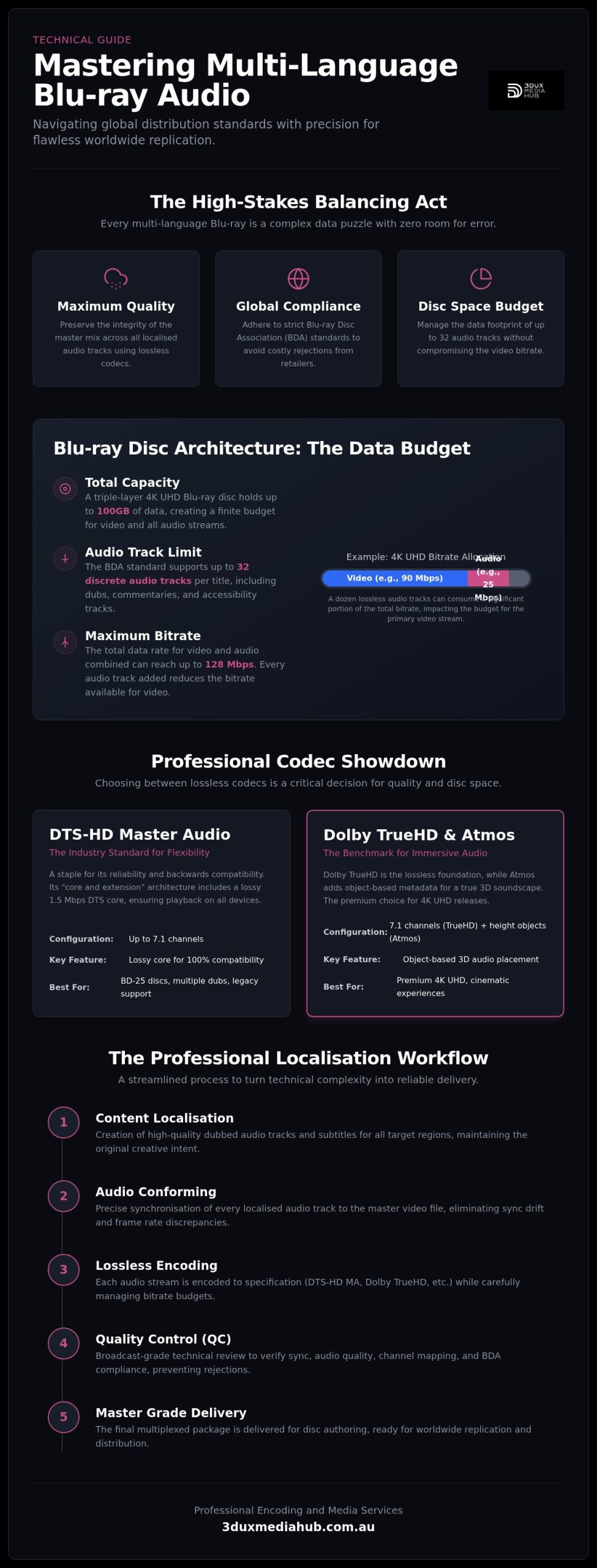
The format supports up to 32 discrete audio tracks per title. While this capacity allows for extensive localisation, it creates a significant challenge for disc space management. Every additional track consumes a portion of the total bitrate budget. For instance, a lossless Dolby TrueHD stream for a 4K UHD release can require roughly 6 Mbps. When managing a dozen languages, authoring houses must carefully balance audio quality against the maximum video data rate, which can reach up to 128 Mbps on a triple-layer 100GB disc. Distributors must prioritise this audio architecture early in the mastering phase to avoid compromising the visual presentation.
The Purpose of Multi-Track Audio in Global Distribution
Localised audio is the primary driver for international sales. Including regional dubs and descriptive audio tracks expands a film’s market reach and ensures accessibility compliance. It’s not just about translation; it’s about maintaining the cinematic experience. High-quality audio encoding ensures that a German or Japanese dub retains the same dynamic range and spatial detail as the original English master. This level of consistency is essential for protecting the brand’s reputation across different territories.
Technical Architecture of a Multi-Language Disc
The disc structure organises audio into primary and secondary streams. Primary streams contain the main feature audio, while secondary streams are typically reserved for director commentaries or accessibility features. This architecture is managed through the following technical components:
- Packet Identifiers (PIDs): These unique markers allow the player to distinguish between different language tracks within the MPEG transport stream.
- Menu Logic: The disc’s navigation code must correctly link language selection buttons to the corresponding audio PIDs.
- Player Defaults: Professional authoring ensures the disc interacts correctly with the player’s internal language settings. If a user’s hardware is set to French, the disc should automatically trigger the French audio track if available.
Precision during this stage prevents “dead” menu links or tracks that fail to trigger on specific regional players. It’s a technical requirement that demands a seasoned hand to ensure global compatibility.
Professional Audio Codecs: DTS-HD Master Audio vs. Dolby Atmos
Selecting the right codec is a balancing act between acoustic transparency and available disc real estate. For professional mastering, lossless codecs are the non-negotiable standard. Unlike the highly compressed audio found on streaming platforms, physical media utilises the MPEG-2 Transport Stream for Blu-ray Discs to deliver uncompromised bit-for-bit accuracy. When executing multi-language audio encoding for Blu-ray, every high-definition track added reduces the overhead available for the primary video stream. Mastering engineers must calculate these bitrate budgets with surgical precision to avoid playback stutter or buffer underruns.
DTS-HD Master Audio: The Industry Standard
DTS-HD Master Audio (MA) remains a staple for independent distributors due to its inherent flexibility. Its primary technical advantage is the “core and extension” architecture. Every DTS-HD MA track contains a lossy 1.5 Mbps DTS core. This ensures 100% backwards compatibility with legacy decoders while providing a lossless 7.1 experience for modern hardware. It is a reliable solution for 5.1 and 7.1 surround configurations. If you are working with a BD-25 disc and need to include three or four localised tracks, DTS-HD MA offers a predictable footprint that simplifies the authoring process.
Dolby Atmos and the Future of Immersive Audio
Dolby Atmos has become the benchmark for premium 4K UHD releases. It moves beyond traditional channels by using object-based metadata to place sound in a three-dimensional space. On Blu-ray, Atmos is delivered via a Dolby TrueHD carrier. While the audio quality is peerless, the technical challenges are significant. A single TrueHD Atmos stream can peak at 6 Mbps. Multiplying this across several languages quickly consumes the bandwidth of a standard BD-50. Implementing multi-language audio encoding for Blu-ray with Atmos requires a safe pair of hands to ensure the disc doesn’t exceed the 128 Mbps maximum throughput of the 4K UHD specification.
The choice between these formats often comes down to the target market and disc capacity. A BD-25 might force a compromise where only the feature language is lossless, while secondary languages use lossy Dolby Digital. On a BD-100 or BD-66, there is more room to breathe. Regardless of the codec, the goal is a seamless consumer experience that works on everything from high-end home theatres to basic soundbars. Precision at this stage ensures your film meets the highest auditory standards without risking technical rejection.
The Content Localisation and Audio Conforming Process
Successful localisation requires more than just collecting audio files from international studios. It demands a rigorous conforming process. Audio conforming ensures that every dubbed track remains in frame-accurate sync with the master video. Discrepancies often arise from frame rate variations between international masters, such as the speed difference between 24fps film and 25fps PAL broadcast standards. Multi-language audio encoding for Blu-ray fails if these timing offsets aren’t corrected with precision. It is a technical hurdle that requires a deep understanding of timecode offsets and pull-up or pull-down procedures.
Integrating dubbing stems is a high-stakes technical task. Dialogue-only tracks must be perfectly balanced with the original music and effects (M&E) stems. This preserves the cinematic mix while replacing the original dialogue. 3DUX Media Hub specialises in audio conforming for international film release, managing these complex asset deliveries to ensure a seamless global master. We act as the final gatekeeper for your high-value media assets.
Conforming Audio for Global Delivery
Precision is the priority when handling disparate file formats from various dubbing houses. We utilise advanced time-stretching and compression algorithms to align audio without altering pitch. This is essential for maintaining the emotional resonance of the performance. We verify sync points across the entire feature, checking for drift that can occur over a two-hour duration. Common technical challenges include:
- Sample Rate Discrepancies: Converting 44.1kHz stems to the 48kHz or 96kHz Blu-ray standard.
- Channel Mapping: Ensuring 5.1 and 7.1 surround configurations match the master spatial layout.
- Format Translation: Converting WAV, AIFF, or proprietary DAW sessions into a unified mastering format.
Subtitle Integration and Synchronisation
Subtitles must be authored concurrently with the audio tracks. This ensures visual cues match the localised dialogue perfectly. We manage multiple subtitle streams, including SDH (Subtitles for the Deaf and Hard of Hearing), forced narratives, and standard foreign language tracks. Forced narratives are critical. They display only when a character speaks a language different from the selected audio track. Technical compliance involves adhering to BDA standards for font rendering, colour palettes, and safe-area margins. This integrated approach prevents the “floating subtitle” effect and ensures a professional consumer experience across all regions.
Quality Control (QC) and Technical Compliance
Professional Quality Control (QC) is the final barrier against catastrophic manufacturing errors. When a master enters the replication phase, any unresolved technical flaw becomes a significant financial liability. Multi-language audio encoding for Blu-ray introduces variables that automated validation tools often miss. The 2026 Blu-ray quality control standards for distributors require bit-for-bit verification of every audio stream. This rigorous process ensures that localised tracks don’t just exist; they function perfectly across all playback environments and hardware configurations.
Testing must occur on a diverse range of hardware players. From high-end 4K UHD decks to entry-level legacy consoles, the disc’s logic must remain robust. Engineers check for seamless audio track switching and verify that menu navigation correctly triggers the intended Packet Identifier (PID). Metadata compliance is equally critical. Parental controls and regional playback flags must be correctly set to prevent the disc from being blocked by hardware in specific territories. Identifying common encoding artefacts, such as pre-echo or digital pops, at this stage prevents a global recall.
The QC Workflow: From Encoder to Master
A professional workflow balances automated scans with human-in-the-loop oversight. Automated software is highly efficient for detecting bitrate spikes that exceed the 128 Mbps threshold. However, human ears are essential for identifying phase issues or channel mapping errors in surround tracks. A common error involves the LFE (Low-Frequency Effects) channel being incorrectly routed during the multi-language audio encoding for Blu-ray of a secondary language. We verify every transition between audio languages to ensure sync remains absolute during real-time switching.
Avoiding Technical Rejections from Retailers
Retailers and distribution partners have zero tolerance for technical non-compliance. Common reasons for rejection include incorrect audio tagging, missing forced narrative subtitles, or digital artefacts in lossless streams. Documenting these QC results provides a transparent audit trail for your distribution partners. Trusting your master to a safe pair of hands ensures your high-value assets move through the supply chain without delay. Our no-nonsense approach to technical media requirements removes the risk of costly rejections and ensures a master-grade product ready for worldwide replication.
Partnering with 3DUX Media Hub for Professional Encoding
Managing high-value media assets requires a partner who understands the immense pressure of global release windows. We bring over 20 years of industry experience to every project, providing the technical confidence you need for a successful launch. Our team specialises in high-efficiency video encoding services tailored for the international market. We cut through the jargon with a direct, no-nonsense approach. This ensures your project moves from initial ingest to the final master without technical friction. We offer comprehensive support from the first encoding pass to the final disc authoring.
Custom Solutions for Independent and Major Distributors
Every project has its own set of technical constraints. We tailor encoding bitrates to maximise quality on both BD-25 and BD-50 discs, ensuring your feature looks and sounds its best. For distributors, this means achieving peak fidelity while staying strictly within the disc’s physical data limits. We also provide expert interactive Blu-ray menu design to facilitate complex multi-language navigation. Our menus are engineered for stability and seamless operation across all regional players. We maintain proactive communication throughout the mastering and authoring process so you’re always informed.
Ready for Global Release
Meeting film festival deadlines or global retail street dates demands efficiency. Our technical hub is designed for fast turnaround times without compromising on precision. We ensure your multi-language audio encoding for Blu-ray meets the exact standards required for 2026 distribution. We handle the complexities of standards conversion and broadcast-grade QC, allowing you to focus on your marketing strategy. Your content is delivered ready for worldwide replication. We act as a proactive partner, ensuring every localised track meets the highest auditory standards. Contact us today to discuss the technical requirements for your next multi-language project.
Securing Your Global Film Release
Mastering the technical complexities of multi-language audio encoding for Blu-ray is the difference between a seamless international launch and a costly distribution failure. You now understand how to balance bitrate budgets across lossless codecs and the necessity of frame-accurate audio conforming. These technical pillars ensure your film maintains its cinematic integrity while meeting the rigorous standards of global retailers. By prioritising broadcast-grade quality control, you eliminate the risk of technical rejections and protect your high-value media assets during the mastering phase.
Our principals bring over 20 years of technical expertise to every project. We specialise in 4K UHD and Blu-ray localisation, utilising broadcast-grade QC protocols to ensure your master is ready for worldwide replication. Whether you are an independent distributor or a major studio, we provide the reliable service required for complex technical media requirements. Contact 3DUX Media Hub for professional Blu-ray authoring and encoding today. Let’s ensure your film reaches its global audience with the precision and quality it deserves. Your international success is within reach.
Frequently Asked Questions
How many audio languages can be encoded on a single Blu-ray disc?
The Blu-ray Disc Association standard supports up to 32 discrete audio streams per title. While this allows for extensive localisation, the practical limit is determined by the total bitrate budget and disc capacity. Including multiple lossless tracks can quickly consume space on a BD-50. Authoring houses must balance these tracks against the video quality to ensure the disc remains within the 128 Mbps maximum throughput required for 4K UHD titles.
What is the difference between DTS-HD MA and Dolby TrueHD for multi-language tracks?
DTS-HD Master Audio uses a core-and-extension architecture, providing a lossy 1.5 Mbps core for backwards compatibility with legacy players. Dolby TrueHD is a bit-for-bit lossless format often used as the carrier for Dolby Atmos object-based audio. When performing multi-language audio encoding for Blu-ray, DTS-HD MA is frequently preferred for independent releases due to its reliable playback on older hardware. Dolby TrueHD remains the benchmark for premium immersive experiences on 4K UHD discs.
Can I include both 5.1 surround and 2.0 stereo tracks for every language?
You can include multiple channel configurations for each language, provided you stay within the 32-track limit. This approach ensures compatibility with both high-end home theatre systems and basic television speakers. However, each additional stream adds to the data overhead. Professional authoring involves mapping these tracks correctly in the menu so the user can switch between surround and stereo versions without navigation errors or sync drift during playback.
How does multi-language audio encoding affect the video bitrate?
Every localised audio stream added to the disc consumes a portion of the total multiplexed bitrate. If you include ten languages in a lossless format, you might use 40 to 60 Mbps just for audio. This reduces the bandwidth available for the video stream, which could lead to compression artefacts in complex scenes. Managing this balance is a critical part of the multi-language audio encoding for Blu-ray process to maintain the highest visual standards.
What is audio conforming and why is it necessary for international releases?
Audio conforming is the technical process of synchronising localised dubs with the master video file. It’s necessary because international audio stems often arrive with different frame rates, such as 25fps PAL instead of the 23.976fps standard. Without precise conforming, the audio will drift out of sync over the duration of the film. This technical alignment ensures that dialogue matches lip movements and visual cues across every language track on the final disc.
Is it possible to add new audio languages to a Blu-ray after it has been authored?
It isn’t possible to add audio tracks once the final disc image has been created. The authoring process multiplexes the audio, video, and subtitle streams into a single transport stream. Any change to the audio assets requires a complete re-authoring of the disc. This involves re-encoding the streams, updating the menu logic, and performing a full round of quality control to ensure the new tracks function correctly without errors.
What technical standards must a Blu-ray master meet for global distribution?
A master must comply with the Blu-ray Disc Association specifications for the physical layer and the application format. This includes adhering to maximum bitrate limits, correct region coding, and metadata compliance for parental controls. For 4K UHD, the master must also meet HDR10 or Dolby Vision standards. Global retailers require a master that passes broadcast-grade QC to ensure it’s free from digital artefacts, sync issues, or navigation failures.
How long does the professional audio encoding and QC process typically take?
The timeline depends on the complexity of the project and the number of localised tracks. A standard feature with three to five languages typically requires five to seven business days for encoding, conforming, and initial QC. Complex projects with 15 or more languages or immersive Dolby Atmos mixes can take longer. We prioritise fast turnaround times to meet distribution deadlines while ensuring every asset meets our rigorous technical standards.