Could a single technical oversight in your subtitle integration or audio conforming lead to a full broadcast rejection? In a global media market projected to reach $8.6 billion by 2034, the stakes for international distribution have never been higher. Identifying the leading content localisation firms in 2026 is no longer just about finding translators; it’s about partnering with technical media hubs that understand the rigours of 4K UHD and Blu-ray delivery. You’ve likely felt the frustration of high-cost errors when generalist agencies fail to meet the strict technical specifications required for global release. It’s a common worry for producers who realise that linguistic accuracy means nothing without total technical compliance.
This article provides a roadmap to identifying experts who specialise in the technical engineering of media distribution. We’ll explore how to ensure seamless global delivery across every platform, from digital streaming to physical media, while maintaining the cinematic quality your audience expects. You’ll learn how to vet a partner for their QC protocols and standards conversion expertise, ensuring your high-value assets are in a safe pair of hands. We’ll break down the essential criteria for a reliable partnership that prioritises technical precision over linguistic shortcuts, moving your project from the edit suite to the world stage with confidence.
Key Takeaways
- Understand the critical distinction between simple linguistic translation and the rigorous technical engineering required for 4K UHD and Blu-ray delivery.
- Identify why leading content localisation firms must possess the infrastructure to handle high-bitrate HEVC encoding and Dolby Atmos audio conforming.
- Evaluate the operational risks of partnering with generalist agencies versus specialist media hubs for high-stakes cinematic and broadcast distribution.
- Utilise a technical vetting checklist to ensure your partner meets international broadcast standards and employs comprehensive QC protocols.
- Recognise how 20 years of industry experience and local Australian expertise provide a safe pair of hands for high-value media assets.
Understanding the Landscape of Content Localisation in 2026
Media localisation is the technical and linguistic adaptation of film and TV assets for global release. It’s a sophisticated engineering process, not just a translation task. In 2026, the industry has shifted away from simple translation agencies. Leading content localisation firms now operate as integrated media hubs. These hubs manage the entire lifecycle of an asset, from subtitle integration to complex audio conforming. This evolution ensures that a feature film or series maintains its cinematic impact across diverse international markets.
The demand for high-stakes distribution requires a partner that handles more than just text. A modern workflow involves several critical components:
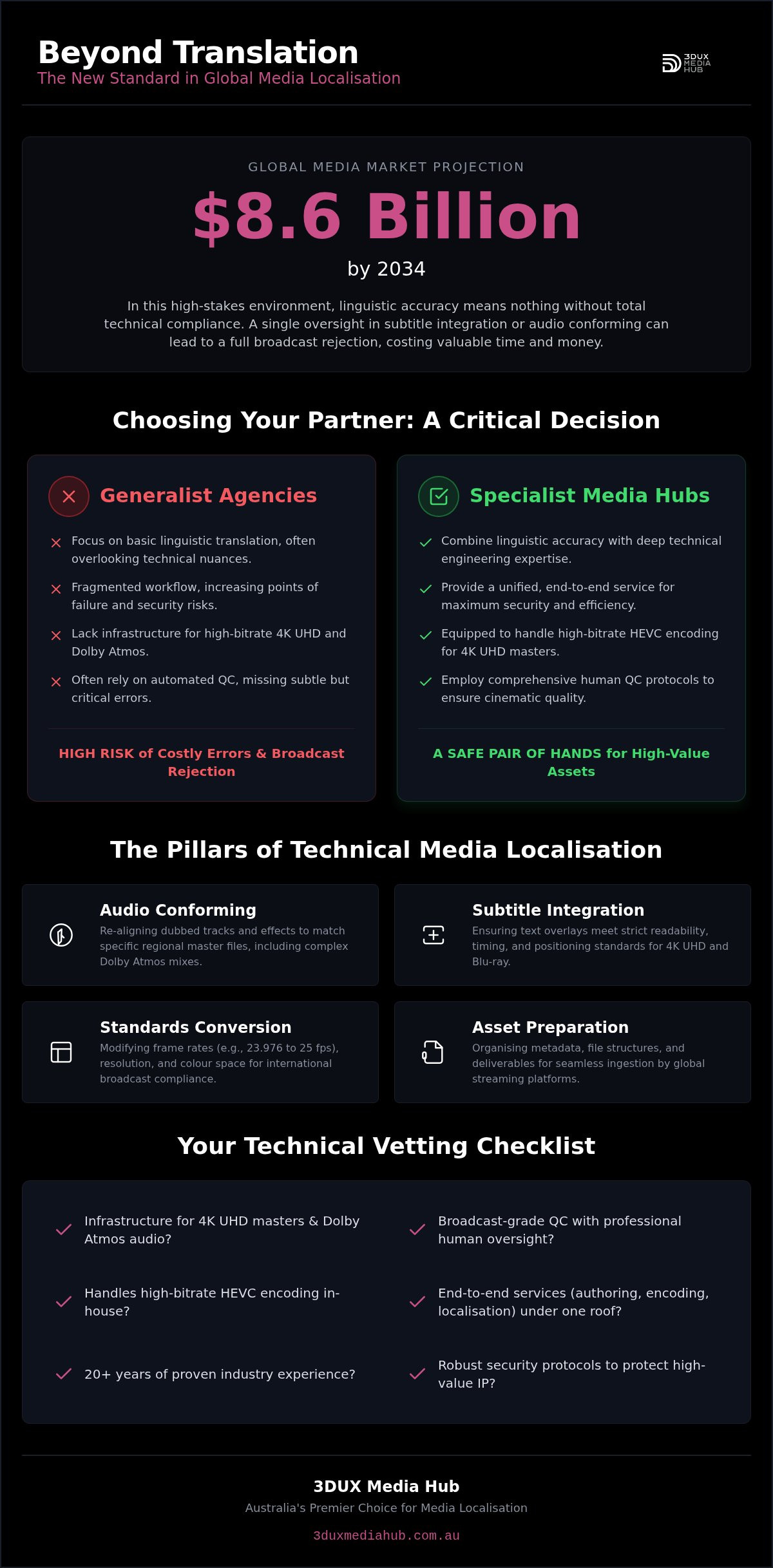
- Audio Conforming: Re-aligning dubbed tracks or effects to match specific regional master files.
- Subtitle Integration: Ensuring text overlays meet strict readability and timing standards for 4K UHD.
- Standards Conversion: Modifying frame rates and resolutions to comply with international broadcast requirements.
- Asset Preparation: Organising metadata and file structures for seamless ingestion by global streaming platforms.
The Evolution of Media Delivery Standards
The widespread adoption of 4K UHD and High Dynamic Range (HDR) has raised the bar for localisation accuracy. Technical errors that might have been hidden in standard definition are glaringly obvious in high-resolution formats. HEVC encoding is now the baseline for maintaining cinematic quality across borders. It allows for efficient delivery without sacrificing the visual depth of the original master. Distributors are increasingly moving away from fragmented vendor models. Managing multiple suppliers for encoding, authoring, and translation creates too many points of failure. Leading content localisation firms provide a unified solution, acting as a safe pair of hands for high-value assets.
Linguistic Accuracy vs. Technical Integrity
A perfect script translation is worthless if the technical execution fails. If a subtitle file isn’t timed to the correct frame rate or the audio bitrate is compromised, the viewer’s experience is ruined. This technical precision is particularly vital for film and TV dubbing, where the performance must align perfectly with the visual cues. Conforming assets to match regional broadcast specs is a non-negotiable step. It involves adjusting loudness levels and channel mapping to meet local regulations. The goal is to maintain the director’s vision while ensuring the content is technically compliant for every territory. By prioritising technical integrity alongside linguistic nuance, media hubs ensure a seamless global delivery that avoids the high costs of broadcast rejection.
Key Criteria That Define Leading Localisation Firms
Leading content localisation firms are defined by their technical backbone. Don’t settle for marketing-focused agencies that lack the infrastructure for high-stakes film and TV masters. According to PwC’s Global Entertainment & Media Outlook, the demand for high-quality localised content continues to surge. This makes technical precision a non-negotiable requirement. You need a partner capable of handling 4K UHD masters and Dolby Atmos audio tracks without compromising the original creative vision.
Broadcast-Grade Quality Control (QC)
Automated checks are a start. They aren’t enough for cinematic releases. Professional human QC is essential to catch subtle sync issues or cultural nuances that software misses. Leading content localisation firms provide exhaustive QC reports for every target territory. This rigour helps you avoid the dreaded “rejection loop” from streaming giants. A single technical error can delay a global launch by weeks. Every territory has its own set of rules for loudness, frame rates, and subtitle formatting. A firm that understands these nuances will save you time and money.
Advanced Encoding and Standards Conversion
Distribution isn’t just about digital files. Mastering for global markets requires deep expertise in standards conversion. Whether it’s converting between legacy PAL and NTSC formats or managing modern high-efficiency video encoding (HEVC), the technical execution must be flawless. Subtitle legibility is another hurdle. Leading partners ensure that text remains readable across various screen ratios and resolutions. This includes everything from small mobile screens to massive 4K projectors. If you’re looking for a partner with this level of technical depth, consider exploring how a dedicated media hub can streamline your distribution workflow. They provide the technical certainty needed to reach global audiences without the fear of broadcast failure.
Generalist Agencies vs. Specialist Media Hubs: Choosing Your Partner
Choosing between a generalist agency and a specialist media hub determines the technical success of your global release. Generalist agencies excel at high-volume software localisation or marketing copy. They rely on AI-driven workflows designed for text, not video. However, film and TV series require a deeper understanding of the mastering pipeline. Leading content localisation firms bridge the gap between linguistic accuracy and technical post-production. They don’t just translate words. They engineer assets for specific delivery platforms, ensuring every file meets the rigorous standards of international distributors.
The hidden costs of using generalists often surface during the final quality control stage. A translation agency might deliver a perfect script that fails to synchronise with the master file. Correcting these errors in the final stages of distribution is expensive. It often leads to missed deadlines and broadcast rejections. Film distributors require a partner who understands the intricacies of digital cinema packages (DCP) and interoperable master formats (IMF). This technical literacy ensures that localised assets integrate perfectly with the primary master from day one. It removes the guesswork and provides a reliable path to market.
The Complexity of Audio Conforming
Audio is frequently the weak link in localisation projects. Conforming multi-language tracks involves more than just lining up sound files. It requires adjusting audio to match different frame rates without causing a pitch shift. This is a critical step for 4K UHD authoring services where the audio must be as pristine as the visual. Technical precision in audio conforming is just as vital as the translation itself. If the 5.1 or 7.1 mix is compromised during the localisation process, the cinematic experience is lost. Specialist hubs ensure that every localised audio track maintains its technical integrity across all playback environments.
Integrated Authoring and Localisation
Efficiency in 2026 relies on minimising asset handling. Localising assets during the Blu-ray authoring phase streamlines the entire workflow. It reduces the number of vendors involved, which significantly lowers the risk of asset handling errors. This integrated approach is essential for global day-and-date releases where turnaround times are tight. By keeping authoring, encoding, and localisation under one roof, you ensure a safe pair of hands for your high-value IP. It creates a methodical process that moves your project toward delivery efficiently, mirroring the fast-paced nature of the modern entertainment industry.
Vetting Your Localisation Partner: A Technical Checklist
Vetting a partner requires moving beyond surface-level marketing claims. In 2026, leading content localisation firms must prove they can handle the technical rigours of global distribution without failing QC. Technical due diligence starts with their infrastructure. You aren’t just looking for a translation provider. You’re looking for a post-production powerhouse that understands the intricacies of the global supply chain. A firm’s ability to document their processes is a clear indicator of their expertise.
Does your prospective partner have a verified history with major distributors? Verify their ability to provide broadcast standards conversion services for every target territory. This includes managing frame rate shifts and loudness standards for international markets. Their protocols for film localisation and audio conforming should be transparent and documented. Ask how they handle multi-channel audio tracks and whether they perform phase checks during the conforming process. Subtitle integration and menu design for multi-region releases also demand high precision. Errors in navigation or text placement can lead to costly physical media recalls or digital platform rejections.
Assessing Technical Capability
Ask about their specific hardware and software suites. A firm relying on consumer-grade tools won’t cut it for high-bitrate 4K UHD masters. Leading content localisation firms invest in enterprise-grade encoding blades and professional monitoring environments. Request samples of their Blu-ray quality control services reports. These documents reveal the depth of their technical scrutiny. A professional report details everything from pixel-level artifacts to subtitle timing drifts. If they can’t provide a comprehensive log of their QC process, they aren’t a safe pair of hands for your assets.
Turnaround Times and Reliability
Fast turnaround is a common claim. It’s often used to hide a lack of depth. Verify these claims against industry benchmarks for feature-length projects. Complex film releases require a dedicated project manager who understands the mastering pipeline. They act as the single point of contact. This ensures the project doesn’t get lost in a faceless ticketing system. Reliability also means scalability. Ensure the firm can scale to handle multi-episode TV series with overlapping delivery dates without compromising on technical integrity. If you need a partner that passes every technical hurdle, contact our media hub for a technical consultation.
3DUX Media Hub: Australia’s Premier Choice for Media Localisation
3DUX Media Hub stands as a benchmark among leading content localisation firms, offering over 20 years of industry experience. We understand that global distribution is a technical engineering challenge rather than a simple linguistic task. Our position as a comprehensive media hub allows us to provide a complete solution for high-stakes media. This includes 4K UHD, Blu-ray, and DVD mastering alongside specialist content localisation. We handle asset preparation and audio conforming with surgical precision, ensuring your high-value assets are ready for any platform, from digital streaming to physical disc.
The synergy between technical authoring and localisation is where we excel. While many firms treat these as separate silos, we integrate them to eliminate the risks of file corruption or sync errors. This “one partner” model is essential for maintaining broadcast-quality QC across international borders. We specialise in high-efficiency video encoding (HEVC) and complex metadata management, ensuring your project meets every international standard. By keeping these services under one roof, we provide the technical certainty that global distributors demand.
Why Distributors Trust 3DUX
Distributors rely on our authoritative technical knowledge to ensure assets are right the first time. We remove the fear of broadcast rejection by applying rigorous QC protocols to every localised file. Our streamlined process reduces the stress of global film delivery, allowing you to focus on the creative release. You get the advantage of an Australian partner with a global distribution mindset. We understand the nuances of regional broadcast specs and the technical requirements for multi-region physical media. This technical depth makes us a safe pair of hands for your most valuable IP.
Getting Started with Your Global Release
Efficiency starts with meticulous organisation. 3DUX organises complex localisation projects by mapping out every technical requirement before a single frame is processed. Early involvement in the post-production phase is critical. It allows our team to identify potential technical hurdles in the master file before they become expensive problems during the localisation phase. Whether you’re preparing a multi-episode TV series or a feature-length 4K release, our methodical approach guarantees results. To secure your global distribution path, Contact 3DUX Media Hub for your next localisation project and speak with a technical expert today.
Securing Your Global Distribution Path
Securing an international release requires moving away from fragmented vendor models and generalist translation agencies. Success in 2026 depends on technical precision, particularly when managing 4K UHD masters and complex audio conforming. As discussed, leading content localisation firms provide the engineering depth needed to pass rigorous broadcast QC the first time, preventing costly delays and rejections. By integrating authoring, encoding, and localisation into a single modular workflow, you protect your high-value assets while ensuring cinematic quality across every territory.
3DUX Media Hub offers over 20 years of technical media experience. We are specialists in 4K UHD and HEVC encoding, providing broadcast-grade QC as a standard for every project. We organise complex delivery requirements into a streamlined path to market, acting as a safe pair of hands for your IP. Don’t let technical oversights compromise your international release. Master your content for global release with 3DUX Media Hub and reach your audience with complete confidence. Your film deserves a partner that understands the high stakes of the modern entertainment industry.
Frequently Asked Questions
What is the difference between translation and content localisation?
Translation converts text from one language to another. Localisation is a technical process that adapts the entire asset for a specific territory. This includes adjusting frame rates, re-encoding video for regional standards, and conforming audio tracks. Leading content localisation firms ensure the final file is technically compliant with local broadcast regulations. It’s about making the content feel native while maintaining the integrity of the original 4K master.
Why do film distributors need specialist localisation firms instead of general agencies?
General agencies often lack the specialised infrastructure required for high-stakes media. Film distributors require partners who understand the mastering pipeline, including HEVC encoding and IMF delivery. Specialist firms provide broadcast-grade QC that generalists cannot match. Using a generalist increases the risk of technical rejection from global streaming platforms. A specialist media hub acts as a safe pair of hands, managing complex technical assets and protecting your intellectual property.
What technical assets are required for global film localisation?
Global distribution requires several high-level assets to ensure a seamless workflow. You must provide high-bitrate masters, such as ProRes 4444 or IMF packages, along with separate Music and Effects (M&E) tracks. Dialogue scripts and time-coded reference files are also essential for accurate subtitle integration. Providing these technical assets early allows localisation firms to identify potential issues in the mastering chain before they cause expensive delays in the international release schedule.
Can localisation firms help with 4K UHD and Blu-ray authoring?
Yes, integrated media hubs provide both services under one roof. This synergy is a hallmark of leading content localisation firms. By combining 4K UHD authoring with localisation, you reduce the risks associated with multi-vendor workflows. This approach ensures that your physical media releases and digital streaming files maintain technical consistency. It also streamlines the QC process, as the technical team can validate localised assets directly within the final authoring environment.
How long does the content localisation process typically take for a feature film?
Turnaround times depend on the project’s technical complexity and the number of target territories. A standard feature film typically requires two to four weeks for comprehensive localisation. This timeframe includes asset preparation, audio conforming, subtitle integration, and rigorous broadcast-grade QC. Early involvement in the post-production phase can often accelerate this process. Providing clean masters and organised metadata ensures the technical team can move your project toward delivery with maximum efficiency.
What is audio conforming, and why is it vital for international releases?
Audio conforming is the technical process of re-aligning audio tracks to match different video masters or frame rates. It’s vital for international releases because frame rate conversions, such as moving from 24fps to 25fps, can cause sync issues or undesirable pitch shifts. Professional conforming ensures that multi-channel mixes, including 5.1 and 7.1, maintain their spatial integrity. Without precise audio conforming, your localised content may face immediate rejection from major broadcasters and streaming platforms.
How do leading firms ensure subtitle quality and compliance?
Quality is ensured through a combination of professional human review and territory-specific technical guidelines. Compliance involves meeting strict standards for font choice, reading speed, and text placement to ensure legibility on 4K UHD displays. Leading firms use exhaustive style guides that account for regional regulatory requirements and platform-specific metadata rules. This methodical approach ensures that subtitles don’t just translate the dialogue but also fit perfectly within the technical constraints of the delivery format.
What should I look for in a localisation firm’s QC report?
A professional QC report should be detailed, technical, and territory-specific. Look for logs that cover pixel-level artifacts, audio phase checks, and subtitle timing drifts. The report must validate metadata structures and ensure compliance with international broadcast standards. It should provide an actionable list of any issues found, categorised by severity. A comprehensive report from a trusted partner provides the technical certainty needed to release your high-value assets onto the global stage without fear.