A 7.1 master isn’t just a 5.1 mix with two extra speakers; it’s a rigorous technical alignment where spatial precision meets strict codec compliance. When you’re preparing a feature for international distribution, 7.1 audio mastering for Blu-ray demands absolute accuracy to ensure your soundstage translates perfectly from the studio to the home theatre. Most professionals understand the pressure of delivery dates, yet many still struggle with the nuances of channel mapping and metadata flags that can trigger a QC rejection.
You’ve likely felt the frustration of audio sync drifting during the authoring stage or the uncertainty of choosing between Dolby TrueHD and DTS-HD Master Audio for global compliance. We’ll solve those pain points by detailing the exact technical requirements for a compliant master. This guide breaks down the encoding process, explains how to organise your tracks for seamless menu integration, and provides a roadmap for achieving zero-error quality control reports. By the end, you’ll have the technical confidence to deliver a cinematic experience that meets the highest industry standards with bit-for-bit precision.
Key Takeaways
- Identify the technical differences between SMPTE and Film channel mapping to ensure your eight-channel master aligns perfectly during the authoring process.
- Evaluate the performance of DTS-HD Master Audio and Dolby TrueHD to select the most compliant lossless codec for your specific global distribution requirements.
- Optimise your workflow for 7.1 audio mastering for Blu-ray by implementing precise file-naming conventions and asset conforming before reaching the authoring house.
- Distinguish when to deploy 7.1 over 5.1 to maximise rear-field localisation and create a more immersive, 360-degree cinematic experience for the end-user.
- Implement rigorous quality control standards to achieve zero-error reports and guarantee your content meets the strict technical specifications of international distributors.
Understanding 7.1 Surround Sound in the Blu-ray Ecosystem
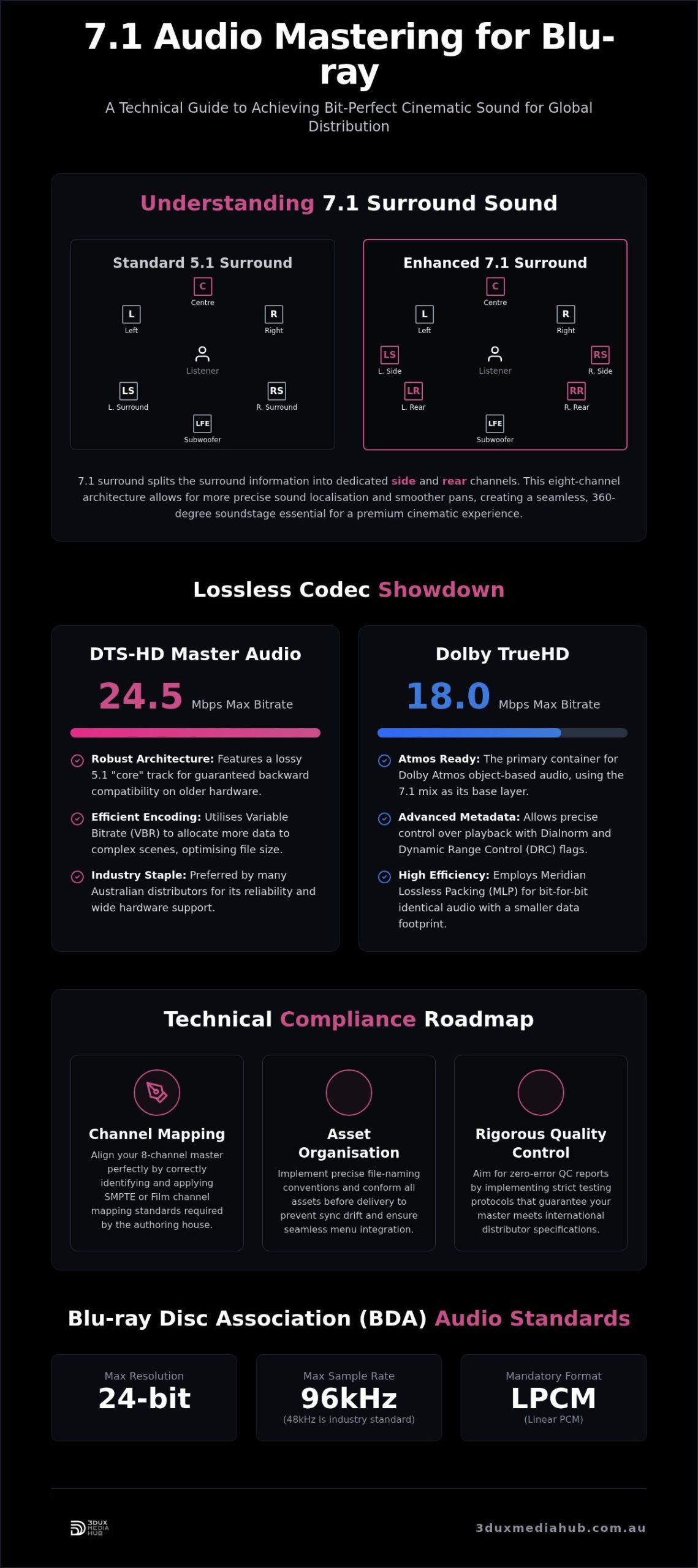
Professional 7.1 audio mastering for Blu-ray involves more than just increasing the speaker count. It’s a discrete eight-channel architecture designed to create a seamless, 360-degree soundstage. While 5.1 systems rely on a single pair of surround speakers, 7.1 splits this information into dedicated side and rear channels. This allows for more precise sound localisation and smoother pans across the back of the room. It’s why 7.1 has become the baseline for premium physical media. As 4K UHD Blu-ray sales grew by 12% in 2025, consumers increasingly expect this level of cinematic immersion as a standard feature.
The technical distinction between uncompressed Pulse Code Modulation (PCM) and lossless codecs is central to the mastering process. PCM is the raw, uncompressed audio data. While it offers maximum quality, its massive file size can eat into the disc’s video bitrate budget. Lossless codecs like DTS-HD Master Audio and Dolby TrueHD solve this. They provide bit-for-bit identical audio to the studio master while significantly reducing the data footprint. This efficiency is vital for complex authoring projects where every megabit counts.
The 7.1 Channel Configuration
A standard 7.1 surround sound master consists of eight discrete tracks. These include Left, Right, Centre, Low Frequency Effects (LFE), Left Side Surround, Right Side Surround, Left Rear Surround, and Right Rear Surround. The LFE channel is specifically bandwidth-limited to 120Hz and requires careful management to avoid clipping or muddying the low end. Phase coherence is critical across all eight channels. If the timing between the side and rear surrounds is off by even a few milliseconds, the spatial imaging collapses, destroying the listener’s sense of directionality.
Blu-ray Disc Association (BDA) Standards for Audio
The BDA defines strict technical boundaries for audio streams. For 7.1 audio mastering for Blu-ray, the specification supports up to 24-bit/96kHz resolution. While 48kHz is the industry standard for most feature films, 96kHz is often reserved for high-fidelity music releases or boutique collector’s editions. Bitrate limits are equally rigid. DTS-HD Master Audio can reach up to 24.5 Mbps, while Dolby TrueHD caps at 18 Mbps. Mastering engineers must ensure their tracks stay within these envelopes to prevent buffer underruns during playback. While LPCM is a mandatory format for hardware compatibility, the majority of global distributors demand DTS-HD MA or Dolby TrueHD for their space-saving benefits and metadata support.
Lossless Codecs: DTS-HD Master Audio vs. Dolby TrueHD
Lossless compression is the only viable method for delivering studio-grade sound within the strict data constraints of a physical disc. While raw PCM is technically pure, it’s an inefficient use of space. For 7.1 audio mastering for Blu-ray, we rely on codecs that preserve every bit while freeing up bandwidth for high-bitrate video. This balance is critical for 4K UHD releases where the video stream often exceeds 60 Mbps. Choosing the right codec depends on your target audience and the technical requirements of your authoring project.
DTS-HD Master Audio Specifications
DTS-HD Master Audio remains a staple for Australian distributors due to its robust “Core + Extension” architecture. Every DTS-HD MA stream contains a lossy 5.1 “core” track. This prevents playback errors on legacy systems that can’t decode the full lossless extension. When mastering for DTS-HD, we typically utilise variable bitrate (VBR) encoding. This allows the codec to allocate more data to complex action sequences while scaling back during quiet dialogue. It’s an efficient way to maintain high average quality without bloating the overall file size. Many local authoring houses prefer this format for its reliability and backward compatibility across a wide range of hardware.
Dolby TrueHD and Advanced Metadata
Dolby TrueHD employs Meridian Lossless Packing (MLP) to achieve its high compression efficiency. It is the primary container for Dolby Atmos metadata on Blu-ray discs. If your project includes object-based audio, the 7.1 master serves as the base layer within the TrueHD stream. Mastering for this format requires precise control over dialnorm and Dynamic Range Control (DRC) flags. Unlike DTS, TrueHD can apply these metadata instructions at the playback level. If these aren’t configured correctly during the encoding process, the end-user might experience inconsistent volume levels or flattened dynamics. Our team provides expert audio encoding and authoring to ensure these metadata flags align with your creative intent.
Bitrate management is the final hurdle. A 7.1 master can peak at 18 Mbps for TrueHD or 24.5 Mbps for DTS-HD MA. On a BD-25 disc, these peaks can significantly impact the video bitrate budget. You must calculate the total multiplexing rate carefully. If the combined audio and video peaks exceed the Blu-ray specification, the disc will stutter or fail to load. Precision encoding ensures your 7.1 master fits perfectly within the disc’s technical limits without sacrificing cinematic impact. This level of technical oversight is what separates a standard release from a high-end collector’s edition.
The 7.1 Mastering Workflow: From Mix Suite to Disc Authoring
Transitioning from a completed mix to a retail-ready disc requires more than just a simple file export. Professional 7.1 audio mastering for Blu-ray follows a modular workflow designed to eliminate technical errors before the assets reach the authoring stage. This process begins with meticulous asset preparation. You must ensure every audio stem aligns perfectly with the final locked picture, accounting for any frame rate adjustments or localisation requirements. Without this initial rigour, the risk of sync drift during the multiplexing process increases significantly.
Channel Mapping and File Integrity
The most common failure point in 7.1 mastering is incorrect channel mapping. The industry relies on two primary configurations: SMPTE (L, R, C, LFE, Ls, Rs, Rls, Rrs) and Film (L, C, R, Ls, Rs, Rls, Rrs, LFE). If your authoring house expects SMPTE but receives Film-ordered stems, the centre channel will bleed into the right speaker, and the LFE will disappear. We use strict file-naming conventions to prevent these “swaps” and verify that all assets are bounced at a consistent 24-bit depth. For complex global projects, we recommend professional audio conforming for international film release to ensure that every surround element remains spatially accurate across different regional video masters.
Quality Control (QC) for 7.1 Audio
Once the audio is encoded into its final lossless container, it enters the quality control phase. This isn’t just a creative check; it’s a technical audit. We scan for digital artefacts, such as pops or clicks, that might have been introduced during the encoding process. Phase cancellation is another critical check. If the side and rear surround channels aren’t perfectly aligned, the immersive effect is lost. Utilising specialised Blu-ray quality control services allows us to identify metadata errors, such as incorrect dialnorm settings or broken sync flags, before the disc goes to replication. This proactive approach ensures that your 7.1 audio mastering for Blu-ray meets the uncompromising standards of global distributors.
The final step involves a full technical compliance test. We verify the master against the Blu-ray Disc Association (BDA) specifications to ensure the combined bitrate of the 7.1 audio and the video stream doesn’t exceed the disc’s physical limits. This data-driven workflow provides a “safe pair of hands” for high-value assets, ensuring that the final consumer experience is exactly what the sound designer intended.
7.1 Vs. 5.1 and Dolby Atmos: Choosing the Right Format
Selecting the appropriate audio format is a strategic decision that balances creative intent with technical disc constraints. While 5.1 remains the global baseline for standard home theatre setups, 7.1 audio mastering for Blu-ray offers a clear advantage for premium collector-grade releases. The two additional discrete channels bridge the spatial gap between the side surrounds and the rear wall. This configuration allows for smoother object pans and a more stable rear soundstage. If your source material was originally mixed in 5.1, upmixing is rarely advisable for professional distribution. However, for modern cinematic productions, 7.1 is the expected standard for high-end physical media.
Dolby Atmos represents the current peak of home audio, but it relies heavily on a solid 7.1 foundation. An Atmos track delivered via Dolby TrueHD contains a 7.1 “bed” that ensures backward compatibility. If a consumer lacks height speakers, the system simply plays the 7.1 master. This ensures your release remains functional across all hardware generations while still offering a “future-proof” experience for enthusiasts. Deciding between these formats requires a clear understanding of your target market and the physical limits of your chosen disc type.
The Fold-Down Process
The technical logic used for audio fold-downs is a critical component of 7.1 audio mastering for Blu-ray. When a 7.1 master is played on a 5.1 or stereo system, the player must redistribute the rear surround information without causing phase cancellation. We use specific downmix coefficients to ensure the “phantom centre” remains clear and dialogue isn’t buried by effects. Testing these downmixes is a mandatory phase of our professional video encoding services. We verify that the audio retains its cinematic impact regardless of the listener’s speaker configuration.
Format Selection for Distribution
Disc capacity often dictates the final audio choice. A lossless 7.1 track consumes significant real estate on a single-layer BD-25, which might force a compromise in video bitrate. Dual-layer BD-50 discs provide the necessary headroom for multiple high-bitrate audio streams. Beyond the feature film, 7.1 audio can significantly enhance your interactive Blu-ray menu design. Using discrete channels for menu transitions and sound effects establishes a premium feel the moment the disc loads. If you need to determine the best format for your next project, our team provides expert Blu-ray and DVD authoring to ensure your assets are optimised for global delivery.
Ensuring Technical Compliance for Global Blu-ray Distribution
Global distribution demands more than just a high-quality mix. It requires a master that adheres to the uncompromising delivery specifications of international film distributors. Every region has unique requirements for frame rates, loudness levels, and metadata flags. Failing to meet these standards results in costly rejections and missed release windows. Professional 7.1 audio mastering for Blu-ray acts as the final safeguard, ensuring your assets are technically compliant before they enter the replication or digital delivery pipeline. Precision at this stage is the difference between a seamless global launch and an expensive technical failure.
Managing a multi-language release adds layers of complexity. You aren’t just delivering one 7.1 track; you’re often managing dozens of localised dubs, secondary audio programmes (SAP), and descriptive audio for the visually impaired. Each of these tracks must be perfectly conformed to the video master. This is particularly challenging when dealing with different global markets that may require frame rate adjustments. A professional authoring house ensures that every language asset is correctly flagged and synchronised, maintaining the cinematic experience across every territory.
Global Standards and Localisation
Coordinating localised assets often requires broadcast standards conversion services to ensure the audio remains in sync across various regional versions. Whether you’re moving from 23.976 fps to 25 fps or managing complex pitch-shifting for PAL-region broadcasts, technical accuracy is non-negotiable. We prepare assets for multi-region Blu-ray authoring by verifying that all secondary audio tracks meet the same rigorous bit-depth and sample-rate requirements as the primary master. This methodical approach prevents playback issues and ensures your content is ready for a global audience.
The 3DUX Media Hub Advantage
3DUX Media Hub specialises in these high-stakes commercial releases. We leverage over 20 years of industry experience to handle the most demanding technical requirements for 7.1 audio mastering for Blu-ray. Our expertise in high-efficiency video and audio encoding allows us to maximise disc real estate without compromising on cinematic quality. We understand the fast-paced nature of the entertainment industry. Our team provides rapid support for urgent film festival deadlines and global distribution schedules, ensuring your master is delivered on time and without error.
Our comprehensive QC process identifies potential issues before they become expensive problems. We verify every bit of your master, from channel mapping to metadata integrity. This proactive strategy ensures your content is “distributor ready” the moment it leaves our facility. Partnering with a seasoned authoring house provides the peace of mind that your high-value assets are in a safe pair of hands, ready for consumer connection on a global scale.
Mastering the Future of Surround Sound
Achieving a technically compliant 7.1 master requires more than just creative mixing; it demands a rigorous understanding of channel architecture, lossless codec specifications, and global delivery standards. By prioritising precise channel mapping and selecting the correct encoding path, you ensure your feature translates with cinematic accuracy across all home theatre systems. Professional 7.1 audio mastering for Blu-ray remains the essential benchmark for premium physical releases, providing the spatial depth and rear-field localisation that modern audiences expect.
3DUX Media Hub brings over 20 years of industry experience to every authoring project. We specialise in high-efficiency 4K UHD and Blu-ray encoding, backed by comprehensive broadcast-grade QC to eliminate technical rejections. Our team handles the complexities of content localisation and standards conversion, ensuring your assets are ready for immediate global distribution. Enquire about our professional 7.1 audio mastering and Blu-ray authoring services today. Secure your production’s legacy with a master that meets the highest technical standards and delivers a flawless consumer experience.
Frequently Asked Questions
Can I use uncompressed 7.1 PCM audio on a Blu-ray disc?
Yes, uncompressed 7.1 LPCM is supported by the Blu-ray specification, but it is rarely the most efficient choice for high-bitrate projects. While LPCM provides a mandatory playback standard for all hardware, its massive data footprint can severely limit the video bitrate budget on a BD-25 disc. Most professional authoring workflows favour lossless codecs like DTS-HD Master Audio to achieve bit-for-bit identical quality while significantly reducing the overall file size.
Is 7.1 audio backwards compatible with 5.1 surround sound systems?
Yes, 7.1 audio is fully backwards compatible with 5.1 and stereo setups through automated fold-down logic. When using DTS-HD Master Audio, a lossy 5.1 “core” ensures legacy systems can still play the audio without errors. For Dolby TrueHD, the Blu-ray player uses specific metadata coefficients to mix the eight channels down to six or two, ensuring the centre channel dialogue remains clear regardless of the listener’s speaker configuration.
What is the best channel order for 7.1 audio mastering?
The industry standard for 7.1 audio mastering for Blu-ray is the SMPTE channel order (L, R, C, LFE, Ls, Rs, Rls, Rrs). While many post-production mix suites work in “Film” order, you must communicate clearly with your authoring house to avoid channel swapping. Providing a specific channel map with your master stems is a vital step in our quality control process to ensure every sound element remains in its intended spatial position.
How much disc space does a 7.1 DTS-HD Master Audio track take up?
A 7.1 DTS-HD Master Audio track typically consumes between 3 GB and 5 GB for a standard 90-minute feature film. The exact size varies based on the audio’s complexity and the chosen sample rate, such as 48kHz or 96kHz. Because DTS-HD MA uses variable bitrate encoding, action-heavy sequences will peak at higher rates, up to 24.5 Mbps, while quiet dialogue sections require less data, helping to manage the disc’s total multiplexing budget.
Do I need a 7.1 mix if my film was originally mixed in 5.1?
You don’t necessarily need a 7.1 mix if your original source material was 5.1. Artificially upmixing a 5.1 track to 7.1 can often introduce phase cancellation or muddy the rear soundstage. If your project is intended for a standard release, a high-quality 5.1 master is perfectly acceptable. However, for premium collector editions or boutique labels, a native 7.1 mix provides the improved rear-field localisation that enthusiasts expect from modern physical media.
What is the difference between 7.1 and Dolby Atmos on a Blu-ray?
7.1 is a channel-based format with fixed speaker positions, while Dolby Atmos is an object-based system that adds height information and dynamic positioning. On a Blu-ray disc, the Atmos metadata is carried within a 7.1 Dolby TrueHD stream. This means the 7.1 audio mastering for Blu-ray serves as the foundational “bed” for the Atmos mix, ensuring that users without height-enabled speakers still receive a high-quality, discrete surround experience.
Does 7.1 audio require a specific Blu-ray player or HDMI cable?
No special HDMI cable is required for 7.1 audio, provided you are using a standard High Speed HDMI cable (version 1.3 or higher). All modern Blu-ray players are capable of bitstreaming 7.1 lossless codecs to a compatible AV receiver. If your equipment is older, the player can often decode the 7.1 signal internally and output it as multichannel PCM, ensuring you still benefit from the full eight-channel soundstage without needing a hardware upgrade.
How do I ensure my 7.1 audio stays in sync with the video master?
Maintaining sync requires meticulous audio conforming before the authoring stage begins. You must verify that your audio stems align perfectly with the final locked video master, accounting for any frame rate conversions or pull-down adjustments. Professional authoring houses use broadcast-grade quality control to scan for sync drift. This ensures the 7.1 master remains perfectly locked to the picture throughout the entire duration of the film, preventing costly distributor rejections.