Australia’s captioning requirements are specific: free-to-air television programming must be captioned for 100% of broadcasts between 6am and 12am, for the period beginning July 1, 2014. According to the ACMA, its Captioning Quality Guidelines explain how quality is assessed, including caption timing, style and format. For anyone sourcing closed captioning services in Australia, meeting the standard is about more than displaying dialogue: captions also need to communicate relevant sounds and identify speakers.
Choosing the right caption format matters. Closed captions can be switched on or off, while open captions are fixed into the video. This guide explains Australian caption quality standards, the types of captioning suppliers provide and how to choose a format for your content. It also outlines how requirements vary across broadcast contexts, helping you plan accessible video delivery.
Key Takeaways
- Understand how Australian caption quality expectations apply to accessibility, timing and presentation.
- Compare the kinds of captioning support suppliers provide and match the service to your content and delivery needs.
- Choose between switchable closed captions and open captions embedded in the video, based on how viewers will watch and share it.
- See which project details shape captioning costs, and how authoring and encoding workflows fit into preparing finished media.
Captioning quality standards and guidelines
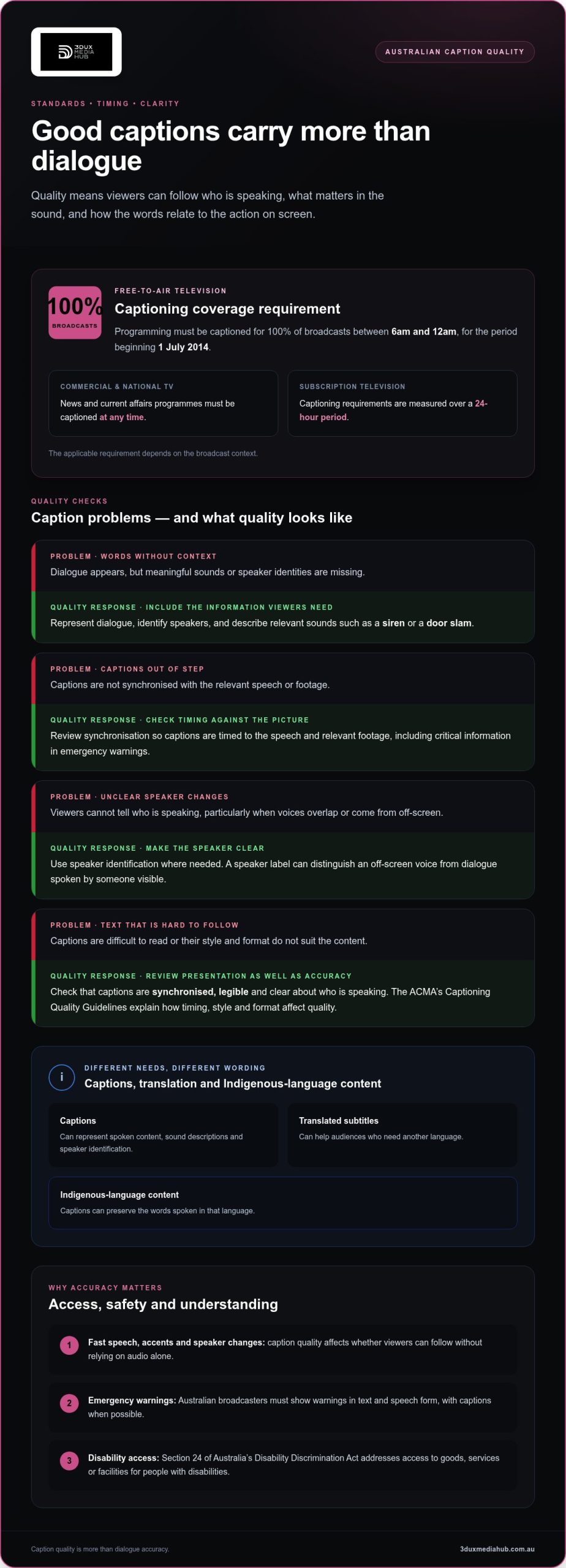
For Indigenous-language content, captions can preserve the words spoken in that language; translated subtitles can help audiences who need another language. Accessibility also depends on capturing dialogue, identifying speakers and describing meaningful sounds, such as a siren or a door slam. These details help viewers follow both the words and the action on screen.
Australia’s Captioning Quality Standard sets expectations for broadcast captions, while the ACMA’s Captioning Quality Guidelines explain how timing, style and format affect quality. A practical review checks that captions are synchronised, legible and clear about who is speaking. For example, a speaker label can distinguish an off-screen voice from dialogue spoken by someone visible.
Free-to-air television programming must be captioned for 100% of broadcasts between 6am and 12am, for the period beginning July 1, 2014. Commercial and national television broadcasters must caption news and current affairs programs at any time. For subscription television, captioning requirements are measured over a 24-hour period, so the applicable context matters.
Section 24 of Australia’s Disability Discrimination Act addresses access to goods, services, or facilities for people with disabilities, according to the Federal Register of Legislation. This legal provision sits alongside broadcast-specific captioning rules. Caption quality also affects whether viewers can follow fast speech, accents and changes between speakers without relying on audio alone.
Emergency warnings show why accuracy and presentation matter. Australian broadcasters must show warnings in text and speech form, with captions when possible. A quality check should confirm that critical spoken information is represented and timed to the relevant footage. For routine programmes, review synchronisation, speaker identification and sound descriptions together. Dialogue accuracy is only one part of caption quality.
Australian captioning suppliers
Suppliers handle recorded captions and live captioning, with delivery shaped by the content and format. For an event or meeting, arrange live remote captioning, share the running order and specialist terms, and plan where captions will appear. Viewers need phone and internet access.
Choosing an Australian captioning supplier
An Australian captioning supplier can prepare captions for recorded or live content, depending on the project. The deliverable matters: a downloadable caption file, captions embedded in a video and captions displayed during a live webinar each require a different workflow. Match the service to the platform and audience. For a technical talk, provide presenter names and subject-specific terms to support accurate speaker identification.
Closed captioning service costs
The cost of closed captioning depends on the project scope and technical requirements, with pricing provided after a quote request. Key factors include video duration, audio clarity, speaker changes, specialist vocabulary, language requirements and file format. A clean recording with one speaker can involve a different workload from a noisy panel discussion. Specify the intended platform and delivery format to define the project scope.
For budget planning, list each video, its duration, language and required caption format. Include any translation or timing requirements. A complete brief helps suppliers assess the work consistently and makes clear what the quote covers.
Delivery times for recorded video captions
Delivery time for recorded captions depends on video length, sound quality, speech complexity and requested output. Overlapping speakers, technical terminology and unclear audio can require closer review. A caption file may also need timing adjustments to match edits in the final video. Share the locked picture and specify the delivery format at the outset, so production and quality checks follow the intended workflow.
For a webinar or meeting, live remote captions are created in real time and can be viewed on a laptop, phone or big screen. Provide the schedule, platform details and speaker terminology before the event, then plan caption display for the audience. For recorded projects, align caption requirements with the final video master and its intended destination using a coordinated media delivery workflow.
Open and closed captions
Closed captions arrive separately and viewers can switch them on or off; open captions are fixed into the video. Subtitles usually translate dialogue, though in Australia the term can also mean closed captions. Live captions appear as speech happens. These differences affect how audiences access and share a programme.
Open and closed caption formats
A closed caption file contains spoken content and coded display instructions for a video platform. Viewers can enable or disable it in the player, making it suitable when they need a choice. Open captions are combined with the video itself, so they stay visible on screen and don’t depend on a platform or player supporting caption controls.
Consider a video shared across different channels. A separate closed caption file offers viewer control but must be compatible with the platform and video. Open captions stay attached to that specific video file, which can simplify sharing and avoid some compatibility issues. The trade-off is that viewers can’t turn off the text or change how it appears.
Captions, subtitles and live captions
Captions represent spoken content and can include sound descriptions and speaker identification. Subtitles commonly show dialogue translated into another language; however, Australian usage sometimes calls closed captions “subtitles”. This overlap can make a project brief ambiguous. Specify whether you need dialogue only, sound descriptions, speaker labels or translation, rather than relying on the format name alone.
Live captions are created in real time, unlike captions prepared for a recorded programme. They can appear instantly on a laptop, phone or large screen during a meeting, talk or performance. Live remote captioning can reach audiences nationally or internationally, with viewers needing phone and internet access. For a webinar, decide where the text will display and provide relevant names or terminology before the session.
For recorded video, choose a separate caption file when viewer control matters and the playback platform supports it. Choose open captions when text must remain visible in a shared video file. If the message also needs translation, distinguish that language requirement from accessibility captions in the production brief.
How much do closed captioning services cost in Australia?
There’s no single rate for closed captioning in Australia. The price depends on the project and is provided after a quote request. The main cost factors are video duration, audio quality, speaker changes, specialist vocabulary, language requirements, turnaround and the final caption format. A clear brief helps define the work before it’s priced.
For example, a clean interview with one speaker involves different captioning work from a panel recording with overlapping voices, background noise and technical terms. Translation adds another layer: subtitle timing, reading speed, line length and positioning all shape the finished file. Specify whether you need captions in the original language, translated subtitles or both.
Format matters too. A closed caption file must match the intended platform’s requirements, while open captions are combined with the video. Live captions are delivered in real time rather than prepared from a finished recording. State the format and intended use in your brief so the quote reflects the actual deliverable.
To request a useful quote, gather the project details first:
- List each video and its running time.
- Describe the recording, including background noise or overlapping speech.
- Identify languages, specialist terminology and any translation needs.
- Specify closed or open captions and the intended platform.
- Set out the required delivery schedule and any review stages.
These details give the supplier a clearer picture of transcription, timing, translation and quality-control requirements. If the source video is still being edited, explain that too. Changes to dialogue or picture edits can affect caption timing and may require another review of the finished version.
For a broader media project, align caption requirements with the video’s localisation and delivery workflow. Plan your media workflow alongside the caption brief, so format and language needs are accounted for in the production plan.
3DUX Media Hub: 4K UHD Authoring
3DUX Media Hub can support the next stage when captioned content is being prepared for 4K UHD, Blu-ray or DVD delivery. Its 4K UHD Authoring service brings a finished title into an authoring workflow, while Video and Audio Encoding prepares media files for delivery. Content Localisation supports projects that need adapted language content.
This is a useful fit when caption decisions are part of a wider release plan rather than a standalone live-captioning requirement. Align the caption format, final picture and intended output before authoring, so the media workflow reflects the finished version. For physical media projects, Blu-ray and DVD Authoring can also form part of that preparation.
To discuss an authoring or encoding project, contact 3DUX Media Hub.
Carry your caption plan into release
Treat captions as part of the release specification, not a final add-on. Lock the picture edit before finalising caption timing, keep language and format requirements beside each version, and align handover details with the destination platform. This gives every team working on the title a shared reference and reduces avoidable mismatches between picture, text and delivery files.
Keep filenames and version identifiers consistent across the master, caption file and translated assets. This makes review and replacement clearer if an edit changes. If you’re comparing closed captioning services in Australia, carry that specification into your wider media plan. It clarifies where caption deliverables sit alongside the finished master and what the next production handoff requires.
For support with the media workflow around your release, contact 3DUX Media Hub. Plan the next stage with confidence and keep your project moving.
Frequently Asked Questions
What closed captioning services are available in Australia?
Australian captioning services can cover recorded programmes, live events, and translated or same-language captions. For example, a training video may need timed captions in its original language, while an international release may need translated text. Live talks and meetings can use real-time remote captions. Define the audience, content type and required language first, as these determine the appropriate approach.
Which Australian providers offer live and pre-recorded closed captioning?
Australian suppliers work across different captioning needs, including real-time captioning for events and caption preparation for recorded media. The right provider category depends on whether captions must appear during a live session or be prepared against an edited programme. For a conference, live captioning serves the event audience; for an online training library, recorded captions can be prepared for each finished video.
What are the Australian accessibility requirements for captions on television and online video?
Requirements depend on the content and how it is distributed. Australian free-to-air television has broadcast captioning obligations, and commercial and national broadcasters must caption news and current affairs programmes at any time. Films on websites should be captioned. For a proposed release, distinguish broadcast television from online video, then consider the relevant platform and applicable accessibility obligations.
How accurate are Australian captioning services, and what affects accuracy?
Accuracy depends on how clearly speech is recorded and how complex it is to interpret. A clean interview with distinct speakers is easier to transcribe than a panel with interruptions, unfamiliar names or specialised terms. Background noise can obscure words, while edits can disrupt timing. Provide spellings for names and technical vocabulary, and use the final edited audio for caption preparation.
How can I compare Australian captioning providers by price, turnaround, accuracy, and formats?
Compare providers using one consistent project brief, then assess how each response addresses the scope. Include video length, audio conditions, languages, delivery format and deadline. Cost depends on the project and is provided after a quote request; turnaround also depends on workload and complexity. For accuracy, look for a defined review process and a deliverable suited to the intended platform, rather than comparing headline claims alone.