Streaming bitrates are a compromise your high-value cinematic assets shouldn’t have to make. While digital platforms offer convenience, they frequently sacrifice the fine detail and dynamic range that define professional cinematography. You understand that for true archival quality and an uncompromised viewer experience, UHD Blu-ray mastering remains the gold standard. It’s the only way to bypass aggressive compression algorithms and deliver a future-proof product that looks exactly as the director intended.
You’re likely facing the complexities of modern disc creation, from choosing between Dolby Vision and HDR10+ to managing the tight tolerances of a 100GB triple-layer disc. This guide provides the technical roadmap you need to navigate the professional authoring workflow with confidence. You’ll learn how to prepare your assets to avoid common QC failures and justify the investment in high-bitrate mastering. We’ll cover everything from HEVC encoding strategies to advanced menu design, ensuring your project is ready for global distribution without the fear of disc rejection during the replication process.
Key Takeaways
- Understand how professional mastering bridges the gap between post-production and home theatre systems to preserve absolute cinematic integrity.
- Master the technical pillars of UHD Blu-ray mastering, including high-bitrate HEVC encoding and why 100Mbps peaks are essential for rendering complex film grain.
- Discover why physical media consistently outperforms 4K streaming by eliminating “bitrate starvation” and aggressive compression artefacts.
- Identify the critical steps in the professional authoring workflow to ensure technical compliance and avoid costly QC failures during replication.
- Gain insights into future-proofing your release through expert localisation and rigorous asset preparation for high-stakes film distribution.
Beyond 4K: Defining Professional UHD Blu-ray Mastering
Pixels are easy. Precision is hard. While many assume 4K is a universal standard, the “4K” badge on a streaming app bears little resemblance to the data density found on a physical disc. Professional UHD Blu-ray mastering serves as the indispensable bridge between the high-end post-production suite and the consumer’s home theatre system. It’s the final stage where raw cinematic potential is forged into a compliant, high-performance product ready for the global market.
In 2026, Ultra HD Blu-ray remains the highest-quality consumer format available. However, resolution is only half the story. The real value lies in the Ultra HD Blu-ray specifications, which allow for 10-bit colour depth, Wide Colour Gamut (Rec. 2020), and bitrates that dwarf even the most robust fibre-optic streaming connections. Mastering ensures these elements remain intact. It preserves the director’s intent without the “bitrate starvation” common in digital delivery. This process involves specialised HEVC encoding, interactive menu design, and a level of technical compliance that consumer-grade software simply cannot reach.
The Role of the Mastering House
A professional mastering house doesn’t just “burn a disc.” We translate complex creative visions into a technically rigid format that must perform flawlessly across every UHD player on the market. This involves managing the massive data requirements of Triple-Layer (100GB) discs. These high-capacity discs require meticulous layer-break placement and buffer management to prevent playback stutter or seek errors. By ensuring the master is “replication-ready” from day one, we eliminate the risk of costly manufacturing delays or entire batch rejections. It’s about being a safe pair of hands for high-value film assets during the final, most critical mile of distribution.
Mastering vs. Simple File Conversion
Don’t confuse a standard H.264 or HEVC export from Premiere Pro with a professional master. They aren’t the same. Professional UHD Blu-ray mastering requires the creation of a BDCMF (Blu-ray Disc Content Master File) structure. This complex architecture includes the primary video stream, multiple audio stems, subtitles, and interactive Java-based menus. We use specialised authoring tools to ensure every element adheres to strict Blu-ray Disc Association standards. A simple file conversion lacks the metadata and structural integrity needed for physical media. Without this level of technical compliance, your content won’t just look worse. It likely won’t play at all.
The Technical Pillars: HEVC, HDR, and Bitrate Management
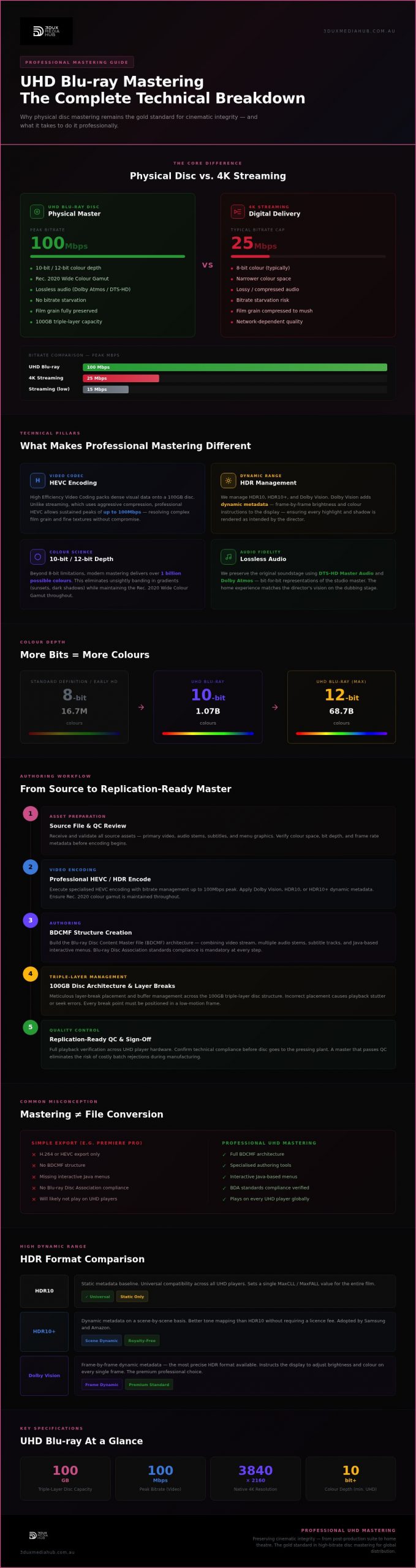
High-quality UHD Blu-ray mastering is built on a foundation of rigorous technical standards. While consumer encoders prioritise file size, professional mastering prioritises data integrity. HEVC (High Efficiency Video Coding) serves as the primary engine for this format. It allows us to pack massive amounts of visual information into a 100GB triple-layer disc. Unlike the aggressive compression used by streaming platforms, which often caps bitrates at 15-25Mbps, physical media provides the headroom for sustained peaks of up to 100Mbps. This massive bandwidth is necessary to resolve complex film grain and fine textures that would otherwise disappear into a digital mush.
Colour depth is where the format truly separates itself from legacy media. We’ve moved beyond the 8-bit limitations of standard definition and early HD. Modern mastering utilises 10-bit or 12-bit depth, providing over a billion possible colours. This eliminates the unsightly “stepping” or banding often seen in gradients like sunsets or dark shadows. Audio is equally critical. We preserve the original soundstage using lossless formats such as DTS-HD Master Audio and Dolby Atmos. These bit-for-bit representations of the studio master ensure the home experience matches the director’s vision on the dubbing stage.
Mastering for High Dynamic Range (HDR)
HDR is the most significant leap in visual quality since the move to HD. In the mastering suite, we manage the nuances between HDR10, HDR10+, and Dolby Vision. HDR10 provides a solid static baseline, but Dolby Vision introduces dynamic metadata. This metadata instructs the display to adjust brightness and colour on a frame-by-frame basis. It’s a meticulous process of metadata management to ensure the TV handles every highlight and shadow correctly. The UHD Alliance sets the benchmarks for these performance requirements, ensuring “Ultra HD Premium” certification is maintained. We also carefully manage SDR backward compatibility to ensure the disc remains playable on older hardware without compromising the primary HDR grade.
Bitrate Allocation and Dual-Pass Encoding
Precision encoding is never a “single-click” affair. We use dual-pass or multi-pass analysis to evaluate the complexity of every scene. The encoder identifies high-motion sequences that require maximum data and simpler frames where bits can be saved. This intelligent allocation prevents macroblocking in fast-moving action and preserves detail in moody, low-light scenes. HEVC has been the industry standard for 4K physical media since 2016. If you require this level of technical excellence for your next project, our team offers expert Video and Audio Encoding services designed for high-stakes cinematic releases. By controlling every variable in the encoding chain, we ensure your master is free from artefacts and ready for the most demanding home theatre environments.
UHD Blu-ray vs. 4K Streaming: The Quality Gap
Marketing departments love the “4K” label. It’s a convenient shorthand for resolution. However, for those involved in UHD Blu-ray mastering, resolution is just the starting point. The true quality gap lies in the data density. Streaming services operate on a model of “bitrate starvation” to minimise bandwidth costs and ensure smooth playback on varied internet connections. This leads to heavy compression that strips away the fine details that define a cinematic image.
When you stream a film, you’re viewing a version that has been optimised for delivery, not for fidelity. Physical media remains the only way to experience a film without the technical compromises imposed by streaming algorithms. It’s the difference between a compressed approximation and a bit-perfect representation of the master file.
Bitrate Breakdown: Disc vs. Digital
The numbers reveal the reality. A typical 4K stream from a major platform usually hovers between 15 and 25 Mbps. In contrast, a UHD Blu-ray disc delivers bitrates between 60 and 128 Mbps. This isn’t just a minor increase; it’s a massive leap in data availability. When you starve a 4K image of data, the encoder makes compromises. It smooths out fine film grain, smudges skin textures, and introduces macroblocking in complex, dark areas. Physical media eliminates these issues. Because the data is read locally from the disc, internet speed and buffering never affect playback quality. You get a consistent, high-bitrate experience every time.
The “Cinematic” Difference
Audio is frequently the biggest casualty in the digital landscape. Most platforms use lossy Dolby Digital Plus, which is compressed to save space. Professional UHD Blu-ray mastering preserves the full studio soundstage using lossless formats like DTS-HD Master Audio or Dolby Atmos. You hear the mix exactly as it was intended on the dubbing stage. This means full dynamic range and zero compression artefacts.
Beyond the technical specifications, there is the issue of permanence and colour accuracy. Streaming libraries are volatile. Titles disappear overnight because of licensing shifts. A physical disc is a permanent archive. It also ensures the DCI-P3 colour gamut is preserved accurately, avoiding the colour shifting introduced by streaming re-transcodes. The tactile experience of custom motion menus and high-quality bonus features adds a layer of value that digital platforms don’t replicate. It transforms a simple viewing into a premium experience.
The Professional Authoring Workflow: From Source to Master
Turning a cinematic master into a retail-ready disc requires more than just technical knowledge. It demands a disciplined workflow. Professional UHD Blu-ray mastering is a multi-stage journey that begins long before the first bit of data is encoded. Every asset must be scrutinised to ensure it meets the rigorous demands of the 4K format. This isn’t a simple drag-and-drop process. It’s a meticulous sequence of events designed to transform raw files into a high-performance consumer product.
The authoring process bridges the gap between post-production and the physical disc. It involves the integration of video, audio, and interactive layers into a single, compliant structure. Each step is designed to preserve quality while ensuring the finished product plays flawlessly on every UHD player globally.
Step 1: Preparing Master Assets
The quality of your output is dictated by your source. 3DUX recommends providing ProRes 4444 or DNxHR files to ensure the highest possible fidelity. These mezzanine formats provide the necessary colour depth and detail for our encoders to work effectively. We also organise complex audio environments, managing multiple language stems and descriptive audio tracks. Subtitle integration is equally vital. We ensure precise timing and positioning to guarantee a seamless experience for global audiences. Starting with clean, high-bitrate assets is the only way to achieve a premium result.
Step 2: Interactive Menu and Feature Design
A disc’s menu is the first thing a viewer sees. It must reflect the film’s aesthetic while remaining fully functional. We specialise in motion menu design that feels like a natural extension of the feature itself. This phase involves programming complex navigation logic, such as seamless branching for director’s cuts or multi-version releases. We ensure the user interface is intuitive and responsive across all hardware, from entry-level players to high-end home theatre centres. Navigation should be invisible; the viewer should move through bonus features and settings without friction.
Step 3: Verification and Final QC
The most critical phase is Quality Control. We produce a “Check-Disc” to test the master on a variety of hardware configurations. This ensures the navigation and playback are flawless before the project moves to mass production. Our team verifies that every master meets strict BDA (Blu-ray Disc Association) specifications. Professional QC at 3DUX prevents costly replication rejections. If you are ready to move your project into production, our 4K UHD Authoring services provide the expertise needed for a successful global launch. We handle the technical heavy lifting so you can focus on the creative vision.
Future-Proofing Your Release with 3DUX Media Hub
Australian distributors operate in a high-stakes environment where technical errors lead to expensive delays. 3DUX Media Hub serves as a “safe pair of hands” for these high-value film assets. We bridge the gap between creative completion and global retail. This isn’t just about file delivery. It is about protecting the commercial longevity of your library. Professional UHD Blu-ray mastering ensures your film is preserved in the highest possible quality, ready for the displays of today and the home theatre systems of tomorrow.
A high-bitrate master is more than a technical requirement. It is a commercial asset. While streaming platforms may change their specifications or remove titles, a physical disc remains the definitive archival version of your work. We focus on maintaining absolute cinematic integrity through every stage of the process. Our UHD Blu-ray mastering services are designed to give your production the premium edge it needs in a crowded marketplace.
Expertise You Can Count On
We bring over 20 years of experience in the Sydney post-production scene to every project. This deep industry knowledge allows us to anticipate technical hurdles before they become problems. We use advanced encoding techniques to maximise the potential of the 4K format, ensuring every pixel serves the director’s vision. Our service is personalised and direct. We don’t just act as a vendor. We act as a partner in your distribution strategy, providing the technical confidence you need for a successful launch.
- Proven track record with high-stakes Australian film releases.
- Expertise in HEVC encoding, HDR integration, and complex menu logic.
- Fast turnaround times that respect your release schedule and market deadlines.
- Modular service offerings that scale to the needs of independent filmmakers and major distributors alike.
Global Distribution Support
Reaching international audiences requires meticulous attention to detail. We provide comprehensive content localisation and standards conversion to ensure your master is ready for worldwide delivery. This includes managing subtitle timing and audio stems for various territories. Our team ensures every file meets strict technical compliance for global distribution. We understand the specific requirements of international retailers and provide the documentation needed for a smooth handover. Ready to master your next project? Contact the experts at 3DUX Media Hub today. We provide the technical precision required for the world’s most demanding formats.
Secure the Future of Your Cinematic Assets
The gap between streaming and physical media is widening. To protect your film’s integrity, you need a distribution master that respects the original vision without compromise. Professional UHD Blu-ray mastering ensures that every pixel and soundstage detail remains intact. This process provides an archival-grade product that consistently outperforms digital delivery. It’s the only way to bypass the bitrate starvation of streaming platforms and deliver true 4K quality to the home theatre.
By prioritising high-bitrate HEVC encoding and rigorous technical compliance, you eliminate the risk of replication failures and manufacturing delays. With over 20 years of technical expertise, 3DUX Media Hub provides full UHD, Blu-ray, and DVD authoring capabilities. We specialise in high-efficiency HEVC and Dolby Vision encoding to ensure your content meets the highest global standards. Our Sydney-based team handles the technical complexity so you can focus on the creative result. Don’t let your project be limited by restrictive compression algorithms. Master your film for global distribution with 3DUX Media Hub. Your audience deserves to see your work exactly as you intended.
Frequently Asked Questions
What is the difference between 4K UHD and standard Blu-ray mastering?
The primary difference lies in the encoding standard and colour space. 4K UHD mastering utilises HEVC (H.265) encoding and supports High Dynamic Range (HDR) with the Rec. 2020 colour gamut. Standard Blu-ray is restricted to AVC (H.264) encoding and the Rec. 709 colour space. UHD projects also require significantly higher bitrates to maintain the integrity of the 3840 x 2160 resolution.
How much data can a UHD Blu-ray disc hold?
UHD Blu-ray discs are available in three specific capacities: 50GB, 66GB, and 100GB. Most high-end cinematic releases utilise the 100GB triple-layer specification. This provides the necessary headroom for sustained high bitrates, multiple lossless audio tracks, and extensive bonus features without compromising visual fidelity.
Do I need a special player to watch a UHD Blu-ray disc?
Yes, a dedicated Ultra HD Blu-ray player is required to decode the HEVC video streams and read the high-density discs. Standard Blu-ray players don’t have the hardware capability to process these files. However, UHD players are backward compatible, meaning they will play your existing Blu-ray and DVD collection without issue.
What file formats should I provide for UHD mastering?
We recommend providing ProRes 4444 or DNxHR mezzanine files for the highest quality results. These formats preserve the 10-bit colour depth required for professional UHD Blu-ray mastering. You should also supply uncompressed audio stems, such as 24-bit WAV files, and compliant subtitle formats like STL or PNG image sequences.
Is HDR included in all UHD Blu-ray mastering projects?
HDR is technically optional but it’s considered an industry standard for the format. Most projects include HDR10 as the baseline metadata. We can also integrate advanced dynamic metadata for Dolby Vision or HDR10+. This ensures the display adjusts brightness and colour on a frame-by-frame basis for the best possible viewer experience.
What is a BDCMF file and why is it important?
The BDCMF (Blu-ray Disc Content Master File) is the encrypted master image produced at the end of the authoring process. It contains the final multiplexed video, audio, and menu data in a strictly compliant structure. This is the only file format accepted by replication facilities to create the glass master for physical disc production.
How long does the professional authoring process take?
A standard feature film typically requires a window of two to four weeks for completion. This timeline covers the multi-pass encoding, interactive menu programming, and the essential Quality Control (QC) phase. More complex projects involving seamless branching or extensive localisation may require additional time to ensure absolute technical compliance.
Can 3DUX help with subtitle integration for international releases?
Yes, we offer comprehensive content localisation as part of our UHD Blu-ray mastering workflow. We manage the integration of multiple subtitle languages and ensure they meet strict timing and positioning standards. This prepares your film for a seamless global release, ensuring compliance with the specific requirements of international distributors.