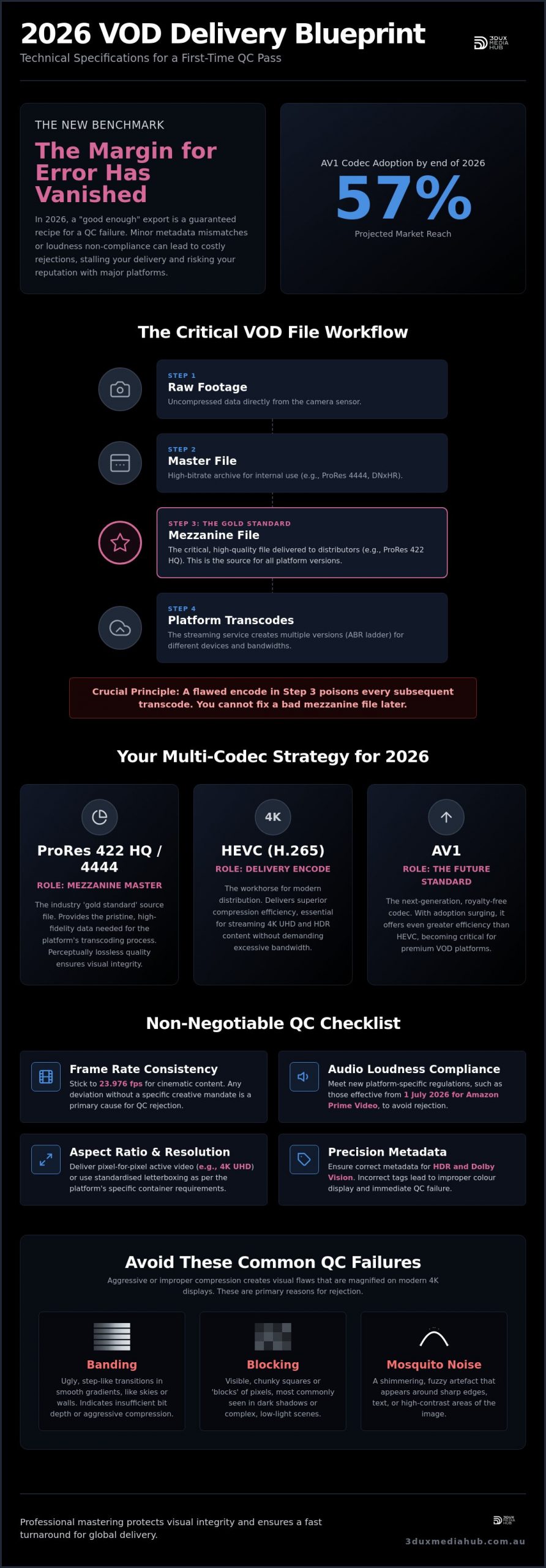
In 2026, a “good enough” export is a guaranteed recipe for a QC failure. With AV1 adoption projected to reach 57 per cent of the market by the end of the year, the margin for technical error in your video encoding specifications for VOD has effectively vanished. You’ve likely felt the sting of a high-value project being knocked back by a global distributor because of a minor metadata mismatch or a loudness non-compliance. It’s a frustrating, costly bottleneck that stalls your delivery timeline and risks your reputation with major platforms.
Mastering these requirements is no longer about just hitting “export” on a standard preset. This guide provides the technical blueprint you need to ensure your content passes rigorous professional inspections on the first go. We’ll demystify the choice between ProRes and HEVC for mezzanine masters, explain the new Amazon Prime Video loudness regulations effective from 1 July 2026, and show you how to maintain high-fidelity playback across the entire consumer device ecosystem.
Key Takeaways
- Understand why the mezzanine file is the critical link in the distribution chain, separating professional masters from standard consumer exports.
- Identify the exact video encoding specifications for VOD required for 2026, including bitrate targets for 4K UHD and the rapid rise of AV1.
- Organise your HDR and Dolby Vision workflows with precision metadata to meet the evolving standards of premium streaming platforms.
- Learn how to integrate manual and automated QC checks to satisfy global compliance standards and avoid costly delivery delays.
- Discover how professional mastering services can protect your content’s visual integrity while ensuring a fast turnaround for international delivery.
Understanding Video Encoding for VOD Distribution
Professional VOD distribution is an unforgiving environment. It demands more than a simple file conversion; it requires a precise video coding format that balances massive data rates against pristine visual fidelity. In the world of film and TV delivery, encoding is the bridge between your final grade and the viewer’s screen. If that bridge is poorly constructed, the quality of your production collapses under the weight of global distribution.
Producers must distinguish between three critical file stages. Raw footage is the uncompressed data straight from the sensor. Master files are your high-bitrate archives, often stored in ProRes 4444 or DNxHR. However, the mezzanine file is what distributors actually want. This is a “gold standard” delivery file that adheres to strict video encoding specifications for VOD. It’s high enough in quality to serve as the source for every subsequent version the platform creates, yet compressed enough to be manageable for transmission.
Relying on “web-optimised” presets from standard editing software is a high-risk strategy. These presets are designed for speed and low bandwidth, often stripping away the bit depth and colour accuracy required for professional QC. On a 4K UHD display, the flaws of aggressive compression are magnified. What looks acceptable on a laptop screen often turns into a blocky, banded mess on an 85-inch OLED. Precision is the only way to avoid rejection.
Encoding vs. Transcoding: What Producers Need to Know
The terminology matters. Encoding is the initial process of converting your master into the mezzanine format. Transcoding occurs later, usually on the platform’s side. This involves taking your mezzanine file and creating an adaptive bitrate (ABR) ladder. This ladder consists of multiple versions of your film at different resolutions and bitrates. It’s how Netflix or Amazon Prime ensures a smooth experience for someone on a 5G phone and someone on a fibre-connected home theatre. If your initial encode is flawed, every single transcode in that ladder will carry those errors. You cannot fix a bad encode with a better transcode.
Lossy vs. Lossless Compression in VOD
True lossless compression is reserved for archival storage because the file sizes are astronomical. For VOD, we aim for “perceptually lossless” encoding. This means the compression is high enough to be efficient but the data loss is invisible to the human eye. Achieving this requires a deep understanding of video encoding specifications for VOD and the artefacts that occur when you push the limits too far. Common issues like banding in clear blue skies, blocking in dark shadows, and mosquito noise around sharp edges are the primary reasons content fails broadcast-grade QC. Avoiding these requires professional-grade tools and experienced eyes on the final master.
Essential Technical Specifications for VOD Deliverables
The landscape of video encoding specifications for VOD has shifted significantly. In 2026, relying solely on H.264 is no longer sufficient for high-tier distribution. AV1 adoption is surging, with a projected 57 per cent market reach by the end of the year. This requires a multi-codec strategy where HEVC and AV1 handle the heavy lifting for 4K and HDR content, while H.264 remains the fallback for legacy device compatibility. Professional delivery is no longer about finding one “best” setting; it’s about providing a high-bitrate mezzanine file that allows the platform to generate these multiple versions without quality loss.
Frame rate consistency remains a non-negotiable pillar of professional mastering. While high frame rates (HFR) are available, 23.976 fps continues to be the global cinematic standard for narrative content. Deviating from this without a specific creative mandate often triggers an immediate QC rejection. Similarly, aspect ratio handling requires absolute precision. Whether you are delivering a 2.39:1 theatrical master or a 16:9 broadcast version, the file must be delivered as “pixel-for-pixel” active video or with standardised letterboxing that meets the platform’s specific container requirements. Amazon Prime Video, for example, now requires 4K resolution for all applicable artwork as of June 2026, reflecting the broader industry push for high-fidelity assets across the board.
Codec Selection: AVC vs. HEVC vs. ProRes
ProRes 422 HQ and 4444 are the industry-recognised gold standards for mezzanine masters. These files serve as the high-fidelity source from which all other versions are derived. For the final delivery encode, HEVC (H.265) provides the necessary efficiency for 4K UHD and HDR distribution. When configuring these files, following Recommended VOD settings from industry leaders ensures your metadata and GOP (Group of Pictures) structures are compliant. While H.264 (AVC) is still used for maximum compatibility, it’s increasingly reserved for lower-resolution proxies or legacy SD/HD streams.
Bitrate and Resolution Requirements
For 4K UHD, the target resolution is strictly 3840×2160. Bitrate targets have climbed to accommodate higher viewer expectations. For a high-quality 4K SDR upload, industry benchmarks suggest a range between 35 and 45 Mbps. For HDR content, this target increases to 44–56 Mbps to maintain detail in the highlights and shadows. Crucially, professional masters must use 4:2:2 chroma subsampling. This preserves the essential colour detail that consumer-grade 4:2:0 files discard. If you’re unsure if your current masters meet these benchmarks, our team provides broadcast quality QC to verify every technical detail before you submit.
Advanced Encoding: HDR, Dolby Vision, and Immersive Audio
The Australian VOD market has reached a tipping point where High Dynamic Range (HDR) is no longer a luxury reserved for tentpole releases. Local viewers equipped with 4K UHD displays now expect the expanded contrast and colour volume that only HDR provides. For producers, this means navigating a more complex set of video encoding specifications for VOD than ever before. Delivering a master that looks spectacular in a grading suite but fails on a consumer TV is a common, and expensive, mistake. Precision in the mastering stage is the only way to protect your creative intent.
Mastering for HDR10 and Dolby Vision
Professional HDR encoding requires a minimum 10-bit depth and strict adherence to the BT.2020 colour space. While HDR10 remains the baseline due to its static metadata, Dolby Vision is the preferred standard for premium delivery. It uses dynamic metadata to instruct the display on how to map every individual shot. Although Dolby Vision 2 was announced in January 2026 with “Content Intelligence” features, current workflows remain the industry standard for the foreseeable future. Accuracy is vital. Blown-out highlights or crushed blacks often occur when the mastering display’s peak brightness isn’t correctly flagged in the metadata. Following Google’s Recommended VOD Settings provides a solid foundation for resolution and bitrate targets, but HDR requires an extra layer of metadata validation to ensure global compatibility. The same HDR precision and colour accuracy demanded by streaming platforms applies equally to physical media — motion menu design for 4K UHD requires identical mastering rigour to ensure every element of the disc experience meets UHD Alliance specifications.
Audio Specifications for Professional VOD
Audio is frequently an afterthought, yet it’s the most common reason for delivery disruption. As of 1 July 2026, Amazon Prime Video requires all content providers to certify that their audio meets ATSC A/85 loudness standards. This is a direct response to new regulations extending the CALM Act to streaming services. Whether you’re delivering in Stereo, 5.1, or the immersive Dolby Atmos format, your files must hit the -24 LKFS (or -23 LUFS for EBU R128) target precisely. Failure to comply now carries a higher risk of rejection than in previous years.
Immersive audio adds another layer of complexity to your video encoding specifications for VOD. Dolby Atmos is now the de facto standard for premium tiers, requiring careful channel mapping and metadata synchronisation. Beyond loudness, lip-sync remains a critical QC check. In high-bitrate files, even a two-frame offset can lead to immediate rejection by global distributors. Organising your audio tracks for multi-language delivery is equally important. Each language pair must be clearly labelled and mapped according to the platform’s specific delivery manifest to ensure the end-user hears exactly what was intended during the mix.
Quality Control and Compliance for Global VOD Platforms
Quality Control (QC) is the final, uncompromising barrier between your production and a global audience. Rejection by a major platform like Netflix or Stan isn’t just a minor inconvenience. It’s a breach of delivery timelines that can lead to significant financial penalties. Even if you’ve followed the video encoding specifications for VOD during the export, errors frequently emerge during the packaging or upload stages. Professional QC ensures your asset is truly “broadcast-ready” before it ever hits the delivery server.
Automated QC software is exceptionally efficient at detecting illegal colours, bitrate spikes, or corrupted frames. However, it cannot replace a seasoned human operator. A machine won’t notice a subtle lip-sync drift or a boom mic peaking into the top of a 4K frame. We advocate for a hybrid approach where machines handle the data validation while experts handle the visual and auditory scrutiny. This is especially critical as platforms migrate to new delivery systems. For instance, Amazon Prime Video users must migrate to Aspera on Cloud by 30 July 2026 to avoid delivery disruptions. A robust QC process ensures your files are compliant with these evolving infrastructure requirements.
Common Reasons for VOD Technical Rejections
Most rejections stem from preventable technical oversights. Digital hits, dropouts, and compression artefacts often occur when bitrates are pushed too low for complex scenes. Incorrect metadata tagging is another frequent culprit. If your aspect ratio flags don’t match the active video, the platform’s automated ingest system will likely kick the file back. Audio is equally sensitive. With Amazon Prime Video’s 1 July 2026 loudness regulation now in effect, any file that fails ATSC A/85 certification is an automatic fail. Phase issues in 5.1 mixes also trigger rejections, as they cause dialogue to disappear when downmixed to stereo by the end-user’s device. The same technical rigour applies to promotional assets — understanding the film trailer preparation services required for cinema and broadcast delivery can help you avoid identical pitfalls across your entire asset package.
The QC Checklist for Distributors
Compliance requires a modular approach to asset verification. Every deliverable must be checked against a rigorous internal list before submission. This includes verifying file integrity through MD5 or SHA-1 checksums to ensure no data was lost during transfer. Closed captions must also be scrutinised. The FCC deadline of 17 August 2026 requires newly manufactured devices to have “readily accessible” caption settings, making compliant sidecar files or embedded tracks more vital than ever. Finally, ensure all localisation assets, such as trailers and the now-required 4K resolution artwork, match the master’s technical profile. Don’t risk a rejection at the finish line. Our broadcast quality QC services provide the final seal of approval for global distribution.
Professional Encoding and Mastering with 3DUX Media Hub
The 2026 distribution environment is a technical minefield. Between the rapid adoption of AV1 and the stringent new loudness regulations for streaming, the margin for error is non-existent. 3DUX Media Hub eliminates the complexity of video encoding specifications for VOD by providing a centralised, expert-led workflow. We don’t just compress files; we master assets for global longevity. Our team understands that a mezzanine file isn’t just a delivery requirement. It’s the preservation of your production’s visual and auditory integrity.
Our technical suite is built for high-stakes delivery. We specialise in 4K UHD authoring and high-efficiency HEVC encoding, ensuring your content meets the exacting standards of every major platform. With over 20 years of industry experience, we recognise the nuances of digital standards that automated tools often miss. We provide the precision required for high-fidelity playback while maintaining the fast turnaround times essential for global distribution and content localisation. We act as the bridge between post-production and the consumer’s screen.
Tailored Encoding Solutions for Every Project
Every production has a different destination. An independent short film destined for a boutique streaming service requires a different technical profile than a major feature film heading for a global theatrical-to-VOD window. We customise every export to meet the unique video encoding specifications for VOD required by your distributor. Our services extend to standards conversion and asset preparation, ensuring your project is ready for any international market. Whether you need to organise multi-language audio tracks or prepare complex sidecar files for closed captions, we handle the technical heavy lifting. We ensure your assets are compliant, organised, and ready for ingest.
Partnering for Success in the Digital Market
In an industry where a single metadata error can stall a release, 3DUX Media Hub is your “safe pair of hands”. We treat your high-value assets with the technical respect they deserve. Our broadcast-grade QC acts as your final insurance policy, significantly reducing the risk of platform rejection. We provide a proactive partnership that moves your content from the grading suite to the consumer’s screen without friction. We don’t just act as a vendor. We are a proactive partner focused on the end goal of global delivery.
Don’t let technical non-compliance derail your delivery schedule or inflate your budget. Contact 3DUX Media Hub to discuss your specific delivery requirements and ensure your content passes QC on the first attempt. We are ready to help you navigate the complexities of 2026 distribution with speed, precision, and authority.
Secure Your Content’s Future in the Global Market
Navigating the 2026 distribution landscape requires a shift from simple compression to professional mastering. You’ve seen how the rapid adoption of AV1 and new loudness regulations have raised the stakes for every production. Success now depends on absolute precision in your video encoding specifications for VOD. By mastering a high-fidelity mezzanine file and implementing rigorous, human-led QC, you protect your visual integrity and avoid the costly delays of platform rejection.
With over 20 years of technical expertise, 3DUX Media Hub is the safe pair of hands for your high-value assets. We are specialists in 4K UHD and HEVC encoding, providing the broadcast-grade QC and compliance testing needed for a first-time pass on any global platform. We understand the high stakes of the entertainment industry and the need for a fast, reliable turnaround. Don’t leave your distribution to chance. Ensure your content meets global standards with 3DUX Media Hub professional encoding services. Your project deserves a delivery as flawless as the production itself.
Frequently Asked Questions
What is the best video codec for VOD distribution?
HEVC (H.265) and AV1 are the industry leaders for high-tier distribution in 2026. While H.264 remains the standard for broad compatibility, it lacks the efficiency required for 4K UHD. AV1 is rapidly becoming the primary choice for major platforms due to its 30 per cent efficiency gain over HEVC. Choosing the right codec depends on your specific video encoding specifications for VOD and the target distributor’s requirements.
What bitrate should I use for 4K UHD VOD encoding?
Target bitrates between 35 and 45 Mbps for standard 4K SDR content. If you are delivering in HDR, these targets increase to a range of 44 to 56 Mbps for standard frame rates. These bitrates ensure the mezzanine file retains enough detail for the platform’s subsequent transcodes. Pushing below these benchmarks risks visible artefacts like banding or blocking on large consumer displays.
What is a mezzanine file in video distribution?
A mezzanine file is a high-quality, “perceptually lossless” compressed version of your final master. It serves as the single source of truth for the VOD platform’s adaptive bitrate ladder. Unlike a raw archive, it’s efficient enough for transfer but maintains enough data to ensure every lower-resolution transcode looks pristine. ProRes 422 HQ is the most common format for these deliverables.
Does my VOD content need to be HDR?
HDR is not strictly mandatory for all VOD releases, but it is the current expectation for premium 4K tiers. Providing an HDR version, specifically in Dolby Vision or HDR10, ensures your content is eligible for “featured” placement on most major platforms. Without an HDR master, your production may be limited to standard HD tiers, which can impact your commercial reach and viewer engagement.
Why was my video rejected by a VOD platform?
Technical rejections usually stem from failures in the QC stage. Common culprits include audio loudness non-compliance, metadata tagging errors, or digital hits and dropouts. With the 1 July 2026 Amazon Prime Video loudness update, even minor deviations from ATSC A/85 standards will trigger a failure. Professional human-led QC is the only way to catch subtle issues like lip-sync drift before submission.
How much does professional video encoding cost?
Professional encoding costs vary based on the project’s duration, the complexity of the delivery manifest, and the number of localisation assets required. Each project has unique technical needs, from simple file conversion to complex 4K UHD authoring with immersive audio. We recommend requesting a tailored quote to ensure all your specific video encoding specifications for VOD are met without unnecessary overhead.
What is the difference between H.264 and HEVC for VOD?
The primary difference is compression efficiency. HEVC is approximately 50 per cent more efficient than H.264, allowing for 4K delivery at manageable bitrates. While H.264 is the fallback for legacy devices, HEVC is the prerequisite for HDR and UHD content. Using HEVC ensures your content meets modern quality benchmarks while keeping file sizes within the platform’s ingest limits.
Do I need a separate audio master for Dolby Atmos?
Yes, Dolby Atmos requires a dedicated master file, typically delivered as an ADM BWF (Audio Definition Model Broadcast Wave File). This file contains the bed tracks and the spatial metadata for audio objects. It is distinct from your standard 5.1 or Stereo print masters. Distributors require this specific format to ensure the immersive mix renders correctly across different consumer playback environments.