
Choosing a post-production partner is easier when you assess four practical areas: feedback workflows, clear account ownership, values alignment and file handoffs. These determine how comments are consolidated, who keeps decisions moving, and how source media and finished deliverables move between teams. Strong creative work matters, but a reliable process helps prevent revisions and delivery from becoming avoidable sources of friction.
It’s reasonable to expect a partner to understand the brief and respond constructively to feedback. The working details matter just as much: how drafts are shared, who gives final approval, and how changes or missing media are handled. Agreeing on these points early gives everyone a clearer route from first cut to approved master.
This guide explains how to assess each part of the workflow before work begins. You’ll learn what to clarify about review rounds and communication, how a single point of contact supports accountability, which values help build a productive relationship, and what to define in the handoff so files and deliverables arrive in the right form.
Key Takeaways
- Map the review path from draft delivery to final approval, including how feedback is consolidated and revisions are managed.
- Clarify who owns project communication and keeps decisions, deliverables and next steps moving.
- Compare working principles and creative expectations early to build a partnership that can handle honest discussion.
- Define file formats, delivery materials and transfer responsibilities in the handoff brief to reduce avoidable gaps.
1. Communication and feedback processes
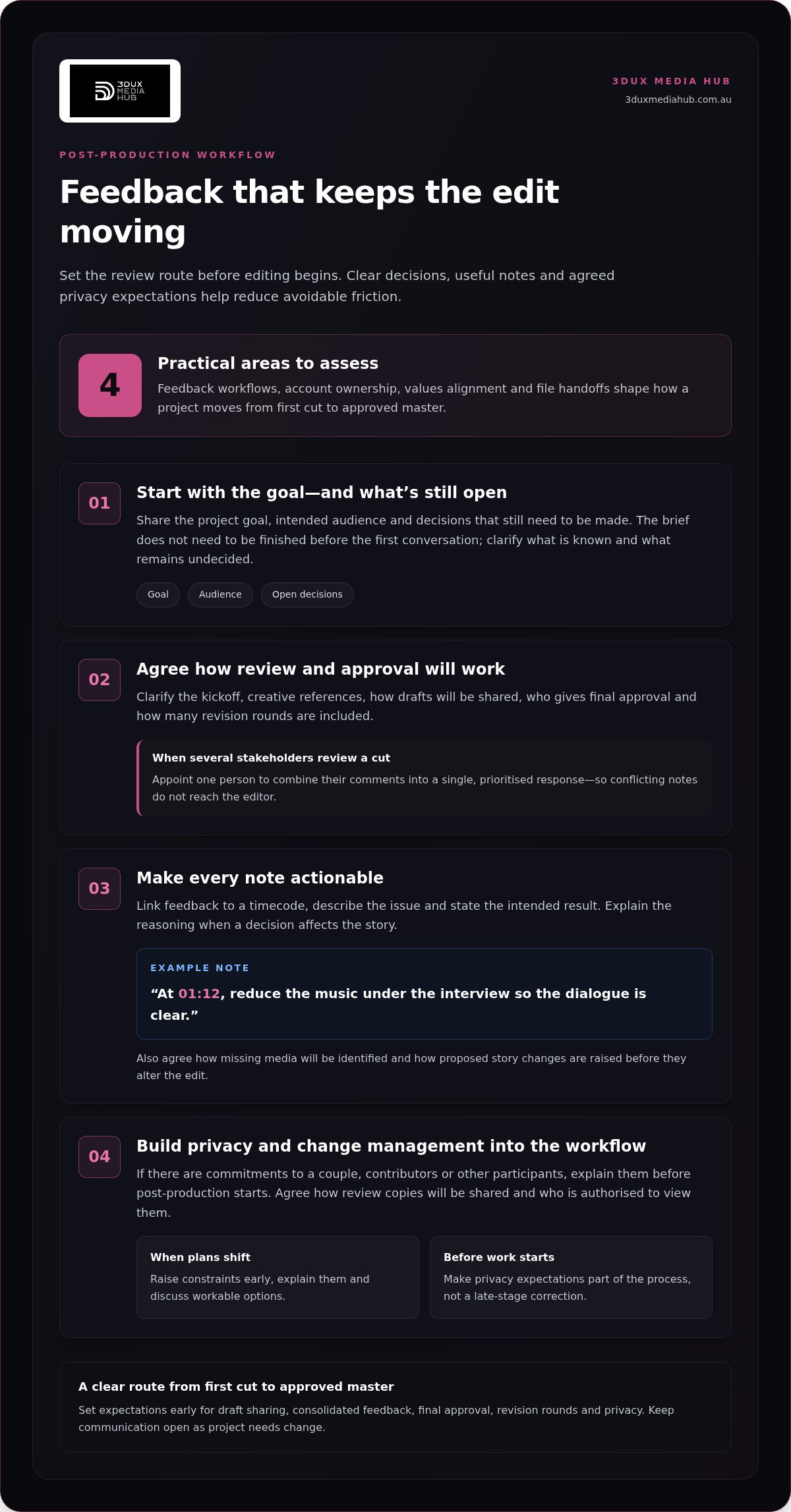
A finished brief isn’t essential before the first conversation. Start with a clear goal, intended audience and the decisions still open. A partner can help shape the approach before the format or deliverables are locked. For example, a team may know it needs localised versions but still be deciding which audience versions to produce. Share what’s known, then identify what still needs a decision.
Make feedback actionable. Link each note to a timecode, describe the issue and state the intended result. “At 01:12, reduce the music under the interview so the dialogue is clear” gives the editor a specific instruction. If a decision affects the story, explain the reasoning rather than sending an unexplained change. Ask how missing media is identified and how proposed story changes are raised before they alter the edit.
Privacy also belongs in the initial conversation. If the project includes commitments to a couple, contributors or other participants, explain those requirements before post-production starts. Agree how review copies will be shared and who is authorised to view them. Clear expectations make privacy part of the workflow, rather than a late-stage correction.
Keep communication open when plans shift. A producing partner who sees that a task may be difficult to complete should say so early, explain the constraint and discuss workable options. NIST identifies experience with similar projects and references as factors to consider when evaluating a provider. These conversations reveal whether the workflow can handle real project decisions, not just a polished first meeting.
2. Account responsibility and a single point of contact
A single point of contact should own project communications, share final deliverables and keep work moving. That person gives the production team a clear route for questions and decisions. Establish their name and responsibilities at kickoff. If an approval is delayed, for example, the contact can identify who needs to act and explain the effect on the next handoff.
Clarify what the contact manages and what stays with your team. They might coordinate schedules, track open decisions, route technical queries and confirm which files are ready for delivery. Your internal lead can retain creative approval. Recording this split in the project plan prevents requests from reaching the wrong person or decisions being treated as approved prematurely.
Set a practical escalation path before work starts. Agree how urgent issues are flagged, who steps in when the main contact is unavailable, and where decisions are recorded. For instance, a file-format question could go to the project contact, who brings in the relevant technical specialist and returns one clear answer. This helps prevent the production team receiving conflicting instructions through separate channels.
Account ownership also matters at delivery. The contact should coordinate the final package, identify the approved master and clarify which versions are intended for each destination. If a project includes localised versions, define how language, titles and version labels will be tracked. Consistent file naming helps distinguish approved files from review exports and superseded drafts.
Assess the setup by tracing one realistic issue from start to finish. Who receives it? Who can make the decision? Who communicates the resolution and updates the delivery status? A direct chain of responsibility makes accountability visible without adding unnecessary approval layers. For projects involving content localisation, clear ownership also helps keep version-specific questions attached to the right deliverable.
3. Values alignment and working relationship
At kickoff, agree what the film must achieve and where it will be distributed. A version for internal viewing may need a different tone from a public campaign. Set out the intended audience, core message and delivery context before creative decisions narrow the options. For example, clarify whether the priority is an emotional story, a clear product explanation or a concise event recap. Shared expectations give the editor a practical basis for creative choices.
Assess values through actions, not slogans. Keeping promises means communicating clearly when a task is at risk. Honesty means explaining why a proposed edit may not support the story. Humility means hearing an alternative without treating every creative difference as a dispute. Openness means considering another approach when it better serves the audience. Use a real project scenario to discuss how each principle would shape the workflow, such as responding to a late change in intended distribution.
Creative alignment needs specific discussion. Ask the editor to explain how pacing, sound choices and storytelling support the project’s purpose. Compare those choices with a representative finished film, then identify which elements should carry across and which should change. A measured pace may suit a reflective profile, while a brisker sequence may better communicate an event’s key moments. This tests shared judgement more effectively than a vague claim of matching your style.
Raise serious concerns while there’s still room to address them. If a cut makes a contributor’s point unclear, describe the issue and explain its effect on the film’s meaning. The producing partners can then discuss whether the edit, structure or intended audience needs reconsideration. Don’t leave concerns about the working relationship unspoken until final delivery. A direct conversation focused on the project, rather than personal criticism, helps both sides agree on a workable next step.
4. Post-production handoffs
A reliable handoff defines what moves between teams, in which format, and at each approval stage. Film deliverables can include an assembly, rough cut, picture lock, sound mix, colour grade, final master and delivery materials. Agree which outputs apply, who approves each stage, and how source footage, project files and final exports will be transferred and retained. Record the platform, titles and any additional versions in the project brief.
In-house post-production offers direct control within your own team; freelance support adds an external specialist, while outsourced post-production assigns a defined scope to an external team. Compare the options by capacity, oversight, coordination needs and responsibility for delivery. The right fit depends on how much control your team needs and which tasks it can resource effectively.
Project pricing may be hourly, per project or retainer-based. Compare the quoted scope, deliverables and condition of the source footage, not just the pricing model. The price depends on the project and is provided after a quote request.
To assess a portfolio, review work similar in format, audience and complexity to your project. NIST identifies experience with similar projects and references as factors to consider. Ask how the examples demonstrate the storytelling, sound and delivery quality you need, then compare those capabilities with your brief.
Film post-production typically takes weeks to months, with timing shaped by project size and complexity. Set a first-draft plan, the number of revision rounds and the approval stages in writing. A clear review schedule helps distinguish editing time from time spent waiting for decisions.
Before hiring, document the scope, deliverables, format, approval authority, revision process and file-transfer responsibilities. Include how changes to the agreed scope will be handled, who retains project files and source footage, and what counts as final acceptance. These terms give both sides a shared reference if delivery expectations shift.
Define your handoff requirements before work starts, then discuss your post-production handoff.
3DUX Media Hub: 4K UHD Authoring
3DUX Media Hub provides 4K UHD Authoring for projects that need a 4K UHD master as part of their delivery plan. Once the post-production handoff is defined and the content is ready for technical preparation, authoring and encoding can help move the approved work towards its intended format.
For other delivery requirements, 3DUX Media Hub also offers Blu-ray and DVD Authoring, Video and Audio Encoding, and Content Localisation. These services connect the finished content with its required output, whether that means an authored disc format, encoded files or localised versions. Clear deliverables and source materials help establish the scope of the work.
Contact 3DUX Media Hub to discuss your project’s authoring or encoding requirements.
Set up your next handoff with clarity
Before your next project starts, turn the agreed workflow into a practical handoff brief. Define the approved master, intended destinations, required deliverables and who owns each decision. This gives your team and production partner a shared reference as the work moves from creative approval to technical delivery.
Choosing a post-production partner is ultimately about finding a working process that fits your project, not just selecting a name. If your next step involves preparing finished content for release, 3DUX Media Hub can support the delivery stage with authoring and encoding services.
Bring your project requirements together and contact 3DUX Media Hub to discuss the next step. A clear brief gives the conversation a focused starting point, so you can move forward with confidence.
Frequently Asked Questions
How will feedback and files be handled?
Agree on a file-transfer method and naming convention that make each version easy to identify. For example, label review exports with the project name, version status and date, then keep approved masters distinct from working files. Maintain a media manifest showing what was sent and received. This gives both teams a practical record if a source file is missing or an outdated export is circulated.
What exactly is included?
What services should a post-production partner offer?
Choose services that match the material and its planned release. A project requiring a finished disc master may need authoring, while distribution files may call for video and audio encoding. 3DUX Media Hub offers 4K UHD Authoring, Blu-ray and DVD Authoring, Video and Audio Encoding, Content Localisation, Motion and Static Menu Design, Broadcast Quality QC and Standards Conversion.
What questions should you ask when choosing a post-production partner?
Ask for a relevant work example, the person accountable for delivery, and a description of how technical problems are resolved. You might ask how the team would handle a missing audio track or a last-minute change to a title card. These scenario-based questions show how the partner approaches practical constraints, communicates options and protects the intended result.
What software, file formats, and collaboration tools should a post-production partner support?
Match the required formats and tools to your production pipeline and final destination. Specify the source files you can provide, the output files you need and how reviews will be shared. For authoring, 3DUX Media Hub lists Scenarist and BluPrint professional software services, and BD-CMF delivery. Clarify the required deliverable before production begins.
How should you protect footage, intellectual property, and confidential content with a post-production partner?
Set out access, use, transfer and retention expectations in the project agreement. Identify who may handle the footage, where approval for additional use must come from, and what happens to working files after delivery. For sensitive material, limit access to people who need it and use an agreed transfer channel. Document ownership and confidentiality terms before sharing assets.