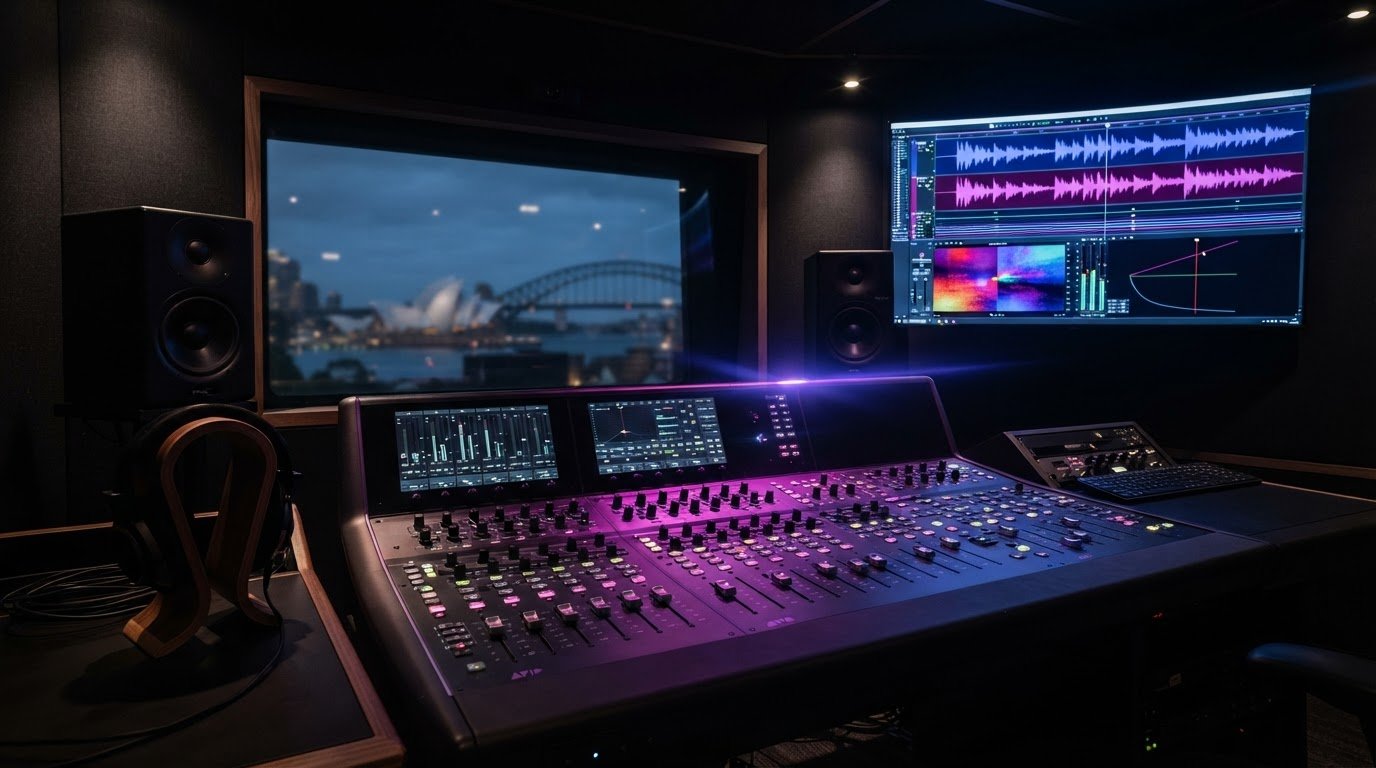
Sydney leads Australia’s broadcast post-production services market by listed company records: the September 2026 list recorded 23 facilities in Sydney, 20 in Melbourne and 13 in Brisbane. Sydney accounted for 12.9% of the listed Australian companies as of September 19, 2026. These figures give a snapshot of the market’s city-by-city spread.
For producers and distributors, the number of facilities is only part of the picture. The right broadcast post-production workflow also depends on each project’s audio, mastering, versioning and delivery requirements.
This guide explains what broadcast post-production facilities in Australia can handle, from audio services and mastering to alternate versions and quality control. You’ll also learn how encoding, localisation and standards conversion fit into a delivery workflow, and what to consider when planning a project for broadcast.
Key Takeaways
- Use the Australian facility directory to understand where broadcast post-production capacity is concentrated and what kinds of workflows facilities support.
- Plan mastering around each destination: picture finish, audio mix and alternate versions all affect the deliverables.
- Map delivery specifications before encoding so file format, audio configuration and quality control align with the broadcaster’s requirements.
- Match the post-production workflow to the project, from localisation and encoding through to authoring for 4K UHD, Blu-ray or DVD.
How many broadcast post production facilities are there based in Australia?
Australian directory figures give a city-level snapshot, rather than a single national facility count. In the September 2026 list, Sydney had 23 company records, Melbourne had 20 and Brisbane had 13. Sydney accounted for 12.9% of listed Australian companies as of September 19, 2026. These records show where facilities are located, but a directory entry does not necessarily represent a separate soundstage or audio suite.
Team sizes vary. The median employee-size range for companies on the Australian list was 1-10 employees as of September 19, 2026. RevenueBase listed 27 Australian broadcast post-production facility companies with 11-50 employees. That range indicates a sizeable group of mid-sized teams, but doesn’t establish which company has the largest overall staff.
Melbourne’s production infrastructure includes Docklands Studios Melbourne. Its sixth sound stage measures 3,700 sqm and has a 900,000 litre water tank. These facilities support production needs such as controlled picture and sound environments. Audio post-production and music capabilities are a separate consideration: assess whether a facility can handle dialogue editing, sound effects, music mixes and the required deliverables.
How do I choose a broadcast post-production provider in Australia? Match its capabilities to your programme, delivery brief and workflow, then review a relevant example, such as a television episode, feature or corporate project. Confirm who manages approvals, versioning and final quality control.
In-house or outsourced? In-house teams work directly within a broadcaster’s workflow. Outsourcing provides project-based capacity and specialist services. Choose according to workload, technical needs and internal resources.
Which standards apply? Caption, audio loudness and accessibility requirements depend on the broadcaster and destination. Include the specifications in your delivery brief, then check captions, mix levels and accessibility assets during QC.
What about grants or tax offsets? Support depends on the production’s eligibility, location and qualifying expenditure. Separate post-production budgets from broader production costs when assessing the project’s funding structure.
Which risks and QC checks matter? Check picture and sound synchronisation, dialogue clarity, caption timing, file integrity and version labels. A documented review before delivery can catch errors that disrupt broadcast workflows.
Mastering and alternate versions
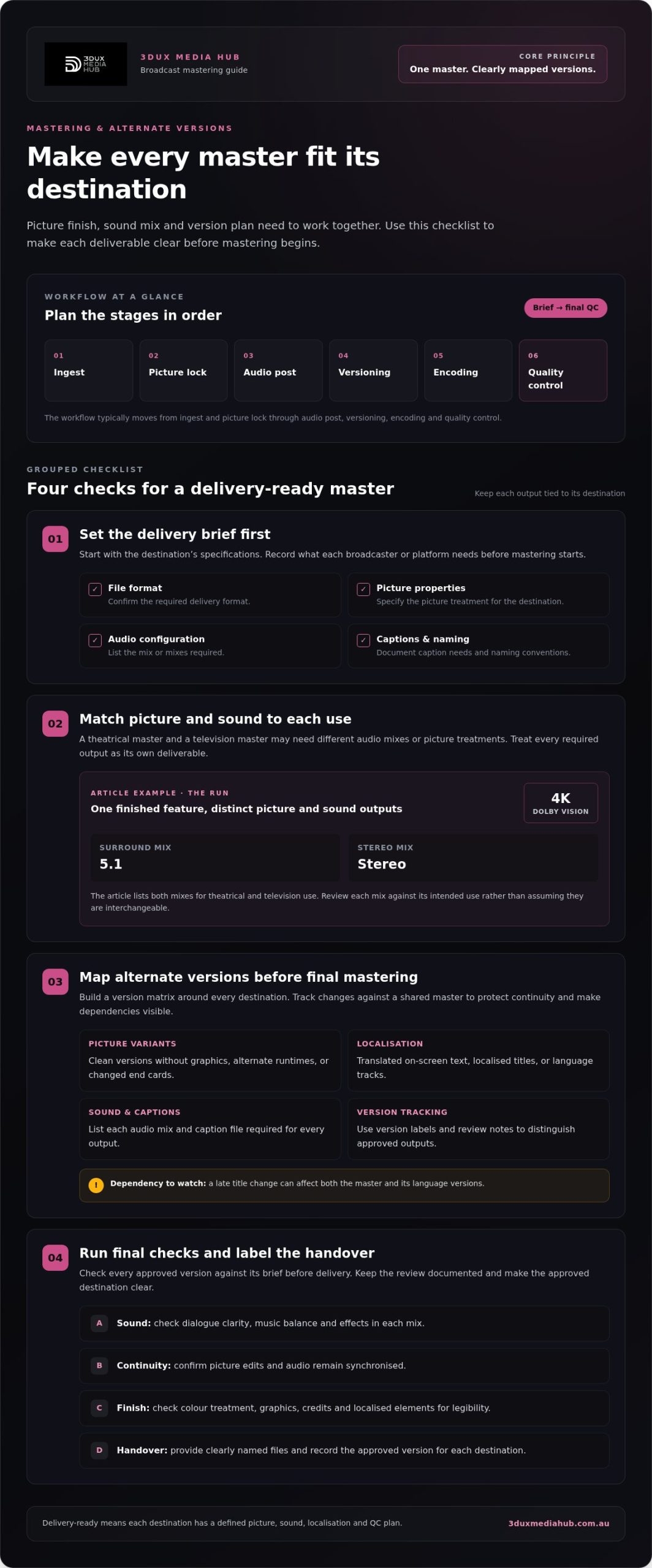
Mastering prepares a finished programme for its intended screens and destinations. The picture, sound mix and version plan must work together.
Broadcast delivery specifications
Start with the destination’s delivery brief. It defines the required file format, picture properties, audio configuration, captions and naming conventions. A theatrical master and a television master may need different audio mixes or picture treatments, so identify every deliverable before mastering begins.
The feature film The Run finished in 4K Dolby Vision, with a 5.1 surround mix and a stereo mix listed for theatrical and television use. This example shows why a master may need distinct picture and sound outputs. A final broadcast quality QC review can check each version against its brief.
Preparing alternate versions
Alternate versions adapt a programme for different audiences, platforms or territories. They may require a clean version without graphics, localised titles, different runtimes or separate audio mixes. Document each change, then track versions against a shared master to protect continuity.
For example, international documentary versions may need translated on-screen text while preserving the original edit. An animation may need alternate end cards or language tracks. Content localisation supports these changes, while version labels and review notes distinguish approved outputs.
Build a version matrix before final mastering begins. List every destination, picture variant, audio mix, caption file and localisation requirement. This makes dependencies visible: a late title change can affect both the master and its language versions.
Keep sound decisions tied to the intended use. A 5.1 mix and stereo mix should be treated as separate deliverables, not assumed to be interchangeable. Review dialogue clarity, music balance and effects in each mix, then check that picture edits and audio remain synchronised.
Keep colour treatment consistent across approved versions. Compare the finished master with its intended screen presentation, and check that graphics, credits and localised elements remain legible. At handover, provide clearly named files and record which version is approved for each destination.
Post-production services for broadcast
Broadcast post-production turns locked footage into a programme prepared for its intended screen. For teams planning broadcast post-production services Australia-wide, aligning the delivery brief, final edit and workflow early helps keep each stage on track.
What is the workflow and timeline for broadcast post-production in Australia? The workflow typically moves from ingest and picture lock through audio post, versioning, encoding and quality control. Timing depends on programme duration, source material, version count, review rounds and delivery requirements.
Organise picture, sound, graphics and metadata into a clear handover. Confirm the final cut before sound work and visual finishing proceed. A documentary handover, for example, might include dialogue cleanup, music placement, graphics checks and localised title cards.
Audio post shapes dialogue, music and effects into a coherent mix for the programme’s intended use. A feature film may need separate mixes for different destinations, while a corporate video may prioritise clear narration and balanced music. Record each approved mix against the delivery brief.
Versioning turns the approved master into the required programme variants. Content localisation can adapt on-screen text and other elements for different audiences. Keep a version matrix recording each language, edit, graphics change and approval status. This helps distinguish the current master from earlier exports.
Encoding converts approved picture and sound into files suited to the destination’s technical brief. Use its specified container, codec, frame rate and audio configuration to guide settings. A handover manifest should identify each file, version and intended use, so recipients can match assets to the correct programme.
Quality control is the final workflow gate. Review the programme from beginning to end, checking picture continuity, sync, dialogue, graphics, captions and file integrity against the brief. Broadcast-quality QC supports this review. Document approvals, apply changes to the correct master, then inspect every final file.
For film and television projects with international audiences, treat localisation and encoding as connected steps. Translated graphics can affect placement, timing and readability, so review them in the finished visual context. A reliable workflow for broadcast post-production services Australia-wide ends with clearly labelled, approved files, not ambiguous exports.
What broadcast delivery specifications and file formats are required in Australia?
There is no single file preset for every Australian broadcast delivery. The broadcaster, platform and programme determine the required container, codec, picture settings, audio layout and supporting assets. Use the destination’s delivery brief as the controlling document, rather than assuming a file made for one outlet will suit another.
Before export, turn the brief into a delivery checklist. Record the required:
- Container and codec, which define how the finished video and audio are packaged.
- Frame size, frame rate and scan type, matched to the supplied master and destination requirements.
- Audio configuration, including the requested mix and channel layout.
- Caption files, language versions, slate details and naming conventions, where required.
- File-transfer method, folder structure and any accompanying metadata.
These fields work together. A broadcaster, for example, may require a specific container and codec combination, a separate caption file and stereo audio. Give each deliverable its own line in the checklist. This helps prevent a correct picture file from being paired with the wrong mix or language asset.
Keep the source master and export settings traceable. Record the approved picture version, its paired audio mix and each output’s destination. If a late edit changes the running order, regenerate affected files from the approved master and repeat the checks. Clear version labels help prevent an earlier export being sent.
Quality control should compare the delivered file against every item in the brief. Review playback for picture faults, sound sync, dialogue, captions and correct start and end points. Then inspect file names and accompanying assets before handover. Broadcast-quality QC supports the final review, while standards conversion can help prepare material for a different technical format.
Need encoding, localisation or QC for a broadcast handover? Arrange video and audio encoding as part of your delivery workflow.
3DUX Media Hub: 4K UHD Authoring
3DUX Media Hub is a natural next step when your finished programme needs authoring, encoding or localisation for defined release formats. Use 4K UHD Authoring for a UHD title, or Blu-ray and DVD Authoring when those formats form part of the release plan.
Video and Audio Encoding prepares media files for their intended technical use. Content Localisation adapts material for different language audiences. These services help move a completed production from approved master to audience-ready deliverables.
For example, a distributor preparing a feature for UHD and DVD can plan authoring and encoding around the agreed assets and delivery requirements. A project with translated on-screen text can include localisation in the workflow.
Contact 3DUX Media Hub to discuss your project, or visit 3duxmediahub.com.au.
Set up your next delivery with confidence
Turn your delivery brief into a clear post-production plan. Identify the approved master, intended audiences and required outputs before work begins. This gives your team a shared reference for decisions, version control and final handover.
For projects that need deliverables beyond broadcast files, 3DUX Media Hub offers 4K UHD Authoring, Blu-ray and DVD Authoring, and Video and Audio Encoding. These services can support a release workflow that needs prepared masters across different formats. The right mix depends on the project’s approved assets and distribution plan.
If you’re assessing broadcast post-production services in Australia, connect the technical brief to the finished deliverables early. This helps keep each output aligned with its intended use.
Contact 3DUX Media Hub to discuss your project’s authoring or encoding requirements. A well-defined workflow is a practical starting point for a confident handover.
Frequently Asked Questions
What broadcast post-production services are available in Australia?
Broadcast post-production services in Australia can cover the technical preparation of completed programmes, including encoding, standards conversion, quality control and localisation. Match the work to the destination and the assets already prepared. A distributor with a locked programme may need file preparation and checks, while a title with translated graphics may also need localisation.
Which Australian post-production studios specialise in broadcast TV, film and streaming?
When comparing broadcast post-production services in Australia, focus on relevant deliverables and workflow rather than a broad label. A feature’s broadcast master, an encoded home-entertainment release and a streaming platform’s delivery package may require different technical handovers. Define whether you need programme finishing, file preparation or platform operation, then assess providers against that scope.
Which Australian cities have the largest broadcast post-production hubs?
Sydney, Melbourne and Brisbane are the leading city hubs in the directory discussed above. For a project team, location can shape access to local production infrastructure and in-person collaboration. It isn’t the only factor: a clear remote handover can support work across Australia. Compare each facility’s relevant capabilities and workflow fit with the project’s requirements before settling on a location.