A single technical rejection from a global streaming platform doesn’t just delay your premiere; it erodes your profit margins and professional reputation. You’ve spent months perfecting every frame, yet the leap from a graded master to a compliant delivery package often feels like a minefield of shifting standards. It’s a common struggle to balance the demands of Dolby Vision against strict bitrate caps while worrying if your cinematic intent will survive the final compression.
This 2026 technical guide demystifies 4K UHD encoding for film distribution, giving you the roadmap to handle HEVC complexities and HDR metadata with absolute precision. You’ll master the technical requirements needed to ensure your film meets global standards and maintains its visual integrity on every screen. We will examine the entire authoring-to-distribution pipeline, covering everything from bitrate optimisation to the nuances of HDR10+ and Dolby Vision. By the end, you’ll have the expertise to clear every broadcast-grade QC check on your first attempt, securing your film’s place in the global market.
Key Takeaways
- Master the technical nuances of HEVC (H.265) and HDR profiles like Dolby Vision and HDR10+ to preserve cinematic integrity across all viewing environments.
- Distinguish between the high-bitrate requirements of triple-layer BD-100 physical discs and the adaptive bitrate ladders necessary for global OTT and VOD delivery.
- Optimise your workflow for 4K UHD encoding for film distribution to eliminate the risk of technical rejections and ensure your assets meet stringent global standards.
- Implement a rigorous, broadcast-grade QC process that combines objective waveform analysis with expert subjective monitoring to secure first-time approval.
- Understand the complete authoring-to-distribution pipeline, from initial asset preparation and technical localisation to final menu design and standards conversion.
The Fundamentals of 4K UHD Encoding for Modern Film Distribution
The Evolution of Ultra High Definition Standards
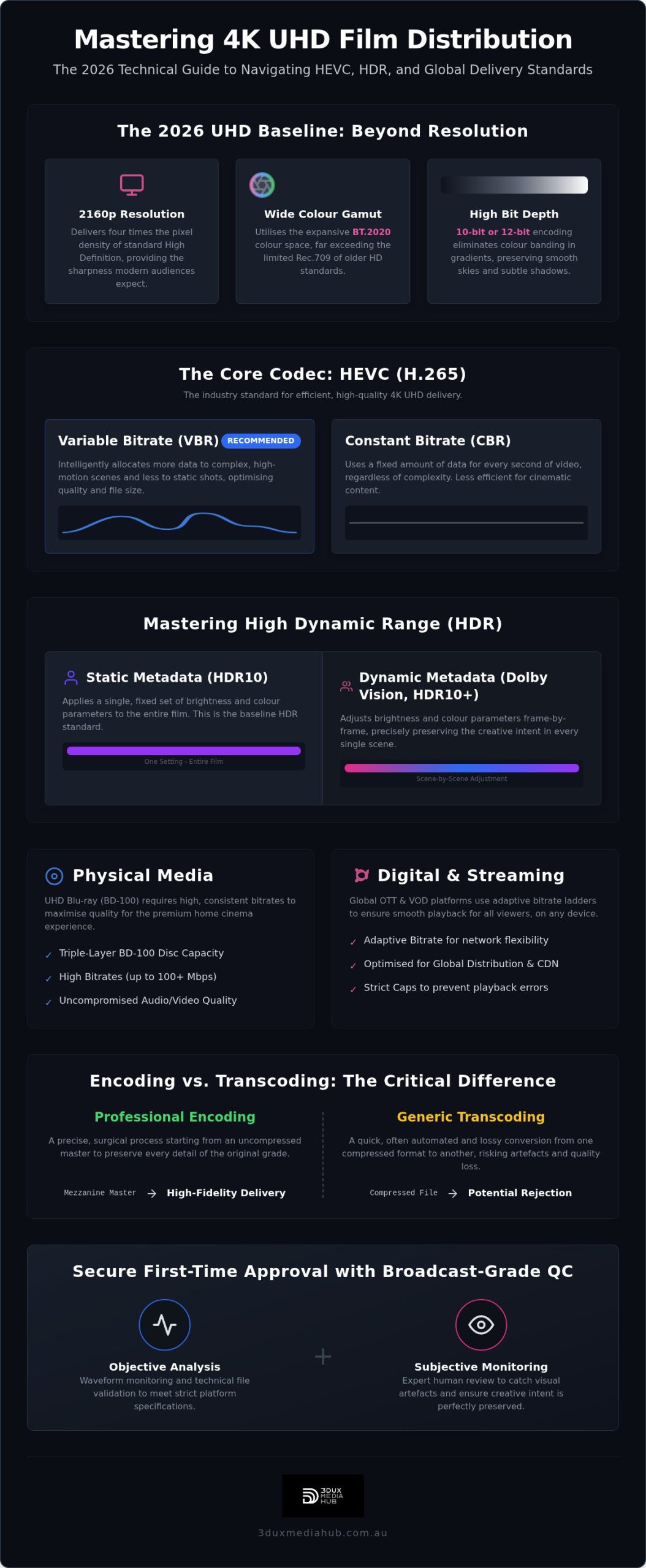
While 4K resolution provides the pixel density required for large-format displays, resolution alone doesn’t guarantee a cinematic experience. The 2026 landscape demands a holistic approach to image quality. True immersion relies on a combination of pixel count and colour accuracy. Professional distribution now mandates several core standards:
- 2160p Resolution: Delivering four times the detail of standard High Definition.
- Wide Colour Gamut (WCG): Utilising the expansive BT.2020 colour space rather than the limited Rec.709.
- High Bit Depth: Using 10-bit or 12-bit encoding to eliminate banding in gradients and shadows.
These specifications ensure that the film looks as intended, whether it’s viewed in a high-end home cinema or on a mobile device. Professional 4K UHD encoding for film distribution manages these variables to create a consistent, high-fidelity experience across all platforms.
Encoding vs. Transcoding: Why Distributors Must Know the Difference
Confusion between encoding and transcoding often leads to costly technical rejections. Transcoding typically involves a quick, lossy conversion from one compressed format to another. It’s often automated and lacks the precision required for high-stakes delivery. Professional encoding is a surgical process. It starts with an uncompressed or mezzanine-level master to build a high-fidelity signal path from the grade to the final file.
Generic presets don’t account for film grain, high-motion sequences, or complex textures. A “one-size-fits-all” approach often results in macroblocking or crushed blacks. Professional mastering requires a variable bitrate strategy that allocates data exactly where it’s needed. This protects the creative intent and ensures the film passes strict quality control checks on the first attempt. It’s the difference between a file that simply plays and one that truly performs.
Technical Mastering Specifications: HEVC, HDR, and High Bitrates
High-fidelity mastering hinges on the precise application of the HEVC (H.265) codec. It is the industry standard for a reason. It offers the efficiency needed for 4K UHD encoding for film distribution while preserving the organic texture of the original capture. While your graded master likely sits at 4:2:2 chroma subsampling, consumer delivery requires a shift to 4:2:0. This reduction is essential for compatibility with home theatre hardware and streaming bandwidth, but it must be executed without introducing digital artefacts. Finding the bitrate “sweet spot” is a science. You must provide enough data for cinematic clarity while staying within the strict caps that prevent playback errors on consumer devices.
Deep Dive into HEVC Encoding Parameters
HEVC is the backbone of 4K delivery in 2026. Choosing between Variable Bitrate (VBR) and Constant Bitrate (CBR) is a critical decision for any distributor. VBR is the superior choice for cinema. It allows the encoder to allocate higher bitrates to complex, high-motion sequences while reducing data for static shots. This intelligent distribution of data prevents macroblocking while maintaining peak visual clarity. Managing intra-frame and inter-frame compression ensures that fine grain and complex textures remain sharp rather than turning into a muddy mess.
HDR and Metadata Management
Mastering for High Dynamic Range involves more than just increasing brightness. HDR10 is the baseline, but it relies on static metadata that applies one setting to the entire film. Dolby Vision and HDR10+ offer dynamic metadata, allowing the display to adjust its output frame by frame. This provides a massive advantage for distributors who want to guarantee their film looks consistent across various consumer displays. Professional video and audio encoding ensures that your HDR metadata is correctly injected and remains backward compatible with standard dynamic range screens.
Audio Encoding for 4K UHD Releases
Modern 4K releases demand immersive, object-based audio. Dolby Atmos and DTS:X have replaced traditional channel-based systems by allowing sound objects to move through a three-dimensional space. The challenge lies in technical asset preparation for international delivery. Audio conforming must be precise to ensure dubbed tracks remain in perfect sync with the HEVC video stream. Whether you are delivering lossless audio for a BD-100 or lossy formats for streaming platforms, the integrity of the soundstage must remain intact.
Physical Media vs. Digital Delivery: Navigating Encoding Requirements
A multi-platform release strategy demands multiple technical masters. You can’t simply upload your UHD Blu-ray file to a streaming service and expect it to pass. 4K UHD encoding for film distribution requires a split approach. Physical media prioritises maximum sustained bitrates. Digital delivery focuses on adaptive efficiency. Failing to distinguish between these two environments results in either playback stutters on discs or visual banding in streaming. Each delivery channel has its own technical DNA, and your encoding strategy must reflect that.
Mastering for 4K UHD Blu-ray Discs
Triple-layer BD-100 discs are the pinnacle of home entertainment in 2026. They support bitrates that dwarf streaming capabilities, often peaking near 128 Mbps. However, high data rates require strict buffer management. If your peak bitrate exceeds the player’s processing limit, the disc will freeze or skip. We also manage AACS 2.0 encryption, which is mandatory for securing your intellectual property on physical formats. Our Professional 4K UHD Authoring Services handle these complexities, including seamless branching. This technique allows you to store multiple versions of a film, such as a Director’s Cut and a Theatrical Release, on a single disc without doubling the required storage space.
Encoding for Streaming and Digital Platforms
Streaming platforms like Apple TV, Netflix, and Amazon Prime don’t want your final delivery file. They require a mezzanine master. This high-bitrate source file acts as the parent for their adaptive bitrate (ABR) ladders. These ladders allow the stream to shift quality in real-time based on the viewer’s internet speed. You must also account for varying aspect ratio requirements and frame rate conversions for global territories. Utilising Professional Video Encoding Services ensures your mezzanine files meet the specific compliance headers for every major OTT provider. Global digital release isn’t a “set and forget” process. Each platform has a unique spec sheet that can run to dozens of pages. Professional encoding handles this heavy lifting, managing everything from localised graphics to forced subtitles and audio channel mapping for dozens of languages. It’s the only way to ensure your film looks consistent across every international territory.
Quality Control and Technical Compliance for Global Distribution
Technical rejections represent a significant financial and operational risk for distributors. A failed quality control (QC) report can stall a global launch, trigger expensive re-mastering fees, and damage your standing with major platforms. Professional 4K UHD encoding for film distribution isn’t complete without a rigorous, multi-layered verification process. We utilise objective QC tools like waveform monitors and vector scopes to validate signal levels, alongside subjective “eyes-on” reviews by seasoned technicians. This dual approach ensures that every frame is technically sound and visually perfect before it reaches the distributor.
Identifying encoding artefacts requires a trained eye and high-end monitoring environments. Banding is a frequent issue in HDR content where smooth gradients, like a sunset, break into visible steps. Macroblocking occurs when the bitrate is insufficient for high-motion scenes, while mosquito noise appears as shimmering around high-contrast edges. We also manage broadcast-grade standards conversion, navigating the complexities of frame rate management between international territories. Whether you’re moving from 23.976fps to 25fps or handling legacy PAL and NTSC requirements, the conversion must be transparent and clean.
The QC Checklist for 4K UHD Delivery
- HDR Metadata Integrity: Verifying that MaxCLL and MaxFALL values remain consistent across the entire feature.
- Synchronisation: Validating that subtitles, closed captions, and localised audio tracks align perfectly with the video master.
- Manual Compliance: Cross-referencing every file against the specific delivery manuals of platforms like Netflix or Amazon Prime.
Avoiding Common Encoding Pitfalls
One of the most dangerous pitfalls is the “crushed black” effect often seen during HDR-to-SDR conversions. If the tone mapping isn’t handled with precision, shadow detail is lost, turning dark scenes into unwatchable ink. Managing film grain is equally challenging. High-efficiency codecs like HEVC can mistake organic grain for noise, attempting to “clean” it and resulting in a plastic, over-processed look. Automated QC is only the first line of defence. For a truly professional result, you need a partner who understands the nuances of cinematic texture. Ensure your project passes the first time with our Broadcast Quality QC services.
Partnering with 3DUX Media Hub for Professional 4K UHD Mastering
3DUX Media Hub brings over 20 years of practical experience to every project. We understand that high-value media assets require more than just a fast processor. They require a seasoned industry veteran who can navigate the specific technical requirements of global delivery platforms. Our comprehensive workflow for 4K UHD encoding for film distribution covers every stage of the mastering process. We don’t just provide raw files. We provide a complete authoring solution that includes motion and static menu design, standards conversion, and professional localisation. This end-to-end capability ensures that your cinematic vision remains intact while meeting the rigorous demands of the international market.
The 3DUX Advantage: Precision and Reliability
Distributors often face a choice between cut-price freelancers and established media hubs. While a freelancer might offer a lower initial quote, the hidden costs of technical rejections and missed deadlines quickly add up. Our authoritative approach saves time and money by getting the encode right on the first attempt. We operate as a “safe pair of hands” for your intellectual property. Our team understands the high stakes of a global release. We act as a proactive partner, identifying potential compliance issues before they reach the QC stage. This reliability is built on decades of experience handling complex technical specifications for the Australian and global entertainment industry. We focus on the “how” and “what” of technical delivery, ensuring your project moves from post-production to the consumer without delay.
Getting Your Film Ready for Release
Starting the mastering process with our technical team is a streamlined experience. We work closely with you to customise encoding profiles that suit your specific distribution goals. Whether you’re targeting a premium triple-layer BD-100 release or a multi-platform digital launch, we optimise the bitrate and HDR metadata to ensure peak performance. We handle everything from content localisation to broadcast-grade QC, reducing friction in your delivery pipeline. By consolidating services like video and audio encoding with menu design, we provide a faster turnaround without compromising on cinematic quality. You can focus on the creative side of filmmaking while we handle the technical heavy lifting required for global success. Our modular flow ensures that each technical need is addressed, moving your project toward a point of contact and final delivery efficiently.
Securing Your Cinematic Legacy in the Global Market
Precision in 4K UHD encoding for film distribution represents the final, vital bridge between your creative master and a global audience. Preserving the integrity of HDR metadata and maintaining high-fidelity bitrates ensures your project meets rigid compliance standards across every delivery platform. By mastering the technical nuances of HEVC and object-based audio, you protect your vision from the risks of technical rejections and visual artefacts that can compromise a release.
With over 20 years of industry experience, 3DUX Media Hub provides a reliable partnership for high-value assets. We specialise in 4K UHD and Blu-ray authoring, offering broadcast-grade QC and fast national turnaround to keep your release on schedule. Contact 3DUX Media Hub for Professional 4K UHD Mastering to streamline your delivery pipeline and ensure your film performs flawlessly on every screen. Your project deserves a technical finish that matches its cinematic ambition. We look forward to helping you reach your audience with absolute clarity.
Frequently Asked Questions
What is the difference between 4K and UHD for film distribution?
The primary difference lies in the aspect ratio and pixel count. 4K refers to the DCI cinema standard of 4096 x 2160 pixels. UHD (Ultra High Definition) is the consumer broadcast and home media standard with a resolution of 3840 x 2160. Most distributors require UHD for streaming and physical discs to match the 16:9 aspect ratio of modern consumer displays while maintaining cinematic clarity.
Why is HEVC used for 4K UHD encoding instead of H.264?
HEVC (H.265) provides approximately 50 per cent better compression than H.264 while maintaining identical image quality. This efficiency is vital for 4K UHD encoding for film distribution because it allows for the inclusion of 10-bit colour depth and High Dynamic Range (HDR) metadata. H.264 simply cannot handle the data density required for 4K without creating unmanageably large files that would fail most streaming or physical media playback specifications.
Can I encode a 4K UHD Blu-ray myself using standard software?
While consumer software can produce 4K files, it lacks the sophisticated buffer management and encryption tools required for commercial distribution. Professional authoring involves managing peak bitrates for BD-100 discs and ensuring AACS 2.0 copy protection is correctly implemented. Using a professional service ensures your project remains compatible with all hardware players, avoiding the high cost of a technical recall due to playback errors on specific consumer devices.
What is a “mezzanine file” in the context of film delivery?
A mezzanine file is a high-bitrate, visually lossless master that serves as an intermediate format between the grade and final delivery. It’s too data-heavy for direct consumer playback but contains the high-fidelity information needed to create various distribution versions. Streaming platforms use these files to generate their adaptive bitrate ladders, ensuring that the final compressed stream looks as close to the original cinematic master as possible.
How does HDR metadata affect the encoding process?
HDR metadata acts as a set of instructions that tells a display how to handle brightness and colour for every scene. During encoding, this metadata must be precisely synchronised with the video frames. If the metadata is incorrectly injected, the viewer may experience “crushed blacks” or inconsistent luminance levels. Professional encoding ensures that dynamic metadata, like Dolby Vision, correctly maps the film’s visual intent to the viewer’s screen.
Why do distributors often reject 4K files for technical reasons?
Technical rejections usually occur because a file fails to meet the rigid delivery specifications outlined in a distributor’s manual. Common issues include bitrate spikes that exceed hardware buffers, corrupted HDR metadata, or audio sync drifts. Professional 4K UHD encoding for film distribution requires a “safe pair of hands” to ensure that every technical header and data packet aligns with global compliance standards, preventing costly delays in your release schedule.
What is the typical bitrate for a professional 4K UHD Blu-ray encode?
Professional encodes for BD-100 discs typically operate with a variable bitrate that averages between 60 and 90 Mbps. Peak bitrates can reach up to 128 Mbps on a triple-layer disc to handle complex textures and high-motion sequences. These figures are significantly higher than the 15 to 25 Mbps bitrates used by most streaming platforms, which is why physical media remains the preferred choice for enthusiasts seeking maximum cinematic quality.
How long does the professional 4K UHD encoding and QC process take?
A standard 4K UHD encoding and QC project typically takes between 3 and 5 business days to complete. This timeframe allows for the initial high-precision encoding pass, metadata injection, and a comprehensive “eyes-on” subjective QC review. If your project requires complex features like seamless branching or extensive content localisation for international markets, the timeline may extend to ensure every technical element meets our broadcast-grade quality standards.