Your high-budget 4K UHD release is only as good as its technical integrity, and a compressed streaming mix won’t satisfy the physical media market. While streaming platforms rely on lossy Dolby Digital Plus, distributors and collectors expect the uncompromised, bit-for-bit precision of Dolby TrueHD. Mastering the complexities of Dolby Atmos encoding for 4K Blu-ray is often the difference between a seamless global launch and a costly technical QC rejection. It’s a high-stakes process where bitrate management and metadata accuracy are non-negotiable.
We agree that the technical gap between streaming and physical media is a significant hurdle for many distributors. This article promises to provide a clear roadmap for mastering lossless immersive audio to ensure your release meets global distribution standards. We’ll explore the benefits of high-bitrate audio, provide strategies for BD-66 and BD-100 disc management, and outline the steps required to ensure your master is optimised for all UHD players and international localisation requirements. From spatial coding to final bitstream verification, here is how you guarantee a premium audio experience for your audience.
Key Takeaways
- Learn the critical difference between channel-based audio and object-based spatial metadata to ensure your mix renders accurately in 3D environments.
- Master the technical balance of bitrate budgets across BD-66 and BD-100 formats to support both HEVC video and lossless audio.
- Optimise your Dolby Atmos encoding for 4K Blu-ray using industry-standard ADM BWF or DAMF master files for frame-accurate results.
- Guarantee global distribution success with rigorous QC protocols that ensure your disc plays perfectly on all international UHD hardware.
- Secure your high-value media assets by leveraging professional authoring expertise to meet stringent global delivery standards.
Understanding Dolby Atmos for 4K UHD Blu-ray
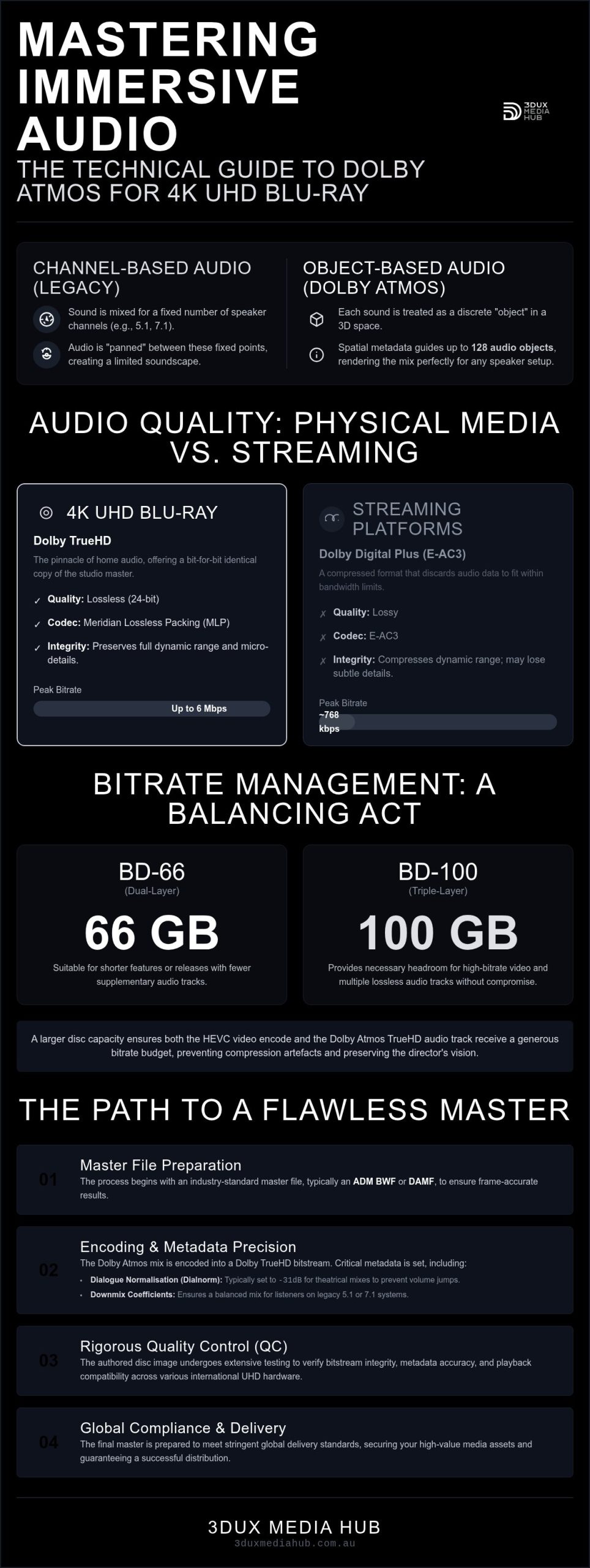
Dolby Atmos represents a fundamental shift in how we process cinema sound. Traditional systems are channel-based. They rely on fixed speaker positions like 5.1 or 7.1. Atmos is object-based. It treats individual sounds as discrete elements that exist in a three-dimensional space. During the Dolby Atmos encoding for 4K Blu-ray process, we use spatial metadata to define the precise coordinates, size, and intensity of these sounds. This metadata allows the consumer’s processor to render the audio in real-time, tailored to their specific speaker configuration.
A professional master file is built using a combination of “beds” and “objects”. The beds usually follow a 7.1.2 layout, providing a stable foundation for the score and ambient environment. On top of this, designers can layer up to 128 individual objects. These objects aren’t tied to a channel. They move fluidly across the room. Managing this complexity requires absolute technical precision. If the metadata is misaligned or the fold-down logic is flawed, the immersive effect collapses. This is why high-end authoring is a critical step in the distribution chain. We ensure that your Dolby Atmos encoding for 4K Blu-ray maintains its spatial integrity across all playback environments.
Lossless vs. Lossy: TrueHD vs. Dolby Digital Plus
The primary technical advantage of 4K UHD Blu-ray is the use of the Dolby TrueHD codec. It utilises Meridian Lossless Packing (MLP) to deliver 24-bit audio that is a bit-for-bit clone of the studio master. Streaming platforms cannot match this. Services like Netflix and Disney+ use E-AC3, also known as Dolby Digital Plus. This is a lossy format. It discards data to fit within narrow bandwidth constraints. For enthusiasts, the difference is night and day. TrueHD offers superior dynamic range and preserves the micro-details in the mix that compression often smothers.
The Benefits of Physical Media for Immersive Audio
Physical media provides a level of stability that streaming simply can’t guarantee. Disc-based audio isn’t subject to the “dialnorm” or heavy-handed dynamic range compression often applied to streaming content to prevent volume spikes on mobile devices. Because a 4K disc has massive storage capacity, we can allocate a generous bitrate budget to the audio. This ensures that even the most complex scenes, featuring dozens of moving objects and high-SPL transients, are reproduced without artefacts. Our Professional Video Encoding Services focus on these high-bitrate standards to ensure every release meets the expectations of the global collector market. When you choose physical media, you’re choosing the intended artistic vision without compromise.
Technical Requirements and Bitrate Management
Effective Dolby Atmos encoding for 4K Blu-ray requires a calculated approach to bitrate management. Distributors must choose between a BD-66 (dual-layer) or a BD-100 (triple-layer) disc based on feature length and asset complexity. While HEVC video consumes the majority of the data pool, the Atmos track is a variable bitrate (VBR) stream. On a 4K UHD disc, these tracks typically peak between 3Mbps and 6Mbps. This is substantially higher than any other consumer format. Choosing a BD-100 often provides the necessary headroom for a high-bitrate video encode without compromising the lossless audio integrity.
Allocating the bitrate budget is a precise balancing act. If your release includes multiple localised dubs or director’s commentaries, the total audio overhead can significantly impact the video’s average bitrate. High-efficiency Professional Video Encoding Services ensure the primary Atmos master remains transparent to the source. This prevents the need for aggressive video compression that could lead to macroblocking in dark scenes or high-motion sequences. For high-stakes releases, we recommend a “safe pair of hands” to manage these complex audio and video encoding requirements.
Metadata and Dialnorm Settings
Precision in metadata is non-negotiable for global compliance. Dialogue Normalisation (dialnorm) must be set correctly, typically at -31dB for theatrical mixes, to prevent jarring volume shifts when the player switches between content or menus. We also ensure that downmix coefficients are correctly flagged. This guarantees that listeners on legacy 5.1 or 7.1 systems hear a balanced mix without losing critical spatial information. Following official Dolby Atmos home theater specifications ensures your master remains compliant with all international hardware standards.
Bitrate Comparison: Streaming vs. Physical
The technical gap between streaming and physical media is best illustrated by raw data. Streaming Atmos is a compromise designed for bandwidth efficiency. 4K Blu-ray is a premium standard designed for absolute fidelity.
| Format | Codec Type | Typical Bitrate |
|---|---|---|
| Streaming (Netflix/Disney+) | DD+ JOC (Lossy) | 768 kbps |
| 4K UHD Blu-ray | TrueHD Atmos (Lossless) | 4500 kbps (avg) |
This massive increase in data provides “audio transparency” to the original studio master. It captures the full frequency response and spatial resolution of the original mix. For distributors, this means a superior product that satisfies the most demanding home theatre markets. Managing these high-bitrate requirements is a core part of the authoring workflow. It ensures your high-value assets are delivered without technical compromise.
The Professional Encoding and Authoring Workflow
Professional Dolby Atmos encoding for 4K Blu-ray begins with high-fidelity source assets. We typically work with Audio Definition Model Broadcast Wave Files (ADM BWF) or Dolby Atmos Master Files (DAMF). These files contain the necessary spatial metadata and object data required for a lossless TrueHD encode. Unlike consumer-grade software, professional workflows ensure that every object coordinate is preserved with absolute precision from the mix room to the disc.
Conforming these assets to the final video master is a critical step. If the audio is mixed at 24fps but the 4K UHD video is mastered at 23.976fps, sync drift will occur. We ensure a frame-accurate alignment before any encoding begins. We use the Dolby Media Encoder to generate the necessary .atmos or .ec3 sub-streams. This process involves the precise configuration of Dolby Atmos Blu-ray data rates to stay within the physical limits of the disc while maintaining master-quality transparency. Once encoded, the assets are integrated into the Scenarist UHD authoring environment. This is where the audio, video, and subtitle streams are multiplexed into the final disc image.
Preparing Assets for the Encoding Hub
Asset preparation requires a methodical approach. A frame-accurate sync between the HEVC mezzanine and the audio master is the foundation of a professional release. When handling international projects, we must also organise multiple language tracks through rigorous conforming. This ensures that every localised dub maintains the same spatial accuracy and sync as the original theatrical mix. We verify every file against the primary video reference to eliminate any potential for playback errors.
Multiplexing and Buffer Management
Multiplexing is the final technical hurdle. We monitor the Transport System Target Decoder (T-STD) buffer constantly. High-bitrate video combined with lossless audio can easily lead to buffer underflow. This causes the disc to freeze or stutter during playback. Professional authoring involves careful buffer management to avoid these failures. This precision is especially vital for discs using seamless branching. The player must switch between different video segments without any audible or visual gaps. Our workflow guarantees that your Dolby Atmos encoding for 4K Blu-ray remains stable even during the most data-intensive sequences.
Quality Control and Global Compliance
The most common concern for any distributor is hardware compatibility. Will the disc play flawlessly on a standard Sony or Panasonic UHD player? This is the benchmark for success. A failure in Dolby Atmos encoding for 4K Blu-ray usually originates from metadata corruption or buffer violations that consumer-grade players cannot resolve. We mitigate this risk by following the same stringent technical specifications required by global majors like Warner Bros. and Sony Pictures. Our process ensures that your high-value assets are compliant with international distribution standards from day one.
Professional QC protocols for immersive audio go beyond simple playback. We verify object positioning and fold-down logic. If a listener uses a legacy 5.1 system, the Atmos stream must fold down accurately without losing dialogue clarity or score elements. We also pay close attention to “Seamless Branching” points. During a layer change or a transition between different video segments, the audio stream must remain continuous. Any dropout or sync slip at these junctions results in an immediate technical rejection. Precision here is non-negotiable.
The 3DUX QC Checklist for Immersive Audio
We don’t rely solely on software emulators. Our 2026 Blu-ray Quality Control workflow involves physical player testing across multiple hardware profiles, including Tier 1 flagship units and budget-friendly players. We perform bit-to-bit verification of the encoded TrueHD stream against the original ADM BWF master. This guarantees that every object coordinate and metadata flag is preserved exactly as the mix engineer intended. This “safe pair of hands” approach is why distributors trust us with their most critical releases.
Compliance for International Markets
International distribution often requires standards conversion. Moving between different frame rates can introduce pitch issues in the audio domain. we apply precise pitch correction to ensure the audio remains tonally accurate regardless of the frame rate conversion. We also ensure that subtitle timing is perfectly preserved alongside the complex Atmos metadata. A clean technical pass is the only way to avoid the massive expense and reputational damage of a global disc recall. For a guaranteed result, you can rely on our Broadcast Quality QC services to secure your master.
Partnering with 3DUX for Atmos Mastering
Australian distributors operate in a high-stakes environment where technical errors lead to expensive delays. Trusting your master to a seasoned partner is essential. 3DUX provides a no-nonsense approach to Dolby Atmos encoding for 4K Blu-ray, drawing on over 20 years of industry experience. We understand the pressure of global distribution deadlines. Our authoring facility is designed for speed and precision. We handle the heavy lifting of HEVC and Atmos integration so you can focus on the release. Precision is our baseline. Efficiency is our promise.
Our team acts as a safe pair of hands for your high-value media assets. We don’t just encode files. We manage the entire technical lifecycle of your release. Whether you are an independent filmmaker or a major studio, our workflow is built for maximum efficiency. We ensure that every bit of spatial metadata is preserved while maintaining the highest possible video bitrate. This technical expertise ensures your release stands out in the competitive 4K UHD market. We bridge the gap between the creative vision and the final consumer hardware.
Comprehensive Authoring Solutions
A successful disc release requires more than just a clean encode. We offer Professional 4K UHD Authoring Services that cover every aspect of the project. This includes everything from motion menu design to the final BDCMF creation. We specialise in complex authoring tasks like seamless branching and multi-language support. Our goal is to provide a complete package that is ready for the replication plant without any technical hitches. We customise our services to meet the specific needs of your project. This ensures a premium consumer experience that meets the expectations of high-end home theatre enthusiasts.
Ready for Global Release
Technical compliance is the key to entering international markets. We ensure your film meets the rigorous standards of global distributors and hardware manufacturers. If you are planning your next project, contact our team for a technical consultation. We can help you navigate the complexities of Dolby Atmos encoding for 4K Blu-ray before you even start the mix. This proactive approach prevents costly revisions during the final authoring stage. 3DUX is the premier hub for technical media services in Australia, providing world-class authoring and encoding for the modern entertainment industry.
Securing Your Global 4K Distribution
Delivering a premium 4K UHD release requires a technical precision that streaming simply cannot replicate. By prioritising lossless TrueHD over compressed alternatives, you ensure your project meets the highest standards of the physical media market. Precise bitrate management and rigorous buffer checks are the only ways to guarantee disc stability across all hardware profiles. Mastering the complexities of Dolby Atmos encoding for 4K Blu-ray is a high-stakes process that leaves no room for metadata errors or sync drift.
With over 20 years of technical mastering experience, we provide the authoritative expertise needed to navigate Scenarist and Dolby Media tools with ease. We focus on fast turnaround times for national and global distribution, acting as a safe pair of hands for your high-value assets. Our no-nonsense approach ensures your master is technically compliant and ready for the world stage. Contact 3DUX Media Hub for professional 4K UHD encoding and let’s bring your immersive vision to life with absolute technical confidence.
Frequently Asked Questions
What is the difference between Dolby Atmos on Blu-ray and on Netflix?
The primary difference lies in the codec and the available bitrate. Blu-ray uses the lossless Dolby TrueHD codec, whereas Netflix and other streaming platforms rely on the lossy Dolby Digital Plus format. This results in significantly higher audio fidelity on physical media, as 4K discs support bitrates up to 6Mbps compared to the 768kbps cap typical of streaming. This extra data preserves the full dynamic range of the original theatrical mix.
Do I need a separate master for 4K UHD and standard Blu-ray?
You generally require a conformed audio master for each format to ensure frame-accurate synchronisation. While the core Atmos data might be identical, 4K UHD video often uses 23.976fps or 24fps, and any timing discrepancies between the 4K and standard HD video mezzanine files will lead to sync drift. We ensure the audio is precisely aligned with the specific video master used for each disc type during the authoring process.
What file format should I provide to 3DUX for Atmos encoding?
We require either an Audio Definition Model Broadcast Wave File (ADM BWF) or a Dolby Atmos Master File (DAMF) for professional authoring. These formats contain the necessary object-based spatial metadata and audio beds required for high-fidelity Dolby Atmos encoding for 4K Blu-ray. Providing these files ensures we can maintain bit-for-bit transparency from your studio master to the final consumer disc image, avoiding any technical metadata loss during the process.
Can Dolby Atmos be encoded for a standard DVD?
No, the legacy DVD specification does not support the spatial metadata required for Dolby Atmos. Standard DVDs are limited to channel-based formats like Dolby Digital (AC3) or DTS Digital Surround, typically capped at 5.1 channels. To deliver an immersive Atmos experience, you must distribute your content on 4K UHD Blu-ray or standard Blu-ray, which support the necessary TrueHD or Dolby Digital Plus extensions required for object-based audio rendering.
How much disc space does a lossless Dolby Atmos track take up?
A lossless Dolby TrueHD Atmos track typically consumes between 3GB and 5GB of disc space for a standard feature-length film. Because the bitrate is variable, the total size depends on the complexity of the sound design and the number of active objects in the mix. This footprint is a critical consideration when balancing your bitrate budget between high-quality HEVC video and multiple language tracks on a BD-66 or BD-100 disc.
Will a Dolby Atmos track work on a soundbar that doesn’t support it?
Yes, the audio will still play via an automated fold-down process. Dolby Atmos streams include a backward-compatible core that allows the audio to be downmixed to 5.1, 7.1, or even stereo depending on the listener’s hardware capabilities. This ensures that your release remains compatible with all home theatre setups, even if the consumer hasn’t yet upgraded to an Atmos-enabled soundbar or a full immersive speaker configuration.
What is the “bed” in a Dolby Atmos mix?
The bed is the traditional channel-based foundation of an Atmos mix, typically arranged in a 7.1.2 configuration. It provides a stable environment for ambient sounds, music, and static effects that don’t require precise object-based movement. During the Dolby Atmos encoding for 4K Blu-ray process, we treat the bed as a fixed soundstage while layering dynamic objects on top to create the three-dimensional immersive effect for the listener.
Why is TrueHD better than Dolby Digital Plus for physical media?
Dolby TrueHD is a lossless codec that delivers an identical copy of the studio master, making it the gold standard for physical media. In contrast, Dolby Digital Plus is a lossy format that uses data compression to reduce file sizes for streaming. TrueHD preserves the full frequency response and subtle nuances of the mix, providing the uncompromised audio experience that 4K UHD collectors expect from a premium physical release.