
What if a single metadata error or a slight bitrate fluctuation meant your film missed its global premiere date? In 2026, the margin for error in master file encoding for distribution has vanished. Major broadcasters and streaming platforms now demand absolute precision, especially with the latest HEVC version 11 standards and the rapid adoption of the AV1 codec. You’ve spent months perfecting every frame; the last thing you want is a rejection notice from an SVOD service because of a technical oversight or a loss of visual quality during compression.
We know the stakes are high when delivering to global markets. You need broadcast-compliant files that pass QC every time without sacrificing your cinematic vision. This guide provides the technical roadmap to master 4K UHD, HDR10+, and Dolby Vision specifications for 2026. We will outline how to organise your workflow to ensure seamless delivery across multiple regions while meeting the latest Australian content investment laws. From multi-pass encoding to rigorous quality control, you’re about to gain the certainty required to protect your high-value assets on any screen.
Key Takeaways
- Distinguish between basic transcoding and professional mastering to ensure your programme meets high-bitrate broadcast specifications without risk of rejection.
- Identify the essential 2026 technical requirements for HEVC, 4K UHD, and HDR10+ to maintain visual integrity across all delivery platforms.
- Optimise your workflow for master file encoding for distribution to guarantee seamless global delivery and compliance with the latest Australian content laws.
- Evaluate the limitations of automated cloud APIs versus bespoke, human-led quality control for protecting high-value film and TV assets.
- Organise your assets for international success by mastering standards conversion and localisation techniques for global market reach.
What are Professional Video Encoding Services?
Professional video encoding services represent the technical bridge between post-production and the consumer’s screen. This process is not merely about file conversion; it is the surgical optimisation of video assets to meet rigid global delivery specifications. In 2026, master file encoding for distribution is a high-stakes requirement for any film or television project aiming for 4K UHD streaming or broadcast. It ensures that your content maintains its structural integrity while conforming to the specific bitrates and metadata standards required by major platforms.
There is a fundamental difference between basic transcoding and professional mastering. Transcoding is often a “black box” process where a file is swapped from one format to another to ensure compatibility. Professional encoding is a bespoke mastering service that prioritises cinematic quality. It involves deep analysis of the source material to prevent visual degradation during compression. This level of precision is the foundation for high-quality professional disc authoring Australia wide, ensuring that physical media and digital masters share the same level of excellence.
Encoding vs. Transcoding: Clearing the Confusion
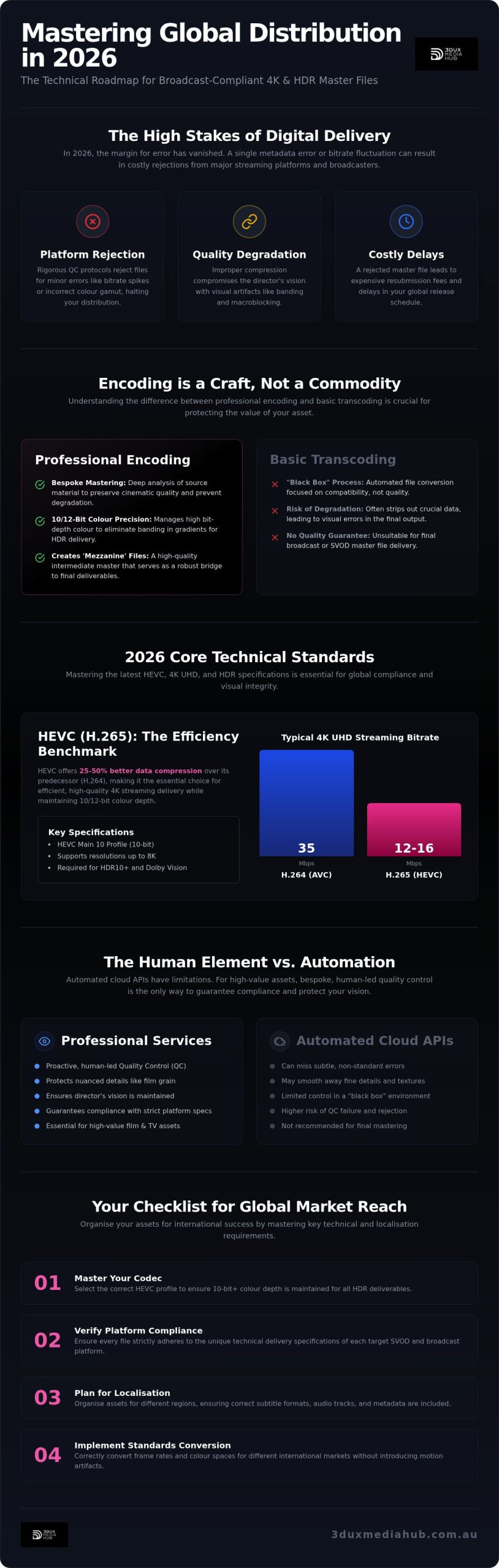
Transcoding is a commodity; encoding is a craft. While transcoding might change a file from a ProRes master to an H.264 for a quick review, professional encoding handles the complex technical nuances required for final release. This includes managing bit depth, often moving between 10-bit and 12-bit colour to avoid banding in gradients. We specialise in creating “Mezzanine” files. These serve as a high-quality intermediate master, providing a robust bridge between the raw production files and the final deliverables. By protecting the colour space and luminance at this stage, we ensure the final product remains broadcast-compliant without losing its cinematic edge.
The Stakes of Professional Distribution
The cost of a technical rejection is high. Global broadcasters and SVOD services employ rigorous Quality Control (QC) protocols. A single bitrate spike or a frame that falls out of the legal colour gamut can result in a rejected master, causing expensive delays in your release schedule. Professional services mitigate this risk through proactive technical management. We ensure that the director’s vision translates accurately across every viewing environment. Whether your audience is watching on a high-end home theatre or a mobile device, the “look and feel” remains consistent. For projects destined for physical media, this precision is even more critical. An error in the master file can lead to catastrophic failures during high-volume replication, making professional master file encoding for distribution an essential safeguard for your investment.
Advanced Encoding Standards: HEVC, 4K, and HDR for 2026
HEVC (H.265) remains the industry benchmark for high-fidelity delivery in 2026. Version 11 of the standard, approved in January 2026, solidifies its role in supporting resolutions up to 8K and advanced HDR metadata. When preparing master file encoding for distribution, selecting the correct profile is critical. It is not just about reducing file size; it is about maintaining the 10-bit or 12-bit colour depth required by premium global platforms. HEVC offers approximately 25% to 50% better data compression than its predecessor, making it the essential choice for 4K delivery.
Managing bitrates requires a strategic approach. For 4K video, H.265 typically requires a bitrate of 12-16 Mbps to maintain quality, whereas the older H.264 standard would require up to 35 Mbps for a similar result. This efficiency allows global digital platforms like Netflix and Amazon Prime to stream cinematic content to millions of devices without compromising visual integrity. Our workflow prioritises these efficiencies while ensuring every file remains broadcast-compliant.
Mastering for 4K UHD and Blu-ray
Physical media still represents the gold standard for visual quality. While streaming platforms cap 4K bitrates to manage bandwidth, 4K UHD authoring services for disc allow for significantly higher bitrates. This headroom is vital for preserving film grain and fine detail that automated systems often smooth away. Professional encoding ensures seamless playback on high-end UHD players, avoiding the macroblocking often seen in lower-tier digital encodes. If you are preparing a high-value asset, consider how our professional encoding team can protect your cinematic vision through every stage of the mastering process.
The Impact of Codec Choice on Visual Quality
HEVC remains the primary codec for 4K mastering to ensure global compatibility. While newer codecs like VVC and AV1 are gaining traction, HEVC provides the most reliable balance of efficiency and hardware support in 2026. Generic encoding profiles often fail when faced with complex cinematic textures like smoke, rain, or fast motion. These scenarios require bespoke variable bitrate (VBR) strategies. We utilise multi-pass encoding to analyse every frame, ensuring that data is allocated where it is needed most. This prevents the “banding” effect in gradients and ensures your master passes rigorous distributor QC on the first attempt.
Mastering for HDR10 and Dolby Vision adds another layer of complexity. These formats require precise metadata injection to tell the display exactly how to render highlights and shadows. We ensure this metadata is correctly synchronised within your master file encoding for distribution, preventing the washed-out appearance that occurs when HDR layers are mismatched. Our technical expertise ensures your content looks exactly as the colourist intended, regardless of the delivery platform.
Professional Services vs. Automated Cloud APIs
Automated cloud APIs offer a seductive promise of speed and low cost. For high-volume social media clips or internal review files, these tools are often sufficient. However, high-value cinematic assets require a different level of scrutiny. Relying on a “black box” algorithm for your final master file encoding for distribution creates significant technical risk. These automated systems lack the ability to interpret artistic intent; they often misidentify intentional film grain as digital noise and “optimise” it into a muddy, smoothed-out mess.
A bespoke, human-led workflow provides the oversight necessary to protect your production. We don’t just push buttons. We consult on the specific technical requirements of your project, ensuring the encoding parameters match the visual complexity of your footage. This technical partnership is what separates a generic file conversion from a broadcast-ready master. When you choose a professional media hub, you’re investing in a “safe pair of hands” that understands the nuances of global delivery standards.
When Automation Isn’t Enough
Complex scenes are the natural enemy of automated encoders. Low-light sequences, high-motion action, and atmospheric effects like smoke or fog often trip up standard algorithms, resulting in visible banding or macroblocking. Automated Quality Control (QC) software can flag a total signal loss, but it rarely detects the subtle visual artefacts that lead to a rejection from a major broadcaster. This is why our broadcast quality control services are vital. Human eyes identify the nuanced flaws that machines miss, ensuring your content passes distributor QC on the first attempt and avoiding the expensive “rejection loop” that plagues many independent productions.
Bespoke Workflows for Independent Film
Independent producers often wear multiple hats, managing everything from post-production to final distribution. We provide the technical bridge required to move your project from a Digital Cinema Package (DCP) to a high-quality Blu-ray or streaming master. Every film has a unique aesthetic; we tailor our master file encoding for distribution to preserve that specific look while staying within your budget. Whether you are preparing for a premier international film festival or a national broadcast release, our team ensures your assets are technically flawless. We specialise in creating masters that meet the highest industry standards, giving you the confidence to pitch to global distributors without fear of technical failure.
Preparing Assets for Global Distribution and Localisation
Global delivery requires more than just a high-quality encode; it demands a master file structured for multiple territories. Preparing your master file encoding for distribution involves a modular approach to asset management. You must account for regional variations in frame rates, language tracks, and metadata from the outset. This is not just about technical compliance. It is about ensuring your content is ready for immediate commercial exploitation in any market without the need for expensive re-renders or technical fixes.
A professional distribution master serves as the single source of truth for your project. It must contain every asset required for a global release, from primary audio to regional dubs. We specialise in the technical architecture of these files, ensuring they meet the specific delivery requirements of international SVOD platforms and traditional broadcasters alike. This level of preparation is what allows a production to move from a local premiere to a worldwide release in days rather than weeks.
Localisation and Asset Preparation
Managing multi-language tracks requires technical precision. We don’t just “add” subtitles. We integrate them into the encoding workflow to ensure they remain perfectly synchronised across all playback environments. This includes the technical management of forced narratives and multiple dubbing streams within a single master container. Audio conforming for international film release is a critical phase here. We ensure that your surround sound mixes are correctly mapped and levels are standardised for international broadcast requirements. Trailer preparation and regional localisation also require specific technical profiles to meet the varying specs of digital delivery and broadcast spots.
Broadcast Standards and Compliance
Despite the shift to digital-first delivery, the technical legacy of PAL and NTSC persists in international delivery specifications. Many global broadcasters still require specific frame rate conversions to match their local infrastructure. We provide comprehensive broadcast standards conversion services to bridge these gaps without introducing motion artefacts or ghosting. Meeting these strict specifications is mandatory for VOD platforms that operate across disparate regions. Our workflow ensures your master file encoding for distribution remains compliant with the technical delivery standards of every target territory. If you are ready to scale your content for the world stage, contact our team to organise your global distribution master today.
Why 3DUX is Australia’s Choice for Media Mastering
3DUX Media Hub has spent over 20 years at the centre of the Australian media and entertainment landscape. We understand the specific pressures of local production and the technical hurdles of global export. Our team acts as a proactive partner, ensuring your content meets the exacting standards of the international market. We provide more than just a service; we offer a “safe pair of hands” for your high-value cinematic assets.
Our national service model is built for speed and precision. We support distributors across the country with fast turnaround times that match the “just-in-time” nature of modern media delivery. Whether you are dealing with a major international release or a local independent film, our expertise ensures your master file encoding for distribution is handled with absolute technical rigour.
A Comprehensive Media Hub
Consolidating your workflow is the best way to maintain file integrity. By keeping encoding, authoring, and broadcast-grade QC under one roof, we eliminate the file handling errors that occur when assets are moved between multiple vendors. This integrated approach is essential for complex 4K UHD projects where metadata and bitrate management must be perfectly aligned across all deliverables.
In 2026, we remain committed to using the latest high-efficiency encoding technologies. We support both the established HEVC standards and the emerging AV1 and VVC codecs to ensure your project stays ahead of the technical curve. Our hub serves as a technical anchor for independent filmmakers, providing them with the same broadcast-grade tools and expertise used by the world’s largest studios. This ensures that every Australian story has the best possible chance of success on the global stage.
Get Started with Professional Encoding
Ready to finalise your project? The process begins with a technical consultation. We assess your source files and discuss your specific distribution goals to determine the optimal encoding parameters. This proactive assessment prevents technical issues before they reach the QC stage, saving you time and protecting your budget.
Preparing your intake assets is straightforward. We provide clear specifications for your source files to ensure a seamless transition into our mastering workflow. Our team is ready to guide you through the technical requirements of master file encoding for distribution, from initial assessment to final delivery. Contact 3DUX Media Hub for professional video encoding services to discuss your project requirements and secure your global release.
Securing Your Global Release in 2026
Achieving a successful release in the current landscape requires absolute technical precision. Success depends on a balance between adopting high-efficiency codecs like HEVC and maintaining the human oversight necessary for broadcast-grade quality control. We’ve detailed why automated APIs often fall short when handling complex cinematic textures and why bespoke workflows are essential for avoiding the expensive rejection loop from major global platforms.
Mastering the technical nuances of standards conversion and localisation ensures your project is ready for any market immediately. By prioritising precise master file encoding for distribution, you protect your visual integrity and ensure your content meets the strict requirements of 2026 streaming and broadcast standards. With over 20 years of industry experience, 3DUX Media Hub provides the expertise and fast turnaround required for high-stakes 4K UHD and Blu-ray masters. We offer a reliable nationwide service for Australian distributors looking for a proactive technical partner.
Master your content for global release with 3DUX Media Hub and move forward with the confidence that your assets are technically flawless. Your cinematic vision deserves a global audience; let’s ensure it arrives exactly as intended.
Frequently Asked Questions
What is the difference between video encoding and transcoding for distribution?
Video encoding is a bespoke mastering process that optimises your content for specific delivery standards like 4K UHD or broadcast. Transcoding is a simpler format conversion, often used for quick review copies or internal file swaps. Professional encoding involves deep technical analysis to protect visual integrity at efficient bitrates. It is the foundation of master file encoding for distribution, ensuring your cinematic vision remains intact while meeting rigid platform specifications.
Why do I need professional encoding for my Blu-ray or 4K UHD release?
Professional encoding is vital because physical media and premium digital platforms require bitrates and metadata that automated systems often mismanage. We ensure that 10-bit or 12-bit colour depth is preserved without banding or macroblocking. This level of precision is necessary to maintain the “look and feel” of high-value film assets. Our expertise prevents technical rejections during the authoring phase, providing a “safe pair of hands” for your national or global release.
How does HEVC encoding improve 4K video quality compared to older codecs?
HEVC (H.265) provides approximately 25% to 50% better data compression than the older H.264 standard at the same quality level. For 4K video, this means achieving cinematic results at 12-16 Mbps rather than the 25-35 Mbps required by legacy codecs. This efficiency is critical for meeting 2026 streaming standards. It allows for the delivery of high-dynamic-range (HDR) content with greater detail and fewer visual artefacts across global digital platforms.
Can professional encoding help my film pass strict broadcast QC requirements?
Yes, our broadcast quality QC service is designed to identify the nuanced visual artefacts that automated software frequently misses. We ensure your files meet the exact luminance, colour gamut, and metadata requirements of international broadcasters. By proactively managing these technical parameters during the encoding phase, we help you avoid the expensive “rejection loop.” This ensures your content passes rigorous distributor inspections on the first attempt, protecting your delivery schedule and budget.
What is standards conversion and why is it necessary for global film distribution?
Standards conversion is the technical process of adapting frame rates and resolutions to match different regional broadcast systems, such as PAL and NTSC. While the world is increasingly digital, many international territories still mandate specific technical delivery specifications for their local infrastructure. We provide high-quality conversion that avoids motion ghosting or stuttering. This is a critical step in preparing a master file encoding for distribution to reach diverse global markets without technical failure.
How long does the professional video encoding process typically take for a feature film?
Turnaround times depend on the technical complexity of the project, including the number of audio tracks and HDR layers required. However, we specialise in fast turnaround for entertainment content, often delivering masters within a few business days following the initial technical assessment. We prioritise efficiency without compromising on the multi-pass encoding or rigorous QC necessary for a professional release. Contact our team to discuss your specific delivery timeline and project requirements.
Do you provide subtitle integration as part of your encoding services?
We provide comprehensive subtitle integration as part of our content localisation services. This involves more than just overlaying text; we technically manage multi-language streams to ensure perfect synchronisation across all playback environments. Our workflow includes the integration of forced narratives and regional dubbing streams within your master file. This preparation is essential for filmmakers aiming for a worldwide release, ensuring your content is fully accessible and technically compliant for every target territory.
What file formats do I need to provide for professional mastering and distribution?
We typically require high-quality Mezzanine files such as Apple ProRes 422 HQ or 4444, or Avid DNxHR, to ensure the best possible encoding results. These source files should be provided at their native resolution and frame rate with all necessary audio stems. Providing robust source material allows us to maintain the highest visual integrity during the 4K UHD or Blu-ray authoring process. We conduct a thorough technical intake to verify your assets before starting the mastering workflow.