
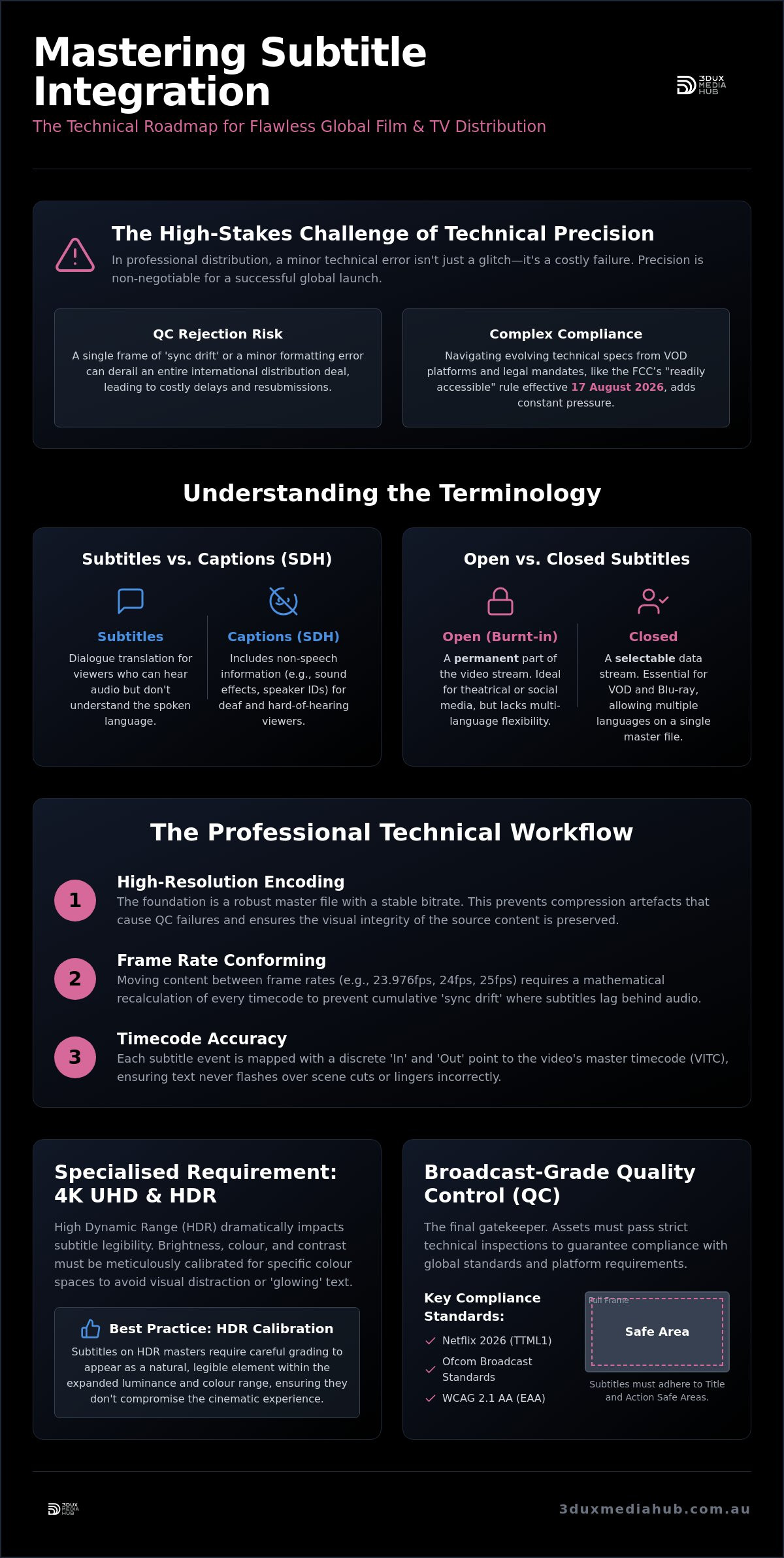
A single frame of sync drift or a minor formatting error can derail an entire international distribution deal. In a sector where technical precision is non-negotiable, professional subtitle integration services are the difference between a successful global launch and a costly QC rejection. You likely understand the frustration of managing complex multi-language assets while trying to determine the best delivery spec for different VOD platforms. It is a high-stakes environment where compliance deadlines, such as the FCC’s new “readily accessible” rule effective 17 August 2026, add constant pressure to the mastering process.
We agree that subtitle integration should be a seamless part of your workflow, not a bottleneck. This article provides the technical roadmap to master these nuances, ensuring your content meets the highest broadcast-grade quality standards. We will examine the latest 2026 requirements from Netflix and Ofcom, compare the utility of burn-in versus closed subtitle streams, and outline how to achieve a compliant master file that guarantees a fast turnaround for your distribution deadlines. By the end of this guide, you’ll have the expertise to navigate the complex technical specifications required for modern film and TV delivery.
Key Takeaways
- Identify how professional subtitle integration services bridge the gap between content localisation and global distribution standards.
- Understand why high-resolution encoding and frame rate precision are critical for maintaining synchronisation across master files.
- Discover the unique technical requirements for 4K UHD and Blu-ray, including HDR impact on subtitle legibility and brightness.
- Master Broadcast Quality QC protocols and Safe Area requirements to ensure assets pass technical inspections on the first attempt.
- Explore efficient workflows for managing complex multi-language assets to meet strict international distribution deadlines.
Understanding Subtitle Integration in Professional Media Mastering
Subtitle integration is the technical discipline of synchronising and embedding text streams into high-resolution video masters. It goes beyond mere translation. Professional subtitle integration services ensure that every line of dialogue and every narrative beat aligns perfectly with the visual and audio timeline. This process acts as the final technical bridge between creative localisation and global delivery. Without precise integration; content risks rejection from major VOD platforms and broadcasters during the quality control phase.
Consumer-grade tools often ignore the nuances of frame rate, colour space, and metadata. Professional-grade mastering requires a high level of technical literacy to manage complex multi-language assets. Technical compliance isn’t a suggestion; it’s a requirement for entry into professional markets. This means meeting specific delivery standards like Netflix’s 2026 TTML1 requirements or the European Accessibility Act’s WCAG 2.1 AA standards. Achieving these benchmarks ensures your content is ready for a global audience without the risk of technical failure.
Subtitles vs. Captions: The Technical Distinction
Post-production workflows distinguish clearly between subtitles and captions. Subtitles are designed for viewers who can hear the audio but don’t understand the language. They focus on dialogue translation. In contrast; Subtitles for the Deaf and Hard of Hearing (SDH) or captions provide essential non-speech information. This includes speaker identification and sound effects. This Overview of Subtitling provides a foundation for these distinct types. Distributors require both to ensure comprehensive market access and legal compliance. Each has different technical standards; such as specific character limits per line and reading speed constraints that must be met to pass professional QC.
Open vs. Closed Subtitles in Distribution
Choosing the right delivery format is critical for technical compliance. Open subtitles, often called burnt-in subtitles, are a permanent part of the video stream. They are ideal for theatrical releases or social media where viewers can’t always toggle settings. However; they lack flexibility for multi-language releases. Closed subtitles are selectable streams. They exist as separate metadata or embedded tracks within a container like an MKV or MP4. They allow for multiple languages on a single master, which is essential for VOD and physical media like Blu-ray. Each release window has specific requirements. VOD platforms usually prefer closed streams for user customisation; while certain broadcast specs might demand burnt-in text for specific regions to guarantee visibility.
The Technical Workflow of Professional Subtitle Integration
Professional subtitle integration services rely on high-resolution video encoding as their technical foundation. This isn’t just about picture quality. It involves creating a robust master that can handle the injection of multiple metadata layers. Whether you’re muxing closed streams into a container or performing a precision “burn-in” for a theatrical release, the underlying video bitrate must remain stable. Technical precision here prevents compression artefacts that often lead to automated QC rejections. We focus on ensuring the text becomes a functional part of the video file without compromising the visual integrity of the master.
Frame rate conversion introduces significant complexity into the synchronisation workflow. Moving content between 23.976 fps, 24 fps, and 25 fps requires a mathematical recalculation of every subtitle timecode. If the text isn’t conformed to the master clock, you’ll encounter “subtitle drift,” where the text eventually lags behind the audio. This conforming process ensures that the text, audio, and video all reference a single, unified timeline. It’s a meticulous task that requires professional oversight to avoid the “rubber-banding” effect seen in poorly integrated files.
Master File Preparation and Synchronisation
Timecode accuracy is the backbone of any professional master. Each subtitle event requires a discrete “In” and “Out” point that maps perfectly to the video’s vertical interval timecode (VITC). This prevents subtitles from flashing over scene cuts or persisting too long on screen. By following strict Broadcast-Grade Quality Control standards, you ensure that the text remains synchronised and legible for the duration of the programme. Frame-accurate synchronisation is a non-negotiable requirement for all broadcast-grade delivery specs.
Multi-Language Asset Management
Modern global releases often demand the management of 20 or more language tracks for a single master file. Each stream must utilise UTF-8 character encoding to ensure that non-Latin scripts, such as Arabic or Mandarin, render correctly across all playback devices. Success depends on rigid naming conventions and folder structures. A single error in the asset package can cause a total failure during the VOD ingestion process. Professional workflows use automated checksums and manual spot checks to verify that every language stream maps correctly to its intended audio track.
Navigating these technical hurdles is easier with a partner who specialises in video and audio encoding to guarantee your assets meet international standards.
Specialised Subtitling for 4K UHD, Blu-ray and DVD
Physical media delivery requires a distinct technical approach compared to the text-based streams used by most streaming platforms. Professional subtitle integration services for discs rely on image-based overlays. These bitmap files are rendered directly by the hardware player. This ensures the font, positioning, and styling remain exactly as the author intended. This method eliminates the unpredictability of web-based players that might override CSS styling or misinterpret character spacing across different devices. It is a fundamental part of high-end 4K UHD authoring where visual consistency is the priority.
High Dynamic Range (HDR) mastering introduces new variables for subtitle legibility. If text is integrated at peak luminance, it can distract the viewer or wash out the surrounding image detail in high-contrast scenes. We calibrate subtitle brightness to match the specific nit levels of the HDR grade. This maintains the artistic intent of the scene while ensuring the text remains comfortable to read in a darkened home cinema environment. Adhering to the BBC’s official subtitling guidelines ensures that these technical adjustments follow established industry best practices for accessibility, timing, and contrast.
Bitmap vs. Text-Based Subtitle Streams
Blu-ray and DVD formats utilise sub-picture streams rather than raw text files. DVD technology is restricted by a legacy 4-colour palette. This requires precise anti-aliasing to avoid jagged edges or “stair-stepping” on modern high-definition displays. Blu-ray and 4K UHD formats offer significantly more headroom. They support high-resolution bitmap overlays that allow for sophisticated typography and transparency. This technical shift ensures that subtitles on a 4K UHD disc look as sharp as the 2160p video they accompany. Managing these assets requires professional authoring software capable of handling large-scale muxing for multi-language releases.
Menu Integration and User Navigation
Integration for physical media includes complex logic programming within the disc’s file structure. The “Subtitle” menu must be correctly mapped to trigger specific streams within the VOB or m2ts container. This process also involves managing “forced subtitles.” These are essential tracks that display automatically during foreign-language dialogue, even when the main subtitles are turned off by the user. We conduct rigorous user experience (UX) testing to verify that subtitle toggling is instantaneous. We also ensure the player correctly remembers user preferences across chapter breaks and menu transitions. This level of detail is essential for a polished, professional product that meets global distribution standards.
Ensuring Compliance through Broadcast-Grade Quality Control
Technical Quality Control (QC) serves as the final gatekeeper before a master file is released to global platforms. Professional subtitle integration services must go beyond simple proofreading to validate technical metrics that automated systems often flag. Every subtitle event is checked for legibility; timing; and positioning. This process ensures that the text doesn’t just represent the dialogue but functions correctly within the video container. Failing to meet these benchmarks leads to immediate rejection by major distributors like Netflix or Apple TV. These platforms enforce rigid specifications to ensure a premium viewer experience across all device types.
Contrast and visibility are paramount. We apply specific outlines or drop shadows to ensure text remains readable against varied backgrounds; from bright outdoor scenes to dark interiors. Without these technical adjustments; subtitles can become lost in the frame’s luminance. This is especially critical for HDR content where peak brightness can wash out poorly integrated text. We also verify that subtitles don’t obscure essential on-screen graphics or forced narrative elements. A single formatting error can derail a distribution timeline; making rigorous manual and automated checks essential for every master file.
Technical Validation and Legibility Standards
Industry standards for 2026 dictate a maximum of 42 characters per line and a limit of two lines per subtitle block. Reading speed is a critical metric. The current benchmark for English content on major streaming platforms is a maximum of 20 characters per second (CPS) for adult audiences and 17 CPS for children’s content. These limits prevent viewer fatigue and ensure information is digestible. The Subtitle Safe Area is strictly defined by SMPTE standards to ensure text remains within the central 90 per cent of the screen and avoids being cut off by display overscan.
Global Delivery Specifications
Navigating the transition between delivery formats is a complex task. Different broadcasters require specific XML or SRT files; such as the TTML1 format mandated by Netflix for 2026 releases. We ensure metadata compliance for multi-language streams; ensuring that language tags and character encoding (UTF-8) are perfectly mapped. Standards conversion also plays a vital role. When content is converted between NTSC and PAL or different frame rates; the subtitle timings must be recalculated to maintain integrity. Secure your distribution window with our Broadcast Quality QC services to ensure every asset is technically compliant.
Optimising Your Global Release with 3DUX Media Hub
Choosing the right technical partner is the final step in securing a successful international release. 3DUX Media Hub operates as a specialised technician for complex content localisation and integration. We provide a single-hub solution for video encoding, authoring, and subtitle integration services. This unified approach eliminates the friction often found when coordinating between multiple vendors. By managing the entire technical workflow in-house; we ensure that your master files are both compliant and ready for immediate distribution. Reliability is our standard. We focus on the seamless execution of your delivery specs to prevent costly delays at the ingestion stage.
Distributors require a partner who understands the high-stakes nature of the entertainment industry. Our communication is direct and solution-oriented. We don’t rely on flashy marketing; we rely on performance. By stripping away unnecessary fluff; we maintain a rhythmic focus on capability and results. This methodical approach allows us to handle high-pressure deadlines while maintaining the high standards required for broadcast-grade quality control. We provide the stability needed in a complex technical field.
20 Years of Authoring and Localisation Expertise
Our team brings over two decades of experience to every project. This longevity has fostered a deep understanding of evolving standards for 4K UHD, Blu-ray, and DVD. We have mastered thousands of hours of content; ranging from independent Australian films to major global studio releases. This seasoned authority allows us to navigate the technical nuances of HDR brightness levels and bitmap rendering with quiet confidence. Whether you are delivering a boutique physical release or a high-volume VOD package; our expertise ensures your content meets the most rigorous delivery specifications. We have evolved alongside technology; remaining current while leaning on a foundation of established industry knowledge.
Streamlined Workflows for Fast Turnaround
Efficiency is critical in the fast-paced distribution sector. We integrate localisation directly into the broader mastering workflow to significantly reduce turnaround times. This includes our standard Broadcast Quality QC; where every asset undergoes meticulous technical validation before delivery. Our methodical rhythm ensures that your deadlines are met without compromising on technical rigour. We understand that a fast turnaround is only valuable if the final product is flawless. You can enquire about our professional localisation and subtitle integration services to secure a dependable, no-nonsense partner for your next global release. We are ready to handle your most complex technical requirements with precision and efficiency.
Securing Your Global Distribution Window
Professional mastering is an exacting discipline. Success depends on more than just accurate translation; it requires frame-accurate synchronisation and strict adherence to technical delivery specs. We have explored how bitmap rendering for physical media and HDR brightness calibration protect the viewer experience. By prioritising broadcast-grade quality control; you ensure your assets pass technical inspections on the first attempt. Reliable subtitle integration services provide the essential technical foundation for this global reach.
Managing multiple language assets through a single technical hub reduces friction and accelerates your timeline. 3DUX Media Hub offers over 20 years of technical post-production experience to handle these complexities. We are specialists in 4K UHD and Blu-ray authoring; providing full broadcast-grade QC as a standard part of our professional service. You can contact 3DUX Media Hub for professional subtitle integration and localisation to ensure your master files are technically sound. Your content is ready for the world stage. We look forward to helping you deliver it with precision.
Frequently Asked Questions
What is the difference between burnt-in and selectable subtitles?
Burnt-in subtitles are permanently rendered into the video frame, while selectable subtitles exist as separate data tracks. Burnt-in text is ideal for theatrical releases or social media where user control is limited. Selectable, or closed, subtitles allow viewers to toggle languages on VOD platforms and physical discs. This flexibility is essential for multi-language distribution packages where a single master file must serve various global regions.
How do you ensure subtitles are synchronised for different frame rates?
We conform every subtitle timecode to the master video clock using frame-accurate synchronisation. Moving content between 23.976 fps and 25 fps requires a mathematical recalculation of every “In” and “Out” point. This process prevents subtitle drift, ensuring that text remains perfectly aligned with the audio regardless of the distribution format. Our professional subtitle integration services include this conforming step to guarantee technical compliance for international broadcasters.
What are forced subtitles and when are they required?
Forced subtitles are tracks that display automatically to translate foreign-language dialogue or clarify on-screen graphics. They appear even when the viewer has the main subtitle track turned off. These are required whenever a film contains passages in a language different from the primary audio. Correct programming of these tracks ensures that essential narrative information is never lost during playback on Blu-ray or VOD services.
Can you integrate subtitles into a 4K UHD Blu-ray master?
Yes, we specialise in high-resolution bitmap integration for 4K UHD and Blu-ray authoring. Unlike standard text files, these image-based overlays provide consistent typography and styling across all hardware players. We also calibrate subtitle brightness levels for HDR (High Dynamic Range) content. This prevents the text from becoming overly luminous or distracting in high-contrast scenes, maintaining the director’s original creative intent.
What file formats do you require for subtitle integration?
We typically work with industry-standard formats such as .SRT, .STL, and .XML files, including Netflix-compliant TTML1. If you have existing scripts in Word or PDF, we can convert these into time-coded master files. Our workflow ensures that the final integrated stream meets the specific metadata requirements of your target platform. Providing high-quality source files allows for a faster turnaround during the encoding and muxing stages.
Do you provide technical QC for subtitle legibility and compliance?
Every project undergoes a rigorous Broadcast Quality QC process to verify timing, contrast, and safe area compliance. We check every event against specific reading speed metrics; such as the 2026 standard of 20 characters per second (CPS) for adult content and 17 CPS for children’s content. This manual review identifies issues that automated tools often miss, such as subtitles flashing over scene cuts. This level of scrutiny is vital for passing stringent platform inspections.
How do you handle non-Latin character sets in subtitle streams?
We utilise UTF-8 character encoding to ensure that scripts like Arabic, Mandarin, and Japanese render correctly across all devices. Professional subtitle integration services require specialised rendering engines to handle complex typography and right-to-left text directions. This technical precision prevents the “tofu” effect, where characters appear as empty boxes. We verify that every language track in your multi-language asset package is fully legible and technically sound.
Why is professional integration better than using automated tools for film distribution?
Professional integration provides the human oversight needed to navigate complex regulatory standards and technical specifications. Automated tools often fail to account for safe areas, reading speeds, or the nuances of frame rate conversion. Our expertise ensures that your master file meets the 2026 standards set by the FCC and international broadcasters. Choosing a seasoned partner reduces the risk of costly rejections and guarantees a broadcast-grade result for your global release.