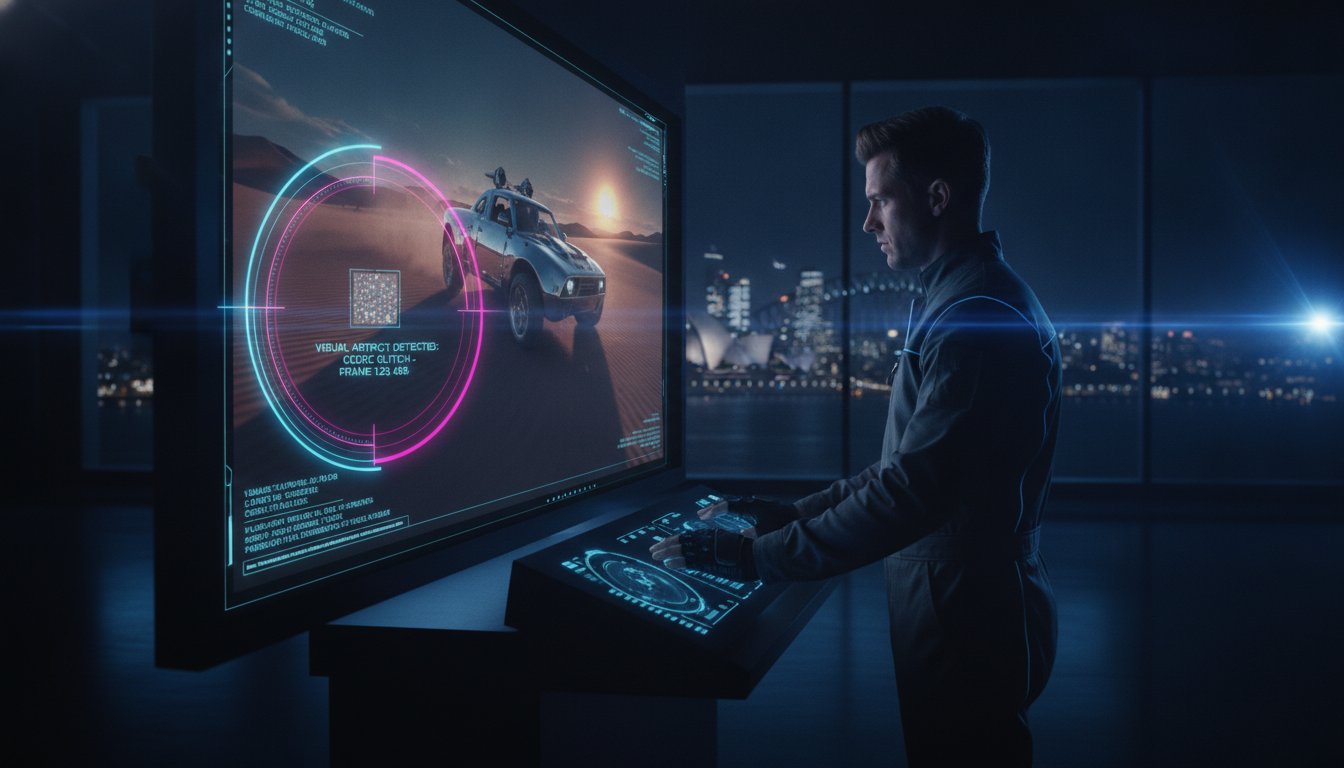
A single dead pixel or an incorrect metadata flag can trigger an immediate rejection from global platforms like Netflix or Apple TV. These technical failures result in significant remastering fees and delayed release schedules. Professional visual quality control services eliminate these risks by identifying artifacts before they reach the distributor. You’ve dedicated months to your project. The final delivery should be the most straightforward part of the process. It shouldn’t be the most stressful.
This article outlines how to achieve zero-defect delivery for global markets. We provide a deep dive into professional QC standards and artifact identification. We’ll examine the nuances of HDR10 versus Dolby Vision specifications. You’ll learn why manual “eyes-on” inspection remains the final authority for professional validation. This guide provides the technical clarity needed to navigate complex delivery requirements and secure peace of mind for physical media replication.
Key Takeaways
- Distinguish between creative choices like film grain and technical defects such as digital noise to ensure artistic integrity remains intact.
- Identify high-risk artifacts including macroblocking, mosquito noise, and frame-rate cadence errors that lead to platform rejections.
- Understand why professional visual quality control services are essential for navigating the strict delivery specifications of global streamers like Netflix and Apple TV.
- Learn how a methodical “eyes-on” workflow catches contextual and continuity errors that automated systems often overlook.
- Master the technical requirements for 4K UHD and Blu-ray mastering to ensure zero-defect delivery and avoid costly remastering fees.
Defining Visual Quality Control Services for Media and Entertainment
Professional visual quality control services represent a forensic audit of a finished master file. This is not a casual viewing experience. It is a frame-by-frame technical inspection performed by specialists in a controlled environment. Every pixel, cadence shift, and metadata flag undergoes scrutiny. Precision at this stage is mandatory. A single missed artifact can trigger a rejection from global distributors. This leads to expensive remastering fees and missed launch dates. Our technicians examine black levels, peak luminance, and chrominance to ensure the signal remains within specified tolerances. We also verify the integrity of head and tail leaders, ensuring all slates and tones align with delivery requirements.
Distinguishing between creative intent and technical failure is a core competency of a QC technician. Film grain is an aesthetic choice. Digital noise is a technical failure. High-end monitoring allows us to see these differences clearly. We use broadcast-grade, calibrated displays in a D65 neutral grey environment to ensure visual accuracy. Content that looks “good enough” for YouTube often fails when subjected to the rigours of 4K UHD and Blu-ray mastering. Higher bitrates and larger screens expose every macroblock, banding issue, and compression error. By employing dedicated visual quality control services, producers protect their investment against technical non-compliance. We provide the professional validation required for high-stakes global distribution.
The Distinction Between QA and QC in Post-Production
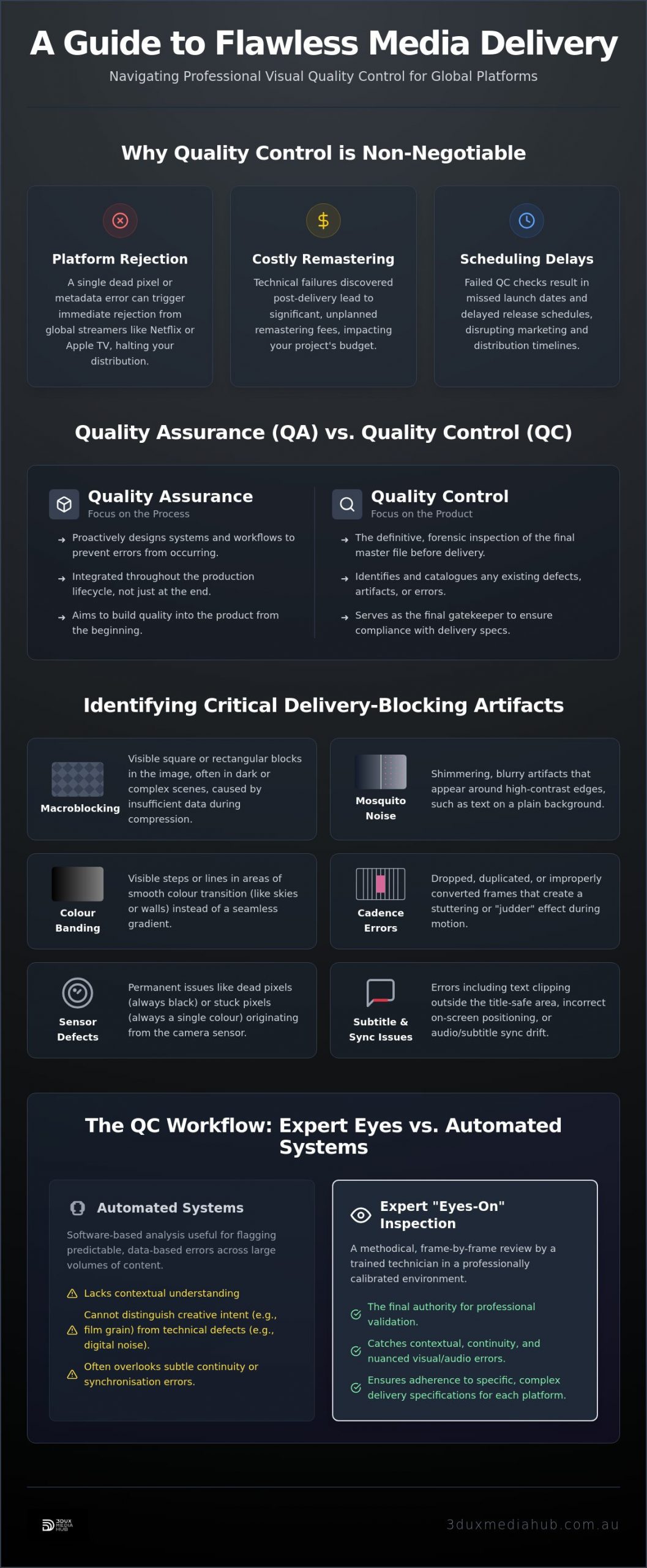
Quality Assurance (QA) focuses on the process. It involves the systems and workflows designed to prevent errors. QC is the final check. It is the definitive inspection of the end product. At 3DUX, we organise the workflow to catch potential issues before the final render. This proactive approach integrates technical mastering into the broader production lifecycle. It ensures that by the time a file reaches the final QC stage, it has already passed through multiple layers of internal verification.
Broadcast and Cinema Standards (SMPTE and Beyond)
Adherence to global standards ensures your content plays correctly on any device. We follow SMPTE guidelines for colour space and luminance. Maintaining legal signal levels is critical for broadcast compliance. If a signal is illegal, it exceeds the technical limits of a broadcast system. This leads to clipping or distortion. Our technicians monitor Video quality metrics to ensure compatibility across diverse display technologies. Whether using Rec. 709 for standard broadcast or Rec. 2020 for High Dynamic Range, our facility ensures every deliverable meets the exact specifications required by global streamers.
Identifying Critical Visual Artifacts and Mastering Errors
Technical errors in a master file are often invisible to the untrained eye. Professional visual quality control services involve identifying minute discrepancies that compromise the viewer experience. Compression artifacts represent a significant portion of delivery failures. Macroblocking occurs when encoders lack sufficient data. Visible square blocks appear in complex areas. Mosquito noise manifests as shimmering artifacts around high-contrast edges. Banding is common in dark gradients. It appears as distinct steps in colour rather than a smooth transition. These issues frequently occur in night scenes or underwater footage where bit depth is challenged.
Temporal issues require a different level of scrutiny. Frame-rate cadence errors often stem from improper standards conversion. Dropped or repeated frames create “judder” during playback. Interlacing artifacts, such as “combing” on moving objects, are unacceptable in modern progressive-scan masters. Beyond the video signal, sensor and lens defects must be flagged. Dead pixels and dust spots on the sensor are permanent fixtures if not corrected. While some AI tools claim to detect these, they often miss subtle chromatic aberration or lens flares that obscure critical detail. For a complete list of industry-standard terms, refer to the Netflix Production QC Glossary.
Localisation adds another layer of complexity. Subtitling errors include text clipping where characters fall outside the title-safe area. Incorrect positioning can obscure essential visual information. Sync drift, where the text slowly de-aligns from the audio, is a common reason for rejection. Utilising professional broadcast quality QC ensures these elements are perfectly synchronised before the final delivery.
Compression and Encoding Failures
High-bitrate encoding for 4K UHD requires specialised inspection. HEVC and AVC compression can strip fine textures. Skin pores and fabric details disappear. Banding in 10-bit masters is often subtle. It requires a calibrated monitoring environment to detect. Our technicians look for “breathing” artifacts where the image quality fluctuates between keyframes. This ensures the master maintains a consistent level of detail throughout the runtime. Professional visual quality control services catch these failures before they reach the consumer.
HDR and Dolby Vision Technical Checks
HDR mastering introduces new variables. Luminance clipping occurs when the signal exceeds the display’s peak brightness capabilities. This results in “blown-out” highlights with zero detail. We verify metadata accuracy for Dolby Vision and HDR10. This ensures the mapping matches the creative intent. A critical step is the SDR down-conversion. We ensure the standard dynamic range version remains colour-accurate for legacy displays. Correcting these errors during the mastering phase prevents costly downstream failures.
The QC Workflow: Expert Eyes-on vs. Automated Systems
Reliability in high-end media distribution requires a dual-layered approach. Automated systems provide speed and mathematical precision. Human experts provide essential context. Relying solely on software is a high-risk strategy that often leads to delivery failure. While algorithms catch objective data errors, they can’t interpret the nuance of cinematography. Our visual quality control services integrate both methodologies to ensure a zero-defect master. This hybrid model provides a safety net that purely automated workflows lack.
We employ a methodical “Three-Pass” system to guarantee compliance:
- Technical Pass: An automated scan detects bitstream integrity issues, digital dropouts, and loudness violations.
- Creative Pass: A technician performs a real-time, “eyes-on” review to identify artifacts, continuity errors, and framing issues.
- Final Compliance: A final verification pass ensures the file meets the specific technical metadata and header requirements of the target platform.
This structured workflow allows us to catch errors that software might ignore. It also prevents the unnecessary rejection of intentional artistic choices. By combining machine efficiency with human expertise, we provide a level of validation that meets the highest global standards.
Automated QC Tools and Their Limitations
Software excels at identifying binary failures. It spots dead pixels, black frames, and peak-level violations with 100% accuracy. However, automated tools often generate “false positives” by flagging intentional film grain or soft-focus shots as technical noise. Conversely, “false negatives” occur when software fails to recognise a subtle compression artifact that a human viewer would find distracting. A machine doesn’t understand the story. It only understands the data. This is why automated tools are a starting point, not the final authority, in professional visual quality control services.
The Expert Evaluator: Training for Precision
Identifying subtle mastering flaws requires more than just technical knowledge. It requires the rigour of decades of industry experience. Our evaluators work in strictly controlled environments to ensure total accuracy. We use calibrated Grade-1 monitors and specific ambient lighting to maintain visual consistency. High-stakes QC is mentally taxing. We manage visual fatigue through disciplined viewing schedules. This ensures our technicians remain sharp and methodical throughout long-form projects. This level of human oversight is what separates a broadcast-ready file from a rejected one.
Why Global Platforms Reject Content: The Business Case for QC
Rejection by a major streaming platform is a catastrophic event for a production’s budget. It triggers the “Fail Once, Pay Twice” reality of international distribution. You pay for the initial mastering; you then pay again for the technical corrections and re-submission fees. Professional visual quality control services act as a financial safeguard against these avoidable costs. Global distributors operate with zero tolerance for technical non-compliance. A single frame of telecined content or a misplaced production slate can halt a global launch. This results in missed marketing windows and strained relationships with platform acquisitions teams. Expert QC ensures your project moves from post-production to profit without technical friction.
The financial stakes are rising alongside industry growth. With US video post-production revenue projected to reach $7.1 billion in 2026, the volume of content is increasing. Platforms are automating their initial ingest checks to manage this scale. If your file doesn’t meet the exact metadata or bitrate requirements, it’s rejected by a machine before a human ever sees it. Protecting your brand reputation requires a proactive approach to technical excellence. High-quality deliverables signal professional competence to distributors and investors alike. Don’t risk your reputation on a “good enough” master. Secure your delivery with professional broadcast quality QC to ensure your content meets every global standard.
Meeting Global Delivery Specifications
Navigating the complex delivery “bibles” for Netflix, Amazon, and Apple TV requires deep technical literacy. For example, as of May 2026, Amazon Prime Video requires the total removal of all non-program content, including production slates and colour bars. They also mandate constant frame rates and specific aspect ratio flags. Furthermore, as of 30 January 2026, new titles must include 2:3 aspect ratio poster artwork or face being blocked from publication. Localisation QC is equally critical. It ensures that subtitles and dubbed audio meet the cultural and technical expectations of international audiences. Asset preparation must be flawless to survive the rigorous ingest processes of modern VOD platforms.
Risk Mitigation in Physical Media
Physical media authoring demands a higher level of rigour than digital streaming. A digital file can be patched; a glass master is final. Once a Blu-ray or DVD enters the replication phase, any surviving error becomes a permanent defect. The cost of a 10,000-unit disc recall is devastating. It includes the loss of physical materials, shipping costs, and retail penalties. We treat 4K UHD and Blu-ray authoring as a high-precision engineering task. Rigorous visual inspection at the authoring stage identifies layer-break issues and menu navigation bugs before they reach the replication facility. This level of technical oversight is the only way to guarantee a zero-defect physical release.
Professional Visual QC and Mastering at 3DUX Media Hub
3DUX Media Hub operates a specialised, state-of-the-art facility dedicated to technical mastering and QC excellence. We bridge the critical gap between creative completion and global delivery. Our visual quality control services provide the professional validation required for high-stakes distribution. We understand that a master file is more than just data; it is the culmination of your creative work. Our team ensures that every deliverable meets the exact specifications of platforms like Netflix, Amazon, and Apple TV. We offer a comprehensive suite of services that includes 4K UHD authoring, Blu-ray and DVD authoring, and video and audio encoding.
Efficiency is a core pillar of our workflow. We provide fast turnaround times without compromising on technical rigour. This is essential in a sector where delivery windows are often narrow. We also specialise in content localisation and asset preparation for global markets. This ensures your project is technically compliant and culturally accurate for international audiences. By centralising these services, we eliminate the risks associated with fragmented post-production workflows. Our facility handles everything from standards conversion to motion and static menu design with methodical precision.
Our Technical Toolkit and Environment
We maintain a strictly controlled environment to ensure total accuracy. Our facility features calibrated monitoring systems for SDR, HDR, and 4K assessment. We utilise industry-leading encoding and QC software to identify technical discrepancies. However, we never rely on software alone. Every project benefits from our hybrid “Three-Pass” methodology. We provide detailed reporting for every QC pass. These reports offer clear, actionable feedback rather than generic error codes. This transparency allows production teams to address issues quickly and effectively. Our visual quality control services are designed to provide absolute confidence in the final master.
Partnering with 3DUX for Your Next Release
We support a diverse range of clients, from independent filmmakers to major international distributors. Our integrated approach brings encoding, authoring, and QC under one roof. This streamlines the process and reduces the potential for communication errors. We act as a dependable, no-nonsense partner in a complex technical field. Our team has evolved alongside the industry, ensuring we remain current with the latest standards like Dolby Vision and HDR10. We value performance over flashiness. Our focus remains on the seamless execution of your delivery workflow.
If you are preparing a project for global distribution or physical media, expert oversight is mandatory. Contact 3DUX Media Hub for a technical consultation to ensure your master is broadcast-ready.
Securing Your Global Distribution Strategy
Global content delivery requires absolute technical precision. Relying on automated checks alone leaves your project vulnerable to platform rejections and costly remastering fees. Expert visual quality control services provide the final layer of professional validation. This ensures your master file meets the rigorous standards of international broadcasters and streaming platforms. By combining human oversight with calibrated monitoring, you protect your investment and your brand reputation.
3DUX Media Hub brings over 20 years of industry experience to every project. We are specialists in 4K UHD and Blu-ray mastering. Our Sydney-based technical expertise provides a global reach for independent filmmakers and major distributors alike. We handle the complexities of encoding, authoring, and compliance so you don’t have to. Ensure your film is distribution-ready with 3DUX Media Hub. Your project deserves a flawless delivery. We look forward to helping you reach your audience with total technical confidence.
Frequently Asked Questions
What is included in a professional visual quality control service?
A professional service includes a frame-by-frame inspection of the video signal to ensure technical and creative integrity. Technicians verify SMPTE signal legality, metadata accuracy, and the absence of digital artifacts. We check head and tail leaders, slates, and audio sync against specific delivery requirements. This methodical process ensures the master file is compliant with global distribution standards before ingest.
How long does a full visual QC pass take for a feature film?
A single, comprehensive pass typically requires 1.5 to 2 times the total runtime of the project. This allows the technician to view the content in real-time while pausing to log specific timecode errors and technical discrepancies. Complex projects involving HDR10 or Dolby Vision may require additional time for metadata verification and luminance mapping checks to ensure total accuracy.
Can automated QC software replace a human visual inspection?
Automated software cannot replace human inspection because it lacks contextual understanding. While machines excel at catching digital dropouts or black frames, they often flag intentional creative choices as technical errors. Expert visual quality control services use a hybrid approach. We use software for objective data analysis and human evaluators for subjective quality assessment to provide the final authority.
What are the most common reasons for a film to be rejected by a distributor?
Rejections usually stem from technical non-compliance with a distributor’s specific delivery requirements. Common failures include illegal luminance levels, incorrect frame-rate cadence, or missing metadata flags. Platforms like Netflix and Amazon also reject files for visible compression artifacts such as macroblocking or banding. Ensuring zero-defect delivery requires rigorous professional validation before the final submission process begins.
Does 3DUX provide QC reports for 4K UHD and Blu-ray authoring?
We provide exhaustive, actionable reports for all 4K UHD and Blu-ray authoring projects. These reports detail every technical and visual finding, allowing production teams to address issues before replication. Our Sydney-based facility specialises in identifying authoring-specific errors like layer-break placement and menu navigation bugs. This documentation is essential for professional validation and final project sign-off.
What is the difference between a technical QC and a creative QC?
Technical QC focuses on objective file data such as bitrate, colour space, and signal legality. Creative QC involves a subjective review of the viewer experience. A creative pass identifies continuity errors, visible production equipment, or jarring edits that software would ignore. Both passes are necessary to ensure a project meets the high-stakes requirements of the professional entertainment industry.
Do you provide visual QC for localised content and subtitles?
We provide specialised visual quality control services for localised assets, including subtitles and dubbed audio. Our team verifies text timing, positioning, and character encoding to prevent clipping or sync drift. This is critical for international releases where technical errors in localisation can lead to immediate platform rejection and lost revenue in diverse global markets.
Why is visual QC critical for physical media replication?
Visual QC is critical because defects on a physical disc are permanent once the glass master is created. Unlike digital streams, you cannot patch a replicated Blu-ray or DVD. Catching a menu bug or a visual artifact at the authoring stage prevents the catastrophic cost of a retail recall. Professional inspection is the only way to guarantee a zero-defect physical release for the consumer market.