Why settle for the variable bitrates and crushed blacks of streaming when your audience demands a reference-quality experience? You understand that a premium film or television project deserves better than the compromises of digital delivery. The process of mastering for physical media often introduces significant technical anxiety. Confusion over bitrate requirements for 4K UHD versus standard Blu-ray, combined with the complexity of managing multi-language audio and subtitle tracks, can jeopardise a global release.
This professional guide details the technical rigour and specialised workflows required for high-end distribution. You’ll discover how to achieve high-fidelity video and audio that consistently exceeds streaming quality. We cover the essentials of HEVC encoding, functional menu programming, and the strict QC protocols necessary to ensure your master passes global distribution standards. From 100GB triple-layer discs to sophisticated localisation, learn to deliver a product that maintains the integrity of your visual grade and meets the expectations of the most discerning collectors.
Key Takeaways
- Understand the technical transition from a digital intermediate to a physical master to maintain the high-end standards expected by collectors.
- Identify the essential encoding requirements for 4K UHD, including the management of HEVC bitstreams and HDR10 or Dolby Vision metadata.
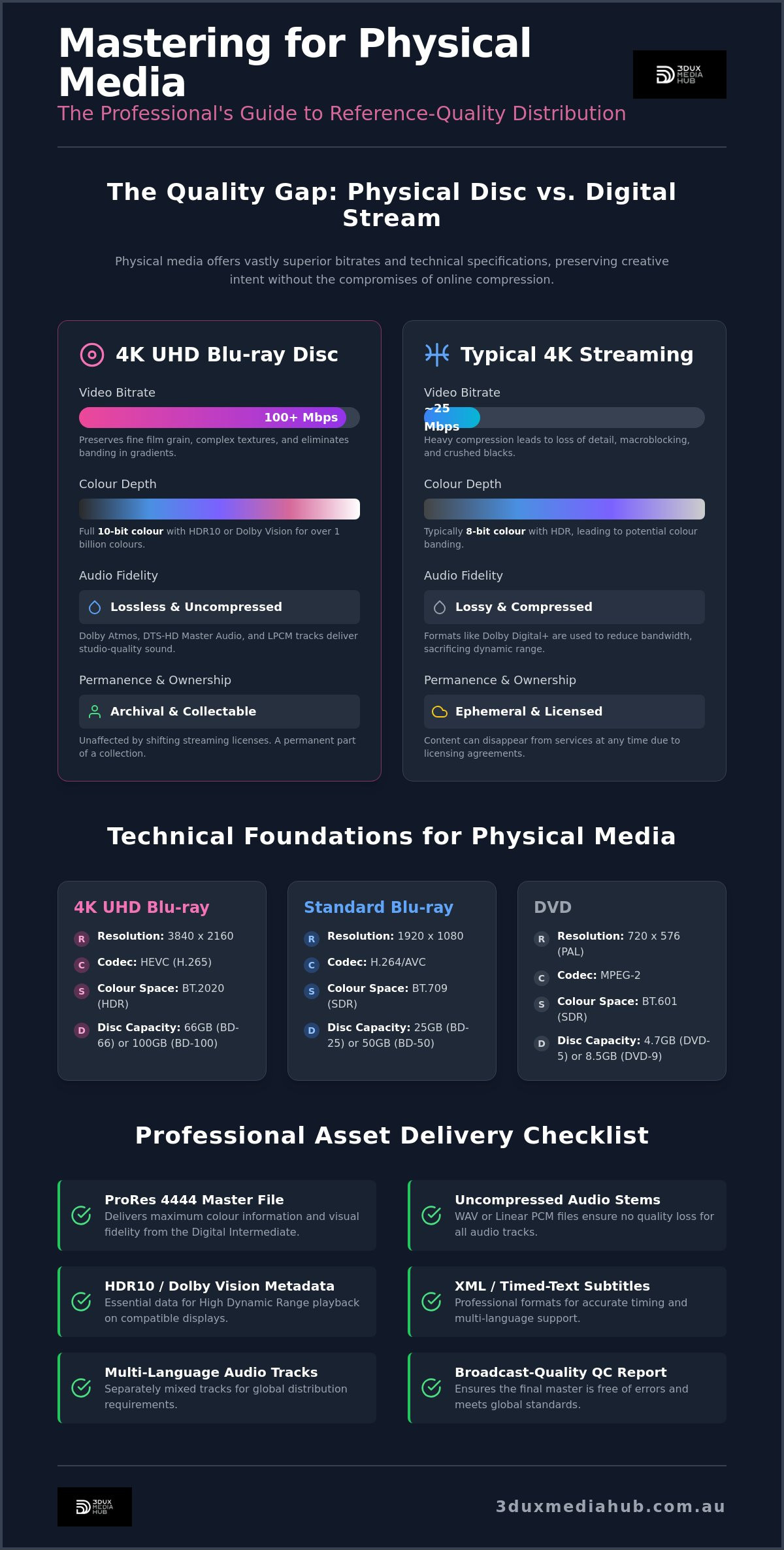
- Discover how the 100+ Mbps bitrate of physical discs preserves fine film grain and complex textures often lost in streaming compression.
- Streamline the process of mastering for physical media by preparing professional-grade assets like ProRes 4444 files and XML subtitle formats.
- Implement broadcast-quality QC and standards conversion to ensure your project is ready for seamless global distribution.
What is Mastering for Physical Media in the 4K Era?
Mastering for physical media represents the final, critical transition from the post-production studio to the consumer’s home. It is the technical process of taking a high-resolution Digital Intermediate (DI) and re-engineering it for the specific constraints and capabilities of a physical disc. This isn’t merely about file conversion. It’s about technical rigour. While streaming services prioritise convenience and low bandwidth, physical media focuses on bit-for-bit integrity. Professionals distinguish between simple video encoding and the comprehensive authoring required for a high-end commercial release.
The current landscape is defined by three primary formats. DVD continues to serve a broad market and legacy installations, while standard Blu-ray remains the high-definition workhorse for most releases. 4K UHD is the current technical peak. It leverages HEVC (H.265) codecs to deliver 3840 x 2160 resolution with 10-bit colour and High Dynamic Range (HDR) metadata. For cinephiles and collectors, these formats are the definitive benchmark. They provide a level of visual and auditory fidelity that streaming platforms simply cannot match due to server-side compression limits.
The Role of Authoring in Media Distribution
Authoring is the architectural phase of a project. It goes far beyond the basic video file. A professional optical disc authoring process involves the intricate assembly of video streams, multi-language audio tracks, and complex subtitle assets. We organise these disparate elements into a logical structure that hardware players can interpret reliably. This includes the design of motion or static menus and the programming of interactive features. Without expert authoring, a disc is just a data carrier. With it, it becomes a curated experience that guides the viewer through the content seamlessly.
Physical vs. Digital: The Quality Gap
The gap between physical discs and digital streams is widening as file sizes for streaming are often capped to reduce distribution costs. Discs offer far greater colour depth and signal stability. You don’t have to worry about “crushed” blacks or macroblocking that occur when a network connection dips. The 2026 media landscape shows a clear trend toward tangible ownership. Collectors value the permanence of a physical library. Discs serve as a reliable archival format, unaffected by the shifting licensing deals of streaming giants. When mastering for physical media, you are creating a product that exists outside the cloud, ensuring your work remains accessible and high-quality for decades.
Technical Foundations: Encoding and Authoring Workflows
Precision encoding is the backbone of mastering for physical media. For 4K UHD distribution, we utilise High-Efficiency Video Coding (HEVC). This codec is essential for managing the massive data requirements of 3840 x 2160 resolution while maintaining visual integrity. Adhering to the Ultra HD Blu-ray Specifications ensures compatibility with modern display standards, including 10-bit colour depth and the BT.2020 colour gamut. Every frame is analysed to ensure the encode reflects the original creative intent without compromise.
Managing High Dynamic Range (HDR) metadata is a granular task. We ensure HDR10 static metadata is correctly injected, alongside optional Dolby Vision dynamic metadata for premium titles. Audio conforming follows a similarly strict path. We prepare immersive formats like Dolby Atmos and DTS-HD Master Audio, ensuring they remain perfectly in sync with the primary video stream. Linear PCM tracks are often included for archival-quality stereo audio. This multi-layered approach provides the “reference quality” experience that collectors demand. For Australian film projects requiring compliance with the most rigorous international standards, our professional 4K UHD authoring services ensure every metadata element and HDR mapping is verified before replication.
Video Compression and Bitrate Management
Engineers must balance visual fidelity against the physical limits of the disc. A BD-66 dual-layer disc provides ample space for many features, but high-bitrate 4K content often requires a triple-layer BD-100. This extra headroom prevents macroblocking in dark scenes and eliminates banding in subtle gradients. Variable Bitrate (VBR) encoding allocates higher data rates to complex, high-motion sequences while reducing bandwidth during static scenes to maintain an optimal average without exceeding disc capacity. This methodical approach ensures the final product surpasses any streaming equivalent. If you require technical assistance with high-end Video and Audio Encoding, our team provides the specialised expertise needed for a stable release.
Interactive Menu Programming
Menu design is both a creative and technical discipline. We develop motion graphics and static assets that provide intuitive navigation for global audiences. Professional authoring distinguishes between the basic sub-picture menus of DVD and the sophisticated Blu-ray Java (BD-J) environment. BD-J allows for seamless branching, dynamic overlays, and complex bonus feature integration. We integrate trailers, commentary tracks, and hidden features with logical navigation that functions flawlessly across all hardware players. Technical constraints are respected to ensure the user interface remains responsive and accessible regardless of the player’s processing power.
Disc vs. Digital: Understanding Bitrate Budgets
Bitrate is the primary differentiator between consumer streaming and professional physical distribution. While a premium streaming service might deliver 4K content at 15 to 25 Mbps, a 4K UHD disc supports data rates up to 144 Mbps. This massive increase in bandwidth isn’t just a technical statistic. It represents the visual ceiling of the project. High bitrates are essential for preserving the organic look of film grain and the fine textures of skin, fabric, and complex environments. When mastering for physical media, we ensure the encode has the necessary “bitrate budget” to avoid the smoothing effects common in digital delivery.
Chroma subsampling also plays a critical role in fidelity. Most consumer delivery formats, both disc and digital, utilise 4:2:0 subsampling to manage file sizes. However, the high bitrate of a physical master allows this 4:2:0 signal to remain robust and stable. Streaming algorithms often struggle with the transition from a 4:2:2 or 4:4:4 studio master, resulting in colour banding in skies or gradients. A physical UHD master maintains the integrity of the original colour grade by providing enough data to represent every nuance of the signal without starvation.
The Problem with Streaming Compression
Streaming providers use aggressive compression to save on bandwidth costs and ensure playback on weak connections. These algorithms often “crush” blacks, removing essential shadow detail to simplify the data stream. Macroblocking becomes highly visible in dark scenes or high-motion sequences. Physical media eliminates these issues through consistent, buffer-free playback. Because a disc provides a stable environment, professional QC is more demanding. Errors that would be hidden by streaming artifacts are clearly visible on a high-bitrate disc, requiring a more rigorous technical standard during the mastering for physical media process.
Audio Fidelity: Lossless vs. Lossy
Audio quality is frequently compromised in the digital realm. Streaming services typically rely on lossy formats like Dolby Digital Plus, which prioritises file efficiency over sonic depth. Physical discs provide the space for lossless codecs such as Dolby TrueHD and DTS-HD Master Audio. These formats are bit-for-bit identical to the studio master. For archival purposes, we often include uncompressed linear PCM tracks to ensure maximum longevity. We also focus on providing a precise centre-channel mix, ensuring dialogue remains clear and grounded within a high-end home theatre environment. This level of sonic precision creates an immersive experience that lossy digital streams cannot replicate.
Preparing Your Assets: A Professional Delivery Checklist
Mastering for physical media starts with the quality of the source. We require high-bitrate, mezzanine-level files to ensure the encode has maximum data to work with. ProRes 4444 or DNxHR (HQ or HQX) are the preferred industry standards. These files preserve 10-bit or 12-bit colour depth, which is vital for HDR mastering and preventing banding in gradients. Lower-quality h.264 or h.265 sources are insufficient. They often introduce compression artifacts that become baked into the final disc master, undermining the premium nature of the format.
Asset organisation is equally critical. All multi-language subtitle files must be supplied in professional formats such as SRT, STL, or XML. We verify that timecode offsets match the primary feature master to prevent sync issues across different regional releases. For global distribution, we manage dubbed audio tracks and ensure all trailers and bonus content meet the same technical standards as the main feature. This methodical approach to asset management prevents delays during the authoring phase and ensures a cohesive viewer experience.
Content Localisation and Asset Preparation
Reaching international markets requires precise standards conversion. While 4K UHD is frame-rate agnostic, legacy DVD formats still require careful handling of NTSC to PAL conversions. We manage frame rate considerations to avoid judder or pitch shifts in audio. Every asset, from the main feature to the smallest “Easter egg”, undergoes rigorous preparation to ensure global compatibility. If you are preparing a project for international release, our Content Localisation services ensure your assets meet every regional requirement with technical precision.
The QC Process: Avoiding Costly Errors
Broadcast-quality QC is the final barrier against expensive replication errors. We perform pixel-by-pixel inspections to identify visual artifacts like dead pixels, dropouts, or illegal colours that might’ve been missed in the edit suite. Our technicians check for aliasing in high-frequency textures and ensure no field-order issues exist in converted footage. We also verify the logical integrity of the disc. This includes testing menu navigation, button highlights, and interactive features across multiple hardware players to ensure universal compatibility. A physical “check disc” is the final line of defence in mastering, providing a tactile verification of the user experience before the project moves to mass production.
The 3DUX Approach: Precision Authoring for Global Distribution
3DUX Media Hub applies over 20 years of technical experience to every project. We understand that a physical release is a permanent record of a filmmaker’s work. Our approach to mastering for physical media prioritises high-efficiency video and audio encoding to ensure the final product meets the highest possible standards. We serve both independent creators and major film distributors. Our team provides a level of technical rigour that automated consumer tools cannot replicate. This long-term industry presence allows us to anticipate hardware quirks and software limitations before they impact your release schedule.
We specialise in 4K UHD and HEVC encoding. This expertise allows us to maximise disc capacity while maintaining visual transparency to the original master. Our workflows are designed for fast turnaround without compromising on broadcast-quality QC. Whether you are preparing a limited boutique release or a high-volume retail title, we provide the stable technical foundation required for global distribution. We recognise the resurgence in the Australian collector’s market. Gen Z and cinephiles alike demand the tangible ownership and superior quality that only a professionally authored disc can provide.
Why Technical Expertise Matters
Relying on automated authoring software introduces significant risk. These tools often fail to handle complex navigation logic or specific metadata requirements for HDR10 and Dolby Vision. 3DUX Media Hub ensures universal compatibility across global hardware players by adhering to strict industry specifications. We’ve mastered content for diverse markets, ensuring that every disc functions as intended regardless of the player’s region or manufacturing date. Our specialised knowledge in standards conversion and content localisation allows us to prepare your project for any international territory with absolute precision. This level of oversight prevents the bitrate starvation and menu failures that plague less rigorous mastering attempts.
Your Partner in Film Distribution
We provide a streamlined workflow that moves from motion menu design to final QC with methodical efficiency. Our team customises masters for specific needs, including film festival screenings and high-end retail releases. We manage every asset, including dubbed audio and multi-language subtitles, to support your global delivery goals. By stripping away unnecessary complexity, we focus on performance and results. Our facility is equipped to handle the rigorous demands of modern 4K UHD specifications, including the latest AACS 2.1 encryption standards. If you are ready to prepare your film for the world stage, Contact 3DUX Media Hub for professional media authoring services to ensure your project receives the technical care it deserves.
Secure Your Project’s Technical Legacy
Professional mastering for physical media ensures your content remains accessible and high-quality long after streaming licenses expire. By prioritising high bitrates and lossless audio, you deliver an experience that meets the technical standards of the global collector’s market. You’ve seen how critical asset preparation and precise HEVC encoding are to avoiding costly replication errors. These technical foundations protect the integrity of your visual grade and audio mix for decades.
Navigating the complexities of 4K UHD and Blu-ray authoring requires a partner with deep technical literacy. 3DUX Media Hub brings over 20 years of industry experience to every project. We provide specialised authoring and broadcast-grade Quality Control to ensure your master functions flawlessly across all hardware players. Master your film for global distribution with 3DUX. Your work deserves a technical foundation as rigorous as your creative vision. We look forward to helping you reach international audiences with a reference-quality release.
Frequently Asked Questions
What is the difference between mastering for streaming and physical media?
Physical media allows for significantly higher bitrates and superior data stability compared to streaming. While streaming 4K is often capped at 25 Mbps to save bandwidth, mastering for physical media utilizes bitrates up to 144 Mbps. This prevents the macroblocking and “crushed” blacks common in digital delivery. Physical mastering also requires specific authoring for disc navigation and hardware compatibility which streaming files do not need.
Do I need separate masters for Blu-ray and 4K UHD?
Yes, separate encodes and authoring structures are required for each format. 4K UHD discs use the HEVC (H.265) codec and support HDR10 or Dolby Vision metadata, while standard Blu-ray relies on the AVC (H.264) codec at 1080p resolution. Each format has distinct technical specifications for colour space and bitrate management, meaning a single master file cannot be used interchangeably across all disc types.
What video formats should I provide for professional authoring?
You should supply high-bitrate mezzanine files such as ProRes 4444 or DNxHR HQX. These formats preserve the 10-bit or 12-bit colour depth necessary for professional encoding and HDR mastering. Avoid providing h.264 or h.265 files, as these consumer-grade formats have already undergone significant compression. Starting with a high-quality master ensures the final disc maintains the integrity of your original visual grade.
How long does the professional authoring and mastering process take?
Turnaround times depend on the complexity of the menu system and the volume of localised assets. A straightforward project can often be completed within a few business days, whereas a global release with multi-language subtitles and complex motion menus requires a longer schedule. We prioritise a fast turnaround for project-based authoring to meet tight distribution deadlines without compromising technical rigour.
Can you integrate multiple subtitle languages on a single Blu-ray disc?
Professional authoring supports dozens of subtitle and audio tracks on a single disc. We integrate industry-standard formats like SRT, STL, or XML to ensure your content is ready for international markets. This localisation process is handled with technical precision to maintain perfect sync across all languages, supporting your global distribution goals from a single master.
What is broadcast-quality QC and why is it necessary for discs?
Broadcast-quality QC is a frame-by-frame technical inspection designed to identify dead pixels, aliasing, and illegal colour levels. It’s essential for mastering for physical media because a disc is a permanent physical product. Unlike streaming content, which can be updated on a server, a replicated disc cannot be corrected after it reaches the consumer. Rigorous QC ensures the master is pixel-perfect before mass production.
Does 3DUX handle physical disc replication as well?
No, 3DUX specialises in the technical authoring and mastering phase rather than physical replication. We deliver the finalised BDCMF or DDP master files that replication facilities require for mass production. Our focus remains on the high-end encoding, menu design, and quality control processes that happen before the project reaches the factory floor.
What is the maximum bitrate for a 4K UHD Blu-ray master?
The Ultra HD Blu-ray specification allows for a maximum data rate of 144 Mbit/s. This high ceiling is what enables the format to preserve organic film grain and complex textures that streaming services must compress. By utilising this full bitrate budget, we ensure the final disc delivers a reference-quality experience that exceeds any other consumer delivery method.