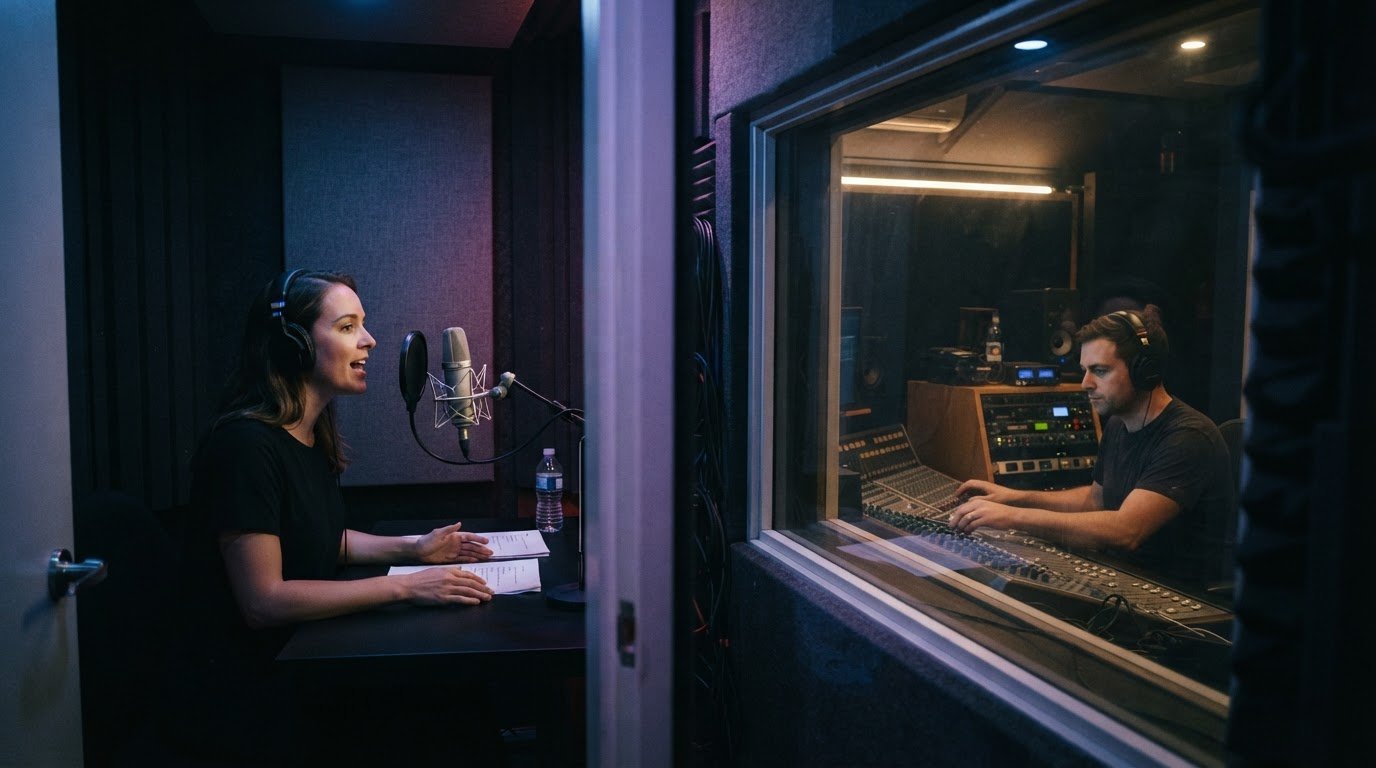
The cost of video localisation depends on the work required for each version, not just the number of languages. Video length, target language, format and level of adaptation all affect the scope. Subtitles, voice-over and dubbing involve different production steps, so their costs differ.
It’s easy to focus on the number of languages when comparing options. But a short subtitle version is a different production task from a recorded voice track or a fully dubbed video. On-screen text updates and technical quality checks can add further work.
This guide explains what video localisation involves and what shapes its cost. You’ll learn how language affects timing and adaptation, how subtitles compare with voice-over and dubbing, and what an agency quote may cover. This makes it easier to understand the work behind a quote and choose an approach that suits your content and delivery needs.
Key Takeaways
- Video localisation can involve more than translation: cultural adaptation, on-screen text and final quality assurance all shape the finished version.
- Compare quotes by production method and included work, not just language count. Subtitles, voice-over and dubbing require different workflows.
- Target-language text can affect timing and screen layout, so language choice influences both adaptation and production requirements.
- The European Accessibility Act has applied since 28 June 2025 to consumer services that provide access to audiovisual media; understand how accessibility requirements relate to your content.
How does the cost compare with a localisation agency?
Agency quotes reflect the production method and the work needed beyond translation. Compare the deliverables, such as timed subtitles, recorded voice-over or synchronised dubbing.
Comparing subtitles, voice-over and dubbing
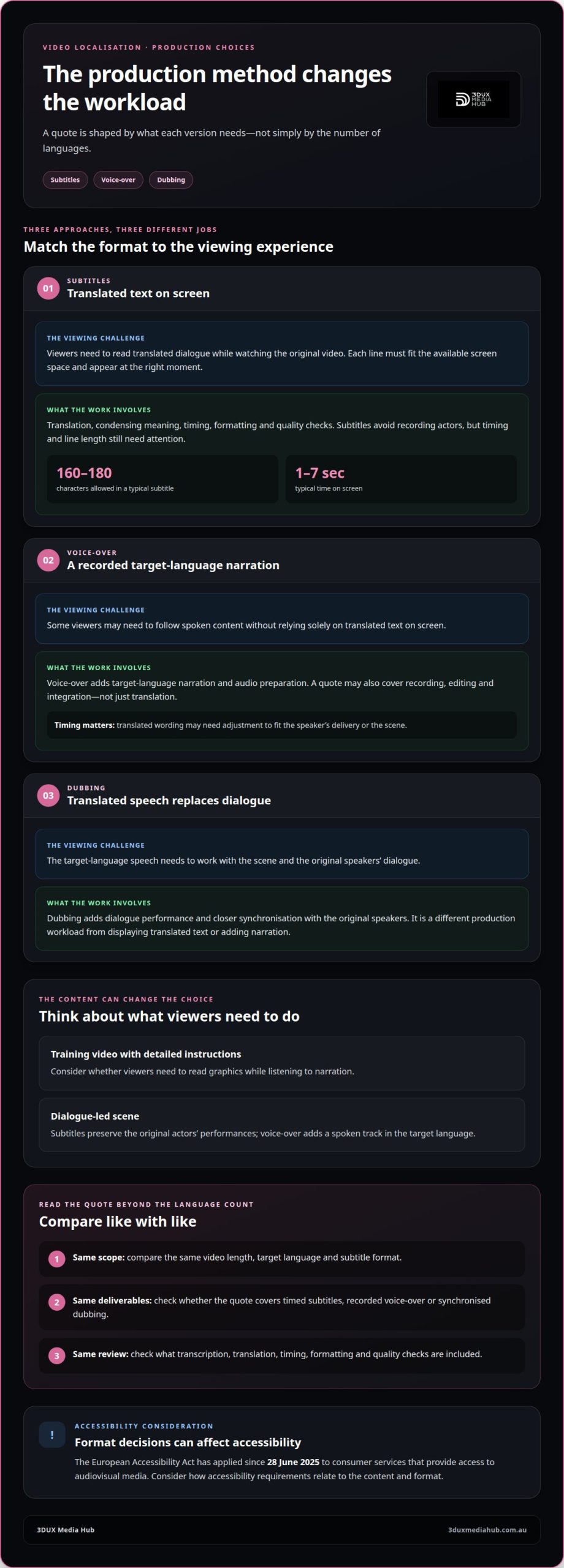
Subtitles display translated text, voice-over adds recorded narration in the target language, and dubbing replaces dialogue with translated speech. Each option changes the production workload and the viewing experience.
Subtitles avoid recording actors, while voice-over requires narration and audio preparation. Dubbing adds dialogue performance and closer synchronisation with the original speakers. The European Union says the European Accessibility Act has applied since 28 June 2025 to consumer services that provide access to audiovisual media. That makes accessibility relevant when choosing a format.
Subtitle and voice-over choices
Choosing between subtitles and voice-over means balancing reading with listening. Subtitles suit viewers comfortable reading on screen, while voice-over lets them follow spoken content without relying solely on translated text.
For a training video with detailed instructions, consider whether viewers need to read graphics while listening to narration. For a dialogue-led scene, subtitles preserve the original actors’ performances, while voice-over adds a spoken track in the target language. A quote may also include recording, editing and integration, not just translation.
Caption pricing and subtitle constraints
Caption and subtitle costs depend on transcription, translation, timing, formatting and quality checks. Captions represent spoken audio, while translated subtitles render dialogue in another language. The requested deliverable affects the work involved.
Subtitle timing and line length need attention: typical subtitles allow roughly 160-180 characters and remain on screen for 1-7 seconds. A translator must condense meaning to fit those limits without losing essential context. Compare quotes for the same video length, language and subtitle format, including timing and review.
Machine translation and professional localisation costs
Machine translation converts speech or transcripts into another language. Professional video localisation adapts and prepares the content for viewing. Machine translation can reduce translation time and cost, while a complete professional workflow adds human review and production tasks.
Machine output alone doesn’t account for timing, cultural context, on-screen text or final playback checks. A translated script, for example, may need editing to fit a speaker’s delivery or subtitle display. When assessing a quote, compare the finished deliverables and included review, not just the translation method.
What is video localisation?
Video localisation adapts a video for viewers in another language and cultural context. It can include translation, revised scripts, translated on-screen text, subtitles or localised audio. The workflow also checks that each version plays correctly and communicates the intended meaning.
From source assets to localised version
The workflow starts with checking the supplied assets and confirming that the source files play correctly. The English recording can then be transcribed and reviewed for omissions. This gives translators an accurate script to work from, rather than incomplete dialogue or memory.
Next, translators adapt the script and on-screen text to fit the company’s voice, tone and brand. A literal translation may not work if an idiom, joke or reference means something different in the target culture. Adaptation preserves the intent while making the content natural for native-language viewers.
For example, a product name or slogan shown on screen may need a translated replacement in the same graphic location. If subtitles are required, the translated lines are inserted into the video. These steps turn a text translation into a version prepared for viewing.
Cultural adaptation and quality assurance
Cultural review checks whether words, visuals and references suit the intended audience. A phrase that works in the source language may be confusing or carry an unintended meaning elsewhere. Reviewers assess context, not just individual words, so the localised script remains accurate and appropriate.
Final video quality assurance involves playing the localised version and comparing it with the source. Reviewers check the translation, cultural context, spoken elements and overall video quality. They can catch subtitles that appear at the wrong moment, a voice track that doesn’t match the scene, or on-screen text left in the original language.
Playback is the final check, not a formality. A script can read correctly while the finished video contains a timing or integration error. Reviewing the complete version confirms that picture, sound and translated elements work together before delivery.
Language-specific pricing factors
Language affects more than translation. Text length, available expertise and the source-to-target language pairing can change adaptation and production requirements.
Text expansion by language
Text expansion occurs when a translation takes more space or time than the original. German and Russian translations can be 20-30% longer than the equivalent English source. That can affect subtitle layout, on-screen graphics and the spoken duration of a voiceover.
A translated line may no longer fit the original screen space, for example. A designer may need to reflow the text, while a voice recording may need timing adjustments to match the scene. The impact depends on the video’s format and how closely its script, graphics and recording are timed.
Pricing by language group
Language-group pricing reflects the expertise and production resources needed for each target language. A quote may include translation, native-language review, voice talent and recording, as well as integrating the result into the video.
A project requiring voice-over, for example, needs suitable talent and an audio session for each language. A subtitle-only version has a different production profile. Compare the same deliverables across languages, including script adaptation, on-screen text and review, rather than treating each language as a simple text swap.
Language-pair pricing differences
A language pair is the combination of the original language and the target language. Some language pairs may have translation rates 20% to 100% higher than others, so the target language alone doesn’t determine the translation workload.
Qualified translators can be harder to find for less common language combinations, which can raise costs. The language pair can also affect the work needed to adapt a script, subtitle document or voice-over recording. For a project covering several target languages, compare the scope and talent required for each pair separately. This makes it clearer why costs differ, even when every version runs for the same length of time.
Cost drivers for video localisation
Businesses can reduce video localisation costs without sacrificing quality by planning assets early, reusing approved translations and matching each format to its audience. Localisation-friendly video production can reduce per-language localisation costs by 15-30%. A consistent source script, clean audio and adaptable graphics also reduce avoidable revisions.
Understanding the cost of video localisation starts with defining the duration, number of languages, production method and workflow complexity. Each additional minute adds material to translate, time and quality-check. A subtitles-only version needs different work from voice-over, which requires a speaker, recording and audio integration. Dubbing adds performance and synchronisation work. More languages also mean more versions to prepare and review.
The scope extends beyond the translated script. English titles and other on-screen text may need extracting, translating and rebuilding in each version. A German translation, for example, may expand beyond the original text and require layout changes. Re-recording a section after a speaker’s mistake can also affect project costs and deadlines.
Quotes commonly include pre-production, production, post-production and project management, although line items differ. Transcription, adaptation, coordination and quality assurance can add 20-60% to per-method costs, depending on complexity. Compare what each quote includes: source-asset checks, translation, recording, graphics work, playback review and revisions. This makes it easier to identify whether a lower figure reflects a simpler scope or fewer deliverables.
To manage the cost of video localisation, prepare final scripts and graphics before production, keep terminology consistent across titles and versions, and reuse approved translations where appropriate. Prioritise professional review for dialogue, brand claims and culturally sensitive material. For the technical delivery stage, plan your video and audio encoding alongside the localisation workflow.
3DUX Media Hub: 4K UHD Authoring
3DUX Media Hub can support projects that need localised content prepared for professional video delivery. Its Content Localisation service addresses language adaptation, while 4K UHD Authoring and Blu-ray and DVD Authoring prepare content for those formats.
Video and Audio Encoding is relevant when you need encoded files for delivery across formats from SD to 4K. Bringing localisation and technical preparation into the same project can help align language versions with their intended outputs. These services suit producers preparing a finished title for home entertainment or other distribution workflows.
If your project needs language adaptation, authoring or encoding, contact 3DUX Media Hub to discuss the work involved.
Plan your next localisation release
A localisation brief is also an opportunity to define what each market needs from the finished title. Set out the intended audience, preferred language format and delivery requirements before production begins. This gives your team a practical basis for assessing the cost of video localisation and aligning the scope with the release plan.
For projects moving from language adaptation to format-ready delivery, 3DUX Media Hub offers Content Localisation alongside 4K UHD Authoring, Blu-ray and DVD Authoring, and Video and Audio Encoding. These services can support a workflow that carries localised content through to prepared masters and encoded files.
Bring your project requirements together and discuss the right production scope with 3DUX Media Hub. Contact 3DUX Media Hub to take the next step with clarity and confidence.
Frequently Asked Questions
How much does it cost to dub a 10-minute video into one language?
The cost depends on whether you need voice-over or full lip-sync dubbing, plus the script, talent and recording requirements. For a 10-minute video with several speakers, casting and matching dialogue to individual scenes adds work beyond a single narrator track. A short, straightforward presentation has a different production scope from a scripted drama with overlapping dialogue and tightly timed performances.
Are subtitles cheaper than dubbing?
Subtitles are generally less expensive than dubbing because they don’t require actors or newly recorded dialogue. For a product demonstration, translated subtitles may be sufficient if viewers can read while watching. A character-led scene may call for recorded performances instead. Compare the finished deliverables, including subtitle timing or audio recording, rather than translation alone.
How much do localisation services cost beyond translation (LQA, engineering, voice)?
There isn’t one fixed add-on cost: LQA, engineering and voice work depend on the assets and delivery scope. A project with separate graphics files, for example, may need text extraction and rebuilding, while a voice-led title needs recording and audio integration. Check whether the scope includes linguistic review, playback checks, file preparation and corrections, as these tasks add work beyond translation.
What is the average cost to localise a video per minute?
There’s no single useful per-minute average across all localisation methods. A minute of subtitles involves different work from a minute of voice-over or lip-sync dubbing, and the total also depends on language and review requirements. For a meaningful estimate, define the source duration, target languages, finished formats, and whether the scope includes adaptation, recording, graphics and final checks.
How much does video translation and transcription cost per minute?
Translation and transcription costs depend on the amount of dialogue, the language pair and the condition of the audio. A clear interview with one speaker is simpler to transcribe than a scene with overlapping dialogue or specialist terminology. A long sequence with pauses may contain few words but still require timing and review throughout.
What are typical voice-over and dubbing rates per minute?
Voice-over and dubbing rates vary with the recording format, talent requirements and production detail. A single narrator reading a clean script needs a different workflow from several actors performing dialogue in sync with on-screen speakers. For comparison, separate the finished-minute rate from any setup, direction, editing or integration work, then assess the total scope for each language version.