
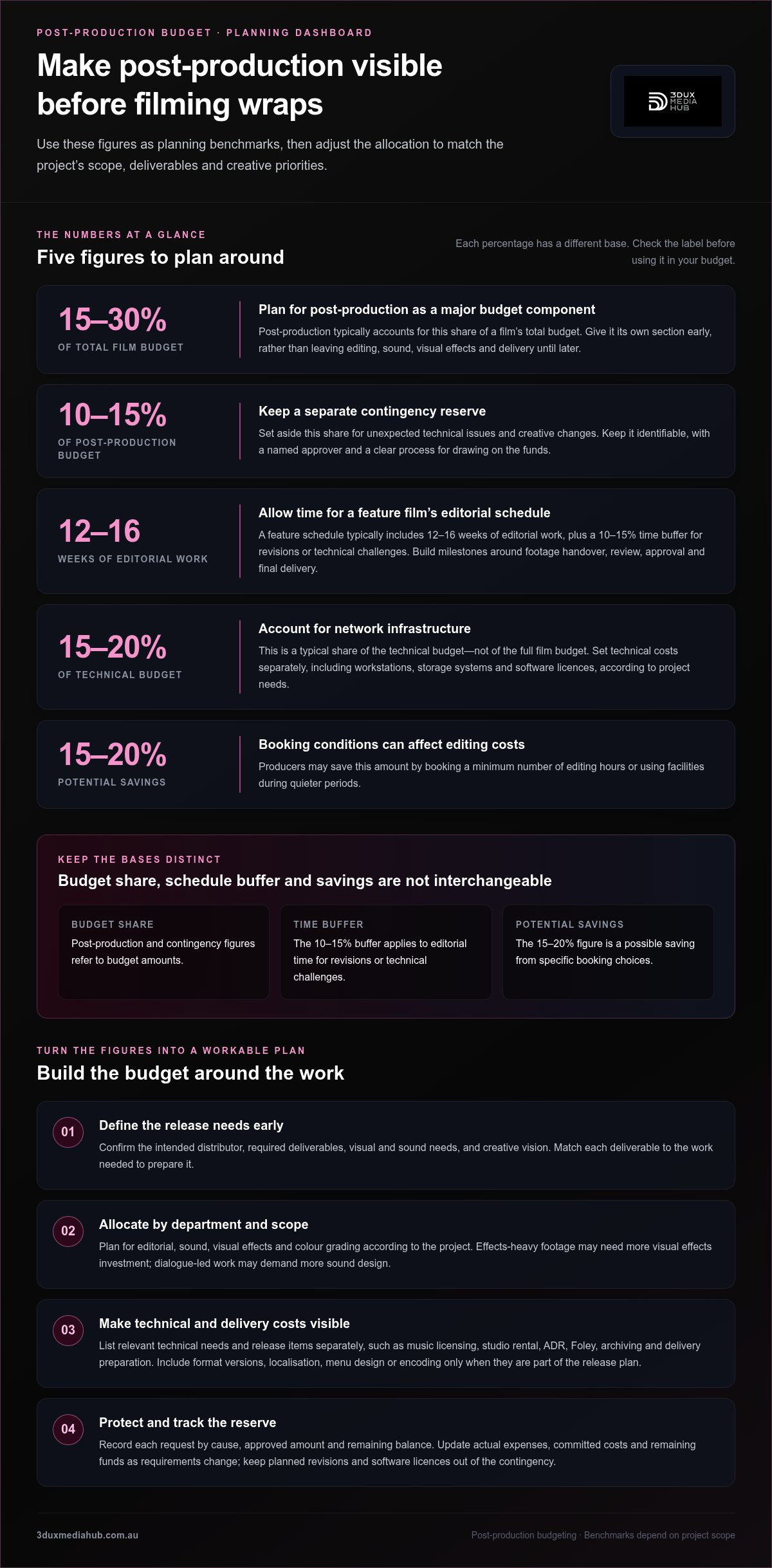
Post-production shouldn’t be whatever’s left in the budget. For budgeting for post-production services, plan the work early, give it a separate budget section, and set aside a contingency for unexpected changes. Post-production typically accounts for 15-30% of a film’s total budget, while a contingency reserve of 10-15% of the post-production budget can help cover unexpected costs.
It’s easy to focus on production and leave editing, sound, visual effects and delivery until later. A clear budget and schedule bring these costs into view early, so you can plan the work and manage changes while keeping the finished film in sight.
Use these four practical steps to plan post-production during pre-production, allocate funds across key tasks, protect a contingency and keep post-production costs separate in your overall budget.
Key Takeaways
- Map delivery requirements and complex creative work before production begins, so the post schedule reflects the project’s real demands.
- Break post-production into cost categories and allocate funds according to the work each deliverable requires.
- Keep contingency funds available for revisions, technical issues and quality-control fixes, rather than absorbing them into routine costs.
- Track post-production in its own budget section to see commitments clearly and update estimates as the project progresses.
1. Planning post-production during pre-production
Start budgeting for post-production services while shaping the project, not after filming wraps. Define the intended distributor, required deliverables, visual and sound needs, and creative vision early. These decisions shape the workflow, schedule and staffing. Confirm distribution requirements, then map each deliverable to the work needed to prepare it.
Review the script for scenes likely to need elaborate sets, complex stunts or special effects, as these can affect editing, visual effects and sound requirements. Estimate hours by breaking the schedule into tasks such as footage ingest, assembly, editing, sound work, revisions and final checks. Match each task to the skills and staff it requires, and update estimates when the script or schedule changes.
Research previous collaborators and bid out vendors before committing. Compare how each proposal handles the workflow, schedule and required deliverables. A post-production schedule for a feature film typically includes 12-16 weeks of editorial work, plus a 10-15% time buffer for revisions or technical challenges. Build milestones around footage handover, review, approval and final delivery.
Control costs by consolidating feedback and limiting unnecessary revision rounds. More decision-makers can mean more rounds and added expense. Producers may save 15-20% by booking a minimum number of editing hours or using facilities during quieter periods. Put revision limits and approval steps in the contract, alongside specific deliverables and usage rights. Work with legal counsel on third-party rights and licence terms that fit distribution needs.
2. Post-production budget allocation
Allocate the post-production total by department, then adjust for the project’s creative priorities. Allocate the post-production budget across editorial, sound, visual effects and colour grading according to the needs of the project. Treat these as planning benchmarks, not fixed shares: effects-heavy footage may need more visual effects investment, while dialogue-led work may demand more sound design.
Audio-mastering costs depend on the material, mix condition, revision needs and required output formats.
Build the technical budget separately from creative labour. Technical budgets should account for workstations, storage systems and software licences, with allocations tailored to the project’s needs. Network infrastructure typically takes 15-20%. These shares describe technical-budget categories, not the full film budget. Also allow for music licensing, studio rental, ADR, Foley, archiving and delivery preparation where the project requires them.
Make delivery costs explicit. Include format versions, localisation, menu design or encoding only where they’re part of the release plan. Video and audio encoding requirements can affect how many finished files the workflow must produce. Review the allocation against the distributor’s specifications before locking the budget, so each technical deliverable has a corresponding line item.
3. Contingency funds for unexpected expenses
Set aside a contingency equal to 10-15% of the post-production budget. This reserve covers unexpected technical issues and creative changes without stripping funds from planned work. Experienced film producers are also advised to reserve 10-15% of total costs for unexpected challenges. Keep the post-production reserve identifiable so it isn’t mistaken for available spending.
This calculation gives producers a working range, not another department allocation. Record the reserve as a separate line item in the film budget, with a named approver and a clear process for drawing on the funds.
Identify likely pressure points before setting the reserve. Late-stage quality-control errors may require repeated QC rounds and add unplanned work. Technical problems with footage, software or storage can also disrupt scheduled tasks. A creative change may affect picture, sound, visual effects and delivery files, so assess its impact across the workflow before approving the spend.
Track each contingency request by cause, approved amount and remaining balance. For example, log a QC correction separately from a new visual-effects request. This helps producers distinguish unexpected expenses from scope changes and see how each decision affects distribution deliverables and the final schedule.
Review the reserve whenever production costs or post-production requirements change. Update the budget with actual expenses, committed costs and remaining funds, then flag forecast overruns early. A contingency shouldn’t conceal routine items such as planned revisions or software licences. Clear film budgeting keeps known costs visible and protects the reserve for genuine surprises.
At the production stage, contingency funding can also address costs that emerge unexpectedly rather than from planned work. A contingency budget can provide funds for unexpected film production costs, such as weather delays or equipment malfunctions. These examples show why contingency funding should remain available for unforeseen needs rather than routine spending. When an unexpected production cost arises, identify its cause and consider it against the available reserve before committing funds.
4. Post-production as a separate budget section
Give post-production its own section in the film budget, separate from shooting, production costs and marketing. A film budget typically lists post-production, including editing and visual effects, as one of four sections. This structure makes the work visible instead of burying it among production line items.
Post-production typically accounts for 15-30% of a film’s total budget. Treat that as a planning range, not an automatic allocation. The project’s length, editing complexity and visual and sound effects requirements determine the work involved. A dialogue-led film and an effects-heavy screen production will need different budget breakdowns.
Group costs by department and deliverable. Include editing, sound design and mixing, visual effects, music composition and licensing, and colour grading. Add software, storage, quality control and final delivery where required. Keep categories distinct, so a change to visual effects doesn’t disappear inside a general post-production figure.
Separate planned work from changes. For example, list agreed editing and effects work as baseline costs, then track approved creative changes against the contingency reserve. Record actual expenses and commitments beside each estimate. This makes updates easier to interpret and helps producers identify whether a change comes from scope, schedule or technical needs.
Link distribution deliverables to the relevant post-production line items, but keep marketing spend separate. A finished master, localised version or menu design serves a production purpose; campaign promotion does not. Clear categories help teams track costs from approved scope through to delivery and identify where budget adjustments belong.
Use this structure when preparing your next post-production budget, and organise your delivery requirements as distinct, trackable items.
3DUX Media Hub: 4K UHD Authoring
3DUX Media Hub supports the delivery stage of your post-production plan with 4K UHD Authoring. Bring the team in when you’re preparing finished masters and know the required formats, territories and language versions. This helps connect budget line items to specific deliverables instead of leaving technical finishing costs vague.
Depending on your release plan, services may include Blu-ray and DVD Authoring, Video and Audio Encoding, and Content Localisation. These meet different delivery needs, from preparing disc formats to encoding picture and sound files or localising content. Define the required outputs early, then budget for the relevant work.
For your project’s authoring and delivery needs, contact 3DUX Media Hub.
Turn the budget into a delivery plan
Connect your approved budget to the assets your audience will receive. Define the master formats, language versions and delivery specifications for each release, then give the relevant work a clear place in your schedule and cost plan. This makes budgeting for post-production services a practical decision-making tool, not just a spreadsheet prepared at the start.
For technical delivery, 3DUX Media Hub offers 4K UHD Authoring, Blu-ray and DVD Authoring, and Video and Audio Encoding. These services fit projects that need finished masters prepared for specified formats. Clear deliverable requirements help align the technical scope with your release plan.
Discuss your project’s authoring and encoding requirements with 3DUX Media Hub. With the delivery work defined, you can move into post-production with a clearer plan for bringing the finished project to its audience.
Frequently Asked Questions
Why are professional budgets and schedules so important?
A clear budget and schedule connect spending decisions with the work required to finish and deliver a film. They give the team a shared reference for tracking commitments, reviewing changes and assessing financial exposure. If approval shifts affect a planned delivery milestone, for example, updating the schedule and budget makes the impact visible and supports timely decisions and clearer reporting to investors.
How much contingency should you set aside for revisions, reshoots, and unexpected post-production costs?
Reserve 10-15% of the post-production budget for unexpected technical issues or creative changes. Track revisions and technical fixes against this reserve, recording the reason, approval and remaining balance for each drawdown. Reshoots can involve production costs as well as later post work, so keep identified reshoot requirements visible in their relevant budget lines rather than obscuring them within routine post-production spending.
How can you reduce post-production costs without compromising quality?
Reduce avoidable rework by assigning clear approval responsibilities and consolidating feedback before each review round. Book a minimum number of editing hours or schedule facility use during quieter periods as cost-saving approaches. Protect essential quality-control and delivery tasks; instead, compare the planned outputs with actual distribution requirements and remove unnecessary versions or work that doesn’t support the release plan.
What are typical post-production costs for a short film, commercial, or YouTube video?
There’s no fixed cost based on format or length alone. Editing complexity, effects, sound requirements, deliverables and turnaround time determine the work and budget. List the required tasks and allocate funds according to their scope.